Pharmacology Study Guide: 2026 Nursing Roadmap
Attempting to memorize every individual medication in your textbook is the fastest way to trigger nursing school burnout. It’s a common trap; you’re likely staring at a mountain of flashcards while searching for a reliable pharmacology study guide for nursing students to help manage the information overload. You aren’t alone in feeling the constant fear of mixing up look-alike medications or struggling to connect a complex mechanism of action to actual bedside nursing interventions.
This high-yield roadmap transforms that chaos into a clear strategy for success. We’ll show you how to master the “prototype” drug of each class to unlock 90% of the knowledge required for your exams and the NCLEX. By focusing on the core principles that govern drug behavior, you’ll gain the confidence to identify “must-know” medications without the mental clutter.
We’ll explore the latest 2026 clinical updates, including the expanded roles of GLP-1 agonists and the 46 novel drugs approved by the FDA in 2025. You will learn a structured framework for categorizing medications, ensuring you can prioritize patient safety and clinical judgment over rote memorization. This guide provides the clarity you need to move from confusion to clinical mastery.
Key Takeaways
- Shift your focus from rote memorization to the “Prototype Drug” concept, a strategic framework that simplifies complex classifications and helps you master the majority of pharmacology content with ease.
- Build a solid foundation by distinguishing between pharmacokinetics and pharmacodynamics, allowing you to anticipate drug effects and nursing interventions with professional precision.
- Identify the high-yield cardiovascular and respiratory drug classes most likely to appear on the NCLEX, ensuring your study time is spent on the most critical clinical material.
- Implement active recall and the “Concept Map” method within this pharmacology study guide for nursing students to improve long-term retention and reduce anxiety during high-stakes exams.
- Leverage micro-learning techniques and high-yield vignettes to master difficult drug categories in under 10 minutes, making your professional development both efficient and mobile-friendly.
Mastering Nursing Pharmacology: Why a Strategic Framework is Essential
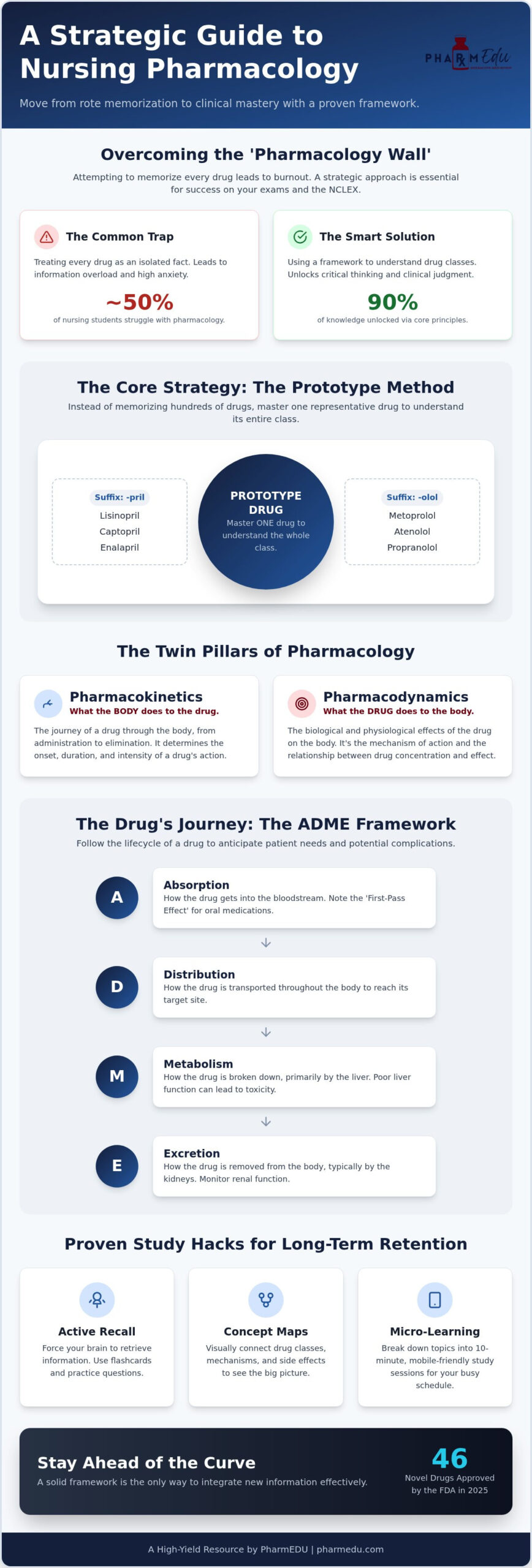
Many students encounter what’s known as the ‘Pharmacology Wall’ early in their education. It’s the point where rote memorization fails because the sheer volume of medications becomes unmanageable. Industry observations suggest that nearly 50% of nursing students struggle with this subject, often because they treat every drug as an isolated fact rather than part of a larger system. To succeed, you need a pharmacology study guide for nursing students that replaces exhaustive list-making with a scalable strategic framework. Understanding the Fundamentals of Pharmacology involves more than just reading labels; it requires a deep dive into how chemical structures interact with biological systems. This shift moves you away from simple recall and toward the critical thinking required in high-stakes clinical environments.
The Prototype Method Explained
The Prototype Method is your most effective tool for exam preparation. Instead of trying to memorize 50 different blood pressure medications, you study one representative drug that embodies the characteristics of its entire class. You can often identify these groups through ‘Suffix Clues’ found in generic names. For example, medications ending in -olol are typically beta-blockers, while those ending in -pril are ACE inhibitors, and -sartan identifies ARBs. By mastering the prototype, you’ve essentially mastered dozens of related drugs simultaneously. The Prototype Method serves as a high-yield mental shortcut that allows nursing students to categorize and predict the actions of hundreds of medications by learning just one representative example.
Connecting Pharmacology to the Nursing Process
True mastery involves connecting these drugs to the nursing process. Pharmacology doesn’t exist in a vacuum; it’s about how a patient’s unique physiology responds to a treatment plan. You must integrate the ADPIE framework (Assessment, Diagnosis, Planning, Implementation, Evaluation) into every study session. Before administering a drug, you assess the patient’s vitals; after administration, you evaluate for the desired effect or potential ‘High-Alert’ adverse reactions. This clinical context is exactly what the NCLEX tests. It isn’t just asking what a drug does. It’s asking what you, as the nurse, will do about it. This approach prepares you for real-world safety and professional accountability. As the FDA approved 46 novel drugs in 2025 alone, having this framework is the only way to stay current without drowning in new data.
The Foundation: Understanding Pharmacokinetics and Pharmacodynamics
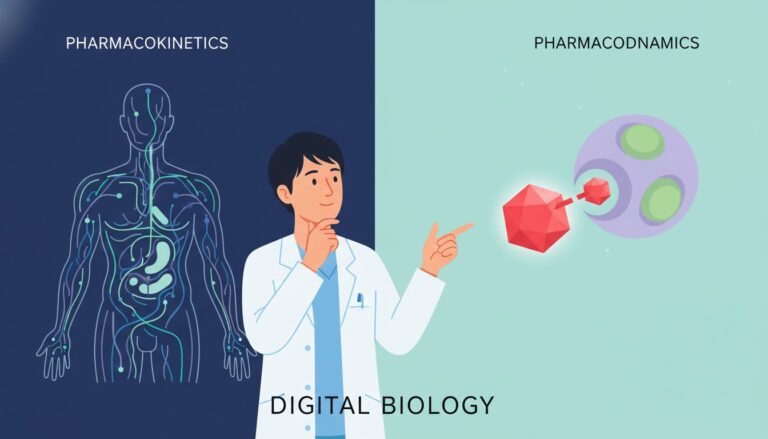
Mastering the prototype method is only the first step. To truly utilize a pharmacology study guide for nursing students, you must grasp the dual pillars of drug action: pharmacokinetics and pharmacodynamics. Think of pharmacokinetics as the drug’s journey through the body. It dictates how quickly a medication works and how long its effects last. Conversely, pharmacodynamics focuses on the biological response the drug triggers once it reaches its target. These principles aren’t just academic; they’re the reasons why you check a patient’s blood pressure before giving an antihypertensive or monitor kidney function before administering an antibiotic.
The ADME Framework for Nurses
The ADME acronym (Absorption, Distribution, Metabolism, and Excretion) is the standard for tracking a drug’s lifecycle. Absorption varies wildly by route. An intravenous medication enters the bloodstream immediately, while an oral drug must survive the digestive system. You can find detailed breakdowns of these pathways in the Open RN Nursing Pharmacology Textbook. Metabolism primarily happens in the liver, while excretion is usually the kidneys’ responsibility. If these organs aren’t functioning correctly, drugs can build up to toxic levels. The first-pass effect is a critical concept for oral medications because it explains why some drugs must be administered in much higher doses orally than intravenously to achieve the same therapeutic effect. Mastering these concepts is simpler when you use Interactive Pharmacology Flashcards to reinforce the ADME principles during your daily study sessions.
Drug-Receptor Interactions and Side Effects
Pharmacodynamics often relies on a ‘lock and key’ mechanism. A drug (the key) must fit into a specific cellular receptor (the lock) to work. Agonists turn the receptor on, while antagonists block it. This specificity is why medications have predictable side effects. For instance, a drug might ‘unlock’ receptors in the heart to lower heart rate but also ‘unlock’ similar receptors in the lungs, causing bronchoconstriction. You must distinguish these expected side effects from idiosyncratic reactions, which are rare and unpredictable. For drugs with a narrow therapeutic index, like aminoglycosides, you’ll monitor ‘Peak and Trough’ levels. This ensures the concentration is high enough to be effective but low enough to avoid permanent damage to the patient’s hearing or kidneys.
Finally, consider the drug’s half-life. This is the time it takes for the concentration of the drug in the body to reduce by half. It’s the primary factor in determining your medication administration schedule. A drug with a short half-life might require dosing every four hours, while one with a long half-life only needs a single daily dose. Understanding this prevents medication errors and ensures the patient stays within the therapeutic range, where the drug is most effective without becoming lethal.
High-Yield Drug Classes Every Nursing Student Must Master
Mastering individual medications is a nearly impossible task, so a truly effective pharmacology study guide for nursing students must prioritize the high-yield classes that appear most frequently on exams. These categories represent the majority of questions you’ll face in both clinical simulations and the NCLEX. For a deep dive into these systems, the University of Minnesota’s Nursing Pharmacology Guide provides an excellent peer-reviewed baseline for your studies. By focusing on these core groups, you build the clinical judgment required to manage complex patient scenarios safely and professionally.
Cardiovascular Pharmacology: The ‘Big Three’
ACE inhibitors and ARBs are often tested together because they target similar pathways. While both lower blood pressure, ACE inhibitors (the -prils) are notorious for causing a persistent dry cough and angioedema. ARBs (the -sartans) are typically the alternative for patients who don’t tolerate that cough. Both require you to monitor potassium levels closely to prevent hyperkalemia. Beta-blockers require a different set of priorities. You can remember the nursing considerations using the ‘4 Bs’: check for Bradycardia, monitor Blood Pressure, watch for Bronchoconstriction (especially in asthmatics), and be alert for masked signs of low Blood Sugar in diabetics. For more details on these mechanisms, see Pharmacology: The Comprehensive Guide to the Science of Drugs.
Endocrine and Psychoactive Medications
Insulin management is a non-negotiable safety skill in any clinical setting. You must know the peak times for rapid-acting versus intermediate-acting insulins because the peak is when your patient is at the highest risk for hypoglycemia. In mental health, antidepressants like SSRIs are common, but you must recognize the danger of Serotonin Syndrome if they’re combined with MAOIs or other serotonergic drugs. When administering Benzodiazepines, your priority is respiratory assessment and fall prevention due to their potent sedative effects.
Respiratory and Anti-Infective Essentials
Respiratory care involves distinguishing between ‘rescue’ bronchodilators, like albuterol, and ‘maintenance’ anti-inflammatories, like inhaled corticosteroids. Anti-infectives require you to recognize family traits to ensure patient safety. Penicillins and Cephalosporins share similar chemical structures, which means a patient with a severe penicillin allergy might also react to a cephalosporin. Fluoroquinolones, like ciprofloxacin, carry specific risks such as tendon rupture that you must teach your patients to report immediately. Understanding these broad categories allows you to predict nursing interventions even when you encounter a specific drug for the first time.
Proven Study Hacks and Mnemonics for Long-Term Retention
The volume of drug information in modern nursing can feel like a flood. Traditional methods, like highlighting textbooks for hours, often fail because they rely on passive recognition rather than active retrieval. A successful pharmacology study guide for nursing students must prioritize active recall and spaced repetition. These techniques force your brain to retrieve information at increasing intervals, which strengthens neural pathways. This ensures that a drug’s mechanism of action is available when you’re at the bedside, not just during a practice test.
Concept mapping is another high-yield strategy that moves beyond simple lists. Instead of a linear format, draw a map that connects a disease process to its pharmacological treatment. Visualizing how a diuretic directly addresses the fluid volume excess of heart failure creates a permanent mental anchor. You can also use targeted mnemonics like ‘P-R-I-L’ for ACE inhibitors (Prevent Remodeling, Increase vasodilation, Lower blood pressure) to group medications. However, mnemonics work best when they’re backed by an understanding of the drug’s physiology. Micro-learning sessions of 15 minutes are significantly more effective than four-hour marathons, as they prevent cognitive fatigue and improve long-term retention. To help maintain the mental energy required for these intense study blocks, Shop-Satisfied provides science-backed supplements aimed at improving focus and overall performance.
Leveraging Digital Study Tools
Passive reading is the enemy of retention. Modern nursing education is shifting toward interactive platforms that support micro-learning. You can explore how these innovations compare to older methods in our analysis of Digital Platforms vs. Traditional Textbooks in 2026. Tools like high-yield video vignettes break down complex topics, such as the RAAS pathway, into five-minute segments. These visual aids simplify the ‘why’ behind the drug, making the ‘what’ much easier to remember. To see these methods in action, you can access our Interactive Pharmacology Flashcards to test your knowledge in real-time.
NCLEX-Style Question Strategies
Succeeding on the NCLEX requires a specific mindset. You’ll often encounter ‘distractor’ answers that are technically true but don’t address the specific clinical priority. Always follow the ‘Safety First’ rule. If a question asks for your priority action, choose the one that keeps the patient alive or prevents the most immediate harm. For ‘Select All That Apply’ (SATA) questions, treat each option as a true or false statement. This analytical approach prevents you from feeling overwhelmed by the number of choices and ensures you’re applying your knowledge rather than guessing. By focusing on these strategies, you turn your study time into a professional rehearsal for clinical practice.
Elevating Your Performance with PharmEDU’s High-Yield Resources
Succeeding in the modern clinical environment requires a resource that evolves alongside current medical standards. PharmEDU’s curriculum is meticulously designed to align with the latest nursing school requirements and the 2026 NCLEX test plans. While traditional resources often become outdated the moment they’re printed, our digital ecosystem remains current. This is vital when you consider that the FDA approved 46 novel drugs in 2025 alone. We integrate these updates into a comprehensive pharmacology study guide for nursing students that prioritizes high-yield information over academic fluff.
Our platform’s strength lies in the power of micro-learning. We understand that your schedule is demanding; therefore, we’ve structured our High-Yield Video Vignettes to help you master an entire drug class in under 10 minutes. These segments distill complex mechanisms into manageable insights, allowing for consistent progress during even the shortest breaks. To ensure this knowledge translates to real-world safety, our Clinical Case Studies bridge the gap between classroom theory and bedside application. By simulating high-stakes scenarios, you develop the clinical judgment necessary to manage patient care without the risk of medication errors.
Personalized Learning Pathways
Every student’s journey is unique, which is why PharmEDU provides performance analytics to track your specific strengths and weaknesses. Our Pharmacology Practice Quizzes adapt to your progress, highlighting areas that require more attention before exam day. The mobile-compliant design ensures that your study materials are accessible anywhere, turning a commute or a lunch break into a productive review session. Beyond individual use, we offer Institutional Platform Licenses that allow entire nursing programs to standardize their pharmacology training, ensuring every student meets the same high bar of professional excellence.
Your Path to Pharmacology Mastery
Mastering pharmacology isn’t about memorizing a dictionary; it’s about adopting the “Class-First” framework we’ve explored throughout this guide. By focusing on prototypes, understanding the ADME lifecycle, and utilizing active recall, you transform a daunting subject into a professional skill set. Pharmacology is the backbone of patient safety, and your dedication to mastering it reflects your commitment to the nursing profession. You have the tools and the strategy; now it’s time to apply them with confidence. Start your PharmEDU subscription today and master pharmacology fast.
Take Command of Your Clinical Future
Mastering drug classifications isn’t an overnight task, but with a structured framework, it becomes a predictable science. You’ve learned how the prototype method and a firm grasp of ADME principles replace aimless memorization with sound clinical judgment. By shifting your focus to high-yield drug classes and utilizing active recall, you’re not just preparing for an exam; you’re building the foundation for safe patient care. This strategic approach ensures you remain calm and capable during high-stakes NCLEX questions and bedside emergencies alike.
A comprehensive pharmacology study guide for nursing students should do more than list facts; it should adapt to your busy clinical schedule. PharmEDU provides this through a digital ecosystem covering over 100 high-yield topics. With interactive flashcards, adaptive practice quizzes, and a mobile-optimized design, you can master complex concepts wherever you are. Our platform functions as your digital mentor, simplifying the toughest drug mechanisms into actionable knowledge that sticks long after the final exam is over.
Unlock High-Yield Pharmacology Mastery with PharmEDU and take the next step in your professional journey today. You’ve already done the hard work of starting; now it’s time to finish with excellence. We’re proud to be your partner in clinical success and professional growth.
Frequently Asked Questions
What is the best way to study pharmacology for nursing students?
The most effective strategy is focusing on drug classes and prototypes rather than trying to memorize every individual medication. This pharmacology study guide for nursing students recommends a “Class-First” approach combined with active recall. By understanding how a single representative drug works, you can predict the actions and nursing considerations for dozens of related medications, which significantly reduces your total study time.
How do I memorize drug side effects for the NCLEX?
Group side effects by their physiological impact on body systems rather than memorizing them for each specific drug. Most medications within a class share predictable side effects because they target the same receptors. For the NCLEX, prioritize life-threatening adverse reactions and “High-Alert” medications. Focusing on these critical safety issues helps you develop the clinical judgment necessary to answer priority-setting questions correctly.
Which drug classes are most likely to appear on nursing exams?
Cardiovascular drugs, endocrine medications like insulin, and respiratory treatments are consistently high-yield categories. In 2026, you should also expect a heavy emphasis on GLP-1 receptor agonists and SGLT-2 inhibitors due to their expanding clinical applications. Anti-infectives and psychoactive medications are also frequently tested, so mastering their prototypes is essential for any comprehensive board review strategy.
What is a prototype drug in nursing pharmacology?
A prototype drug is a lead medication that represents the shared characteristics, mechanisms, and side effects of an entire pharmacological class. For example, Lisinopril serves as the prototype for ACE inhibitors. Mastering a prototype is a core component of a pharmacology study guide for nursing students because it provides a mental template you can apply to every other drug in that group.
How many hours a week should I spend studying pharmacology?
Consistency is more valuable than total hours, but most successful students dedicate 10 to 15 hours per week to pharmacology. Instead of long cramming marathons, break your study time into 20-minute micro-learning sessions. This method prevents cognitive fatigue and improves long-term retention. You should adjust this time based on the complexity of the specific drug classes you’re currently covering in your curriculum.
Can I use digital study guides instead of traditional textbooks?
Digital study guides are often more effective because they offer interactive elements like adaptive quizzes and video vignettes that textbooks lack. Digital platforms also stay current with the latest medical updates, such as the 46 novel drugs approved by the FDA in 2025. These tools support mobile learning, allowing you to review high-yield content during clinical rotations or short breaks throughout your day.
What are the most common medication errors nursing students should know?
Confusion between look-alike and sound-alike (LASA) medications and incorrect dosage calculations are the most frequent errors in clinical settings. Students also struggle with “omission errors” or administering medications via the wrong route. Understanding the “Rights of Medication Administration” and knowing your drug prototypes helps prevent these errors by ensuring you recognize when a prescribed dose or route seems inappropriate for the patient.
How does PharmEDU help with pharmacology board reviews?
PharmEDU provides a structured digital ecosystem featuring High-Yield Video Vignettes and Interactive Pharmacology Flashcards designed for efficient board preparation. Our platform uses performance analytics to identify your specific knowledge gaps, allowing you to focus your energy where it’s needed most. This personalized approach ensures you’re prepared for both the factual requirements and the clinical judgment challenges of the NCLEX and professional practice.