Mastering NCLEX Pharmacology Review: The 2026 Comprehensive Guide

What if the reason most nursing students struggle with pharmacology isn’t a lack of effort, but a lack of the right approach? If you’ve spent hours memorizing drug names only to feel like the information evaporates before exam day, you’re not alone. A thorough NCLEX pharmacology review isn’t just about memorization; it’s about building a structured understanding of how drugs work, why they’re used, and how to apply that knowledge under pressure.

That frustration is real, and it’s one of the most common challenges nursing students face on the road to licensure. Pharmacology is dense, the NCLEX tests it at a clinical reasoning level, and the gap between passive studying and true preparedness can feel enormous.

This guide is designed to close that gap. You’ll find practical strategies for retaining pharmacological concepts, a breakdown of the principles that matter most for the NCLEX, and an honest look at the resources that can help you study smarter. From high-yield drug categories to evidence-informed study techniques, everything here is built to move you from feeling overwhelmed to walking into exam day with genuine confidence.

Key Takeaways

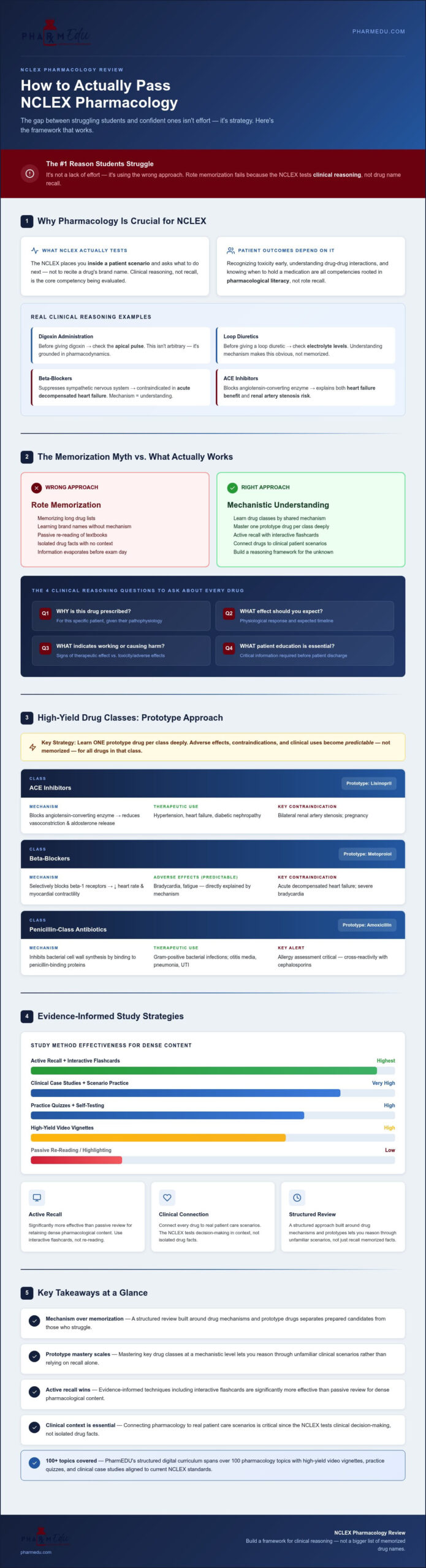
  • A structured NCLEX pharmacology review built around drug mechanisms and prototype drugs-not rote memorization-is what separates prepared candidates from those who struggle on exam day.
  • Mastering key drug classes and understanding how they work at a mechanistic level allows you to reason through unfamiliar clinical scenarios rather than relying on recall alone.
  • Evidence-informed study techniques, including active recall with interactive flashcards, are significantly more effective than passive review for retaining dense pharmacological content.
  • Connecting pharmacology to real patient care scenarios is essential for NCLEX success, as the exam tests clinical decision-making, not isolated drug facts.
  • PharmEDU’s structured digital curriculum-spanning over 100 pharmacology topics with high-yield video vignettes, practice quizzes, and clinical case studies-is built to align with current NCLEX standards and supports learning on any device.

Why Pharmacology is Crucial for NCLEX Success

Pharmacology sits at the intersection of nearly every clinical decision a nurse makes. Understanding why a drug works, not just what it’s called, is what allows nurses to anticipate complications, recognize adverse effects early, and intervene before a patient’s condition deteriorates. For anyone preparing for licensure, a rigorous NCLEX pharmacology review is less about accumulating drug facts and more about developing the clinical reasoning framework that the exam is specifically designed to test.

The NCLEX doesn’t ask you to recite a drug’s brand name. It places you inside a patient scenario and asks what you should do next. That shift in framing changes everything about how pharmacology needs to be studied.

The Importance of Pharmacological Knowledge in Nursing

Safe medication administration depends on understanding the full picture: mechanism of action, therapeutic window, contraindications, and the physiological context of the patient receiving the drug. A nurse who understands that beta-blockers suppress the sympathetic nervous system will recognize why they’re contraindicated in a patient with acute decompensated heart failure, even if that specific combination was never explicitly memorized. Pharmacological knowledge also shapes nursing assessments directly. Before administering digoxin, a nurse checks the apical pulse. Before giving a loop diuretic, electrolyte levels matter. These aren’t arbitrary steps; they’re grounded in pharmacodynamics and pharmacokinetics.

Patient outcomes are measurably tied to how well nurses understand the drugs they administer. Recognizing early signs of toxicity, understanding drug-drug interactions, and knowing when to hold a medication and notify the provider are all competencies rooted in pharmacological literacy, not rote recall.

Common Misconceptions About Pharmacology

The most persistent myth in nursing education is that pharmacology mastery means memorizing long drug lists. It doesn’t. Memorizing that metoprolol is a beta-blocker is only useful if you understand what beta-blockade actually does in the body, and how that mechanism connects to the patient’s pathophysiology. This is where many students fall short, and it’s precisely the gap the NCLEX is designed to expose.

Clinical reasoning in pharmacology means asking layered questions:

  • Why is this drug prescribed for this specific patient?
  • What physiological effect should you expect, and when?
  • What findings would indicate the drug is working, or causing harm?
  • What patient education is essential before discharge?

Evidence-based practice reinforces this approach. Clinical guidelines are built on drug mechanisms and population-level outcomes, not brand name familiarity. Nurses who understand the pharmacological rationale behind a treatment protocol are better equipped to question orders, advocate for patients, and adapt when clinical circumstances change. That’s the standard the NCLEX holds candidates to, and it’s the standard that defines safe, competent nursing practice.

Key Pharmacology Concepts You Must Master

Building a solid NCLEX pharmacology review strategy starts with recognizing what actually needs to be understood versus what only needs to be recognized. The distinction matters more than most students realize. Pharmacology becomes manageable, and even logical, once you stop treating each drug as an isolated fact and start seeing it as a member of a class with predictable behaviors rooted in a shared mechanism.

Understanding Drug Classes and Prototype Drugs

Every major drug class operates through a defined mechanism, and that mechanism explains nearly everything clinically relevant about the drugs within it. Learning one prototype drug per class deeply is far more efficient than skimming dozens of individual agents. Here’s how the highest-yield classes break down for NCLEX preparation:

  • Antihypertensives: ACE inhibitors (prototype: lisinopril) block angiotensin-converting enzyme, reducing vasoconstriction and aldosterone release. This explains both their therapeutic effect in heart failure and their contraindication in bilateral renal artery stenosis.
  • Beta-blockers: Metoprolol selectively blocks beta-1 receptors, decreasing heart rate and myocardial contractility. Understanding this mechanism makes adverse effects like bradycardia and fatigue predictable rather than memorized.
  • Antibiotics: Penicillins (prototype: amoxicillin) inhibit bacterial cell wall synthesis. This mechanism explains why they’re ineffective against organisms without cell walls, such as mycoplasma.
  • Anticoagulants: Warfarin inhibits vitamin K-dependent clotting factors; heparin potentiates antithrombin III. These distinct mechanisms drive entirely different monitoring parameters, INR versus aPTT, and reversal agents.
  • Diuretics: Loop diuretics (prototype: furosemide) inhibit sodium-potassium-chloride cotransport in the loop of Henle. This is why hypokalemia is a predictable consequence, not an obscure side effect.

Pharmacokinetics and pharmacodynamics anchor all of this. Pharmacokinetics describes what the body does to a drug: absorption, distribution, metabolism, and excretion. Pharmacodynamics describes what the drug does to the body. A patient with hepatic impairment metabolizes drugs differently; a patient with renal failure excretes them more slowly. These aren’t abstract concepts; they directly inform dosing decisions and assessment priorities at the bedside.

Managing Adverse Effects with Clinical Precision

Recognizing adverse effects before they escalate is one of the most tested nursing competencies on the NCLEX. The key isn’t memorizing every possible reaction; it’s understanding which effects are mechanistically predictable and therefore highest priority. ACE inhibitors cause a dry cough due to bradykinin accumulation, not an allergic reaction. Aminoglycosides carry nephrotoxicity and ototoxicity risks tied directly to their mechanism and renal clearance. Knowing the why makes the monitoring intervention obvious.

Patient education is equally critical. A patient on warfarin needs to understand dietary consistency with vitamin K, not avoidance of it. A patient starting a beta-blocker needs to know not to stop the medication abruptly. These aren’t discharge afterthoughts; they’re safety interventions grounded in pharmacological reasoning.

Structuring your study around drug classes, prototype agents, and mechanism-driven adverse effects is exactly the kind of high-yield approach that PharmEDU’s pharmacology curriculum is built around, connecting clinical reasoning to the content the NCLEX actually tests.

Effective Study Strategies for NCLEX Pharmacology

Knowing what to study is only half the equation. How you study determines whether that knowledge actually sticks when it matters most. A structured, method-driven approach to your NCLEX pharmacology review transforms dense content into retrievable, applicable clinical knowledge, and that distinction is what separates candidates who pass from those who don’t.

Building a Study Schedule

Consistency outperforms intensity every time. A weekly study plan built around pharmacology should prioritize depth over breadth, dedicating focused blocks to one drug class at a time rather than skimming across categories. A practical framework looks like this:

  • Days 1-2: Learn the mechanism and prototype drug for one class (e.g., loop diuretics, anticoagulants). Understand the pharmacodynamics before touching adverse effects.
  • Days 3-4: Apply that knowledge through clinical scenarios and case-based questions. Don’t just read; actively retrieve and reason.
  • Day 5: Review weak points identified during practice, then preview the next drug class.
  • Days 6-7: Mixed practice questions across previously covered classes to reinforce retention through spaced repetition.

Balance matters here. Spending 100% of study time on content review without practicing questions is a common trap. Aim for roughly equal time between content acquisition and active application, adjusting based on your performance data from practice assessments.

Leveraging Resources Effectively

Not all resources serve the same purpose, and using them strategically is more effective than using more of them. Interactive flashcards are among the most evidence-supported tools for active recall, forcing retrieval rather than passive recognition. PharmEDU’s interactive pharmacology flashcards are designed specifically for this purpose, reinforcing drug class relationships and clinical decision points in a format that works on any device.

For rapid conceptual reinforcement, PharmEDU’s high-yield video vignettes deliver focused pharmacology content across more than 100 topics, making them well-suited for review sessions when time is limited. Pair those with PharmEDU’s pharmacology practice quizzes to immediately test comprehension after each topic, and the feedback loop becomes genuinely productive.

Clinical case studies add the final layer. They bridge the gap between knowing a drug’s mechanism and applying that knowledge inside a patient scenario, which is precisely how the NCLEX frames its questions. When you integrate case-based learning with regular self-assessment, you’re not just studying pharmacology; you’re building the clinical reasoning skills the exam is actually measuring.

The most effective approach combines all three: structured content review, active recall through flashcards, and scenario-based application. Each method reinforces the others, and together they build the kind of durable understanding that holds up under exam pressure.
Mastering NCLEX Pharmacology Review: The 2026 Comprehensive Guide

Connecting Pharmacology to Clinical Practice

Understanding a drug’s mechanism is foundational, but the real test comes when that knowledge meets a patient. Clinical practice demands something more than textbook recall; it requires the ability to read a situation, integrate pharmacological principles with patient-specific variables, and make decisions in real time. That’s the standard your NCLEX pharmacology review ultimately prepares you for.

Real-World Applications of Pharmacology

Pharmacological principles don’t exist in isolation from patient care; they shape every step of the medication administration process. Before a nurse gives a dose of lithium, they assess renal function and hydration status, because lithium’s narrow therapeutic index makes toxicity a genuine risk in even mildly dehydrated patients. That assessment isn’t a procedural checkbox; it’s pharmacokinetics applied at the bedside.

Interdisciplinary collaboration adds another layer. Pharmacists identify interaction risks that prescribers may not catch under time pressure. Physicians adjust dosing based on nursing assessments. Nurses are often the last checkpoint before a drug reaches the patient, which means their pharmacological literacy directly affects safety outcomes. Understanding why a drug is prescribed, not just how to administer it, positions nurses as active contributors to the care team rather than passive executors of orders.

Drug interactions are a particularly high-stakes area in practice. Consider a patient on warfarin who is newly prescribed a broad-spectrum antibiotic; the antibiotic disrupts gut flora that produce vitamin K, which can unpredictably elevate INR and increase bleeding risk. Recognizing that interaction requires understanding both drugs at a mechanistic level, not just knowing their names.

Clinical Case Studies as Learning Tools

Case studies replicate the layered complexity of real clinical scenarios in a structured learning format. They force you to integrate assessment findings, drug mechanisms, and patient-specific factors simultaneously, which mirrors exactly how the NCLEX frames its higher-order questions.

PharmEDU’s clinical case studies are built around this principle. A case might present a patient with chronic kidney disease who is prescribed an NSAID for pain management, then ask you to identify the pharmacological conflict and the appropriate nursing response. Working through that scenario requires synthesizing renal pharmacokinetics, drug-disease interactions, and patient advocacy, all at once.

If you’re ready to move from isolated drug facts to integrated clinical reasoning, explore PharmEDU’s clinical case studies and see how scenario-based learning transforms pharmacology preparation into genuine practice readiness.

Why Choose PharmEDU for Your NCLEX Pharmacology Review?

There’s no shortage of pharmacology resources available to nursing students. What’s rare is a platform that integrates structured content, clinical reasoning practice, and flexible access in a single, cohesive curriculum. PharmEDU is built specifically for that purpose, and the difference shows in how its tools are designed to work together rather than as disconnected study aids.

Designed for Nursing Students

PharmEDU’s curriculum is aligned with current NCLEX standards, which means the content isn’t generic pharmacology pulled from a medical reference. It’s organized around the clinical reasoning framework the exam actually tests. Covering more than 100 pharmacology topics, the platform moves students through drug class mechanisms, prototype agents, adverse effect recognition, and patient education priorities in a sequence that mirrors how clinical decision-making actually unfolds.

That alignment matters because studying from materials designed for a different audience creates gaps. Nursing students need pharmacology framed around assessment priorities, patient safety, and interdisciplinary communication, not just molecular mechanisms. PharmEDU’s high-yield video vignettes, interactive pharmacology flashcards, and clinical case studies are all built with that clinical framing in mind, connecting drug knowledge directly to the kinds of patient scenarios that appear on the NCLEX.

Flexible Learning Options

Nursing school doesn’t follow a predictable schedule, and effective study tools shouldn’t require one either. PharmEDU offers both monthly and annual subscription options, giving students the flexibility to choose access that fits their timeline, whether that’s the final stretch before exam day or a longer, more gradual review period. The platform’s mobile-friendly design means content is accessible across devices, so a review session can happen between clinical rotations just as easily as at a desk.

For nursing programs looking to support students at scale, PharmEDU’s institutional platform license extends that same structured curriculum to entire cohorts, giving faculty a consistent, evidence-aligned pharmacology resource that complements classroom instruction without duplicating it.

The tools reinforce each other by design. Practice quizzes generate immediate feedback after each topic, flashcards build active recall between sessions, and case studies translate mechanism-level knowledge into clinical judgment. That layered approach is what separates PharmEDU from platforms that rely on a single learning format, such as mnemonics alone, without the formal educational framework to support deeper reasoning.

If you’re ready to build the pharmacological foundation that the NCLEX demands, join PharmEDU today and access a curriculum designed to take you from content knowledge to clinical confidence.

Your Path to NCLEX Pharmacology Confidence Starts Now

Pharmacology doesn’t have to be the obstacle standing between you and licensure. The core principles are clear: build your knowledge around drug mechanisms and prototype agents, apply evidence-informed study techniques that prioritize active recall over passive review, and connect every concept to real clinical scenarios. That’s the framework a rigorous NCLEX pharmacology review is built on, and it’s what separates candidates who pass from those who don’t.

The gap between knowing pharmacology and reasoning through it confidently closes with the right structure and the right tools. PharmEDU’s curriculum spans over 100 high-yield pharmacology topics, with interactive flashcards, practice quizzes, and clinical case studies all accessible in a mobile-friendly environment that fits your schedule, not the other way around.

You’ve already taken the first step by building a stronger foundation today. The next one is putting it into practice. Master pharmacology with PharmEDU’s comprehensive review platform and walk into exam day prepared to reason, not just recall.

Frequently Asked Questions About NCLEX Pharmacology Review

What are the most common pharmacology topics on the NCLEX?

The NCLEX consistently emphasizes drug classes with direct patient safety implications. Cardiovascular medications (antihypertensives, anticoagulants, cardiac glycosides), psychotropic drugs, antibiotics, pain management agents, and endocrine medications such as insulin and thyroid drugs appear frequently. The exam doesn’t test drug names in isolation; it embeds them in clinical scenarios that require you to identify appropriate nursing interventions, recognize toxicity, or prioritize patient education.

How can I improve my retention of pharmacology concepts?

Active recall consistently outperforms passive review for retaining dense content. Instead of rereading notes, test yourself regularly using tools like interactive flashcards, which force retrieval rather than recognition. Spacing your review sessions across multiple days, rather than cramming a single class in one sitting, also strengthens long-term retention. Connecting each drug to a specific patient scenario gives the information clinical context, which makes it far more memorable than an abstract list.

Are there practice questions available for pharmacology review?

Yes, and using them consistently is one of the highest-yield study habits you can build. PharmEDU’s pharmacology practice quizzes are designed to generate immediate feedback after each topic, so you identify gaps while the content is still fresh rather than discovering them during a full-length practice exam. Prioritize questions that require clinical reasoning over simple recall, since that’s the format the NCLEX actually uses.

What study resources are recommended for pharmacology preparation?

A strong NCLEX pharmacology review draws on multiple resource types working together. High-yield video content helps you grasp mechanisms efficiently. Interactive flashcards build active recall between sessions. Clinical case studies translate that knowledge into applied reasoning. PharmEDU’s digital curriculum integrates all three formats across more than 100 pharmacology topics, which removes the friction of piecing together resources from different platforms.

How does PharmEDU compare to traditional textbooks?

Traditional pharmacology textbooks are comprehensive but rarely structured around NCLEX clinical reasoning priorities. PharmEDU’s curriculum is aligned with current NCLEX standards, which means the content is sequenced around the decision-making framework the exam tests, not just alphabetical drug lists or molecular detail. The platform also supports active learning through quizzes and case studies, whereas textbooks are inherently passive. For students with limited study time, that distinction matters considerably.

What role does pharmacology play in nursing practice?

Pharmacology underpins nearly every clinical decision a nurse makes, from pre-administration assessments to recognizing early signs of toxicity to patient education before discharge. Nurses are frequently the last checkpoint before a medication reaches a patient, which means pharmacological literacy is directly tied to patient safety outcomes. Understanding drug mechanisms also positions nurses to contribute meaningfully in interdisciplinary care discussions rather than simply executing orders.

How should I balance pharmacology with other subjects while studying?

Pharmacology shouldn’t be studied in isolation from other content areas because the NCLEX integrates it across every clinical domain. A practical approach is to study pharmacology in parallel with the corresponding body system or disease process. When reviewing cardiac pathophysiology, cover antihypertensives and antiarrhythmics simultaneously. This reinforces both areas at once and mirrors how clinical questions are actually structured on the exam.

When should I start reviewing pharmacology for the NCLEX?

Starting early gives you the spacing advantage that makes retention durable. Ideally, begin structured pharmacology review several months before your exam date, dedicating regular, focused sessions to one drug class at a time rather than attempting a comprehensive review in the final weeks. If you’re closer to your exam, prioritize high-yield drug classes with direct patient safety implications and use practice quizzes to identify which areas need the most attention first.

What if the reason most nursing students struggle with pharmacology isn’t a lack of effort, but a lack of the right approach? If you’ve spent hours memorizing drug names only to feel like the information evaporates before exam day, you’re not alone. A thorough NCLEX pharmacology review isn’t just about memorization; it’s about building a structured understanding of how drugs work, why they’re used, and how to apply that knowledge under pressure.

That frustration is real, and it’s one of the most common challenges nursing students face on the road to licensure. Pharmacology is dense, the NCLEX tests it at a clinical reasoning level, and the gap between passive studying and true preparedness can feel enormous.

This guide is designed to close that gap. You’ll find practical strategies for retaining pharmacological concepts, a breakdown of the principles that matter most for the NCLEX, and an honest look at the resources that can help you study smarter. From high-yield drug categories to evidence-informed study techniques, everything here is built to move you from feeling overwhelmed to walking into exam day with genuine confidence.

Key Takeaways

  • A structured NCLEX pharmacology review built around drug mechanisms and prototype drugs-not rote memorization-is what separates prepared candidates from those who struggle on exam day.
  • Mastering key drug classes and understanding how they work at a mechanistic level allows you to reason through unfamiliar clinical scenarios rather than relying on recall alone.
  • Evidence-informed study techniques, including active recall with interactive flashcards, are significantly more effective than passive review for retaining dense pharmacological content.
  • Connecting pharmacology to real patient care scenarios is essential for NCLEX success, as the exam tests clinical decision-making, not isolated drug facts.
  • PharmEDU’s structured digital curriculum-spanning over 100 pharmacology topics with high-yield video vignettes, practice quizzes, and clinical case studies-is built to align with current NCLEX standards and supports learning on any device.

Why Pharmacology is Crucial for NCLEX Success

Pharmacology sits at the intersection of nearly every clinical decision a nurse makes. Understanding why a drug works, not just what it’s called, is what allows nurses to anticipate complications, recognize adverse effects early, and intervene before a patient’s condition deteriorates. For anyone preparing for licensure, a rigorous NCLEX pharmacology review is less about accumulating drug facts and more about developing the clinical reasoning framework that the exam is specifically designed to test.

The NCLEX doesn’t ask you to recite a drug’s brand name. It places you inside a patient scenario and asks what you should do next. That shift in framing changes everything about how pharmacology needs to be studied.

The Importance of Pharmacological Knowledge in Nursing

Safe medication administration depends on understanding the full picture: mechanism of action, therapeutic window, contraindications, and the physiological context of the patient receiving the drug. A nurse who understands that beta-blockers suppress the sympathetic nervous system will recognize why they’re contraindicated in a patient with acute decompensated heart failure, even if that specific combination was never explicitly memorized. Pharmacological knowledge also shapes nursing assessments directly. Before administering digoxin, a nurse checks the apical pulse. Before giving a loop diuretic, electrolyte levels matter. These aren’t arbitrary steps; they’re grounded in pharmacodynamics and pharmacokinetics.

Patient outcomes are measurably tied to how well nurses understand the drugs they administer. Recognizing early signs of toxicity, understanding drug-drug interactions, and knowing when to hold a medication and notify the provider are all competencies rooted in pharmacological literacy, not rote recall.

Common Misconceptions About Pharmacology

The most persistent myth in nursing education is that pharmacology mastery means memorizing long drug lists. It doesn’t. Memorizing that metoprolol is a beta-blocker is only useful if you understand what beta-blockade actually does in the body, and how that mechanism connects to the patient’s pathophysiology. This is where many students fall short, and it’s precisely the gap the NCLEX is designed to expose.

Clinical reasoning in pharmacology means asking layered questions:

  • Why is this drug prescribed for this specific patient?
  • What physiological effect should you expect, and when?
  • What findings would indicate the drug is working, or causing harm?
  • What patient education is essential before discharge?

Evidence-based practice reinforces this approach. Clinical guidelines are built on drug mechanisms and population-level outcomes, not brand name familiarity. Nurses who understand the pharmacological rationale behind a treatment protocol are better equipped to question orders, advocate for patients, and adapt when clinical circumstances change. That’s the standard the NCLEX holds candidates to, and it’s the standard that defines safe, competent nursing practice.

Key Pharmacology Concepts You Must Master

Building a solid NCLEX pharmacology review strategy starts with recognizing what actually needs to be understood versus what only needs to be recognized. The distinction matters more than most students realize. Pharmacology becomes manageable, and even logical, once you stop treating each drug as an isolated fact and start seeing it as a member of a class with predictable behaviors rooted in a shared mechanism.

Understanding Drug Classes and Prototype Drugs

Every major drug class operates through a defined mechanism, and that mechanism explains nearly everything clinically relevant about the drugs within it. Learning one prototype drug per class deeply is far more efficient than skimming dozens of individual agents. Here’s how the highest-yield classes break down for NCLEX preparation:

  • Antihypertensives: ACE inhibitors (prototype: lisinopril) block angiotensin-converting enzyme, reducing vasoconstriction and aldosterone release. This explains both their therapeutic effect in heart failure and their contraindication in bilateral renal artery stenosis.
  • Beta-blockers: Metoprolol selectively blocks beta-1 receptors, decreasing heart rate and myocardial contractility. Understanding this mechanism makes adverse effects like bradycardia and fatigue predictable rather than memorized.
  • Antibiotics: Penicillins (prototype: amoxicillin) inhibit bacterial cell wall synthesis. This mechanism explains why they’re ineffective against organisms without cell walls, such as mycoplasma.
  • Anticoagulants: Warfarin inhibits vitamin K-dependent clotting factors; heparin potentiates antithrombin III. These distinct mechanisms drive entirely different monitoring parameters, INR versus aPTT, and reversal agents.
  • Diuretics: Loop diuretics (prototype: furosemide) inhibit sodium-potassium-chloride cotransport in the loop of Henle. This is why hypokalemia is a predictable consequence, not an obscure side effect.

Pharmacokinetics and pharmacodynamics anchor all of this. Pharmacokinetics describes what the body does to a drug: absorption, distribution, metabolism, and excretion. Pharmacodynamics describes what the drug does to the body. A patient with hepatic impairment metabolizes drugs differently; a patient with renal failure excretes them more slowly. These aren’t abstract concepts; they directly inform dosing decisions and assessment priorities at the bedside.

Managing Adverse Effects with Clinical Precision

Recognizing adverse effects before they escalate is one of the most tested nursing competencies on the NCLEX. The key isn’t memorizing every possible reaction; it’s understanding which effects are mechanistically predictable and therefore highest priority. ACE inhibitors cause a dry cough due to bradykinin accumulation, not an allergic reaction. Aminoglycosides carry nephrotoxicity and ototoxicity risks tied directly to their mechanism and renal clearance. Knowing the why makes the monitoring intervention obvious.

Patient education is equally critical. A patient on warfarin needs to understand dietary consistency with vitamin K, not avoidance of it. A patient starting a beta-blocker needs to know not to stop the medication abruptly. These aren’t discharge afterthoughts; they’re safety interventions grounded in pharmacological reasoning.

Structuring your study around drug classes, prototype agents, and mechanism-driven adverse effects is exactly the kind of high-yield approach that PharmEDU’s pharmacology curriculum is built around, connecting clinical reasoning to the content the NCLEX actually tests.

Effective Study Strategies for NCLEX Pharmacology

Knowing what to study is only half the equation. How you study determines whether that knowledge actually sticks when it matters most. A structured, method-driven approach to your NCLEX pharmacology review transforms dense content into retrievable, applicable clinical knowledge, and that distinction is what separates candidates who pass from those who don’t.

Building a Study Schedule

Consistency outperforms intensity every time. A weekly study plan built around pharmacology should prioritize depth over breadth, dedicating focused blocks to one drug class at a time rather than skimming across categories. A practical framework looks like this:

  • Days 1-2: Learn the mechanism and prototype drug for one class (e.g., loop diuretics, anticoagulants). Understand the pharmacodynamics before touching adverse effects.
  • Days 3-4: Apply that knowledge through clinical scenarios and case-based questions. Don’t just read; actively retrieve and reason.
  • Day 5: Review weak points identified during practice, then preview the next drug class.
  • Days 6-7: Mixed practice questions across previously covered classes to reinforce retention through spaced repetition.

Balance matters here. Spending 100% of study time on content review without practicing questions is a common trap. Aim for roughly equal time between content acquisition and active application, adjusting based on your performance data from practice assessments.

Leveraging Resources Effectively

Not all resources serve the same purpose, and using them strategically is more effective than using more of them. Interactive flashcards are among the most evidence-supported tools for active recall, forcing retrieval rather than passive recognition. PharmEDU’s interactive pharmacology flashcards are designed specifically for this purpose, reinforcing drug class relationships and clinical decision points in a format that works on any device.

For rapid conceptual reinforcement, PharmEDU’s high-yield video vignettes deliver focused pharmacology content across more than 100 topics, making them well-suited for review sessions when time is limited. Pair those with PharmEDU’s pharmacology practice quizzes to immediately test comprehension after each topic, and the feedback loop becomes genuinely productive.

Clinical case studies add the final layer. They bridge the gap between knowing a drug’s mechanism and applying that knowledge inside a patient scenario, which is precisely how the NCLEX frames its questions. When you integrate case-based learning with regular self-assessment, you’re not just studying pharmacology; you’re building the clinical reasoning skills the exam is actually measuring.

The most effective approach combines all three: structured content review, active recall through flashcards, and scenario-based application. Each method reinforces the others, and together they build the kind of durable understanding that holds up under exam pressure.

Mastering NCLEX Pharmacology Review: The 2026 Comprehensive Guide

Connecting Pharmacology to Clinical Practice

Understanding a drug’s mechanism is foundational, but the real test comes when that knowledge meets a patient. Clinical practice demands something more than textbook recall; it requires the ability to read a situation, integrate pharmacological principles with patient-specific variables, and make decisions in real time. That’s the standard your NCLEX pharmacology review ultimately prepares you for.

Real-World Applications of Pharmacology

Pharmacological principles don’t exist in isolation from patient care; they shape every step of the medication administration process. Before a nurse gives a dose of lithium, they assess renal function and hydration status, because lithium’s narrow therapeutic index makes toxicity a genuine risk in even mildly dehydrated patients. That assessment isn’t a procedural checkbox; it’s pharmacokinetics applied at the bedside.

Interdisciplinary collaboration adds another layer. Pharmacists identify interaction risks that prescribers may not catch under time pressure. Physicians adjust dosing based on nursing assessments. Nurses are often the last checkpoint before a drug reaches the patient, which means their pharmacological literacy directly affects safety outcomes. Understanding why a drug is prescribed, not just how to administer it, positions nurses as active contributors to the care team rather than passive executors of orders.

Drug interactions are a particularly high-stakes area in practice. Consider a patient on warfarin who is newly prescribed a broad-spectrum antibiotic; the antibiotic disrupts gut flora that produce vitamin K, which can unpredictably elevate INR and increase bleeding risk. Recognizing that interaction requires understanding both drugs at a mechanistic level, not just knowing their names.

Clinical Case Studies as Learning Tools

Case studies replicate the layered complexity of real clinical scenarios in a structured learning format. They force you to integrate assessment findings, drug mechanisms, and patient-specific factors simultaneously, which mirrors exactly how the NCLEX frames its higher-order questions.

PharmEDU’s clinical case studies are built around this principle. A case might present a patient with chronic kidney disease who is prescribed an NSAID for pain management, then ask you to identify the pharmacological conflict and the appropriate nursing response. Working through that scenario requires synthesizing renal pharmacokinetics, drug-disease interactions, and patient advocacy, all at once.

If you’re ready to move from isolated drug facts to integrated clinical reasoning, explore PharmEDU’s clinical case studies and see how scenario-based learning transforms pharmacology preparation into genuine practice readiness.

Why Choose PharmEDU for Your NCLEX Pharmacology Review?

There’s no shortage of pharmacology resources available to nursing students. What’s rare is a platform that integrates structured content, clinical reasoning practice, and flexible access in a single, cohesive curriculum. PharmEDU is built specifically for that purpose, and the difference shows in how its tools are designed to work together rather than as disconnected study aids.

Designed for Nursing Students

PharmEDU’s curriculum is aligned with current NCLEX standards, which means the content isn’t generic pharmacology pulled from a medical reference. It’s organized around the clinical reasoning framework the exam actually tests. Covering more than 100 pharmacology topics, the platform moves students through drug class mechanisms, prototype agents, adverse effect recognition, and patient education priorities in a sequence that mirrors how clinical decision-making actually unfolds.

That alignment matters because studying from materials designed for a different audience creates gaps. Nursing students need pharmacology framed around assessment priorities, patient safety, and interdisciplinary communication, not just molecular mechanisms. PharmEDU’s high-yield video vignettes, interactive pharmacology flashcards, and clinical case studies are all built with that clinical framing in mind, connecting drug knowledge directly to the kinds of patient scenarios that appear on the NCLEX.

Flexible Learning Options

Nursing school doesn’t follow a predictable schedule, and effective study tools shouldn’t require one either. PharmEDU offers both monthly and annual subscription options, giving students the flexibility to choose access that fits their timeline, whether that’s the final stretch before exam day or a longer, more gradual review period. The platform’s mobile-friendly design means content is accessible across devices, so a review session can happen between clinical rotations just as easily as at a desk.

For nursing programs looking to support students at scale, PharmEDU’s institutional platform license extends that same structured curriculum to entire cohorts, giving faculty a consistent, evidence-aligned pharmacology resource that complements classroom instruction without duplicating it.

The tools reinforce each other by design. Practice quizzes generate immediate feedback after each topic, flashcards build active recall between sessions, and case studies translate mechanism-level knowledge into clinical judgment. That layered approach is what separates PharmEDU from platforms that rely on a single learning format, such as mnemonics alone, without the formal educational framework to support deeper reasoning.

If you’re ready to build the pharmacological foundation that the NCLEX demands, join PharmEDU today and access a curriculum designed to take you from content knowledge to clinical confidence.

Your Path to NCLEX Pharmacology Confidence Starts Now

Pharmacology doesn’t have to be the obstacle standing between you and licensure. The core principles are clear: build your knowledge around drug mechanisms and prototype agents, apply evidence-informed study techniques that prioritize active recall over passive review, and connect every concept to real clinical scenarios. That’s the framework a rigorous NCLEX pharmacology review is built on, and it’s what separates candidates who pass from those who don’t.

The gap between knowing pharmacology and reasoning through it confidently closes with the right structure and the right tools. PharmEDU’s curriculum spans over 100 high-yield pharmacology topics, with interactive flashcards, practice quizzes, and clinical case studies all accessible in a mobile-friendly environment that fits your schedule, not the other way around.

You’ve already taken the first step by building a stronger foundation today. The next one is putting it into practice. Master pharmacology with PharmEDU’s comprehensive review platform and walk into exam day prepared to reason, not just recall.

Frequently Asked Questions About NCLEX Pharmacology Review

What are the most common pharmacology topics on the NCLEX?

The NCLEX consistently emphasizes drug classes with direct patient safety implications. Cardiovascular medications (antihypertensives, anticoagulants, cardiac glycosides), psychotropic drugs, antibiotics, pain management agents, and endocrine medications such as insulin and thyroid drugs appear frequently. The exam doesn’t test drug names in isolation; it embeds them in clinical scenarios that require you to identify appropriate nursing interventions, recognize toxicity, or prioritize patient education.

How can I improve my retention of pharmacology concepts?

Active recall consistently outperforms passive review for retaining dense content. Instead of rereading notes, test yourself regularly using tools like interactive flashcards, which force retrieval rather than recognition. Spacing your review sessions across multiple days, rather than cramming a single class in one sitting, also strengthens long-term retention. Connecting each drug to a specific patient scenario gives the information clinical context, which makes it far more memorable than an abstract list.

Are there practice questions available for pharmacology review?

Yes, and using them consistently is one of the highest-yield study habits you can build. PharmEDU’s pharmacology practice quizzes are designed to generate immediate feedback after each topic, so you identify gaps while the content is still fresh rather than discovering them during a full-length practice exam. Prioritize questions that require clinical reasoning over simple recall, since that’s the format the NCLEX actually uses.

What study resources are recommended for pharmacology preparation?

A strong NCLEX pharmacology review draws on multiple resource types working together. High-yield video content helps you grasp mechanisms efficiently. Interactive flashcards build active recall between sessions. Clinical case studies translate that knowledge into applied reasoning. PharmEDU’s digital curriculum integrates all three formats across more than 100 pharmacology topics, which removes the friction of piecing together resources from different platforms.

How does PharmEDU compare to traditional textbooks?

Traditional pharmacology textbooks are comprehensive but rarely structured around NCLEX clinical reasoning priorities. PharmEDU’s curriculum is aligned with current NCLEX standards, which means the content is sequenced around the decision-making framework the exam tests, not just alphabetical drug lists or molecular detail. The platform also supports active learning through quizzes and case studies, whereas textbooks are inherently passive. For students with limited study time, that distinction matters considerably.

What role does pharmacology play in nursing practice?

Pharmacology underpins nearly every clinical decision a nurse makes, from pre-administration assessments to recognizing early signs of toxicity to patient education before discharge. Nurses are frequently the last checkpoint before a medication reaches a patient, which means pharmacological literacy is directly tied to patient safety outcomes. Understanding drug mechanisms also positions nurses to contribute meaningfully in interdisciplinary care discussions rather than simply executing orders.

How should I balance pharmacology with other subjects while studying?

Pharmacology shouldn’t be studied in isolation from other content areas because the NCLEX integrates it across every clinical domain. A practical approach is to study pharmacology in parallel with the corresponding body system or disease process. When reviewing cardiac pathophysiology, cover antihypertensives and antiarrhythmics simultaneously. This reinforces both areas at once and mirrors how clinical questions are actually structured on the exam.

When should I start reviewing pharmacology for the NCLEX?

Starting early gives you the spacing advantage that makes retention durable. Ideally, begin structured pharmacology review several months before your exam date, dedicating regular, focused sessions to one drug class at a time rather than attempting a comprehensive review in the final weeks. If you’re closer to your exam, prioritize high-yield drug classes with direct patient safety implications and use practice quizzes to identify which areas need the most attention first.

Similar Posts

Leave a Reply

Your email address will not be published. Required fields are marked *