
PANCE Pharmacology Review: The 2026 Comprehensive Study Guide
Would you gamble your career on just 42 questions? With pharmaceutical therapeutics accounting for 14% of your total exam score, the pharmacology section often feels like the most daunting barrier to becoming a certified PA. It’s easy to feel paralyzed by the sheer volume of drugs you’re expected to master. This PANCE pharmacology review addresses the common fear that rote memorization won’t be enough when you’re faced with complex clinical vignettes on exam day.
We understand the frustration of trying to link a drug’s mechanism of action to its clinical side effects while the pressure of a $550 application fee hangs over your head. You deserve a study process that provides security and clarity rather than more confusion. This guide promises to simplify the 2026 NCCPA blueprint by focusing on high-yield drug classes and the specific application strategies required to succeed on your first attempt.
You’ll gain a clear roadmap for mastery that moves away from static lists and toward the integrated, organ-system approach the 2026 exam demands. We’ll preview the most critical medications, discuss how to navigate the “next best step” questions, and provide the tools you need to walk into the testing center with absolute confidence.
Key Takeaways
- Learn how to navigate the 2026 NCCPA blueprint by integrating pharmacology into each specific organ system rather than studying drugs in isolation.
- Identify the most high-yield medications in cardiovascular and endocrine health to prioritize your PANCE pharmacology review effectively.
- Develop “If-Then” clinical logic to predict side effects and contraindications by connecting a drug’s mechanism of action to patient presentations.
- Execute a two-step study roadmap that uses baseline quizzes and organ-system blocking to ensure comprehensive coverage of the material.
- Discover how interactive flashcards and high-yield video vignettes can replace rote memorization with deep, clinical understanding.
Understanding the 2026 NCCPA Blueprint: Why Pharmacology is Crucial
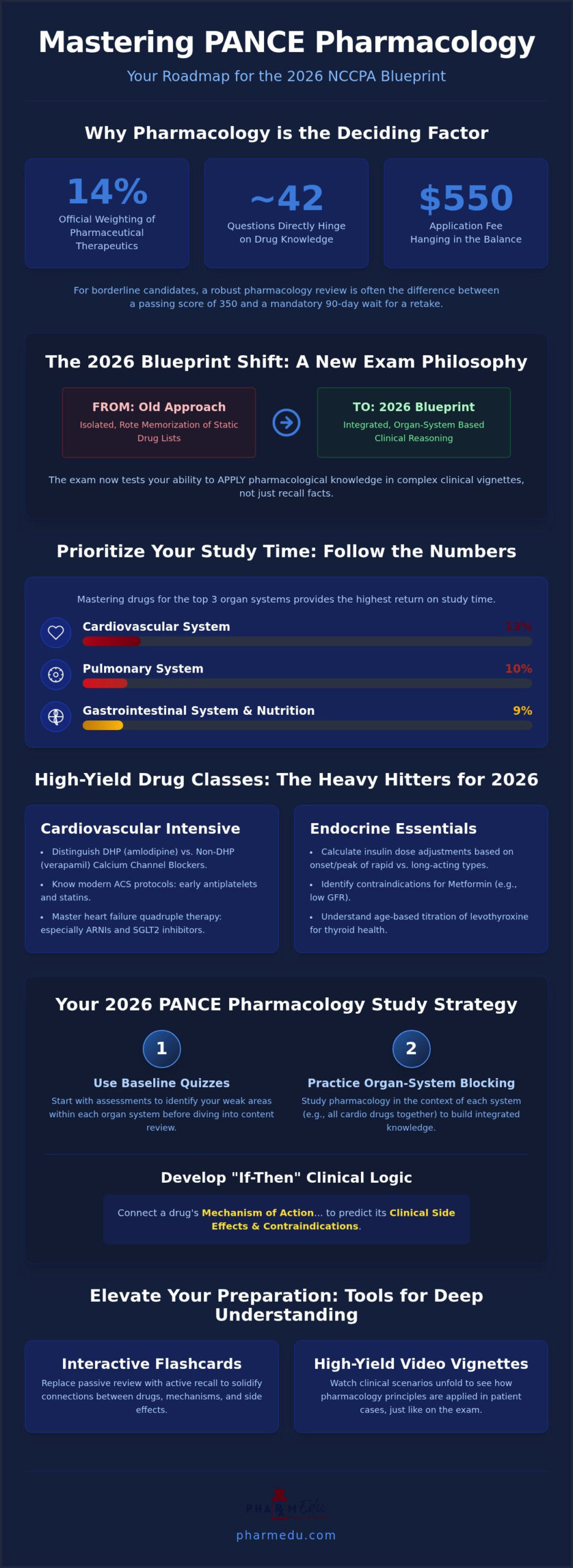
Success on the board exam requires more than just memorizing a list of generic names. The 2026 blueprint reflects a significant shift in how the Physician Assistant National Certifying Exam (PANCE) evaluates your competency. While the official “Pharmaceutical Therapeutics” category is weighted at 14%, this figure is deceptive. Pharmacology isn’t a siloed subject; it’s the clinical backbone of every organ system. For borderline candidates, a robust PANCE pharmacology review is often the deciding factor between a passing score of 350 and a mandatory 90-day waiting period for a retake.
The NCCPA has moved away from simple recall questions. You won’t just be asked to identify a drug’s class. Instead, you’ll face multi-step clinical reasoning challenges. You might identify a diagnosis correctly, but the question will then ask for the most appropriate management for a patient with specific contraindications, such as renal impairment or pregnancy. This integration means you’re being tested on your ability to apply pharmacological knowledge in a real-world, high-stakes environment where approximately 42 questions will directly hinge on your drug knowledge.
Pharmacology Weighting by Organ System
To study efficiently, you must follow the numbers. Cardiovascular (13%), Pulmonary (10%), and Gastrointestinal (9%) systems represent the largest portions of the exam. Mastering the heavy hitters in these categories, like antihypertensives and anticoagulants, provides the highest return on your study time. Don’t ignore the hidden pharmacology in smaller sections either. Psychiatry and Dermatology questions frequently focus on side effect profiles, such as the metabolic risks of atypical antipsychotics or the monitoring requirements for systemic retinoids. Using the blueprint as a guide allows you to prioritize high-yield topics over obscure medications that rarely appear on the exam.
The Anatomy of a PANCE Pharmacology Question
Modern board questions follow a predictable but rigorous structure. You’ll often see a vignette describing a patient’s symptoms, followed by a prompt asking for the “Best Initial Treatment” or “Next Step in Management.” These questions require you to rule out options based on drug-drug interactions or patient comorbidities. You should also stay alert for buzzwords that are now embedded within descriptive clinical phrases. For example, instead of seeing “dry cough,” the vignette might describe a patient who recently started an ACE inhibitor and now presents with a persistent, non-productive nocturnal cough. Recognizing these patterns is the key to moving beyond rote memorization and toward true clinical mastery.
High-Yield Drug Classes: The Heavy Hitters for 2026
While every drug class is fair game, the Official NCCPA PANCE Content Blueprint makes it clear that your study time shouldn’t be equally distributed. A strategic PANCE pharmacology review focuses on the high-yield classes that appear most frequently in clinical vignettes. Cardiovascular and endocrine medications are the heavy hitters, often requiring you to understand not just the drug itself, but the specific guideline-directed medical therapy behind its use.
Cardiovascular Pharmacology Intensive
Cardiovascular questions often hinge on your ability to distinguish between Dihydropyridine (DHP) and Non-dihydropyridine calcium channel blockers. Remember that DHPs like amlodipine primarily cause peripheral vasodilation, while non-DHPs like verapamil and diltiazem are more cardioselective. For acute coronary syndrome, modern protocols emphasize early antiplatelet therapy and statin initiation over older mnemonics. In heart failure management, you must recognize the transition toward quadruple therapy, specifically the vital inclusion of Angiotensin Receptor-Neprilysin Inhibitors (ARNIs) and SGLT2 inhibitors.
Endocrine pharmacology focuses heavily on insulin management and thyroid protocols. You’ll need to know the onset and peak of rapid-acting versus long-acting types to solve dose-adjustment vignettes. Metformin remains the first-line therapy for Type 2 Diabetes unless contraindications like a low GFR are present. For thyroid health, understanding the titration of levothyroxine in elderly patients versus younger adults is a common exam focus.
Antibiotics and Antivirals: A Simplified Framework
Infectious disease questions test your antibiotic stewardship and your ability to select the “drug of choice” for common pathogens. Grouping drugs by their mechanism of action helps you predict cross-reactivity and side effects. Cell wall inhibitors like penicillins and protein synthesis inhibitors like macrolides are essential to master. You’ll also need to identify antiviral therapy basics for HIV and Hepatitis, focusing on the primary initial regimens.
- Cell Wall Inhibitors: Penicillins, Cephalosporins, and Vancomycin.
- Protein Synthesis Inhibitors: Aminoglycosides, Tetracyclines, and Macrolides.
- Must-Know Side Effects: Watch for Red Man Syndrome from rapid vancomycin infusion or the nephrotoxicity associated with aminoglycosides.
Neurology and psychiatry classes like SSRIs and antiepileptics are equally high-stakes. You’ll need to monitor for serotonin syndrome and understand the narrow therapeutic windows of drugs like phenytoin. Side effect profiles, such as the weight gain associated with valproate or the agranulocytosis risk of clozapine, are frequently tested. If these complex mechanisms feel overwhelming, utilizing high-yield video vignettes can help you visualize how these drugs interact at the cellular level.
Clinical Vignette Mastery: Moving Beyond Rote Memorization
Mnemonics can only take you so far. When you’re sitting for the exam, you won’t just see a question asking for the mechanism of a specific diuretic. Instead, you’ll see a patient with specific comorbidities that make that diuretic either the perfect choice or a dangerous mistake. A truly effective PANCE pharmacology review shifts your focus from “what” a drug is to “why” it’s used in a specific clinical context. This requires mastering “If-Then” logic. If a patient has heart failure and diabetes, then your choice of antihypertensive must account for renal protection.
Patient demographics often dictate the correct answer when multiple “gold standard” options exist. For example, while ACE inhibitors are foundational in many cardiovascular protocols, initial therapy for hypertension in Black patients often starts with a thiazide diuretic or a calcium channel blocker. Similarly, you must adjust your thinking for pediatric or pregnant patients. The AAPA PANCE Review Resources emphasize that the board exam tests your ability to provide safe, individualized care. If you can’t identify why a medication is contraindicated for a specific demographic, you risk losing easy points on high-yield questions.
The Mechanism-First Approach
The “Mechanism-First” approach is the key to PANCE success because it allows you to deduce clinical outcomes rather than memorizing isolated facts. If you understand exactly which receptor a drug targets, you can predict 90% of its side effects without looking at a list. For instance, knowing that a medication is a non-selective beta-blocker tells you it will likely cause bronchoconstriction in patients with asthma. Applying autonomic nervous system basics allows you to visualize the drug’s impact on the entire body. It’s a structured, logical way to handle the pressure of the exam.
Common “Red Flag” Scenarios on the PANCE
Certain medications appear frequently because they have narrow therapeutic windows or significant toxicity profiles. You must recognize the classic signs of digoxin toxicity, such as yellow-green vision, or the tremors and ataxia associated with lithium. Warfarin management, specifically monitoring the INR and recognizing vitamin K interactions, is another recurring theme. Pregnancy contraindications are equally critical. You should have a mental “Top 10” list of teratogens, including ACE inhibitors, statins, and tetracyclines. Finally, use the Beers Criteria as your guide for geriatric patients. Avoiding anticholinergics and long-acting benzodiazepines in the elderly isn’t just good practice; it’s a high-yield exam strategy. Utilizing Clinical Case Studies that mirror these scenarios will help you internalize these red flags before test day.
Your 2026 PANCE Pharmacology Study Strategy
Mastering the vast amount of drug information required for the boards doesn’t happen by accident. It requires a methodical approach that mirrors the way you’ll practice medicine. While previous sections of this guide highlighted the “what” and the “why” of the 2026 blueprint, this strategy focuses on the “how.” A structured PANCE pharmacology review should span the final eight weeks of your preparation, moving from broad assessments to granular, high-stakes clinical simulations.
- Step 1: Baseline Assessment. Start with a pharmacology-focused practice quiz. This isn’t about the final score; it’s about identifying which organ systems feel like “black holes” in your memory.
- Step 2: Organ-System Blocking. Stop studying pharmacology as a standalone subject. When you review cardiology, integrate the antihypertensives and anticoagulants immediately. This builds the “If-Then” logic necessary for complex vignettes.
- Step 3: Active Recall. Use digital flashcards to test your knowledge of mechanisms and side effects. Passive reading is the enemy of retention.
- Step 4: Clinical Vignette Simulation. Apply your knowledge to multi-step case studies. Practice choosing the “next best step” when the first-line drug is contraindicated.
- Step 5: The “Red Flag” Final Review. In your final week, focus exclusively on narrow therapeutic index drugs and high-yield contraindications.
The Power of Spaced Repetition
The “forgetting curve” is a documented psychological phenomenon where information is lost over time if there’s no attempt to retain it. You can combat this by using interactive flashcards that use spaced repetition algorithms. These tools prioritize the drugs you struggle with while pushing mastered topics further out in your schedule. Setting up a daily review cycle that takes less than 30 minutes ensures that you’re constantly reinforcing your knowledge. Consistency beats intensity every time. You’ll find that five short sessions a week are far more effective for long-term retention than a single ten-hour “cram” session on the weekend. To streamline this process, you can utilize Interactive Pharmacology Flashcards designed specifically for the 2026 blueprint.
Utilizing High-Yield Video Vignettes
Elevating Your Preparation with PharmEDU
Achieving mastery over the vast pharmaceutical landscape requires more than just a collection of facts. It demands a structured, reliable partner that can translate complex data into clinical confidence. PharmEDU serves as that digital mentor, providing a comprehensive library of over 100 pharmacology topics specifically curated for board preparation. This platform doesn’t just list medications; it provides the context and clinical application necessary for a truly effective PANCE pharmacology review.
The platform is designed to meet the needs of modern students who must balance clinical rotations with intense study schedules. By offering a suite of professional tools, we ensure that every minute of your preparation is high-yield and outcome-focused. Our resources include:
- High-Yield Video Vignettes: Expert-led sessions that simplify complex mechanisms of action through micro-learning.
- Interactive Pharmacology Flashcards: Digital tools designed to combat the forgetting curve through active recall.
- Pharmacology Practice Quizzes: Board-style questions that mirror the difficulty and format of the actual exam.
- Clinical Case Studies: Real-world scenarios that help you practice “If-Then” logic and management decisions.
Because the platform is fully mobile-compliant, you can transition seamlessly from your laptop to your smartphone. This flexibility allows you to review critical drug classes during a break at the clinic or while commuting, ensuring your preparation never stalls.
PharmEDU vs. Traditional Textbooks
In a field where clinical guidelines change rapidly, static textbooks can become outdated before they even hit the shelves. Digital platforms provide the distinct advantage of real-time updates, ensuring you’re always studying the most current evidence-based protocols. While a 1000-page manual can be overwhelming and filled with low-yield fluff, our high-yield summaries focus exclusively on what you need to know for the 2026 blueprint. For a deeper look at why modern students are moving away from paper, explore our guide on Comprehensive Pharmacy Review: Digital Platforms vs. Traditional Textbooks. Efficiency is the cornerstone of our approach, allowing you to master the material without the burden of academic jargon.
Success Stories and Institutional Trust
Our commitment to precision has made us a trusted partner for both individual students and PA programs. Success on the PANCE isn’t just about hard work; it’s about having the right roadmap. PharmEDU has helped thousands of students pass the exam on their first attempt by providing the clarity and support needed to handle high-stress testing environments. This track record of excellence is why many universities now utilize our Institutional Platform License to standardize pharmacology education across their cohorts. We take the administrative burden of board prep off your shoulders, allowing you to focus on your professional growth. Don’t leave your certification to chance. Join PharmEDU today and master PANCE pharmacology to secure your future as a certified Physician Assistant.
Securing Your Future as a Certified Physician Assistant
Success on the 2026 boards isn’t about how many hours you spend reading a textbook. It’s about how effectively you can apply drug knowledge to complex clinical scenarios. By moving away from rote memorization and adopting a “Mechanism-First” approach, you transform pharmacology from a daunting barrier into a scoring advantage. You’ve learned that integrating medications into organ systems and utilizing spaced repetition are the most reliable ways to ensure long-term retention. A disciplined PANCE pharmacology review is the final bridge between your clinical rotations and your professional certification.
We’ve built a platform that respects your time and your career goals. With a library of over 100 high-yield topics, expert-led video vignettes, and board-style practice quizzes, you’ll have every resource necessary to walk into the testing center with complete confidence. Don’t let the 14% weighting or the $550 retake fee cause unnecessary anxiety. You have the knowledge; you just need the right roadmap to prove it on exam day.
Start Your PharmEDU Subscription and Ace the PANCE today. Your career as a certified PA is within reach, and we’re here to help you cross the finish line with precision and authority.
Frequently Asked Questions
How much of the PANCE is pharmacology?
Pharmaceutical therapeutics officially accounts for 14% of the NCCPA content blueprint. This translates to approximately 42 questions on your 300-question exam. It’s important to remember that drug-related questions are also integrated into every organ system, so your actual pharmacological knowledge impacts a much larger portion of your total score than the percentage suggests.
What are the most common pharmacology questions on the PANCE?
The most frequent questions appear as clinical vignettes that require you to identify the “best initial treatment” or the “next step in management.” You’ll rarely face simple recall questions about drug names. Instead, you’ll need to select the most appropriate medication while considering the patient’s specific comorbidities, contraindications, and potential drug-drug interactions described in the scenario.
Should I focus on brand names or generic names for the PANCE?
How do I memorize side effects for so many different drug classes?
The most effective strategy is to use a “Mechanism-First” approach rather than rote memorization. If you understand the specific receptor a drug targets, you can logically deduce its side effects. For instance, knowing how a beta-blocker affects the autonomic nervous system allows you to predict its impact on heart rate and bronchial smooth muscle without memorizing a list.
Is PharmEDU better than Quizlet for PANCE review?
PharmEDU provides a more comprehensive and professionally curated experience than static flashcard apps. While Quizlet is helpful for basic vocabulary, it lacks the expert-led video vignettes and integrated clinical case studies found on our platform. We offer a structured roadmap designed specifically for the 2026 blueprint, ensuring your study time is spent on high-yield, board-accurate material.
Can I pass the PANCE if I struggle with pharmacology?
It’s possible, but struggling with 14% of the exam makes your margin for error in other sections very thin. Because pharmacology is woven into high-weight categories like cardiology and pulmonology, it’s often the “make or break” subject for borderline candidates. Improving your drug knowledge is one of the most reliable ways to boost your overall score and confidence.
When should I start my PANCE pharmacology review?
You should start integrating drug reviews into your organ-system studies as early as your first clinical rotation. For an intensive final review, we recommend starting a structured eight-week plan before your test date. This timeline provides enough space for the spaced repetition and active recall necessary to move information from your short-term memory into long-term clinical mastery.