
15 Essential Pharmacology Study Tips for Nursing Students in 2026
What if the secret to passing pharmacology isn’t memorizing every page of a 1,200-page textbook, but mastering the logic behind just a few dozen drug classes? You’re likely staring at a mountain of notes right now, feeling the weight of patient safety responsibilities and the pressure of the looming 2026 NCLEX updates. It’s completely normal to feel overwhelmed when similar drug names like hydralazine and hydroxyzine start to blur together during a midnight study session. Using the right pharmacology study tips for nursing students can transform this anxiety into clinical confidence.
We understand that the transition from theory to the bedside requires more than just a good memory; it requires a systematic approach to information. This guide provides high-yield strategies designed to help you master the overwhelming volume of drug data and achieve nursing school success. We’ll walk through 15 essential techniques, ranging from decoding pharmaceutical suffixes to utilizing digital micro-learning tools that fit your busy schedule. By the end of this article, you’ll have a clear roadmap to pass your exams with high grades and retain critical knowledge for the April 2026 NCLEX test plan changes.
Key Takeaways
- Transition from rote memorization to a system-based approach by mastering pharmaceutical suffixes and prefixes to identify entire drug families instantly.
- Implement the 20-minute rule for digital micro-learning to maximize long-term retention and eliminate the cognitive fatigue of marathon study sessions.
- Apply these pharmacology study tips for nursing students to prioritize patient safety by focusing on critical nursing assessments and evaluation before medication administration.
- Leverage high-yield video vignettes and interactive flashcards to transform idle commute time into structured, high-grade preparation for the 2026 NCLEX.
Why Pharmacology is the Gatekeeper of Nursing School
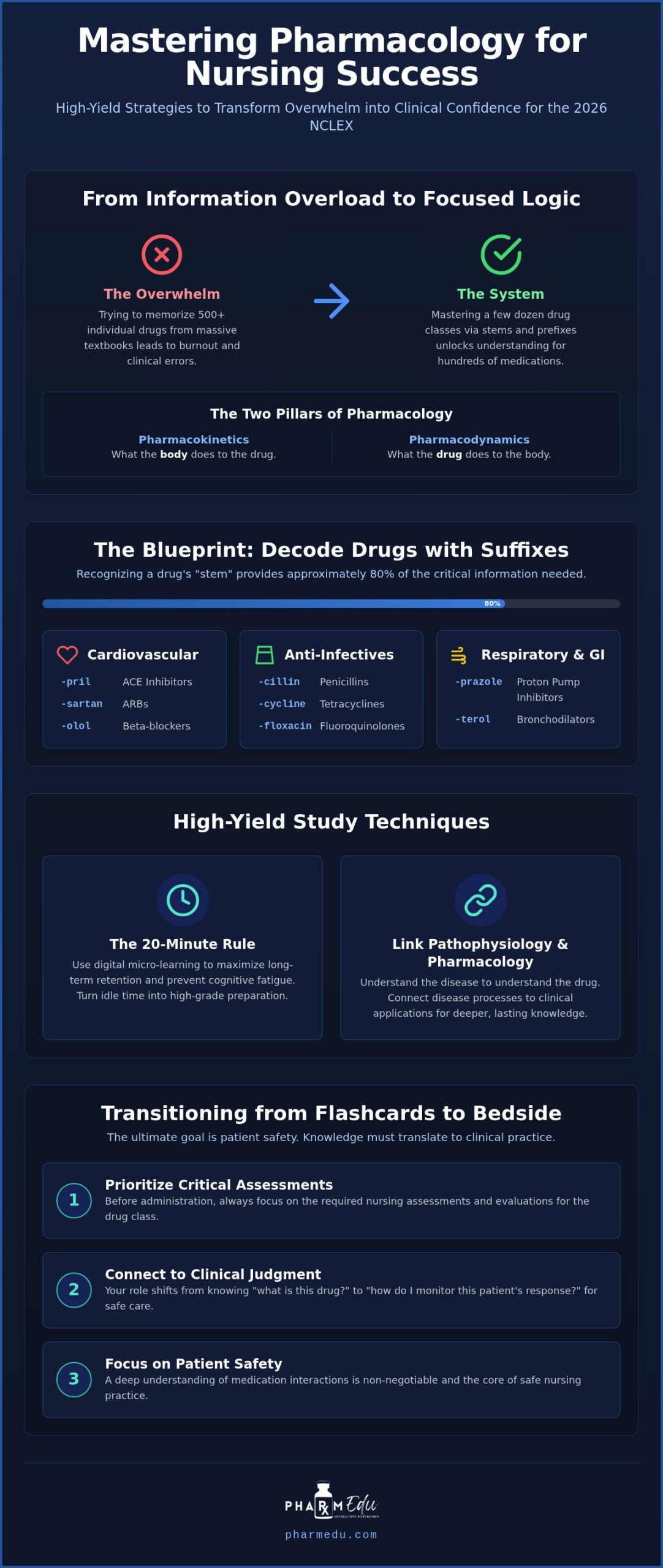
Nursing school introduces many hurdles, but few are as daunting as the first pharmacology course. Students often transition from biology, where they study static systems, to pharmacotherapeutics, where they must understand dynamic chemical interactions. It feels like learning a new language because it is one. You aren’t just memorizing names; you’re learning how substances alter human physiology. For a comprehensive overview of pharmacology, one must look at both pharmacokinetics, which is what the body does to the drug, and pharmacodynamics, which is what the drug does to the body. Using targeted pharmacology study tips for nursing students can help bridge this linguistic gap early in your education.
The stakes are high because nursing programs prioritize pharmacology as a primary safety measure. In a clinical setting, your role shifts from “what is this drug” to “how do I monitor this patient’s response.” Traditional rote memorization often fails here. It doesn’t prepare you for the nuances of patient safety or the critical thinking required for the 2026 NCLEX updates. Programs use this course as a gatekeeper because a nurse who doesn’t understand medication interactions is a liability to patient care.
The Volume Challenge: 500+ Drugs and Counting
You can’t truly understand how a drug works if you don’t understand the disease it’s meant to treat. Pathophysiology and pharmacology are two sides of the same coin. Before opening your drug guide, ensure you have a solid foundation in the underlying physiology. If you don’t understand why a heart is failing, you won’t grasp why a beta-blocker or a diuretic is the appropriate intervention. PharmEDU bridges this gap by using High-Yield Video Vignettes to connect disease processes directly to clinical application. This ensures you aren’t just studying in a vacuum but are building the clinical judgment necessary for modern nursing practice.
The Blueprint: Mastering Drug Classes via Suffixes and Prefixes
A drug class is a group of medications that share similar chemical structures, mechanisms of action, or therapeutic uses. Instead of attempting to memorize individual generic names in a vacuum, you should master the “stem” strategy. This linguistic approach identifies families of drugs by their specific prefixes or suffixes. It’s one of the most effective pharmacology study tips for nursing students because it allows you to categorize new information instantly without starting from scratch every time you see a new drug name.
Suffixes like -olol or -pril often provide about 80% of the information you need to know regarding a drug’s function and potential side effects. If you recognize the stem, you automatically understand the target organ, the intended therapeutic effect, and the primary nursing assessments required. This systematic method is a staple in the Top 10 Tips for Pharmacology for those looking to excel in rigorous nursing curricula. While outliers like digoxin or warfarin don’t follow these naming conventions, they represent a small fraction of the medications you’ll encounter.
High-Yield Suffixes Every Nursing Student Must Know
Focus your energy on these common linguistic markers to build a strong foundation for your exams and clinical rotations:
- Cardiovascular stems: -pril identifies ACE inhibitors; -sartan marks Angiotensin II Receptor Blockers (ARBs); and -olol denotes Beta-blockers.
- Anti-infective stems: -cillin for penicillins; -cycline for tetracyclines; and -floxacin for fluoroquinolones.
- Respiratory and GI stems: -prazole for proton pump inhibitors and -terol for bronchodilators like albuterol.
Categorization over Individual Memorization
Creating “mental buckets” for drug classes prevents the information overlap that leads to confusion and clinical errors. Rather than trying to remember the unique quirks of every single medication, you should focus on class-wide side effects and nursing considerations. For instance, knowing that ACE inhibitors as a class can cause hyperkalemia or a dry cough is more efficient than studying lisinopril and enalapril as separate entities. Mastering these pharmacology study tips for nursing students ensures you spend your time on high-yield concepts rather than redundant details.
Identifying drug class stems allows you to categorize medications instantly during the NCLEX-RN, which significantly increases your test-taking speed and overall accuracy. If you find these linguistic patterns difficult to track, using Interactive Pharmacology Flashcards can help reinforce these stems through repetitive, structured practice. This approach ensures that when you see an unfamiliar drug name at the bedside, you aren’t guessing; you’re applying a proven blueprint for safe patient care.
Digital Micro-Learning: How to Study Smarter, Not Longer
Reading about a mechanism of action (MOA) in a static textbook is often confusing. It’s much more effective to watch a visual representation of how a drug interacts with a cellular receptor. PharmEDU’s High-Yield Video Vignettes simplify complex pharmacokinetics by showing you the process in motion. This visual approach caters to different learning styles and makes the information stick. You should integrate at least one video into your daily routine to reinforce the concepts you’ve read about. This creates a multi-sensory learning experience that improves recall during high-pressure clinical rotations.
Interactive Quizzing as Active Recall
Passive reading is a common trap. You might feel like you’re learning, but without testing your knowledge, you aren’t building long-term retention. You should move to active testing as early as possible in your study cycle. Pharmacology Practice Quizzes force your brain to retrieve information, which strengthens neural pathways. Don’t just look at whether you got an answer right or wrong. You must analyze the “rationale” provided for every question. Understanding the “why” behind an answer is what builds true clinical judgment. This method is a key component of The Ultimate Pharmacology Study Guide for Nursing Students in 2026. By combining active recall with these pharmacology study tips for nursing students, you ensure that drug knowledge moves from your short-term memory into long-term clinical expertise.
Flashcards to Bedside: Pharmacology in Clinical Practice
Mastering the theoretical side of drug classes is only half the battle. To truly succeed, you must translate those definitions into bedside actions. The nursing process provides the framework for this transition, focusing on assessment, implementation, and evaluation. Before administering any medication, your assessment must be precise. For instance, you shouldn’t give a beta-blocker without first verifying the patient’s heart rate and blood pressure. Applying these pharmacology study tips for nursing students in a clinical setting ensures you don’t just pass the test; you protect your patients from avoidable harm.
Patient education is another critical component of the implementation phase. You need to explain complex drug mechanisms in simple, accessible terms. Instead of telling a patient they’re taking a “loop diuretic for fluid volume excess,” explain that the “water pill helps your kidneys remove extra fluid to make breathing easier.” Recognizing “red flag” side effects in real-time, such as the sudden onset of angioedema or a specific type of rash, is what separates a student from a competent clinician. This high-stakes environment requires you to move beyond simple recall and into the realm of clinical judgment.
High-Yield Content for the NCLEX-RN
While there are thousands of drugs, examiners frequently focus on the “Top 200” most commonly prescribed medications. You should prioritize drugs with a narrow therapeutic index, where the margin between a therapeutic dose and a toxic dose is very slim. Medications like Lithium, Digoxin, and Warfarin are exam staples because they require constant monitoring of serum levels or clotting times. For a deeper look at cardiovascular safety and monitoring, consult our ACE Inhibitors Pharmacology: The High-Yield Guide for Healthcare Students (2026). Mastering these specific groups will provide the highest return on your study time.
Case Studies: Applying Knowledge to Patient Scenarios
Case studies are the most effective way to simulate the decision-making process you’ll face during clinical rotations. They allow you to practice identifying drug-drug interactions and prioritizing care for multiple patients without the immediate pressure of the bedside. If a patient is on both an ACE inhibitor and a potassium-sparing diuretic, you must recognize the increased risk for hyperkalemia. Practicing with real-world scenarios helps you understand the “why” behind nursing interventions. To bridge the gap between your notes and the hospital floor, you can utilize interactive Clinical Case Studies to sharpen your clinical judgment before your next shift. This active application of knowledge is what ultimately builds the confidence needed for the 2026 NCLEX-RN and beyond.
Scaling Your Success with PharmEDU’s High-Yield Resources
Transitioning from classroom theory to clinical practice requires a centralized, reliable system that organizes the chaos of a modern nursing curriculum. A PharmEDU Monthly Subscription acts as your digital mentor, distilling the vast landscape of drug information into actionable, high-yield steps. Unlike static pharmacology textbooks that can’t keep pace with the 2026 clinical standards, this platform evolves to provide the most current data. It offers a structured environment where you can apply the pharmacology study tips for nursing students discussed throughout this guide, ensuring your preparation is both efficient and accurate.
With access to over 100 pharmacology topics, you can customize your study path to match your specific semester needs. Whether you’re focusing on cardiovascular drugs this week or preparing for a cumulative final, our micro-learning segments allow you to master content on any device. For institutional learners, the platform includes administrative tracking features that provide a clear view of progress. This level of organization ensures that no critical drug class is overlooked before you step onto the hospital floor for your clinical rotations.
Mastering the NAPLEX and Beyond
Your journey toward clinical excellence doesn’t end when you finish nursing school. Building a lifelong foundation for pharmacotherapy mastery is essential for professional advancement and long-term patient safety. PharmEDU helps you bridge the gap between being a student and becoming a practicing professional by emphasizing the clinical judgment required for complex patient scenarios. This comprehensive approach is also invaluable for those moving toward advanced roles. For specialized board preparation, you can consult The Best NAPLEX Prep Course Guide: How to Pass in 2026 to see how these high-yield strategies apply to professional certification exams.
Join the Community of Successful Nursing Students
Digital platforms are rapidly replacing traditional, heavy pharmacology textbooks because they offer an interactive experience that paper simply cannot match. You can watch a complex mechanism of action unfold in a video vignette, test your recall with a quiz, and carry your entire study library in your pocket. You should start your journey today by replacing outdated paper cards with PharmEDU’s interactive pharmacology flashcards, which use spaced repetition to cement your knowledge. These are the modern pharmacology study tips for nursing students that lead to high grades and bedside confidence. Unlock your full pharmacology potential with a PharmEDU subscription today!
Mastering Pharmacology for the 2026 Clinical Landscape
Success in pharmacology isn’t about working harder; it’s about studying smarter through system-based categorization and active recall. By shifting your focus from individual drug names to linguistic stems and clinical priorities, you build a foundation that lasts far beyond your final exam. These pharmacology study tips for nursing students are designed to bridge the gap between heavy textbooks and the fast-paced reality of modern healthcare. You’re preparing for a career where safety and precision are paramount, and your study habits should reflect those professional standards.
You don’t have to face the volume of the 2026 curriculum alone. Utilizing digital-first tools like 100+ High-Yield Video Vignettes and NCLEX-style Practice Quizzes allows you to turn study time into clinical confidence. With Mobile-Friendly Micro-Learning, you can master complex pharmacokinetics whenever and wherever it fits your schedule. Your commitment to excellence deserves a platform that works as hard as you do. Start your high-yield pharmacology journey with PharmEDU today! You’ve got the passion for patient care, and with the right resources, you’ll have the expertise to match.
Frequently Asked Questions
What is the hardest drug class to learn in nursing school?
Cardiovascular medications are frequently considered the most challenging due to their impact on multiple body systems and complex electrolyte shifts. Drugs like ACE inhibitors, beta-blockers, and calcium channel blockers require a deep understanding of pathophysiology. Mastering these requires more than simple memorization; you must grasp how they alter hemodynamics. Breaking these into smaller subclasses is one of the most effective pharmacology study tips for nursing students to avoid cognitive overload.
How many hours a day should I study for pharmacology?
Consistency matters more than the total number of hours. You should aim for 60 to 90 minutes of focused study each day rather than attempting long weekend sessions. Utilizing the 20-minute micro-learning rule helps maintain high retention levels. This approach allows your brain to process drug mechanisms without hitting a wall of fatigue. Spreading your sessions across the week ensures that the information moves from short-term to long-term memory.
Should I focus on brand names or generic drug names for the NCLEX?
You must prioritize generic drug names because the NCLEX-RN and other board exams almost exclusively use them. Brand names can change between manufacturers or countries, but the generic name remains the standard in clinical practice. Learning the generic name also helps you identify the drug’s stem, which reveals its class and function. Focusing on generics early in your studies will make your board preparation much smoother and more predictable.
Can I pass pharmacology without memorizing every single drug?
You don’t need to memorize every drug to succeed in nursing school. Instead, focus on learning the “prototype” drug for each major class. If you understand how the prototype works, you’ll know the side effects and nursing considerations for every other drug in that category. This system-based approach is one of the top pharmacology study tips for nursing students. It reduces the thousands of possible drugs down to a few dozen manageable concepts.
What are the best mnemonics for common medication side effects?
Mnemonics like “SLUDGE” are invaluable for identifying the side effects of cholinergic drugs, representing salivation, lacrimation, urination, defecation, GI distress, and emesis. For beta-blockers, remember that “Beta-1” affects one heart and “Beta-2” affects two lungs. These memory aids simplify the evaluation of adverse reactions during clinical rotations. Using these tools alongside visual aids ensures you can recall critical safety information quickly when you’re at the patient’s bedside.
How do I distinguish between drugs that have similar sounding names?
Distinguishing between “look-alike, sound-alike” drugs requires a focus on TALL man lettering and linguistic stems. For example, hydralazine and hydroxyzine serve completely different purposes despite their similar appearance. You should always double-check the drug class stem to verify the medication’s intent. Digital tools often highlight these differences to prevent errors. Developing a habit of verifying the drug’s mechanism rather than just its name is a vital safety practice for every student.
Is it better to use physical or digital pharmacology flashcards?
Digital flashcards are significantly more effective than physical ones because they utilize spaced repetition algorithms. These systems track which drugs you find difficult and show them more frequently. They also offer portability, allowing you to study on your phone during clinical breaks or commutes. Interactive Pharmacology Flashcards provide a more engaging experience than paper, making it easier to maintain a consistent study routine throughout your busy nursing program.
How does PharmEDU help with pharmacology board review?
PharmEDU streamlines board preparation by offering a comprehensive library of High-Yield Video Vignettes and Pharmacology Practice Quizzes. These resources are designed to simulate the decision-making process required for the 2026 NCLEX-RN. By focusing on the most frequently tested drug classes and nursing considerations, the platform helps you prioritize your study time. You’ll gain the clinical judgment needed to pass your exams and provide safe, effective care as a registered nurse.