
Physician Assistant (PA): The 2026 Career, Education, and Pharmacology Guide
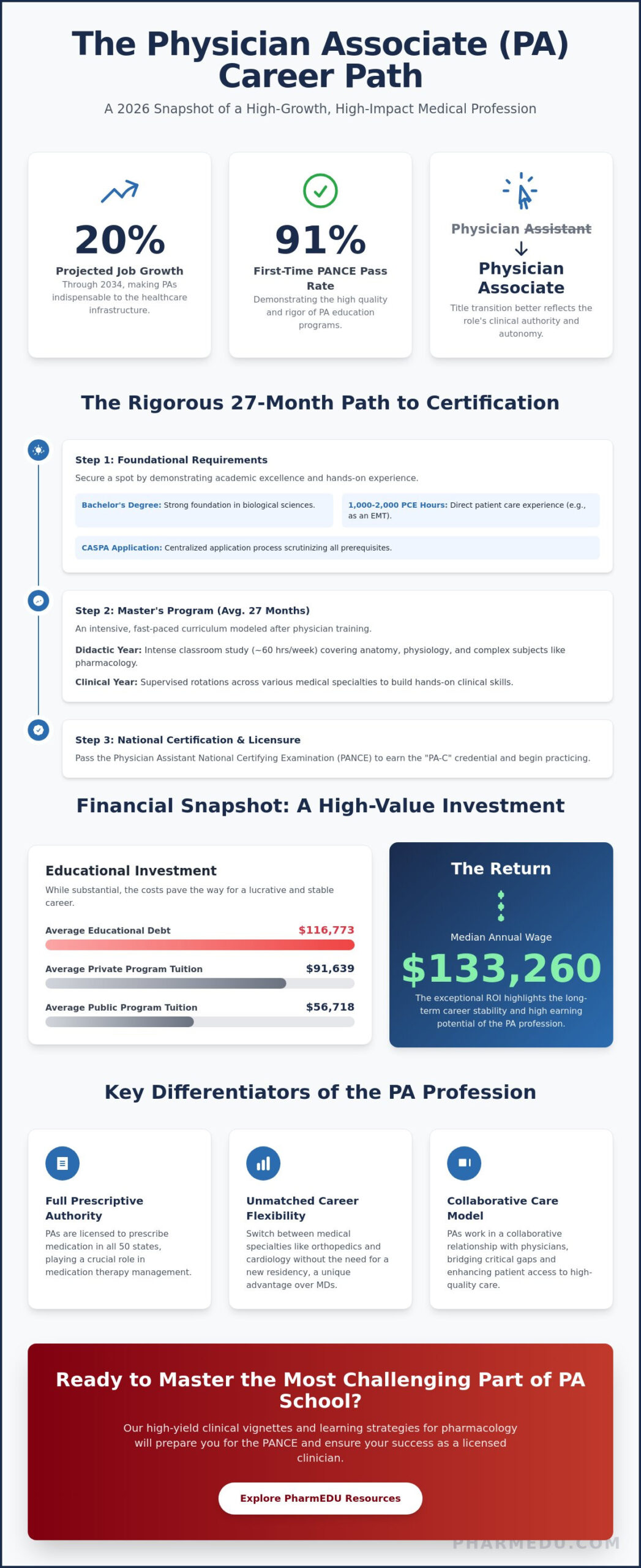
While 91% of graduates pass the PANCE on their first try, the road to becoming a physician assistant involves far more than just a single exam. With a projected 20% job growth through 2034 and a median annual wage of $133,260, the career’s appeal is undeniable. You likely recognize the immense potential of this role, yet you might feel overwhelmed by the intensive didactic year or the high failure rates often seen in pharmacology courses. It’s a challenging path, especially when you’re balancing an average of $116,773 in educational debt with the need for absolute clinical precision in a rapidly shifting regulatory environment.
We promise to help you master this journey by providing the academic strategies and regulatory clarity you need to succeed as a licensed clinician. This guide maps out the 2026 certification path and clarifies the evolving scope of practice in states like New York and California. We’ll also deliver high-yield resources for mastering the complex pharmacology and AI integration required of a modern medical professional, ensuring you’re prepared for every clinical challenge and administrative requirement on your path to professional growth.
Key Takeaways
- Understand the professional shift from Physician Assistant to Physician Associate and what this title change means for your clinical identity and board certification.
- Identify the critical milestones of the 27-month Master’s program, including CASPA requirements and strategies to manage the rigorous didactic and clinical phases.
- Clarify your prescriptive authority and DEA registration requirements to confidently manage medication therapy within a modern, team-based healthcare environment.
- Discover why traditional memorization fails and how to use high-yield clinical vignettes to master the physician assistant pharmacology curriculum.
- Analyze the latest 2026 compensation data and job growth trends to strategically position yourself in high-demand specialties and lucrative geographic regions.
What is a Physician Assistant (PA)? Defining the Modern Clinician
A Physician assistant is a highly skilled medical professional who practices medicine in every specialty and clinical setting. These clinicians are board-certified and licensed to provide direct patient care, often serving as the primary point of contact in modern health systems. While the profession historically used the title “Assistant”, the industry is currently finalizing a transition to “Physician Associate” to better reflect the clinical autonomy and diagnostic authority these professionals hold. This shift, initiated by the AAPA in May 2021, has gained significant legislative momentum in 2026 as more states update their regulatory language to match the role’s reality.
The PA education follows the medical model. It’s modeled after physician training, focusing on the biological and pathological components of disease. In contrast, Nurse Practitioners (NPs) follow a nursing model that emphasizes patient-centered holistic care and health promotion. By 2026, the US faces a projected shortage of up to 86,000 physicians, making PAs indispensable to the national healthcare infrastructure. They bridge the gap in primary care and surgical subspecialties, ensuring that patient volume doesn’t compromise care quality. With a projected 20% job growth through 2034, the role is a cornerstone of future medical delivery.
Core Roles and Responsibilities
PAs manage the full spectrum of patient care. They diagnose complex illnesses, order diagnostic tests, and develop comprehensive treatment plans. In surgical settings, they act as first assistants, performing delicate procedures and managing post-operative recovery. A deep understanding of pharmacology is vital for their daily practice. Since PAs have prescriptive authority in all 50 states, they must master drug interactions and dosing protocols to ensure patient safety. Their ability to perform clinical procedures, from suturing to joint injections, makes them versatile assets in any clinic.
PA vs. MD vs. Nurse Practitioner: Key Differences
The primary difference lies in the training timeline. Physicians spend four years in medical school followed by three to seven years of residency. PAs complete a master’s degree in approximately 27 months and enter the workforce immediately without a mandatory residency. While NPs often have full practice authority in many states, PAs traditionally work in a collaborative relationship with physicians. However, legislative updates, such as the 2026 New York bill allowing PAs with 3,600 hours of experience to practice without supervision, are narrowing this gap. This structure allows for incredible lateral mobility. A physician assistant can switch from orthopedics to cardiology without the need for a new residency, a level of flexibility that MDs do not share.
The Rigorous Path: PA School Requirements and Education
Securing a seat in a physician assistant program requires more than just academic excellence. Most accredited programs demand a Bachelor’s degree with a robust foundation in biological sciences. You’ll navigate the Centralized Application Service for Physician Assistants (CASPA), where prerequisites like the GRE and a significant volume of Patient Care Experience (PCE) are scrutinized. Successful candidates typically bring 1,000 to 2,000 hours of direct clinical experience, such as working as an EMT or a medical assistant. This ensures you’ve seen the realities of patient care before the academic intensity begins.
Programs are accredited by the ARC-PA to ensure they meet strict national standards. Most of these Master’s level programs span 24 to 27 months. The financial commitment is substantial. For the 2025-2026 cycle, average tuition for residents at public schools is $56,718, while private programs cost approximately $91,639. Despite an average debt load between $112,500 and $116,773, the ROI remains exceptionally high. The Occupational Outlook Handbook reports a median annual wage of $133,260, justifying the initial cost through long-term career stability and high earning potential.
The Didactic Year: Drinking from a Firehose
The first half of the program is the didactic year. You’ll immerse yourself in anatomy, physiology, and clinical medicine for up to 60 hours a week. Many students find pharmacology to be the most taxing subject due to the relentless pace of new drug classes and mechanisms. It’s easy to feel buried under the information overload. Maintaining your mental health during this phase is critical for long-term success. If you’re feeling the pressure, seeking out specialized pharmacology support can help you organize complex data into manageable, high-yield insights.
Clinical Rotations: Applying Knowledge to Patients
Once you’ve survived the classroom, you’ll enter the clinical phase. This involves 2,000 hours of supervised practice across various medical specialties. You’ll rotate through core areas like family medicine, general surgery, and emergency medicine. This transition is where the physician assistant student learns to apply textbook pharmacotherapy to real-world patients. You’ll move from memorizing drug-drug interactions to managing them in a living, breathing clinical environment. These rotations are vital for building the confidence needed to transition from a student to a licensed clinician.
Scope of Practice: Prescriptive Authority and Team-Based Care
A physician assistant operates with a high degree of clinical autonomy, particularly regarding prescriptive authority. As of 2026, PAs maintain the legal right to prescribe medications, including controlled substances, in all 50 states and the District of Columbia. This authority requires a valid DEA registration to manage Schedule II through V medications. While specific regulations vary by state, the national trend favors Optimal Team Practice (OTP). This policy, championed by the American Academy of Physician Associates, seeks to modernize laws so that PAs can practice without being legally tethered to a specific physician. For more on the profession’s evolution, you can explore the official definition of What is a PA? to understand how these roles are shifting.
Safe prescribing isn’t just about legal right; it’s about clinical precision. Effective clinicians often move away from outdated manuals in favor of a comprehensive pharmacy review that utilizes digital vignettes and real-time updates. This modern approach is essential for managing complex patient profiles where polypharmacy is common. In states like New York, 2026 legislative updates now allow PAs with 3,600 hours of clinical experience to practice with even greater independence, reflecting the high level of trust placed in their medical decision-making.
Specialization Opportunities for PAs
One of the most attractive aspects of being a physician assistant is lateral mobility. Unlike physicians, who are often locked into a specialty by their residency, PAs can transition between fields without additional board exams or years of retraining. You might start your career in orthopedic surgery, assisting in joint replacements, and later move into cardiology or emergency medicine. This flexibility allows PAs to follow their interests and adapt to the needs of the healthcare market, which currently sees high demand in procedural subspecialties like cardiovascular surgery.
Understanding Prescribing Risks
With great authority comes the responsibility of mitigating medication errors. PAs play a frontline role in the opioid stewardship movement, ensuring that pain management protocols are both effective and safe. They must balance the need for patient relief with the rigorous monitoring of controlled substances. This role differs significantly from the path of how to become a pharmacist, where the focus is on the chemistry, dispensing, and pharmacological management of the drugs themselves. For the PA, the focus remains on the diagnostic application and the patient’s long-term clinical outcome.
Mastering Pharmacology: The Secret to PA School Success
Mastering the pharmacological curriculum is often the single greatest challenge for a physician assistant student. While many rely on flashcards to survive weekly quizzes, rote memorization often crumbles under the weight of the didactic year’s relentless pace. You aren’t just learning drug names; you’re learning to manage complex physiological responses in real time. When you’re faced with over 1,000 distinct medications, memorizing every side effect is impossible. Success requires a shift toward logic and clinical application.
The PharmEDU approach replaces traditional list-based learning with high-yield video vignettes and case studies. This methodology mirrors how you’ll actually practice medicine. By integrating drug classes directly with clinical medicine modules, you create a mental map that links a diagnosis to its pharmacological solution. Using interactive tools to bridge this gap ensures that the knowledge you gain during your second semester is still accessible when you’re standing at a patient’s bedside during your clinical year. If you want to simplify your study routine, you can explore our high-yield pharmacology modules designed specifically for clinical precision.
High-Yield Pharmacology Study Strategies
Efficiency is the key to surviving the “pharmacology wall.” Instead of treating every drug as an isolated data point, focus on the “Drug Class” method. If you understand the mechanism of action (MOA) and primary contraindications for one ACE inhibitor, you understand them for the entire class. This reduces the volume of information you must retain by nearly 80%. For those starting with a weaker science background, leveraging a pharmacology study guide for nursing students provides a solid foundational review of the most common medications before you dive into the deeper complexities of the PA curriculum.
Preparing for the PANCE: Pharmacology Content
Pharmacology represents a significant portion of the PANCE blueprint, appearing across almost every organ system category. The examiners frequently target cardiovascular agents, endocrine medications, and antimicrobials. You’ll need to know more than just the first-line treatment; you’ll need to understand why a specific drug is chosen for a patient with multiple comorbidities. Micro-learning segments are particularly effective here. By breaking your board prep into 15-minute high-intensity sessions, you prevent the burnout that often leads to a dip in scores. A physician assistant who masters these segments early will find the 91% first-time pass rate well within their reach.
The Future of the Profession: Compensation and Job Outlook
The career outlook for a physician assistant is exceptionally strong as we move through 2026. The U.S. Bureau of Labor Statistics projects a 20% job growth through 2034, which is significantly faster than the average for all occupations. This demand translates to approximately 12,000 new openings each year. Financial rewards match this growth; the median annual wage reached $133,260 in May 2024. While the national average is high, compensation varies by specialty. Procedural fields like Cardiovascular Surgery are currently the highest paying, with average salaries ranging from $152,500 to over $158,000. It’s also vital to track the gender pay gap, as 2026 data shows male PAs earn a mean of $152,000 compared to $137,000 for female PAs, a $15,000 difference that professional advocacy groups continue to address.
Telehealth and artificial intelligence have fundamentally reshaped the daily workflow. By 2026, AI tools are widely used to assist with clinical decision-making and to reduce the administrative burden of charting. This technological shift allows PAs to focus more on patient interaction and complex case management. Geographic flexibility is also increasing. Several states, including Arizona, Missouri, and New Mexico, introduced bills in early 2026 to join the PA Licensure Compact. This movement makes it easier for clinicians to practice across state lines, supporting the rise of multi-state telehealth networks and solving provider shortages in rural areas.
The PANCE and Recertification (PANRE)
Maintaining your credentials is a lifelong commitment that follows a 10-year certification cycle. During every two-year period, you must log 100 Continuing Medical Education (CME) credits to stay current with evolving standards of care. This includes staying updated on the latest guidelines for common drug classes, such as ACE inhibitors and newer antihypertensive protocols. High-yield review platforms like PharmEDU provide the structured, evidence-based content needed to pass the PANRE without the stress of information overload. Continuous learning ensures that your clinical precision remains sharp long after you leave the classroom.
Advocacy and the Physician Associate Title
The push for the “Physician Associate” title is more than a name change; it represents a broader legislative drive for autonomous practice. A landmark 2026 bill in New York now allows a physician assistant with 3,600 hours of experience to practice without direct physician supervision. Similarly, California has increased the supervision ratio, allowing one physician to oversee up to eight PAs as of January 1, 2026. These changes empower PAs to act as primary solutions to the national primary care shortage. As you move from graduation to your first clinical contract, understanding these regulatory shifts will help you negotiate better terms and find a role that fully utilizes your medical training.
Advancing Your Clinical Career in 2026
The journey to becoming a physician assistant is defined by academic intensity and clinical precision. You’ve explored the rigorous 27-month educational path and the expanding scope of practice that allows for significant lateral mobility across medical specialties. As you transition from the didactic year to the clinical environment, your success depends on your ability to transform complex medical data into safe patient outcomes. It’s a challenging road, but the professional rewards and the impact on patient care make every hour of study worthwhile.
Mastering pharmacology shouldn’t be a barrier to your professional growth. By choosing to Master PA School Pharmacology with PharmEDU Subscriptions, you gain access to over 100 high-yield pharmacology topics and interactive flashcards. Our platform features clinical case studies and mobile-compliant micro-learning segments that fit into your busy schedule, allowing you to study effectively between clinical rotations. You’ve put in the work to reach this stage; now it’s time to secure your future as a licensed clinician. Your commitment to excellence is the foundation of a rewarding medical career, and we’re ready to support your progress every step of the way.
Frequently Asked Questions
What is the difference between a Physician Assistant and a Physician Associate?
The difference between a Physician Assistant and a Physician Associate is primarily a title change adopted by the American Academy of Physician Associates in May 2021. Both titles refer to the same licensed, board-certified medical professional. This rebranding reflects the modern clinician’s high level of autonomy and diagnostic authority. While professional organizations have transitioned to the new title, many state laws and medical boards are still in the process of updating their official terminology as of 2026.
How long does it take to become a Physician Assistant?
It typically takes approximately six to seven years of higher education to become a physician assistant. This includes a four-year Bachelor’s degree followed by a Master’s program that spans between 24 and 27 months. You should also factor in the time required to accumulate 1,000 to 2,000 hours of direct patient care experience. This clinical background is a mandatory prerequisite for the majority of accredited programs across the United States.
Is PA school harder than medical school?
Difficulty is subjective, but PA school is often described as more intense due to its compressed timeline. While medical school lasts four years and is followed by residency, PA programs deliver approximately 75% of that medical knowledge in just over two years. This creates a relentless didactic pace often referred to as drinking from a firehose. Medical school goes deeper into research and molecular theory, but PA school demands faster clinical application and immediate readiness for practice.
Can Physician Assistants prescribe medication?
Yes, physician assistants have full prescriptive authority in all 50 states and the District of Columbia. They can prescribe Schedule II through V controlled substances as long as they maintain a valid DEA registration. While state-specific regulations vary regarding the level of physician collaboration required, the national trend in 2026 is toward Optimal Team Practice. This allows PAs to manage complex medication therapies and pharmacological interventions with increasing independence.
What is the PANCE and how do I pass it?
The PANCE is the Physician Assistant National Certifying Examination, a five-hour comprehensive test required for initial licensure. To pass, you must master the NCCPA blueprint, which heavily weights cardiovascular, pulmonary, and endocrine systems. In 2025, the national first-time pass rate was 91%. Success generally requires a structured study plan that utilizes high-yield clinical vignettes and micro-learning segments rather than simple rote memorization of drug lists.
What is a competitive GPA for PA school admission in 2026?
A competitive GPA for admission in 2026 generally ranges from 3.5 to 3.7 for both cumulative and science coursework. While many programs set a minimum threshold of 3.0, the high volume of applicants through CASPA makes the process extremely selective. Admissions committees also prioritize your science GPA and look for consistent performance in difficult prerequisites like organic chemistry, microbiology, and human anatomy to ensure you can handle the graduate-level workload.
Do PAs need to complete a residency after graduation?
No, PAs aren’t required to complete a residency to begin practicing medicine. They’re trained as generalists and are legally eligible to work in any specialty immediately after passing the PANCE. However, optional 12-month postgraduate residencies are available for those who wish to gain advanced procedural skills in subspecialties like neurosurgery or emergency medicine. These programs provide a structured environment to master high-acuity clinical tasks before taking on a full patient load.
How much do Physician Assistants make on average?
The median annual wage for a physician assistant was $133,260 according to May 2024 data from the Bureau of Labor Statistics. Compensation is often higher in surgical subspecialties, where average salaries in 2026 range from $152,500 to $158,000. Your earning potential is also influenced by geographic location and practice setting; PAs in outpatient care centers and hospital systems typically earn more than those in traditional primary care clinics.