
Pharmacology for PAs: 2026 High-Yield Study Guide
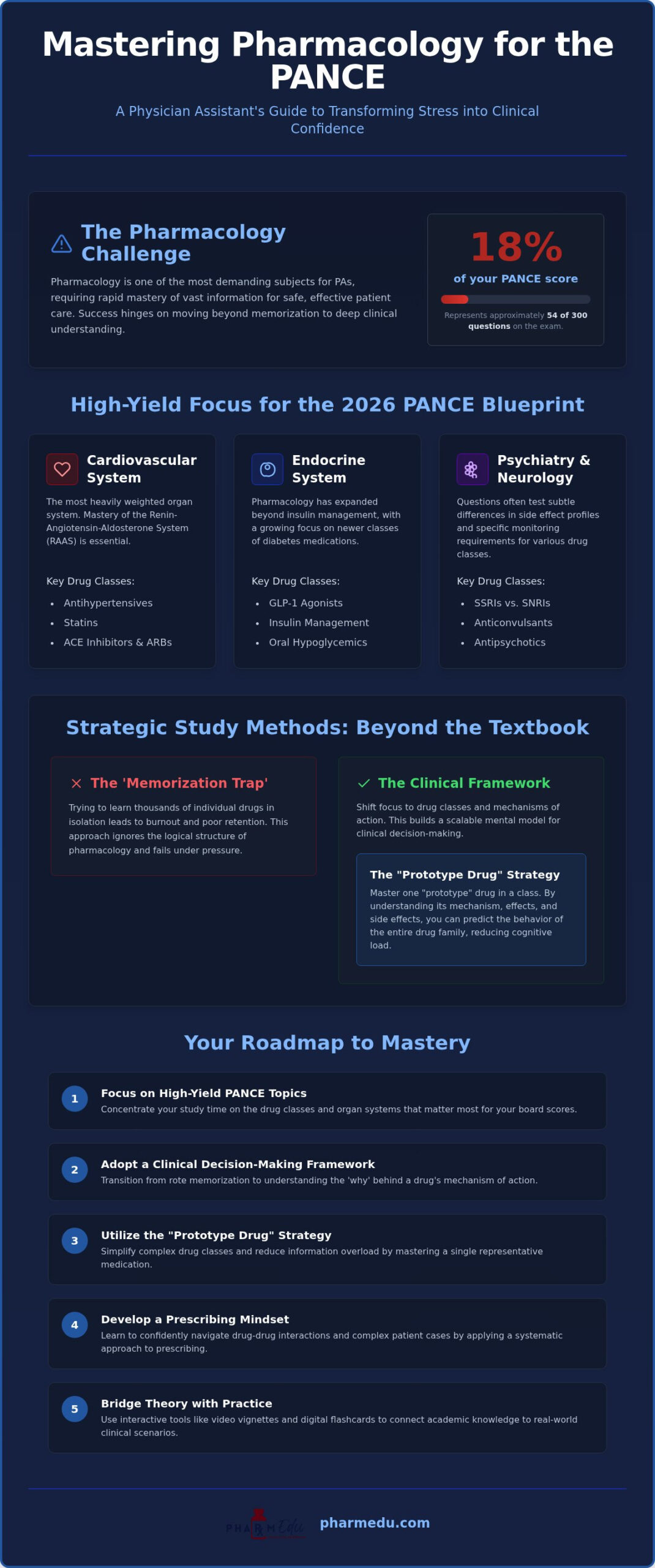
Did you know that pharmacology and therapeutics account for approximately 18% of your PANCE score, representing roughly 54 of the 300 questions on the exam? It’s a daunting figure, especially when you’re staring at a mountain of drug classes, contraindications, and side effects that feel more like a dry academic list than a clinical tool. We know that mastering pharmacology for physician assistants often feels like a relentless exercise in rote memorization. You’re likely feeling the weight of information overload and the looming responsibility of your future prescribing authority, which can lead to significant anxiety during your clinical rotations and board preparation.
This guide is designed to transform that stress into clinical confidence. We’ll help you master the complexities of pharmacology for PA school and the PANCE through evidence-based clinical frameworks and high-yield study strategies. Instead of just memorizing generic names, you’ll learn to connect mechanisms of action directly to patient outcomes. We’re going to walk through the 2026 PANCE blueprint changes, identify the most critical organ systems to focus on, and provide a clear roadmap that saves you time while preparing you for the high-stakes decisions you’ll make at the bedside.
Key Takeaways
- Identify the highest-yield sections of the 2026 PANCE blueprint to focus your study time on the drug classes that matter most for your board scores.
- Discover why mastering pharmacology for physician assistants requires transitioning from rote memorization to a clinical decision-making framework.
- Learn the “prototype drug” strategy to simplify complex drug classes and reduce the burden of information overload during your rotations.
- Master a five-step prescribing mindset that helps you navigate drug-drug interactions and complex patient cases with professional confidence.
- Explore how interactive study tools like video vignettes and digital flashcards bridge the gap between academic theory and real-world clinical practice.
Why Pharmacology for Physician Assistants is the Ultimate Challenge
PA school is often described as “drinking from a firehose,” and nowhere is this more evident than in the study of pharmacology. While medical students may have more time to sit with the nuances of biochemistry, students in the Physician Assistant Profession must master a massive volume of drug data in an accelerated timeframe. You aren’t just learning names; you’re preparing for a career where your signature on a prescription pad carries immense weight. This intensity defines the transition from didactic lectures to clinical rotations, where theoretical knowledge must suddenly become actionable patient care.
Success in this field requires distinguishing between “nice-to-know” details and “high-yield” information. For the PANCE, high-yield means the drug classes, contraindications, and adverse effects that appear most frequently in clinical vignettes. It’s the core knowledge that ensures you can safely manage a patient’s treatment plan while working within a collaborative practice model. Mastering pharmacology for physician assistants isn’t about knowing every rare drug on the market; it’s about being clinical ready for the patients you’ll see every day.
The Stakes of Pharmacotherapeutics in PA Practice
As a PA, you hold significant legal and ethical responsibilities. Prescribing authority is a privilege that demands a rigorous understanding of how medications interact within the human body. A deep foundation in pharmacology is essential for maintaining patient safety and avoiding the dangers of polypharmacy. In complex cases, especially with geriatric patients, the ability to identify potential drug-drug interactions is what separates a competent clinician from one who inadvertently causes harm. Your role is to be the final check in the safety chain, ensuring that every therapeutic intervention is both appropriate and safe.
Overcoming the ‘Memorization Trap’
Many students fall into the trap of rote memorization, trying to learn thousands of individual drug names in isolation. This approach often leads to burnout and exam failure because it ignores the logical structure of medicine. To manage the massive cognitive load of pharmacology for physician assistants, you must shift your focus to drug classes and mechanisms of action. By understanding how a “prototype” drug works within a specific category, you can predict the effects and side effects of an entire family of medications. This strategic categorization simplifies the learning process and builds a mental framework that survives the pressure of high-stakes testing and real-world clinical decision-making. Focus on the “why” behind the drug, and the “what” will become much easier to recall.
Mastering the PANCE Blueprint: High-Yield Drug Classes
The 2026 PANCE blueprint places heavy emphasis on clinical application, requiring you to do more than just recall drug names. Cardiovascular disease remains the most heavily weighted organ system, making antihypertensives and statins “heavy hitters” you can’t afford to miss. Educators often focus on these specific areas when designing a PA pharmacology curriculum, ensuring that students can apply theoretical knowledge to complex patient vignettes. You’ll also see a significant number of questions on endocrine and psychiatric medications, where the distinction between drug classes often hinges on subtle side effect profiles.
Endocrine pharmacology has expanded beyond traditional insulin management to include the growing world of GLP-1 agonists. In neurology and psychiatry, the board exams frequently test your ability to differentiate between SSRIs and SNRIs, or to identify the specific monitoring requirements for anticonvulsants. Mastering pharmacology for physician assistants means understanding these nuances before you walk into the testing center. If you’re looking for a way to test your retention on these topics, our Pharmacology Practice Quizzes offer a realistic simulation of board-style questions.
High-Yield Focus: ACE Inhibitors and ARBs
The Renin-Angiotensin-Aldosterone System (RAAS) is a cornerstone of cardiovascular therapy. You must understand the mechanism of action for ACE inhibitors and ARBs to answer questions about heart failure and diabetic nephropathy. Examiners love to test the “ACE cough,” caused by bradykinin accumulation, and the life-threatening risk of angioedema. Mastering pharmacology for physician assistants also involves knowing that these drugs are strictly contraindicated in pregnancy due to teratogenicity. Read our ACE Inhibitors Pharmacology Guide for a deeper dive into these essential clinical concepts.
Antibiotics: A Systematic Approach
Navigating the “Antibiotic Ladder” requires a systematic framework rather than scattered memorization. You should categorize antibiotics by their coverage of Gram-positive and Gram-negative organisms. For example, when treating community-acquired pneumonia in a PANCE scenario, you must decide between macrolides or respiratory fluoroquinolones based on the patient’s comorbidities. High-yield side effects are also frequent targets; always associate fluoroquinolones with the risk of tendon rupture or QT prolongation. Developing this coverage-based mindset is the most efficient way to handle the infectious disease portion of the exam.
Strategic Study Methods: Beyond the Textbook
Mastering pharmacology for physician assistants requires a departure from the traditional “read and highlight” approach. Textbooks offer comprehensive data; however, they don’t always teach you how to retrieve that information under the pressure of a board exam. To truly prepare for the PANCE and clinical practice, you need a strategy that prioritizes long-term retention over short-term recognition. Passive reading creates a false sense of security that often evaporates when you’re faced with a complex clinical vignette.
- Step 1: Focus on Prototypes. Instead of memorizing every drug in a class, pick one “prototype” and learn it deeply. If you understand the pharmacokinetics and side effects of Lisinopril, you can predict how most other ACE inhibitors will behave.
- Step 2: Use Visual Mnemonics. Linking a drug’s mechanism to a specific image creates a mental anchor. This technique is especially effective for complex autonomic nervous system drugs that are difficult to visualize.
- Step 3: Active Recall. Testing yourself on a concept is far more effective than re-reading a chapter. If you can’t explain a mechanism of action without looking at your notes, you haven’t mastered it yet.
- Step 4: Vignette-Based Learning. Start practicing with clinical scenarios early in your studies. This bridges the gap between a drug’s name and its real-world application.
- Step 5: Spaced Repetition. Use digital tools to revisit difficult topics at increasing intervals. This method fights the “forgetting curve” and ensures the information stays fresh for your board day.
Integrating these methods into your daily routine changes how you view pharmacology for physician assistants. It turns a list of names into a logical system of clinical tools. By focusing on how drugs work rather than just what they are called, you build a foundation that supports both exam success and safe prescribing.
The Power of High-Yield Video Vignettes
Passive lectures often lead to cognitive fatigue and diminished focus. Short, focused videos utilize visual storytelling to break down complex pharmacokinetics into manageable pieces. This format improves retention by engaging multiple senses simultaneously, making it easier to recall information during high-stakes exams. Micro-learning segments allow busy students to master complex drug mechanisms during short breaks between clinical rounds or lectures.
Leveraging Interactive Pharmacology Flashcards
Digital flashcards offer significant advantages over traditional paper methods for PANCE preparation. These tools utilize algorithms to show you difficult cards more frequently, ensuring you spend time where it’s needed most. You can use “tagging” features to isolate your weakest drug classes, such as oncology or neurology, for intensive review. This process leverages the science of active recall, which is the most reliable way to form long-term memories of drug-drug interactions and contraindications.
Clinical Application: From Classroom to Prescribing
Transitioning from the classroom to the clinic is where the true challenge of pharmacology for physician assistants begins. You aren’t just answering multiple-choice questions anymore; you’re making decisions that affect human lives. Developing a “Prescribing Mindset” is crucial for safety. This involves a five-step check for every patient: confirm the indication, screen for contraindications, identify potential interactions, verify the correct dose for renal or hepatic function, and prepare a patient education plan. This systematic approach reduces cognitive load and prevents errors during busy clinical shifts.
Geriatric patients present a unique challenge due to polypharmacy. When managing older adults, your focus shifts toward simplifying regimens and avoiding high-risk medications listed on the Beers Criteria. You must also master the art of patient education. Explaining side effects is a delicate balance. If you overemphasize rare risks, you may cause non-compliance; if you understate them, you compromise safety. Focus on what the patient should expect and when they should call the office. Utilizing clinical decision support tools can provide a safety net, but they should never replace your clinical judgment. To sharpen these skills, exploring our Clinical Case Studies provides the practice you need before seeing real patients.
High-Yield Clinical Pearls for Rotations
During your rotations, you’ll encounter “Black Box Warnings” that you must commit to memory. These are the most serious warnings issued by the FDA, often involving life-threatening risks like the suicidality associated with certain antidepressants or the tendon rupture risk of fluoroquinolones. Beyond the warnings, you must know your monitoring parameters. If you’re prescribing an ACE inhibitor, you’re also responsible for ordering a basic metabolic panel to check potassium and creatinine levels. Forging these habits early prevents common prescribing errors, such as failing to adjust dosages for a patient’s declining GFR.
Pharmacology in Chronic Disease Management
Chronic disease management requires a deep understanding of step-wise therapy. In conditions like Asthma and COPD, you’ll follow a ladder of treatment that starts with short-acting bronchodilators and progresses to inhaled corticosteroids or long-acting muscarinic antagonists. Similarly, navigating the latest guidelines for Type 2 Diabetes involves more than just prescribing metformin; you must understand when to add SGLT2 inhibitors or GLP-1 agonists based on cardiovascular risk. While the focus here is specific to the PA role, you can Review our Pharmacology Study Guide for Nursing Students to see how these foundational disease management concepts are shared across the healthcare team.
PharmEDU: The Premier Pharmacology Review for Future PAs
Mastering pharmacology for physician assistants requires a platform that evolves alongside the 2026 PANCE blueprint. PharmEDU provides comprehensive access to over 100 pharmacology topics, ensuring no clinical stone is left unturned during your preparation. Our digital environment replaces the static nature of traditional study guides with a dynamic, interactive experience. You’ll find High-Yield Video Vignettes specifically crafted for the modern learner who needs to bridge the gap between dry theory and bedside application. These segments focus on the “why” behind drug mechanisms, making complex pharmacokinetics easier to visualize and retain.
To reinforce this knowledge, the platform features Interactive Flashcards and Pharmacology Practice Quizzes that utilize the active recall strategies we’ve discussed. These aren’t just simple definition cards; they’re designed to challenge your clinical reasoning. Furthermore, our Clinical Case Studies mirror the actual board exam format, allowing you to practice high-stakes decision-making in a risk-free environment. By simulating the “Next Best Step in Management” questions you’ll face on the PANCE, we help you build the stamina and precision required for exam day success.
Designed by Educators for Healthcare Professionals
The PharmEDU mission is rooted in making pharmacology accessible, high-yield, and clinically relevant. We understand that your rotation year is a period of intense pressure and limited time. That’s why our mobile-compliant design is a core feature; it allows you to squeeze in micro-learning segments between patient rounds or during your commute. For academic programs looking to elevate their students’ performance, we offer an Institutional Platform License. This allows PA programs to integrate our evidence-based curriculum directly into their didactic and clinical phases, providing a standardized, high-quality resource for every student in the cohort.
Success on the PANCE and Beyond
Just as digital curriculum tools enhance the learning environment, healthcare organizations often implement cloud-based solutions like 123 EDI to streamline their electronic data interchange, ensuring that administrative workflows are as efficient as clinical ones.
The value of a comprehensive pharmacy review is undeniable in a digital-first world. Students who rely on interactive platforms often report higher confidence levels when transitioning to clinical practice compared to those using only traditional textbooks. PharmEDU doesn’t just help you pass a test; it builds the foundation for a lifetime of safe prescribing. By focusing on prototype drugs and clinical pearls, you’ll enter your first year of practice with a “prescribing mindset” already in place. Don’t leave your board scores or your future patients’ safety to chance. Start your PharmEDU subscription today and master PA pharmacology.
Securing Your Future as a Confident Prescriber
Mastering pharmacology for physician assistants doesn’t have to feel like an insurmountable task. By shifting your focus toward high-yield prototype drugs and clinical decision-making frameworks, you transform a massive list of medications into a logical toolset for patient care. Success on the 2026 PANCE and in your future clinical rotations depends on your ability to bridge the gap between academic theory and real-world prescribing safety. You’ve explored how to categorize drug classes and manage complex interactions; now it’s time to solidify that knowledge with resources designed for your professional success.
PharmEDU provides the support you need to excel with over 100 high-yield topics and mobile-compliant micro-learning segments that fit into your busy schedule. Our interactive study tools and case studies ensure you’re always board-ready. Start Your PharmEDU Pharmacology Review Today to gain the precision and confidence required for modern PA practice. You’re well on your way to becoming a vital member of the healthcare team, and we’re here to help you master every therapeutic challenge you’ll face at the bedside.
Frequently Asked Questions
What is the best way to study pharmacology for PA school?
Focusing on active recall and prototype drugs is the most effective approach. This method helps you categorize medications by class and mechanism instead of memorizing thousands of names in isolation. Using interactive tools like flashcards and video vignettes makes the process much more efficient. It’s the most reliable way to master pharmacology for physician assistants while managing the heavy didactic workload of PA school.
How much pharmacology is on the PANCE exam?
Approximately 18% of the PANCE exam is dedicated to pharmacology and therapeutics. This translates to roughly 54 questions out of the 300 total items on the test. Because this section carries such significant weight, your board preparation strategy must prioritize high-yield drug classes and clinical application over low-yield details that rarely appear in vignettes. Focusing on these core areas ensures you maximize your score.
Is PharmEDU better than traditional pharmacology textbooks?
PharmEDU offers a dynamic alternative to traditional textbooks by focusing on micro-learning and clinical readiness. While textbooks are often static and overwhelming, our platform uses interactive flashcards and high-yield video vignettes to bridge the gap between theory and practice. This digital-first approach helps you retain information more effectively than passive reading ever could. You’ll find it’s a far more efficient way to prepare.
Can I use PharmEDU on my mobile device during rotations?
Yes, the platform features a mobile-compliant design specifically for students on clinical rotations. You can access micro-learning segments and high-yield vignettes during short breaks or between patient encounters. This flexibility ensures you don’t lose valuable study time while navigating the busy schedule of your rotation year. It’s like having a digital mentor in your pocket during your most demanding clinical weeks.
Does PharmEDU offer institutional access for PA programs?
We provide an Institutional Platform License designed for universities and PA programs. This option allows faculty to integrate our curriculum directly into their courses and track student performance through administrative tools. It’s an effective way for programs to provide a standardized, high-quality pharmacology review for every student in the cohort. Many institutions find this approach superior to relying on disparate study materials.
How often is the pharmacology content updated on PharmEDU?
Our curriculum is developed and regularly updated by healthcare educators to reflect the latest clinical guidelines and PANCE blueprint changes. We ensure that our content remains current with the 2026 standards, providing you with the most accurate information for your exams and future practice. You won’t have to worry about studying outdated protocols or medications. This commitment to accuracy ensures your clinical knowledge remains sharp.
Are there practice questions specifically for the PANCE pharmacology section?
PharmEDU includes Pharmacology Practice Quizzes and Clinical Case Studies that specifically mirror the PANCE format. These tools challenge your ability to select the “Next Best Step in Management” in clinical vignettes. Practicing with these scenarios early is vital for mastering pharmacology for physician assistants and building the stamina needed for the actual board exam. It’s the best way to ensure you’re ready for the testing center.
What drug classes are considered ‘high-yield’ for physician assistants?
High-yield drug classes include cardiovascular agents like ACE inhibitors and statins, endocrine medications such as GLP-1 agonists, and infectious disease treatments. You should also focus on psychiatric drugs and neurology medications, as these appear frequently in clinical scenarios. Mastering these heavy hitters provides the highest return on your study time investment. These are the categories that consistently appear on the national certification exam.