
Mastering Pharmacology Time Management: 2026 Guide
The secret to passing pharmacology isn’t studying more; it’s intentionally studying less of the wrong things. Most students treat their textbooks like a marathon they have to run at a sprint, yet they still find themselves drowning in a sea of identical-sounding drug suffixes and side effects. Mastering time management for pharmacology class requires a shift from brute-force memorization to strategic prioritization. If you feel like you’re working harder than ever but still struggling to distinguish an ACE inhibitor from an ARB during a timed exam, you aren’t alone.
It’s exhausting to spend ten hours in the library only to realize you’ve forgotten the first prototype by the time you reach the fifth. We agree that the sheer volume of information can feel insurmountable, especially as the 2026 clinical landscape introduces more complex regulations and drug pricing shifts. This guide will show you how to optimize your study hours by focusing on high-yield drug classes and clinical applications that actually appear on exams. You’ll learn a repeatable routine to boost your scores and ensure long-term retention for the NAPLEX or NCLEX without hitting a wall of burnout. We’ll explore the power of active recall, the “high-yield” mindset, and the digital tools that turn hours of reading into minutes of mastery.
Key Takeaways
- Mastering time management for pharmacology class requires shifting focus from exhaustive memorization to identifying high-yield prototype drugs that represent entire classes.
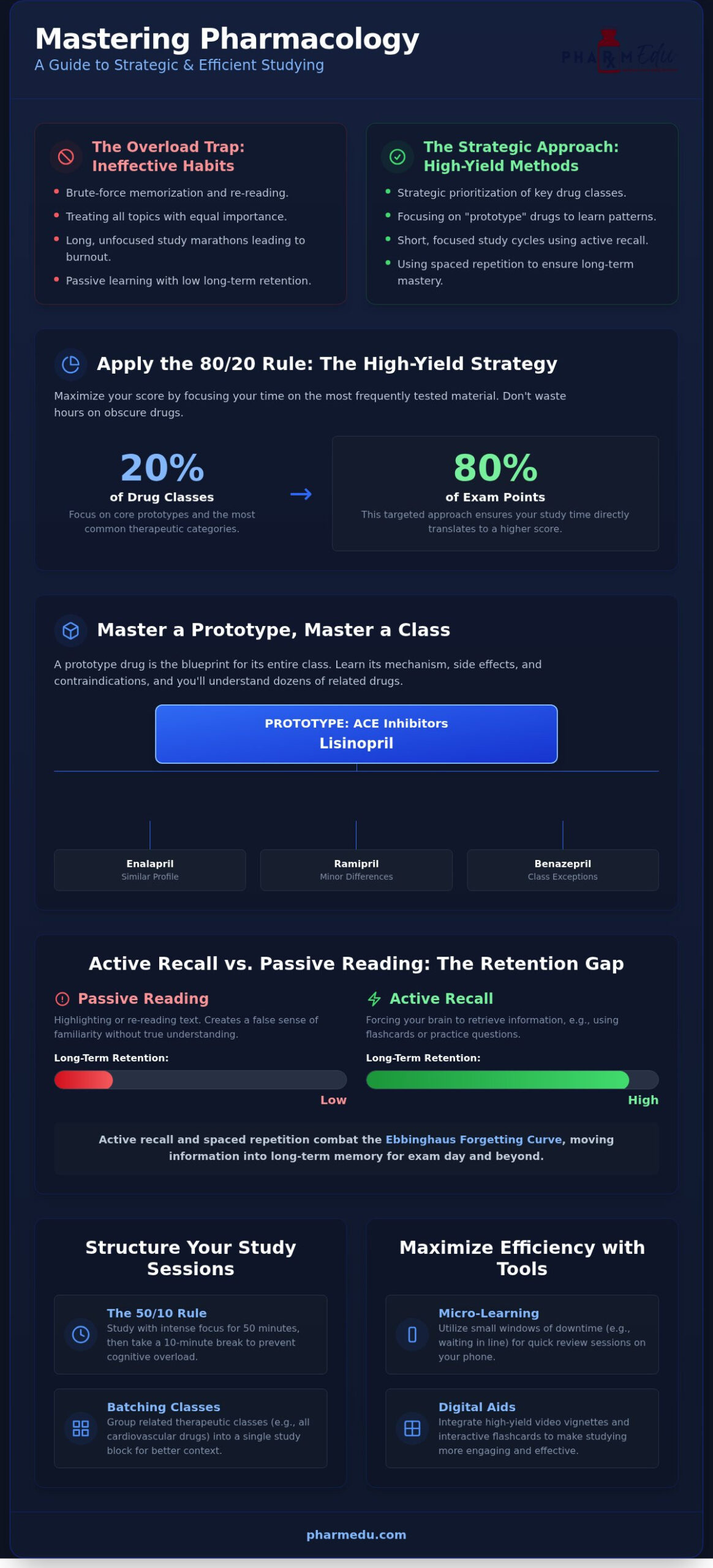
- Applying the 80/20 rule allows you to prioritize the drug categories most likely to appear on exams, ensuring higher scores with more targeted study hours.
- Implementing active recall and spaced repetition techniques helps you overcome the Ebbinghaus Forgetting Curve, securing information for both your current semester and the NAPLEX or NCLEX.
- Using structured scheduling methods like the 50/10 rule and batching related therapeutic classes prevents cognitive overload and maintains high levels of focus during dense sessions.
- Integrating micro-learning tools, such as high-yield video vignettes and interactive flashcards, enables you to maximize efficiency by studying effectively during small windows of downtime.
Why Time Management for Pharmacology Class is Different
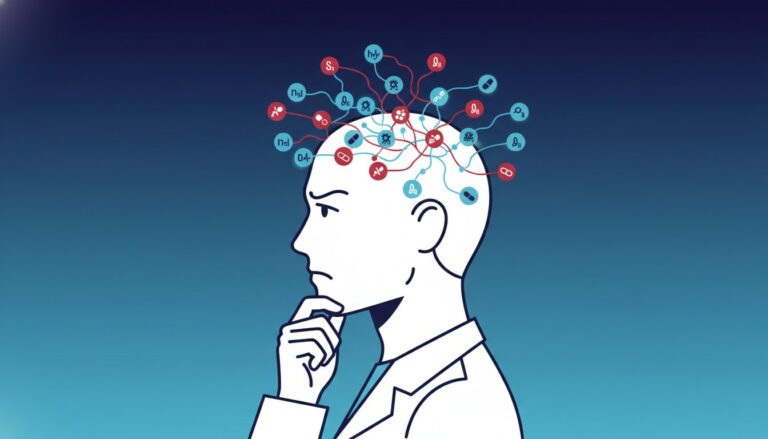
Every student eventually hits what we call the “Pharmacology Wall.” It’s the specific point where traditional study habits, like highlighting textbooks or re-reading notes, stop producing passing grades. Unlike other sciences, pharmacology demands a unique volume-to-retention ratio. You aren’t just learning concepts; you’re memorizing thousands of data points that carry direct implications for patient safety. In 2026, the density of this information has reached a new peak. With the implementation of the Medicare Drug Price Negotiation Program and the rapid introduction of novel biologics, the modern student must track more clinical and regulatory data than any previous generation. Successfully understanding the fundamentals of pharmacology requires a shift from simple recognition to rapid recall.
The difference between recognition and recall is the difference between passing and failing. When you read a chapter, you might recognize the name of a beta-blocker, but that doesn’t mean you can recall its specific contraindications under the pressure of a timed exam. Effective time management for pharmacology class focuses on closing this gap. It’s about moving away from the “butt-in-chair” philosophy and toward high-intensity, active learning cycles that respect your brain’s cognitive limits.
The Information Overload Trap
Reading a 1,200-page textbook from cover to cover is a classic time-sink. It creates a false sense of productivity while leaving you vulnerable to the “forgetting curve.” Many students fall into passive study habits, spending hours sitting at a desk without actually moving information into long-term memory. This creates “dead zones” in your schedule where you’re physically present but mentally stagnant. To fix this, you must identify when you’re simply scanning words rather than processing mechanisms of action. If you don’t change your approach, you’ll spend more time re-learning old material than mastering new drug classes.
Pharmacology vs. Other Sciences
In subjects like physiology or anatomy, you can often “logic” your way to an answer. If you understand the structure of the heart, you can deduce how blood flows. Pharmacology isn’t always so kind. You can’t logic your way through drug names, suffixes, or specific adverse effects that don’t follow a conceptual pattern. This memorization breadth is what makes time management for pharmacology class so difficult. You have to set realistic expectations for each session. Trying to master 40 individual drugs in one afternoon is impossible. Instead, your schedule must prioritize drug-class prototypes, allowing you to learn the “rules” of a class so you can later manage the exceptions.
The High-Yield Strategy: Prioritizing Drug Classes
Effective time management for pharmacology class requires a ruthless application of the Pareto Principle. In a clinical curriculum, roughly 80% of your exam points typically stem from 20% of the drug classes. If you spend equal time on obscure orphan drugs and foundational cardiovascular agents, you’re misallocating your most valuable resource: your focus. Professional organizations often share general time management tips for pharmacy school, but in pharmacology, those strategies must be specifically tailored to syllabus weights. Examine your course outline to identify which units carry the most points and front-load your week with those high-priority topics. Don’t let your personal interest in a niche topic dictate your schedule; let the exam’s point value be your guide.
Focusing on Prototypes
A prototype drug is the “gold standard” representative of its therapeutic class. It serves as a blueprint, embodying the primary mechanism of action, common side effects, and typical contraindications for an entire group of medications. Mastering a single prototype drug allows you to predict the clinical profile of dozens of related medications within the same class, effectively slashing your total study time. Once you understand the behavior of the prototype, you only need to learn how the “me-too” drugs differ from that baseline. Creating a “Master Class List” helps you visualize this hierarchy, turning a chaotic list of names into a structured map of pharmaceutical knowledge.
Mechanism-Based Organization
Grouping medications by their mechanism of action (MOA) prevents the confusion that arises from memorizing drugs in alphabetical order or by brand name. When you understand the “how” behind a drug, the “why” of its side effects becomes intuitive rather than an exercise in rote memorization. For instance, if you know how a specific class affects the renin-angiotensin-aldosterone system, you can logically deduce why it might cause hyperkalemia or a dry cough. Using a resource like our ACE Inhibitors Guide provides a clear example of how class-based mastery simplifies complex systems. Mapping side effects directly to the MOA reduces the burden on your memory. Instead of memorizing ten unrelated symptoms, you learn how a drug’s interaction with a specific receptor naturally leads to those physiological changes. To reinforce this structure, consider using interactive pharmacology flashcards that focus on these high-yield connections during your daily study blocks.
Active Recall vs. Passive Reading: Which Saves More Time?
The Ebbinghaus Forgetting Curve proves that within 24 hours of a lecture, the human brain loses approximately 70% of new information. If your strategy for time management for pharmacology class involves reading the same chapter three times, you’re fighting a losing battle against biology. Passive reading creates an illusion of competence; you recognize the words, so you assume you know the material. True mastery requires active recall, which is the process of forcing your brain to retrieve information without looking at your notes. Testing yourself early and often isn’t just an assessment tool; it’s a learning event that saves you hours of re-reading later in the semester.
The Power of Spaced Repetition
Spaced repetition involves reviewing material at increasing intervals to move drug facts from short-term to long-term memory. Instead of a grueling 4-hour weekend cram session that leaves you exhausted, aim for 15 minutes of daily retrieval. This consistent “micro-learning” approach keeps the material fresh and prevents the massive knowledge decay that occurs during long breaks. For those looking for specific active recall tips tailored to their curriculum, our Pharmacology Study Guide for Nursing Students offers a roadmap for integrating these sessions into a busy clinical schedule. Using Interactive Pharmacology Flashcards during these brief windows ensures that your limited study time is spent on high-intensity retrieval rather than passive scanning.
Case Studies as Time-Savers
Many students view case studies as “extra” work, but they’re actually one of the most effective time-saving tools in your arsenal. Applying drug knowledge to a patient scenario triggers “deep processing,” a cognitive method that anchors abstract facts to concrete situations. When you see how a patient’s comorbidities interact with a drug’s contraindications, you’re no longer memorizing a list; you’re solving a puzzle. Our Clinical Case Studies help you predict the exact style of questions you’ll face on timed exams. By integrating clinical application into your weekly time blocks, you bridge the gap between theory and practice, ensuring you don’t have to “re-learn” the material when boards like the NAPLEX or NCLEX arrive. This strategic approach to time management for pharmacology class ensures that every minute spent studying translates directly into exam-day confidence.
Designing Your 2026 Pharmacology Study Schedule
A successful calendar for 2026 isn’t about filling every hour with work; it’s about protecting your cognitive energy. The 50/10 rule is essential for the dense nature of this subject. You study for 50 minutes with total focus, followed by a 10-minute complete break away from screens. This prevents the mental fatigue that leads to the “dead zones” mentioned earlier. Effective time management for pharmacology class also relies on batching. Instead of jumping between unrelated topics, group your study days by physiological systems. Dedicate specific blocks to autonomic drugs, then transition to cardiovascular agents. This allows your brain to stay within one biochemical “language” for longer periods, which aids in making logical connections between mechanisms.
Planning is your most effective defense against burnout. Use Sunday evening to perform a “Sunday Setup.” Look at your syllabus weights and map out which high-yield prototypes you’ll tackle each day. This removes the decision fatigue of wondering what to study when you’re already tired. If you’re currently navigating clinical rotations or a busy work week, your schedule must remain fluid. Shift your deep-dive sessions to your days off and rely on micro-learning during your shifts. Having a pre-planned list of topics ensures that even a 15-minute gap in your clinical schedule becomes a productive review session.
The Daily Pharma Routine
Consistency beats intensity every time. Start your morning with a 10-minute flashcard “warm-up” to reactivate yesterday’s prototypes. Use your mid-day breaks for micro-learning segments, such as watching High-Yield Video Vignettes on your mobile device. This turns transit time or lunch breaks into high-value review. Reserve your evening for a deep dive into one specific high-yield drug class. This is when you map mechanisms of action and adverse effects without distractions. By the time you reach your evening session, you’ve already interacted with the material twice, making the deep dive much more efficient.
Weekly Review and Maintenance
Knowledge decay is the primary enemy of board preparation. You must include a “Cumulative Review” block every weekend. This isn’t for learning new material; it’s for revisiting everything from the past three weeks. Use Pharmacology Practice Quizzes to simulate exam conditions and identify which topics require a pivot in your strategy. If you’re consistently missing questions on a specific class, that’s your signal to allocate more time to it in next week’s Sunday Setup. This iterative process ensures that your time management for pharmacology class stays aligned with your actual performance, not just your study plan.
Leveraging PharmEDU for Maximum Study Efficiency
The most sophisticated study schedule still requires the right tools to be effective. PharmEDU acts as a digital mentor, transforming the way you approach time management for pharmacology class. By replacing hours of dense textbook reading with our High-Yield Video Vignettes, you can grasp complex mechanisms in a fraction of the time. These vignettes are specifically designed to highlight clinical essentials, ensuring you don’t waste mental energy on low-yield details that won’t appear on your exams. This targeted approach allows you to focus your attention on the 20% of material that typically accounts for 80% of your grade.
Micro-Learning and Mobile Access
Studying shouldn’t be confined to a library desk. Our mobile-compliant platform allows you to reclaim the “in-between” moments of your day, such as a 15-minute transit ride or the time spent waiting between clinical rounds. Video-based learning caters to both visual and auditory learners, significantly increasing retention rates compared to passive reading. This approach doesn’t just help you pass your next quiz; it builds the foundation for your future career. For a broader look at long-term strategy, our NAPLEX Prep Course Guide explains how to maintain this efficiency through your final board examinations.
Data-Driven Study Sessions
Efficiency is as much about what you stop doing as what you start. PharmEDU provides detailed performance stats that allow you to identify weak spots instantly. Instead of over-studying cardiovascular drugs you’ve already mastered, you can pivot your attention to autonomic nervous system prototypes where your scores might be lagging. This data-driven approach ensures your time management for pharmacology class is always optimized for your current level of knowledge. We provide a “High-Yield” guarantee by focusing strictly on the topics most likely to appear on national exams.
Our platform supports both individual students seeking personal mastery and faculty members utilizing an Institutional Platform License to track student progress. By integrating Pharmacology Practice Quizzes and Clinical Case Studies into your routine, you move beyond mere memorization. You’re training your brain to apply knowledge in real-time, which is the exact skill required for the NCLEX or NAPLEX. This transition from theoretical study to practical application is what ultimately prevents burnout and ensures you’re prepared for the clinical responsibilities of 2026 and beyond.
Take Control of Your 2026 Clinical Success
Mastering time management for pharmacology class isn’t about working more; it’s about working with greater precision. By embracing the 80/20 rule and prioritizing prototype drugs, you can cut through the noise of dense textbooks and focus on what truly matters for patient safety and exam performance. Moving from passive reading to active recall ensures that the knowledge you gain today remains accessible for your future board exams and clinical practice. Whether you’re batching your study sessions or utilizing the 50/10 rule, consistency and strategy are your best defenses against academic burnout.
PharmEDU is ready to be your partner in this journey, providing the high-yield resources you need to succeed. With 100+ high-yield topics, interactive pharmacology flashcards, and clinical case studies for real-world application, our platform is designed to fit into your busy life. You don’t have to navigate this complex subject alone. Our tools bridge the gap between classroom theory and the clinical environment, ensuring you remain prepared for the challenges of a modern healthcare career.
Stop wasting time and start mastering pharmacology with PharmEDU’s monthly subscription. Your path to academic excellence and professional confidence starts with a more efficient study routine. We’re here to help you every step of the way.
Frequently Asked Questions
How many hours a week should I study for pharmacology?
Most successful students dedicate between 10 and 15 hours per week to this subject, but the quality of your sessions is more important than the total time. Effective time management for pharmacology class involves breaking these hours into daily micro-learning blocks rather than one long weekend session. This consistent exposure prevents cognitive fatigue and helps you navigate the high density of information without feeling overwhelmed by the sheer volume of drug data.
Is it better to study by drug name or by drug class?
You should always prioritize studying by drug class rather than individual drug names. Mastering a prototype drug for each class allows you to understand the shared mechanism of action, common side effects, and contraindications for dozens of related medications. This strategy significantly reduces the amount of rote memorization required. Once you understand how the class behaves, you only need to focus on the unique differences or “exceptions” within that group.
How can I remember drug suffixes and prefixes quickly?
The fastest way to remember suffixes is to group them by their therapeutic class and use them as cognitive anchors. For example, recognizing that “-olol” always refers to beta-blockers allows you to identify a drug’s function instantly. You can reinforce these patterns by using Interactive Pharmacology Flashcards that focus on these linguistic cues. This method turns thousands of individual names into a manageable system of patterns, which is essential for rapid recall during timed exams.
What should I do if I fall behind in my pharmacology study schedule?
If you fall behind, stop trying to catch up on every detail and pivot your focus to upcoming high-yield topics. Identify the drug classes that carry the most weight on your next exam and prioritize those prototypes during your limited study blocks. Use Pharmacology Practice Quizzes to find your biggest knowledge gaps so you don’t waste time reviewing material you already understand. Focus on clinical safety and major mechanisms to secure the most points possible.
Can I pass pharmacology without reading the entire textbook?
Yes, many students pass by focusing on high-yield summaries, video vignettes, and clinical applications instead of dense textbook chapters. Textbooks often contain historical data and niche details that aren’t relevant to modern exams or clinical safety. Utilizing a platform like PharmEDU allows you to focus on the “must-know” information that is likely to appear on boards. This targeted approach saves you hours of scanning academic prose and improves your time management for pharmacology class.
How do I balance pharmacology with my clinical rotations?
Balance your rotations by utilizing micro-learning during the “in-between” moments of your shift. Use 10-minute breaks or transit time to review High-Yield Video Vignettes on your mobile device. When you’re on the floor, pay close attention to the medications your patients are receiving, as seeing a drug’s effect in a real-world scenario reinforces your study. This practical application anchors theoretical knowledge, making your formal study sessions much more efficient when you’re off the clock.
Are flashcards really effective for complex drug mechanisms?
Flashcards are extremely effective if they are designed for active recall rather than simple recognition. Instead of just writing a name on one side, your cards should prompt you to explain a drug’s mechanism of action or its physiological impact. Digital flashcards that use spaced repetition are particularly valuable because they force you to revisit difficult mechanisms just as you’re about to forget them. This process builds the long-term retention necessary for both classroom exams and board certification.
When should I start preparing for my pharmacology board exams?
Preparation for the NAPLEX or NCLEX should begin during your first week of pharmacology class. Board preparation is a cumulative process, not a separate event you do at the end of your program. By using Clinical Case Studies and focusing on high-yield prototypes now, you’re building a foundation that makes final board review much less stressful. Consistent time management for pharmacology class ensures that you aren’t just memorizing for a semester grade, but retaining information for your professional license.