
Quick Pharmacology: The High-Yield Guide to Mastering Drugs in 2026
What if the secret to passing your 2026 board exams isn’t found in the thousand page textbook gathering dust on your desk? Most healthcare students feel buried under a mountain of drug classes, complex mechanisms of action, and endless lists of adverse effects. It’s incredibly difficult to connect a molecular pathway to a clinical outcome when you’re already exhausted from a long shift on clinical rotations. You likely feel that there simply aren’t enough hours in the day to master every medication in the pharmacopeia.
We understand that information overload is the biggest hurdle to your professional success. This guide shows you how to implement a quick pharmacology strategy that prioritizes high-yield retention over brute-force memorization. By moving away from dry academic jargon and toward structured, digital micro-learning, you can finally regain control of your study schedule. We’ll preview the essential drug classes for 2026, explain how to bridge the gap between theory and practice, and provide a roadmap to help you excel on the NAPLEX or NCLEX with total confidence.
Key Takeaways
- Prioritize high-yield clinical facts over academic fluff to focus on the concepts most likely to appear on your 2026 board exams.
- Adopt a quick pharmacology approach by utilizing 15-minute micro-learning sessions that leverage the spacing effect for superior memory retention.
- Streamline your study process by mastering prototype drugs, allowing you to understand the mechanisms and effects of entire medication families at once.
- Reclaim “dead time” during your daily schedule by replacing passive scrolling with high-yield video vignettes and interactive digital tools.
- Develop the clinical confidence required for the NAPLEX or NCLEX by transitioning from rote memorization to a structured, educator-led framework.
Defining Quick Pharmacology: Mastering the High-Yield Essentials
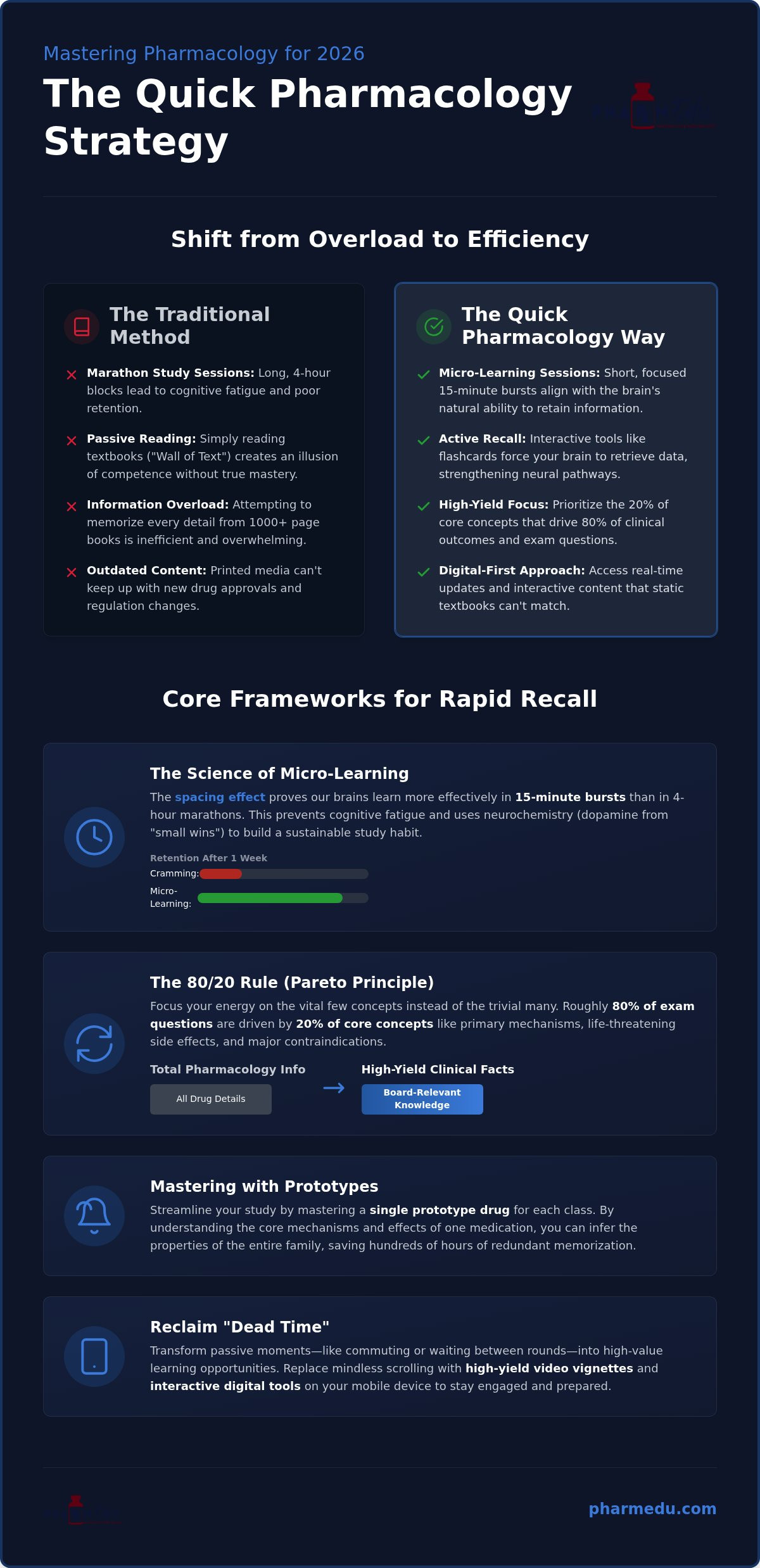
Efficiency in medical education isn’t about cutting corners; it’s about strategic prioritization. Most students attempt to memorize every detail of a comprehensive overview of pharmacology, only to find themselves overwhelmed by data that rarely appears on exams. This is where the 80/20 rule, or the Pareto Principle, becomes your most valuable study tool. In the context of drug mastery, roughly 80% of clinical outcomes and board exam questions are driven by 20% of the core concepts. These high-yield essentials include primary mechanisms of action, life-threatening adverse effects, and critical contraindications.
Distinguishing between “nice to know” academic fluff and “need to know” board facts is the hallmark of a successful student. Academic textbooks often spend chapters on historical drug synthesis or rare chemical interactions that don’t influence bedside decisions. Conversely, high-yield study focuses on the clinical application of drugs you’ll actually prescribe or administer. Quick pharmacology is a multi-modal approach to rapid drug mastery that synthesizes high-yield clinical data with digital learning tools to maximize retention and exam performance.
Why Traditional Textbooks Fail Busy Students
The “Wall of Text” problem is real. When you’re staring at a 1,200-page volume, your cognitive load skyrockets, making it nearly impossible to retain specific details. Passive reading is a low-utility study method that lacks the active recall necessary for long-term memory. Furthermore, the pharmaceutical landscape moves faster than the printing press. For instance, textbooks printed in early 2026 likely missed the May approval of Baxfendy (Baxdrostat) for resistant hypertension or the March launch of Awiqli, the first once-weekly basal insulin. Relying on static media means you’re studying yesterday’s medicine.
The Shift to High-Yield Med Review in 2026
Board exams like the NAPLEX and NCLEX have fundamentally changed. They’ve moved away from simple rote memorization toward complex clinical application. You aren’t just asked what a drug does; you’re asked how to manage a patient’s therapy when new regulations or drug approvals change the standard of care. Digital platforms now lead the way by providing real-time updates and interactive formats that textbooks can’t match. To see how these concepts fit into the broader scientific landscape, you can explore Pharmacology: The Comprehensive Guide to the Science of Drugs. This shift ensures that your preparation remains relevant to both the exam room and the hospital ward.
The Science of Micro-Learning: Why Short Study Bursts Win
Marathon study sessions are often a badge of honor for healthcare students, but they’re scientifically inefficient. The spacing effect demonstrates that our brains absorb information more effectively when it’s delivered in 15-minute bursts rather than 4-hour blocks. This approach aligns with the brain’s natural capacity for focus. By adopting a quick pharmacology habit, you’re working with your biology instead of against it. Short, focused sessions prevent cognitive fatigue and ensure that your limited study time results in genuine long-term retention.
Motivation is driven by neurochemistry. Completing a short module or a small set of practice questions triggers a dopamine release. These “small wins” create a positive feedback loop, making it easier to return to the material even after a long shift. This is vital for managing the forgetting curve, which is particularly steep for complex drug names. New 2026 approvals like Zanvastro (zilganersen) for Alexander disease or Zenbexus (iberdomide) for multiple myeloma require frequent touchpoints to stick. Mobile-compliant tools turn those 10-minute gaps between patient rounds into high-value learning opportunities.
Active Recall and Spaced Repetition
Reading a textbook is a passive act that often leads to the illusion of competence. Interactive pharmacology flashcards change the game by forcing your brain to retrieve data from scratch. This active retrieval triggers long-term potentiation, which is the process of strengthening neural pathways to make memories permanent. Spaced repetition algorithms ensure you review the most difficult drugs exactly when you’re about to forget them. This turns your study time into a high-intensity workout for your neurons, ensuring you’re ready for the clinical floor.
Video Vignettes: Visualizing Pharmacodynamics
Visualizing pharmacodynamics is often the missing link for students. Dual coding, the practice of pairing visual animations with auditory explanations, significantly improves recall compared to text alone. High-yield video vignettes simplify mechanisms of action that are otherwise difficult to grasp. Instead of struggling to imagine how a first-in-class aldosterone synthase inhibitor like Baxfendy works, you can watch a concise animation that illustrates the process in seconds. This visual bridge is essential for a quick pharmacology strategy. You can enhance your retention by integrating high-yield video vignettes into your daily routine to bridge the gap between abstract science and clinical reality.
Core Drug Class Frameworks for Rapid Recall
Memorizing the vast pharmacopeia agent-by-agent is a recipe for burnout. A truly effective quick pharmacology strategy relies on structural frameworks that group medications by their therapeutic class. Rather than treating every new drug as an isolated fact, you should adopt the Prototype Drug method. This technique involves mastering one representative medication, such as Lisinopril, to automatically understand the mechanism of action, side effect profile, and contraindications for the entire “-pril” family. By focusing on the family traits, you reduce the volume of information you need to memorize by nearly 90%.
The 2026 pharmaceutical landscape is dominated by innovations in metabolic and cardiovascular health. Based on current clinical trends and board exam weighting, you must prioritize these five high-yield classes during your review:
- GLP-1 Agonists: Including new oral formulations like Orforglipron and once-weekly injectables.
- SGLT2 Inhibitors: The “flozin” family, critical for both diabetes and heart failure management.
- Direct Oral Anticoagulants (DOACs): Such as Apixaban and Rivaroxaban.
- ACE Inhibitors and ARBs: The foundation of the RAAS pathway.
- Monoclonal Antibodies: Specifically those targeting inflammatory cytokines or PCSK9.
The Autonomic Nervous System (ANS) Cheat Sheet
The ANS is the gateway to predicting drug side effects across almost every body system. Think of the Sympathetic nervous system as the accelerator and the Parasympathetic as the brake. To master this quickly, focus on receptor locations. Alpha-1 receptors live in the vasculature; Beta-1 receptors are primarily in the heart; Beta-2 receptors reside in the lungs. When you know where a receptor is located, you can predict exactly what an agonist or antagonist will do. High-yield staples like Albuterol (a Beta-2 agonist) or Atropine (an anticholinergic) are frequently tested because their effects perfectly demonstrate these physiological rules.
Cardiovascular and Renal Essentials
Cardiovascular drugs are best understood by their interaction with the Renin-Angiotensin-Aldosterone System (RAAS). This pathway serves as a high-yield anchor for diuretics, ARBs, and ACE inhibitors. For a deeper dive into this specific family, review our ACE Inhibitors Pharmacology: The High-Yield Guide. ACE inhibitors prevent the conversion of angiotensin I to angiotensin II, which directly lowers systemic vascular resistance and reduces blood pressure while providing vital renal protection. Understanding this pathway also helps you grasp the role of new 2026 approvals, such as Baxfendy (Baxdrostat), which targets the RAAS further down the line as an aldosterone synthase inhibitor.
Practical Strategies for On-the-Go Pharmacology Study
Effective study habits in 2026 aren’t about finding more time; they’re about optimizing the time you already have. Most students lose hours every week to “dead time”, those small gaps during commutes, gym sessions, or while waiting between classes. A successful quick pharmacology plan begins with a schedule audit. Once you identify these pockets of time, you can swap mindless social media scrolling for high-yield video vignettes that deliver specific drug data in under five minutes. This transition turns wasted minutes into productive learning blocks.
Validation is the final piece of the puzzle. After reviewing a topic via video, you should immediately test your retention with quick-fire quizzes. This immediate feedback loop prevents the illusion of competence that often comes from passive reading. By the time you reach your clinical rotation, you won’t just remember the drug name; you’ll understand its application. Using clinical case studies further cements this knowledge by forcing you to apply drug mechanisms to real world patient scenarios. This four step process turns a chaotic study schedule into a streamlined path toward mastery.
Leveraging Mobile-Compliant Platforms
Your smartphone is often dismissed as a distraction, but it’s actually the most powerful learning tool in your arsenal when paired with a professional platform. Modern healthcare education requires mobile-compliant design that allows you to start a module on your laptop and finish it on your phone during a 10-minute coffee break. Seamless syncing ensures you never lose your place. This flexibility is essential for students who need to stay current with the 141 new scope of practice bills introduced across 41 states in early 2026. Being able to access high-quality content anywhere ensures you’re always prepared for the next clinical challenge.
Integrating Case Studies into Quick Review
The human brain is hardwired to remember stories, not isolated lists of adverse effects. Clinical case studies transform dry pharmacological data into memorable patient narratives. When you see a patient scenario involving a 65-year-old with resistant hypertension, the mechanism of a first-in-class drug becomes a solution rather than a definition. This approach helps you think like a clinician before you even step into the exam room. For those specifically entering the nursing field, you can find tailored strategies in The Ultimate Pharmacology Study Guide for Nursing Students.
To start optimizing your dead time today, you can explore our Clinical Case Studies and interactive tools designed for the modern student.
PharmEDU: Your Partner in High-Yield Pharmacology Mastery
Managing the rigors of healthcare education in 2026 demands a level of efficiency that traditional methods simply cannot provide. PharmEDU stands as the premier digital platform for comprehensive pharmacology review, specifically engineered to eliminate the friction of information overload. By focusing on quick pharmacology through high-yield micro-learning, we transform a daunting curriculum into manageable, educator-designed segments. This platform doesn’t just help you pass your exams; it ensures you retain critical drug information for a lifetime of clinical practice. Whether you’re aiming for the NAPLEX or the NCLEX, our structured approach provides the shortest path to professional confidence.
What’s Inside the PharmEDU Platform?
Our ecosystem includes over 100 high-yield topics that align directly with national board certification standards. You’ll gain access to High-Yield Video Vignettes that simplify complex molecular pathways, making it easier to visualize how a drug interacts with its target receptor. These are paired with Interactive Pharmacology Flashcards designed for active recall and Pharmacology Practice Quizzes to validate your mastery in real time. This combination of tools provides the support of a dedicated pharmacology mentor available 24/7. Because the platform is fully mobile-compliant, you can complete a 15-minute micro-learning segment during your clinical break, ensuring that your study habits fit into your actual life.
Individual vs. Institutional Access
Choosing a path to quick pharmacology mastery shouldn’t be a financial burden. We believe that high-quality education should be accessible to every student, which is why we offer a PharmEDU Monthly Subscription for those needing short-term review and a PharmEDU Annual Subscription for long-term mastery. These plans are designed to be flexible, supporting you through both your coursework and your final board preparations.
Beyond individual use, we provide an Institutional Platform License for universities and healthcare systems. These institutional partnerships allow faculty to monitor student progress, track performance metrics, and integrate our Clinical Case Studies into their formal coursework. This collaborative environment ensures that students and educators are always on the same page regarding clinical readiness. The move toward digital resources is accelerating as students prioritize efficiency and accuracy over outdated methods. To understand how these tools compare to older study formats, explore our analysis of Comprehensive Pharmacy Review: Digital vs. Traditional.
Secure Your Clinical Future with High-Yield Mastery
Mastering the vast world of medications in 2026 doesn’t require endless hours of passive reading. By adopting a quick pharmacology mindset, you focus on the high-yield concepts that actually appear on board exams and in clinical practice. We’ve explored how micro-learning segments and prototype drug frameworks can dramatically reduce your cognitive load while improving long-term retention. These strategies turn your daily “dead time” into a powerful asset, allowing you to bridge the gap between theory and patient care without burning out.
Ready to transform your study habits? Start your high-yield pharmacology journey with a PharmEDU subscription today! You’ll gain access to over 100 high-yield topics delivered through mobile-compliant micro-learning segments. Our platform includes interactive flashcards and quizzes designed by healthcare educators to ensure you’re fully prepared for the NAPLEX or NCLEX. Your professional journey is a marathon, but your daily study doesn’t have to be. Take the first step toward clinical excellence and exam confidence today.
Frequently Asked Questions
What is the most effective way to learn pharmacology quickly?
The most effective way to master pharmacology is to prioritize high-yield concepts that drive roughly 80% of exam questions. By adopting a quick pharmacology strategy, you focus on prototype drugs rather than memorizing every agent individually. This method allows you to understand the mechanism of action and side effects for an entire drug family at once. Combining this strategy with 15-minute micro-learning bursts ensures superior retention compared to traditional study marathons.
Can I really prepare for the NAPLEX using micro-learning?
You can absolutely prepare for the NAPLEX using micro-learning because modern board exams prioritize clinical application over rote memorization. Our platform breaks down over 100 high-yield topics into digestible segments that align with 2026 national certification standards. This approach helps you build the mental stamina required for the exam while ensuring you master the specific drug classes and clinical scenarios most likely to appear on your pharmacy boards.
How many hours a day should I spend on pharmacology review?
Consistency is more important than the total number of hours spent studying. Instead of a single four-hour marathon, aim for 30 to 60 minutes of high-intensity review spread throughout your day. Breaking your study into three 15-minute sessions leverages the spacing effect, which significantly improves long-term memory. This method is especially effective for busy students who need to balance clinical rotations with board preparation without sacrificing their performance.
Is PharmEDU better than traditional textbooks for board prep?
PharmEDU offers several advantages over traditional textbooks, primarily through real-time updates and interactive engagement. Textbooks are often outdated by the time they reach students, whereas our digital platform includes the latest 2026 drug approvals like Baxfendy or Awiqli. Unlike passive reading, our system uses high-yield video vignettes and practice quizzes to force active recall. This interactive format is designed to mirror the clinical decision-making process required for success.
What are the highest-yield drug classes to study for nursing school?
For nursing school exams and the NCLEX, the highest-yield drug classes include cardiovascular agents, autonomic nervous system medications, and metabolic drugs like GLP-1 agonists. You should also prioritize anticoagulants and respiratory medications. Mastering these core families provides a foundation for the majority of clinical questions. Our curriculum focuses specifically on these high-stakes areas, ensuring you spend your limited study time on the medications you’ll encounter most frequently in practice.
Does PharmEDU offer practice questions for pharmacology exams?
Yes, our platform includes a comprehensive library of pharmacology practice quizzes and clinical case studies to validate your learning. These interactive tools are designed to test your ability to apply drug knowledge in real-world scenarios. By answering questions immediately after a micro-learning segment, you reinforce the material and identify any gaps in your understanding. This active testing is a critical component of any effective quick pharmacology study plan in 2026.
Can I access PharmEDU on my mobile device during clinicals?
Our platform is fully mobile-compliant, allowing you to access all video vignettes, flashcards, and quizzes directly from your smartphone or tablet. This design is perfect for students who want to turn a 10-minute break during clinical rotations into a productive study session. Your progress syncs automatically across all devices, so you can transition seamlessly from a mobile review session to a deeper study period on your laptop later in the day.
How often is the pharmacology content updated on PharmEDU?
We update our pharmacology content regularly to reflect the rapidly changing pharmaceutical landscape of 2026. This includes integrating new drug approvals, such as the September approval of Zanvastro for Alexander disease, as soon as they become clinically relevant. Our team of healthcare educators ensures that all modules align with the current standards of practice and the latest board exam emphases, providing you with the most accurate and timely information available.