How to Not Forget Drugs After the Exam: Strategies for Long-Term Pharmacology Retention
What if the exhaustive hours you spent memorizing drug classes and contraindications weren’t destined to evaporate the moment you walked out of the testing center? It’s a frustrating, nearly universal experience in medical education: the high-stakes pressure of boards leads to intense cramming cycles that leave you feeling empty-handed when you finally reach the bedside. You’re likely searching for how to not forget drugs after the exam because you’ve realized that “siloed” learning just doesn’t stick when a patient’s safety is on the line. We agree that the traditional approach to pharmacology is often more about passing a test than building a professional foundation.
You can bridge this gap by mastering the cognitive science and clinical habits needed to turn fleeting facts into permanent knowledge. This guide will show you how to move from short-term memorization to long-term mastery by integrating pharmacology into a functional mental model. We’ll explore why spaced repetition is considered the gold standard for retention, with research showing that students utilizing these systems can see exam score increases of 6% to 13%. You’ll learn to build a sustainable study routine that ensures your pharmacological expertise remains sharp for licensing boards and, more importantly, for every clinical decision you’ll make in your career.
Key Takeaways
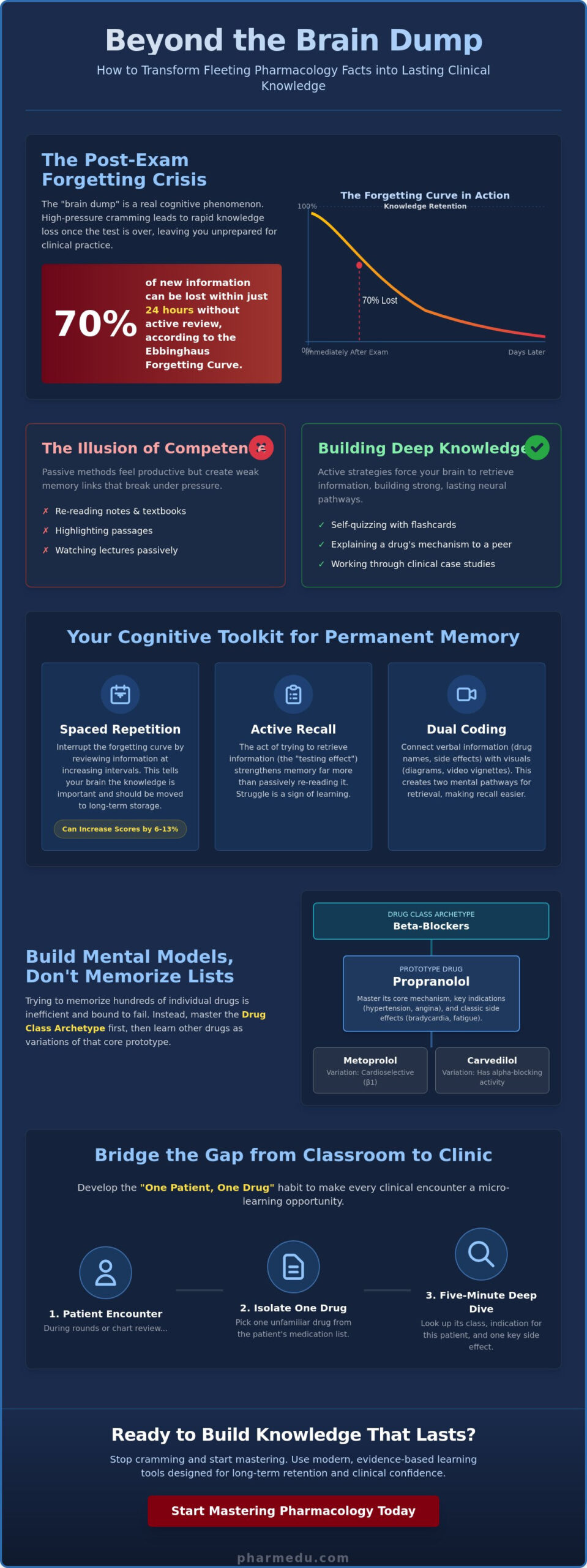
- Understand the cognitive mechanics of the “brain dump” and learn how to counteract the Ebbinghaus Forgetting Curve, which can lead to a 70% loss of information within 24 hours.
- Discover how to not forget drugs after the exam by shifting from passive review to active recall and Spaced Repetition Systems that secure knowledge in your long-term memory.
- Simplify complex pharmacology by mastering Drug Class Archetypes and the Prototype Drug method instead of attempting to memorize individual medications in isolation.
- Develop the “One Patient, One Drug” clinical habit to ensure every patient encounter reinforces your professional expertise and builds confidence in bedside decision-making.
- Learn to leverage dynamic digital tools, such as high-yield video vignettes and interactive flashcards, to maintain professional competence long after your formal education ends.
The Science of the ‘Brain Dump’: Why We Forget Drugs After the Exam
The “brain dump” isn’t just a slang term used by exhausted medical students; it’s a documented cognitive event where working memory reaches total saturation. When you cram for a pharmacology final, you’re essentially force-feeding your brain’s short-term storage with thousands of data points, from half-lives to CYP450 interactions. Once the exam concludes, the sudden psychological relief signals to your brain that this information is no longer “mission-critical.” This triggers a process of rapid cognitive offloading. Understanding this phenomenon is the first step in learning how to not forget drugs after the exam and transitioning toward true clinical proficiency.
The problem often lies in the distinction between recognition and recall. Standardized exams frequently rely on multiple-choice formats that reward recognition. You see a drug name, recognize it from your notes, and select the correct answer. However, the hospital floor doesn’t provide four options. Clinical application requires active recall, which is the ability to retrieve information from memory without external cues. When the pressure of the exam vanishes, the weak recognition links break. This leaves you with a blank slate when you encounter the same drug in a patient’s chart days later.
The Ebbinghaus Forgetting Curve in Medical Education
The rate at which we lose new information is staggering. The Ebbinghaus Forgetting Curve demonstrates that, without intentional review, about 70% of new information is lost within the first 24 hours. For a medical student, this means that most of the mechanisms of action you memorized on Tuesday are gone by Wednesday evening if you don’t revisit them. Cramming creates a much steeper decline in retention compared to distributed practice. To combat this, Spaced repetition is essential because it forces the brain to re-engage with the material just as it’s about to be forgotten. The forgetting curve for pharmacology is particularly aggressive because drug names and dosages often lack an inherent logical structure, making them harder to anchor in long-term memory without a dedicated system.
Passive vs. Active Learning: The Root of the Problem
Many students fall into the trap of passive learning, such as re-reading notes or highlighting textbooks. This creates an “illusion of competence” where you feel familiar with the material but haven’t actually encoded it. There’s a profound neurological difference between recognizing a drug name on a page and understanding its physiologic mechanism. When you’re looking for how to not forget drugs after the exam, you have to stop treating pharmacology as a list of facts and start treating it as a dynamic system. Passive review fails because it doesn’t challenge the brain to work. Active strategies, like self-quizzing or explaining a drug class to a peer, build the deep neural pathways required for long-term retention.
Building a Permanent Memory: Cognitive Strategies for Retention
Moving from temporary recognition to permanent mastery demands a fundamental shift in how you engage with pharmacological information. If you’re wondering how to not forget drugs after the exam, the answer lies in the “Testing Effect.” This cognitive principle proves that the act of retrieving information from memory strengthens long-term retention far more effectively than simply reviewing it. When you struggle to remember a specific mechanism, your brain builds more robust neural pathways. This is why self-quizzing isn’t just a way to measure knowledge; it is the process of creating it. By interleaving different drug classes during your review sessions, you force your mind to discriminate between similar clinical presentations, which is exactly what you’ll do in a hospital setting.
Dual coding also plays a vital role in securing these memories. By pairing verbal facts, such as a drug’s name and its side effects, with visual imagery or high-yield video vignettes, you create two distinct ways for your brain to access the same information. This redundancy is a powerful defense against the cognitive offloading that typically follows a major exam. It ensures that when you’re at the bedside, you aren’t just searching for a word; you’re accessing a complete mental model of how a medication interacts with the human body.
Spaced Repetition: Flattening the Forgetting Curve
The evidence-based technique of spaced-repetition is the most effective way to counteract the rapid decay of complex data. Instead of reviewing everything at once, you revisit material at increasing intervals: one day, one week, and eventually one month after the initial exposure. Digital systems excel here because they automate this schedule, ensuring you only see a card right as you’re about to forget it. Utilizing tools like Interactive Pharmacology Flashcards allows you to maintain this rhythm with minimal administrative effort, turning a daunting volume of data into manageable, high-yield sessions that fit into a busy clinical schedule.
The Power of Active Recall and Self-Testing
Active recall is most effective when it’s entirely cue-free. Try blank-sheet brainstorming. Take a piece of paper and write down everything you remember about a drug class before looking at your notes. It’s often uncomfortable, but that difficulty is the catalyst for professional growth. Don’t fear low scores on Pharmacology Practice Quizzes; a failed question provides a more durable learning moment than a correct guess because it exposes a specific weakness in your understanding. This process transforms studying from a passive chore into an active pursuit of clinical competence.
Mnemonics and Memory Palaces: When to Use Them
Memory palaces are excellent for complex, multi-step systems like the autonomic nervous system. By placing drug effects in a familiar physical space, you leverage your brain’s natural spatial memory. Creative, “sticky” mnemonics are also helpful for memorizing lists of adverse reactions, as the weirdest associations are often the most memorable. However, these creative hooks have limits. They function as entry points, not the foundation. For lasting competence, these associations must be grounded in pharmacology logic to ensure you understand why a drug behaves as it does, rather than just remembering a clever rhyme.
Categorization Over Memorization: Using Drug Class Logic
Rote memorization is a losing game in medical education. To truly master how to not forget drugs after the exam, you must stop treating every new medication as an isolated piece of trivia. Instead, pivot your focus toward Drug Class Archetypes. By understanding the core physiological mechanism shared by a group of drugs, you can predict their therapeutic effects and adverse reactions without relying on a mental script. This “Mechanism-First” approach transforms pharmacology from a burden of memory into a logical system of clinical prediction.
When you focus on the underlying science, you naturally begin to generate appropriate cognitive pharmacology schema. These schemas act as mental frameworks that allow you to slot new information into existing knowledge. If you understand how a receptor functions, the drug’s name becomes a simple label for a process you already comprehend. This depth of understanding is what separates a student who passes a test from a clinician who safely manages a patient’s care.
Mastering Suffixes and Prefixes
Linguistic anchors are your first line of defense against forgetting. Common stems provide immediate context for a drug’s identity. For example, the suffix “-olol” identifies beta-blockers, “-pril” indicates ACE inhibitors, and “-sartan” points to Angiotensin II Receptor Blockers (ARBs). You can find a deeper dive into these specifics in our ACE Inhibitors high-yield guide. While these stems cover the majority of medications, it’s vital to flag “memory outliers.” These are drugs like labetalol, which has a unique stem but shares beta-blocking properties. Identifying these exceptions early prevents confusion during high-pressure clinical rotations.
The Prototype Drug Strategy
Instead of trying to learn every detail of twenty different medications in a single class, master one representative “prototype” drug. If you’re studying statins, let Atorvastatin be your mental anchor. Learn its mechanism, side effects, and contraindications in exhaustive detail. Once this prototype is firmly established in your long-term memory, you’ve created a “mental file folder” for the entire class. When you encounter Rosuvastatin or Simvastatin, you don’t need a new folder. You simply note how they differ from your prototype. This strategy reduces your cognitive load and ensures that the fundamental characteristics of the drug class remain accessible long after your formal exams are over.
From Classroom to Clinic: Practical Habits for Mastery
The transition from a lecture hall to a clinical environment often exposes the fragility of rote memorization. While previous sections focused on cognitive frameworks, true long-term retention is forged through daily professional habits. If you want to master how to not forget drugs after the exam, you must stop viewing pharmacology as a separate subject and start integrating it into every patient interaction. Adopting the “One Patient, One Drug” habit is a powerful way to achieve this. Commit to researching the specific mechanism, metabolism, and side effect profile of at least one medication for every patient you encounter. This practice transforms an abstract chemical name into a vital component of a real person’s care plan.
Correlating pharmacology with pathophysiology creates a cohesive narrative that the brain can store more easily than isolated facts. When you understand the underlying disease process, the drug’s action becomes the logical conclusion of a story. This narrative approach is far more durable than a list of side effects. To sharpen these skills, engage with clinical case studies that simulate real-world decision-making. These simulations force you to apply your knowledge in context, which is the ultimate test of clinical proficiency.
Clinical Correlation: Making Drugs Real
It’s significantly easier to remember a drug when it’s attached to a human face or a specific clinical scenario. Personal stories act as emotional anchors for memory. If you find a particular class of medications difficult to grasp, develop your own clinical vignettes. Imagine a specific patient profile, their presenting symptoms, and how the drug will alter their physiology. This method moves beyond the page and prepares you for the high-stakes environment of a hospital floor. By practicing with our interactive Clinical Case Studies, you can build this “muscle memory” in a safe, structured environment before you ever step into a patient’s room.
Micro-Learning: The 10-Minute Maintenance Habit
Consistency always outperforms intensity in the pursuit of long-term mastery. A ten-minute daily review session is far more effective for neural consolidation than a five-hour marathon on the weekend. This micro-learning approach respects the busy schedule of a medical professional while keeping the forgetting curve flat. You can leverage “dead time,” such as your morning commute or the minutes between rounds, for pharmacology refreshers. Setting small, manageable maintenance goals ensures that your knowledge remains sharp. This is especially critical for those looking ahead to professional milestones, as consistent daily engagement keeps your NAPLEX prep fresh and reduces the need for stressful re-learning later in your career.
Finally, utilize the “See One, Do One, Teach One” model. Teaching a concept to a peer or a student is one of the most effective retention tools available. When you explain a drug’s mechanism to someone else, you are forced to organize your thoughts and identify gaps in your own understanding. This active participation ensures that you don’t just recognize the information but truly own it.
Leveraging Digital Platforms for Lifelong Competence
The evolution of medical education has rendered traditional study methods increasingly obsolete for maintaining long-term mastery. While previous sections detailed the cognitive science and clinical habits necessary for retention, the final piece of the puzzle involves the infrastructure you use to support those habits. The shift from static comprehensive pharmacy review textbooks to dynamic digital platforms is a necessity for the modern practitioner. Textbooks are often outdated by the time they reach the shelf; digital ecosystems provide real-time updates and interactive feedback that prevent the “brain dump” described earlier.
If you’re still struggling with how to not forget drugs after the exam, consider the role of immediate feedback. Static review doesn’t correct your misconceptions in real time. Digital platforms utilize interactive quizzes that provide instant rationales for every answer. This immediate correction prevents knowledge decay by ensuring you don’t consolidate incorrect information. Many institutions now recognize this, providing institutional platform licenses to ensure their students’ success extends far beyond the final exam and into their professional lives.
Why High-Yield Video Vignettes Work
PharmEDU’s high-yield video vignettes leverage the dual coding principle by allowing you to see and hear a drug’s mechanism simultaneously. This multi-sensory approach creates stronger neural connections than reading text alone. We understand that medical professionals are often time-poor. By breaking down complex topics into five-minute digestible segments, these vignettes cater to micro-learning needs. The mobile-compliant design supports an “anywhere, anytime” study habit, allowing you to turn a brief break in the clinic into a productive review session.
PharmEDU: Your Partner in Professional Excellence
Long-term mastery isn’t a destination; it’s a continuous process. Accessing a library of over 100 pharmacology topics ensures that you have a reliable reference long after your initial exam date has passed. You can use interactive flashcards and practice quizzes to automate your spaced repetition schedule, removing the administrative burden of tracking what you need to review. Transitioning from a student mindset to a lifelong pharmacy career requires a shift toward sustainable, technology-driven learning. PharmEDU serves as your digital mentor, providing the precision and clinical depth required to maintain professional excellence throughout your entire career path.
Mastering Pharmacology for the Bedside and Beyond
The transition from short-term memorization to permanent clinical mastery requires a deliberate shift in strategy. You now understand that the “brain dump” is a result of working memory saturation, which can be overcome by leveraging drug class logic and the prototype drug method. By integrating pharmacological science into your daily clinical habits, you ensure that your knowledge remains functional and ready for patient care. This approach moves you beyond the cycle of cramming and toward a deep, intuitive understanding of how medications interact with human physiology.
Learning how to not forget drugs after the exam isn’t just about professional survival; it’s about building the confidence needed to make safe, effective clinical decisions throughout your career. To sustain this growth, you should utilize digital tools that automate your spaced repetition and provide immediate, high-yield feedback. With over 100 high-yield topics and interactive flashcards designed by healthcare educators, you have the resources necessary to maintain your professional edge. Start your journey to pharmacology mastery with a PharmEDU subscription today. Your commitment to continuous improvement is the hallmark of a dedicated healthcare professional, and we’re here to support your development every step of the way.
Frequently Asked Questions
How long does it take to forget drug names after an exam?
Information loss begins almost immediately, with the Ebbinghaus Forgetting Curve suggesting that up to 70% of new material is lost within 24 hours without review. This rapid decay is why students often search for how to not forget drugs after the exam shortly after their finals. Without intentional reinforcement, your brain classifies these names as low-priority data once the high-stakes testing environment concludes.
What is the best way to remember drug side effects for the long term?
The most effective method is to link side effects directly to the drug’s mechanism of action (MOA) rather than memorizing a list. If you understand that an ACE inhibitor prevents the breakdown of bradykinin, the side effect of a dry cough becomes a logical physiological consequence. This mechanism-first approach creates a durable mental model that persists far longer than rote memorization of isolated facts.
Are mnemonics actually effective for clinical practice?
Mnemonics are useful as temporary “hooks” or entry points for complex lists, but they shouldn’t be your primary clinical tool. While a clever rhyme helps you recall a list of adverse reactions during an exam, it doesn’t provide the deep understanding needed for patient safety. Always pair mnemonics with physiological logic to ensure you’re practicing medicine based on science rather than just memory tricks.
How much time should I spend reviewing pharmacology after I graduate?
Aim for approximately 10 to 15 minutes of daily micro-learning rather than long, infrequent study sessions. Consistency is the key to maintaining professional competence and ensuring you don’t lose the foundational knowledge you’ve built. Integrating this review into your daily routine, such as during a commute or between patient rounds, makes the habit sustainable throughout a long medical career.
What is the difference between active recall and spaced repetition?
Active recall is the process of retrieving information from your memory without looking at your notes, while spaced repetition is the schedule on which you perform that retrieval. Active recall strengthens the neural pathway; spaced repetition ensures that the review happens just as you’re about to forget. Combining these two strategies is the most scientifically proven method for how to not forget drugs after the exam.
Can I just rely on drug reference apps like Lexicomp or Epocrates?
Reference apps are vital tools for verifying dosages and rare interactions, but they shouldn’t replace your foundational knowledge. Relying solely on an app during a patient encounter can slow down clinical decision-making and lead to a “tunnel vision” that misses broader physiological patterns. Use these apps as a professional safety net to supplement a strong, internalized understanding of pharmacology.
How do I remember drug interactions without memorizing a giant table?
Focus on the major metabolic pathways, particularly the cytochrome P450 system, and the physiological effects of drug classes. Instead of memorizing every pair of interacting drugs, learn which medications are potent inhibitors or inducers of specific enzymes. Understanding these “bottlenecks” allows you to predict interactions across hundreds of different drug combinations without the need for exhaustive, static tables.
Is it better to study by drug class or by organ system?
Studying by drug class is generally superior for understanding mechanisms and side effects, while organ systems provide better clinical context. A hybrid approach is often most effective. Start by mastering the drug class archetypes to build a logical foundation. Then, use clinical case studies to see how those drugs are applied within specific organ systems and disease states during real-world practice.