Pharmacology for Medical Students: 2026 High-Yield Guide
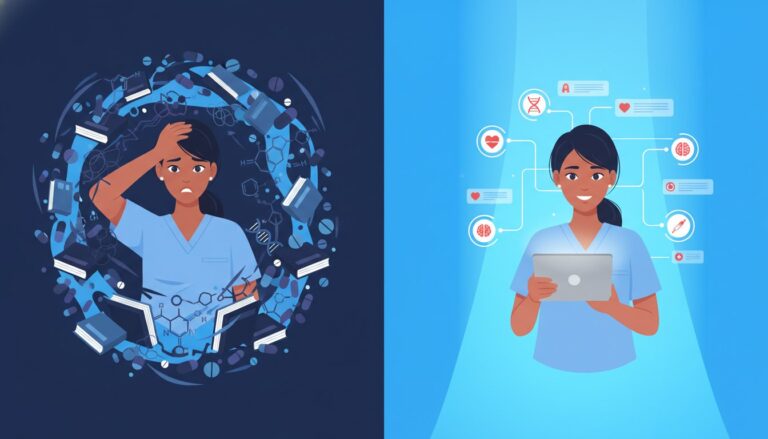
Rote memorization is the fastest way to forget everything you need for your boards. Most pharmacology for medical students feels like an exhausting list of suffixes and side effects, leaving you buried under massive textbooks and anxious about USMLE questions. It’s frustrating when similar drug classes start to blur together after a long night of study. You need a digital mentor that simplifies the mental burden of learning, rather than another dry academic resource that adds to the noise.
This 2026 high-yield guide provides a modern framework to master complex drug mechanisms and ace your exams with confidence. We’ll show you how to move beyond basic memorization by using active recall and logic-based categorization. By the end of this article, you’ll have a clear roadmap for using interactive tools like video vignettes and clinical case studies to ensure long-term retention and higher board scores. We’re here to help you approach these scientific complexities with precision, professional support, and a focus on your career progression.
Key Takeaways
- Learn why shifting from rote memorization to a logical framework is essential for mastering drug-receptor interactions.
- Identify the “Big Five” high-yield drug systems to streamline your study of pharmacology for medical students.
- Understand the benefits of using interactive video vignettes and flashcards over traditional, high-volume textbooks.
- Master a structured study strategy that layers drug classes onto a solid foundation of organ physiology.
- Discover how mobile-compliant digital tools can help you maintain board readiness even during busy clinical rotations.
Why Pharmacology for Medical Students is the “Gatekeeper” Course
Medical pharmacology represents the study of drug-receptor interactions and their eventual clinical outcomes. It’s the critical bridge between basic science and clinical practice, which is why many faculty members refer to it as the “gatekeeper” of the medical curriculum. For second-year students, pharmacology for medical students often feels like an insurmountable wall of data. The difficulty doesn’t stem from the complexity of a single drug, but rather from the sheer volume of information that must be synthesized and applied to patient care scenarios. Success requires shifting from memorizing facts to understanding the underlying logic of how chemicals alter human physiology.
The USMLE Step 1 and Step 2 Pharmacology Landscape
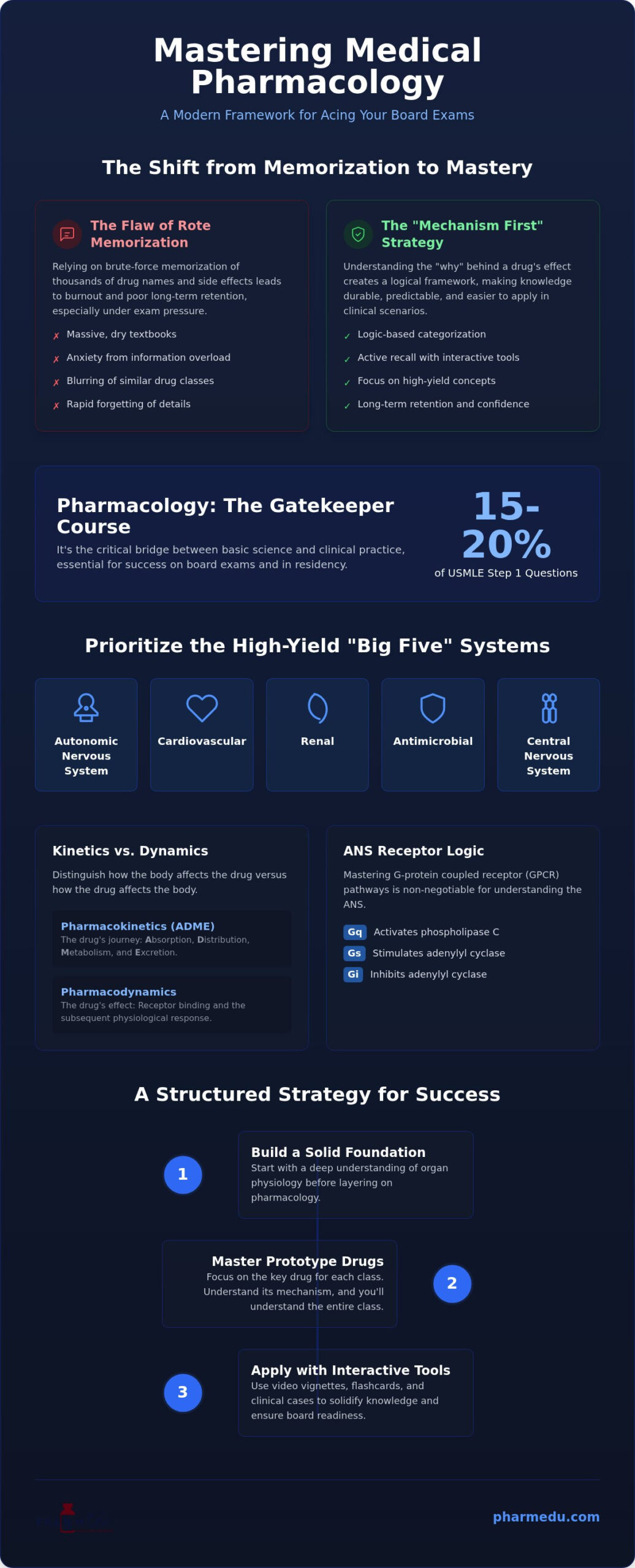
Success on board exams requires a deep understanding of how drugs behave within the human body. Pharmacology questions typically make up a significant portion of the USMLE Step 1, often ranging between 15% and 20% of the total content. These questions rarely test a drug in isolation. Instead, they require integration across multiple organ systems. You might be asked how a specific diuretic used for renal management impacts cardiovascular stability or electrolyte balance. As you transition to Step 2, the focus shifts from pure Mechanism of Action (MOA) to clinical management. Understanding side effect profiles becomes vital, as these often dictate the “next best step” in a treatment plan when a first-line therapy fails or is contraindicated.
The Failure of Rote Memorization in 2026
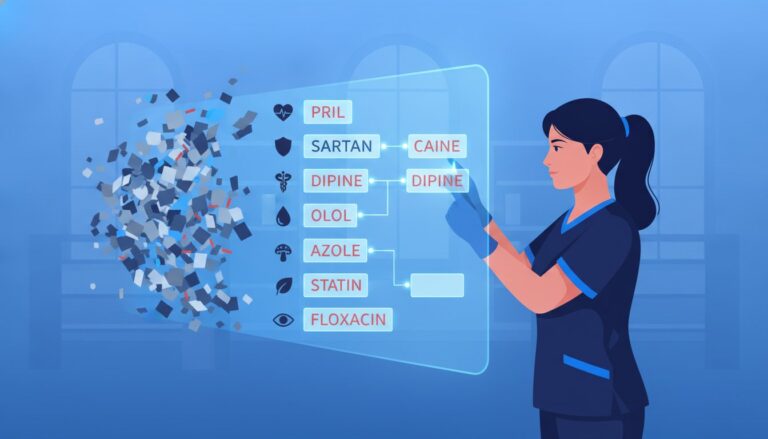
Attempting to memorize 2,000+ drug names, dosages, and interactions is a direct path to burnout. In the modern medical education environment, this brute-force approach is no longer sustainable or effective. A “Mechanism First” strategy allows for logical drug categorization, turning a list of names into a predictable system of science. Pharmacology serves as the foundational science for all medical interventions; it’s the logic that dictates why we choose one molecule over another. By focusing on high-yield concepts rather than low-yield trivia, you build a mental scaffold that lasts through residency. Mastering pharmacology requires you to understand the “why” behind the drug’s effect, making it much harder to forget during the high-pressure environment of the boards. This shift from passive reading to active, logic-based learning is what separates students who struggle from those who excel in pharmacology for medical students.
High-Yield Pharmacology Topics for Board Success
To excel in pharmacology for medical students, you must prioritize the systems that offer the highest return on investment. Educators often refer to these as the “Big Five”: the Autonomic Nervous System (ANS), Cardiovascular, Renal, Antimicrobial, and Central Nervous System. Instead of getting lost in a sea of generic names, focus on the prototype drug for each class. If you understand the physiology and side effects of a prototype like Lisinopril, you’ve essentially mastered the entire ACE inhibitor class. This mental efficiency is vital for managing the 2026 curriculum, which now includes an expanded focus on monoclonal antibodies and complex biologics like TNF-alpha inhibitors.
You also need to distinguish between pharmacokinetics and pharmacodynamics. Pharmacokinetics (ADME) describes the drug’s journey through the body, focusing on absorption, distribution, metabolism, and excretion. Pharmacodynamics focuses on the receptor binding and the subsequent physiological response. Board examiners frequently test the nuances of volume of distribution and clearance because these values directly impact clinical dosing and patient safety.
Autonomic Nervous System: The Foundation of Clinical Logic
Mastering the ANS is non-negotiable. It’s the logic gate for almost every other system you’ll study. Most questions hinge on G-protein coupled receptor (GPCR) pathways. Remember the “q, i, s” logic for alpha and beta receptors. Gq activates phospholipase C, Gs stimulates adenylyl cyclase, and Gi inhibits it. When you encounter a drug, first ask if it’s a sympathomimetic, which mimics the sympathetic nervous system, or a sympatholytic, which blocks it. Distinguishing between these categories early prevents confusion when you’re asked to predict heart rate or pupillary changes under acute stress.
Antimicrobials and Resistance Mechanisms
Antimicrobial questions focus heavily on the mechanism of action and specific toxicities. You’ll need to separate cell wall inhibitors, like penicillins and cephalosporins, from protein synthesis inhibitors, like macrolides or aminoglycosides. Aminoglycosides are particularly high-yield due to their narrow therapeutic index and the risk of ototoxicity and nephrotoxicity. Boards also frequently test mechanisms of resistance. Whether it’s a change in the penicillin-binding protein or the development of an efflux pump, understanding how bacteria fight back is essential for Step 1 and Step 2 success. To help visualize these complex interactions, you can explore high-yield video vignettes that break down these mechanisms into digestible, logical steps.
Interactive Learning vs. Traditional Pharmacology Textbooks
Traditional 1,000-page “gold standard” textbooks have long been the backbone of medical education, but they often struggle to keep pace with the 2026 digital environment. These massive volumes are static, making it difficult for students to find specific information quickly when they’re on rounds or preparing for a quiz. In contrast, digital platforms offer a level of searchability that physical indices simply can’t match. When you’re studying pharmacology for medical students, every minute saved searching for a drug’s metabolism profile is a minute you can spend on active recall.
Passive reading is a low-yield activity that often leads to the “illusion of competence.” You might feel like you’re learning while scanning pages, but without active engagement, retention remains low. Interactive flashcards and practice quizzes force your brain to retrieve information, which is the only way to build long-term memory. From a financial perspective, the cost-effectiveness of a monthly or annual subscription far outweighs the high price of print sets. While a single hardcover textbook can cost over $140, a digital subscription provides updated, interactive content for a fraction of that investment.
The Power of High-Yield Video Vignettes
Visual storytelling is one of the most effective ways to anchor a complex Mechanism of Action (MOA) in your mind. Instead of reading a dry description of how a drug binds to a receptor, seeing it visualized through high-yield video vignettes creates a lasting mental image. Just as many users look for high-performance streaming through Edge IPTV for their entertainment needs, medical students require that same level of crisp, reliable video delivery for their high-yield vignettes. These 5-10 minute micro-learning segments are perfect for busy students who need to squeeze in study time between clinical rotations. Seeing a clinical case study visualized before you dive into the technical details provides a practical context that makes the science feel real and relevant.
Medical schools are increasingly moving away from traditional models toward a comprehensive pharmacy review platform. This shift allows institutions to utilize faculty analytics to track student progress in real-time, identifying which topics are causing the most confusion across the cohort. It also supports the “flipped classroom” trend, where students engage with digital content independently and use class time for high-level clinical problem-solving. This modern approach ensures that your education is as dynamic and data-driven as the medical field itself, moving away from passive absorption toward professional mastery.
A Step-by-Step Strategy to Ace Your Pharmacology Exams
Mastering pharmacology for medical students requires a structured hierarchy rather than a brute-force memory attack. You should start by solidifying your understanding of the target organ’s physiology. If you don’t grasp the nuances of the cardiac cycle, you’ll struggle to predict the effects of different antiarrhythmics. Once the physiological foundation is set, you can layer on the drug classes and their primary mechanisms of action. This logical progression ensures that each new piece of information has a “hook” to latch onto in your memory, making the facts much harder to lose under the stress of an exam.
Active Recall and Spaced Repetition Techniques
Active recall involves testing your brain’s ability to retrieve data without the help of your notes. It’s far more effective than re-reading, which often leads to passive recognition rather than actual mastery. Use digital flashcards to focus on the drug classes where you feel less confident. Implementing a spaced repetition schedule, like the 1-3-7 day rule, is vital for long-term retention. Reviewing a topic one day after initial exposure, then on day three, and again on day seven, prevents the “forgetting curve” from eroding your progress. This methodical approach is the most efficient way to handle the massive volume of information required for boards.
Integrating Clinical Case Studies
The patient vignette is the primary format for the USMLE and other high-stakes exams. These questions test your ability to apply science to a living person rather than simply reciting a definition. You must train yourself to spot “buzzwords” that lead directly to a specific drug or side effect. For instance, a patient complaining of “yellow-tinted vision” while on heart medication should immediately trigger thoughts of digoxin toxicity. Identifying these subtle clues is essential for high-yield performance.
Clinical decision-making also hinges on your knowledge of contraindications. Examiners love to present a patient who needs a specific treatment but has a co-morbidity that makes that treatment dangerous. Identifying these pitfalls is what separates high-scoring students from the rest of the pack. To refine these skills, you can engage with interactive Clinical Case Studies that simulate real-world medical challenges. This practice allows you to test your logic and clinical judgment before you ever step into an exam room or a hospital ward.
PharmEDU: The Modern Solution for Pharmacology Mastery
PharmEDU functions as a comprehensive digital ecosystem designed to replace the inefficiencies of traditional study methods. With a library exceeding 100 high-yield topics, the platform addresses the specific challenges of pharmacology for medical students by distilling complex concepts into actionable knowledge. The mobile-compliant design ensures that you can review critical drug profiles while moving between hospital rotations, turning small gaps in your schedule into productive study sessions. Interactive pharmacology practice quizzes and clinical case studies bridge the gap between theory and real-world application. These tools aren’t just for individual learners; they also power institutional pharmacology education, providing a standardized, high-quality resource for diverse medical programs.
Tailored Content for USMLE Step 1 and Step 2
The platform’s curriculum is meticulously aligned with the current USMLE Step 1 and Step 2 content outlines. By focusing strictly on high-yield information, we eliminate the academic filler that often leads to student burnout. For example, our detailed breakdown of ACE inhibitors and other core cardiovascular drug classes provides exactly what you need for board success. This precision allows you to master the most testable material in significantly less time. We ensure that every video and quiz reflects the latest clinical guidelines and pharmaceutical developments, maintaining our role as a reliable partner in your professional journey.
Micro-Learning for the Busy Medical Student
Micro-learning is the cornerstone of the PharmEDU experience. Our high-yield video vignettes are engineered for maximum retention, using visual storytelling to explain complex mechanisms in under ten minutes. The platform’s progress tracking features ensure that no topic is overlooked; you’ll always know exactly where you stand in your preparation. This structured approach removes the administrative burden of planning your study sessions, allowing you to focus entirely on learning. We invite you to join our growing community of future physicians who are choosing a more efficient, logical path to mastering pharmacology for medical students and securing their clinical future. To build the necessary academic foundation for these competitive medical paths, you can discover The Learner’s Home for specialized coaching and support.
Transitioning from the overwhelming volume of traditional textbooks to a logical, mechanism-based framework is the most effective way to secure board success. By focusing on high-yield topics and the “Big Five” systems, you build a foundation that supports both USMLE Step 1 and the clinical management required for Step 2. Mastering pharmacology for medical students doesn’t have to be a source of anxiety when you use a structured, evidence-based approach. It’s about working smarter, not just harder.
PharmEDU serves as your digital mentor, providing over 100 topics delivered through high-yield video vignettes that fit perfectly into a busy clinical schedule. Our mobile-compliant design allows for micro-learning between rotations, ensuring you stay prepared without the burden of administrative planning. Trusted by major institutions and individual students alike, our platform provides the tools you need for long-term retention and professional growth. Start Your PharmEDU Subscription Today and take the next step toward professional excellence. You have the potential to excel; we provide the precision to get you there.
Frequently Asked Questions
How much pharmacology is on the USMLE Step 1 exam?
Pharmacology typically accounts for 15% to 20% of the questions on the USMLE Step 1 exam. These questions often integrate knowledge across various organ systems, requiring you to understand how a drug’s mechanism affects whole-body physiology. Because of this high density, mastering pharmacology for medical students is essential for achieving a competitive score. Examiners frequently focus on autonomic drugs, antimicrobials, and cardiovascular agents, often testing them through complex patient vignettes rather than simple recall.
What is the best way to memorize drug names and classes?
The most effective method is a “mechanism-first” approach rather than rote memorization. By focusing on the prototype drug for each class, you can predict the effects and side effect profiles of related molecules. Utilizing active recall and spaced repetition through digital tools ensures that information moves into long-term memory. Instead of trying to learn 2,000 individual names, categorize them by their physiological targets. This strategy reduces the cognitive load and prevents burnout during exam preparation.
Are digital pharmacology platforms better than traditional textbooks?
Digital platforms offer significant advantages over traditional textbooks, including superior searchability and interactive features like high-yield video vignettes. While textbooks are static and can cost over $140, digital resources provide dynamic content that evolves with current clinical guidelines. They also facilitate active learning through integrated quizzes and flashcards, which are more effective for retention than passive reading. This modern approach is more cost-effective and aligns better with the fast-paced, mobile nature of medical education.
How does PharmEDU help with NAPLEX and other board certifications?
PharmEDU provides a comprehensive review of over 100 topics that align with major board certification outlines, including the NAPLEX. The platform focuses on high-yield content that is most likely to appear on licensing exams, stripping away unnecessary academic fluff. By using interactive pharmacology practice quizzes and clinical case studies, students can simulate the exam environment. This preparation ensures that you aren’t just memorizing facts but are developing the clinical judgment necessary for professional certification.
Can I use PharmEDU on my mobile device during clinical rotations?
Yes, the platform features a mobile-compliant design specifically created for micro-learning on the go. This allows you to review drug mechanisms and side effects during brief breaks or between clinical rotations. Having access to professional-grade educational content on your phone or tablet turns idle time into productive study sessions. It’s a reliable way to maintain board readiness without needing to carry heavy physical resources, supporting your professional development throughout your clinical years.
What are high-yield pharmacology topics for medical students?
High-yield topics for medical students center on the “Big Five” systems: autonomic, cardiovascular, renal, antimicrobial, and the central nervous system. These areas are frequently tested on the USMLE because they form the foundation of clinical practice. Mastering the G-protein coupled receptor pathways and the mechanisms of antibiotic resistance is particularly important. By prioritizing these core systems, you ensure that your study time is spent on the concepts with the highest probability of appearing on your exams.
How do high-yield video vignettes improve drug retention?
High-yield video vignettes improve retention by using visual storytelling to anchor complex mechanisms of action in your memory. These short, focused segments transform abstract scientific concepts into clear, mental images that are easier to retrieve during high-pressure exams. By seeing a clinical case visualized, you develop a practical context for the drug’s use. This multi-modal approach is far more effective for long-term retention than reading dry text, as it engages multiple cognitive pathways simultaneously.
Does PharmEDU offer institutional access for medical schools?
PharmEDU offers an Institutional Platform License designed for universities, pharmacy schools, and nursing programs. This access includes administrative tools that allow faculty to track student progress and performance through detailed analytics. It supports modern educational trends like the flipped classroom, where students engage with digital content before attending interactive sessions. Schools can provide their entire student body with high-quality, standardized pharmacology resources, ensuring that every learner has the support needed to meet rigorous professional requirements.