
Mastering PANCE Pharmacology Questions: A High-Yield 2026 Study Guide
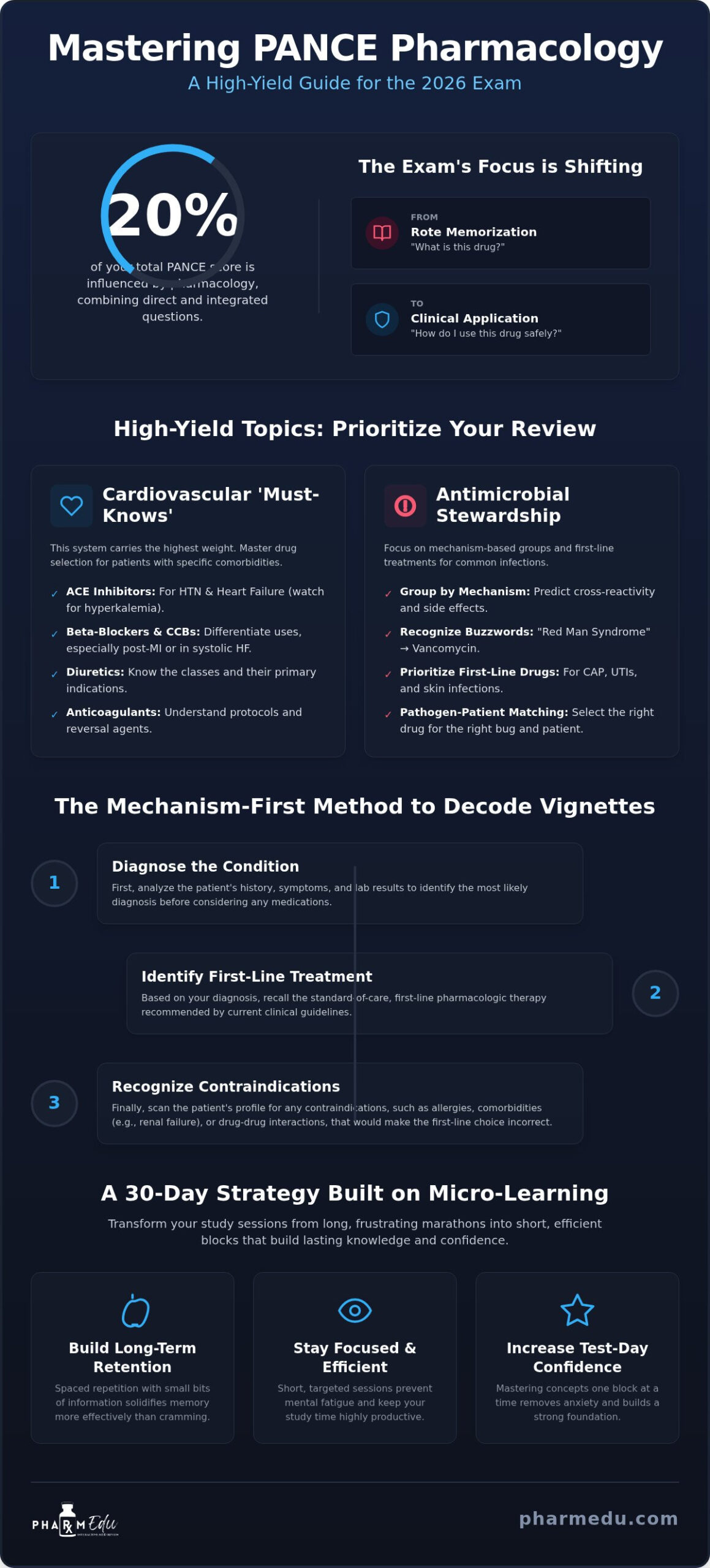
What if the key to passing the most daunting section of your board exam isn’t found in a thousand-page textbook, but in how you read between the lines of a clinical case? Many students spend hundreds of hours memorizing side effect profiles that all sound the same, only to feel paralyzed when faced with complex PANCE pharmacology questions that require high-level application rather than rote recall. It’s understandable to feel anxious when you realize that pharmaceutical therapeutics and integrated drug knowledge can influence up to 20% of your total score.
We know the pressure of trying to distinguish between similar mechanisms of action while the clock is ticking. This guide will show you how to deconstruct complex clinical vignettes and master the high-yield drug classes that form the backbone of the 2026 exam. You’ll gain a clear list of must-know medications and learn how micro-learning can transform your study sessions into efficient, confidence-building blocks. We’ll move past the frustration of forgotten lists and focus on the practical, mechanism-based reasoning you need to succeed on exam day.
Key Takeaways
- Discover why pharmacology represents 20% of the exam and how to shift your focus from simple identification to clinical decision-making.
- Prioritize high-yield topics like cardiovascular pharmacology and antimicrobials to ensure you’re mastering the most frequent exam categories.
- Master the “Mechanism-First Method” to decode complex PANCE pharmacology questions and quickly filter out irrelevant patient data.
- Implement a 30-day study strategy that utilizes micro-learning segments to build long-term retention and confidence.
The Anatomy of PANCE Pharmacology Questions in 2026
The Physician Assistant National Certifying Exam (PANCE) serves as the final barrier between a student and their professional career, and pharmacology is frequently the most significant hurdle. While the official NCCPA blueprint lists “Pharmaceutical Therapeutics” at a 15% weight, the actual impact on your score is closer to 20% when you factor in integrated system questions. This weighting isn’t accidental; it reflects the critical role that safe and effective prescribing plays in modern clinical practice. For the 2026 exam cycle, you’re expected to be familiar with the blueprint that took effect in January 2025, which prioritizes current evidence-based clinical standards over outdated protocols.
How Pharmacology is Integrated Across the Blueprint
Success on the exam requires recognizing that pharmacology is woven into every organ system. You’ll encounter PANCE pharmacology questions disguised as cardiovascular emergencies, endocrine follow-ups, or pulmonary management cases. Instead of simple recall, the exam tests your ability to apply pharmacokinetics and pharmacodynamics to specific patient profiles. For example, a question might present an elderly patient with a reduced GFR, requiring you to adjust a dose or choose an alternative medication entirely. Understanding the distribution of these questions is vital for efficient study:
- Cardiovascular and Pulmonary: These systems carry the highest weight on the exam and frequently feature drug-selection questions as the “best next step.”
- Question Stems: Look for phrases like “best initial therapy” or “most likely side effect” to identify where clinical judgment is required.
- Pharmacodynamics: Focus on how drugs interact with receptors in the context of specific pathologies rather than just memorizing drug names.
The Shift from Knowledge to Application
The 2026 standard moves away from “what is this drug” and toward “how do I use this drug safely.” Rote memorization often fails because board-style questions use multi-step logic. You might need to diagnose the condition first, then identify the first-line treatment, and finally recognize a specific contraindication for that treatment based on the patient’s history. This is common in vignettes involving polypharmacy, where identifying a drug-drug interaction is the key to the correct answer. A clinical vignette is a simulation of real-world patient care. By focusing on application, you build the reasoning skills needed to navigate the 300-question exam across its five 60-minute blocks. Don’t just learn the drug name; learn why it’s the superior choice for the patient described in the stem.
High-Yield Drug Classes: Prioritizing Your PANCE Review
Don’t waste time memorizing every drug in the pharmacopeia. The Official PANCE Content Blueprint confirms that certain systems carry more weight, meaning your time is better spent on high-volume topics. Focusing on these “heavy hitters” ensures you’re prepared for the most common scenarios you’ll encounter on exam day. By prioritizing your review based on blueprint weighting, you can study more efficiently and reduce the anxiety associated with the vast amount of material.
Mastering the Cardiovascular ‘Must-Knows’
Cardiovascular pharmacology is the primary driver of many PANCE pharmacology questions. You’ll need a deep understanding of ACE Inhibitors; you must know their role in managing heart failure and hypertension while monitoring for side effects like hyperkalemia. Differentiating between Beta-blockers, Calcium Channel Blockers (CCBs), and diuretics in clinical stems is essential. Questions often test your ability to choose the right agent for a patient with specific comorbidities. For example, you might be asked to select a Beta-blocker for a post-MI patient or avoid non-dihydropyridine CCBs in systolic heart failure. Don’t forget to review anticoagulation protocols and reversal agents, as these are frequent favorites for testing safety and emergency management.
Antibiotic Stewardship in Board Questions
Antimicrobials can feel like an endless list, but the PANCE rewards those who understand mechanism-based classification. Grouping drugs by their function helps you predict cross-reactivity and shared side effects. Certain “buzzwords” are classic indicators in PANCE pharmacology questions; for instance, “Red Man Syndrome” should immediately point you toward Vancomycin and the need for slower infusion rates. You should prioritize first-line treatments for common presentations like community-acquired pneumonia, uncomplicated UTIs, and skin infections. Knowing the pathogen-patient match is more valuable than knowing every niche antibiotic. Mastering these patterns allows you to answer questions quickly and accurately.
Endocrine and psychiatric medications also demand focused attention. Diabetes management is a high-yield area where you must understand the clinical indications for SGLT2 inhibitors and GLP-1 agonists beyond simple glycemic control. In psychiatry and neurology, the boards focus on safety. You’ll likely see questions regarding the extrapyramidal symptoms of antipsychotics or the cardiovascular contraindications for triptans used in migraine therapy. If you’re tired of sifting through unverified study sets, PharmEDU’s interactive pharmacology flashcards provide a structured, high-yield alternative designed specifically for PA students.
Clinical Vignettes vs. Rote Memorization: Solving Complex Cases
Many students approach their boards by memorizing endless lists of drug names and side effects. While this might work for simple recall, it often fails when you’re faced with multi-layered PANCE pharmacology questions. The 2026 exam prioritizes clinical application, requiring you to understand why a specific drug is chosen for one patient but avoided for another with a similar presentation. Shifting to a “Mechanism-First Method” allows you to predict side effects and contraindications based on how a drug actually functions in the body. When you master the core pharmacology principles, you stop guessing and start reasoning through the logic of the question stem.
Identifying “Red Herrings” is another critical skill for success. Exam writers frequently include irrelevant patient data, such as a remote surgical history or non-contributory family traits, to distract you from the primary clinical problem. Developing “If-Then” logic helps you filter this noise. For example, if the patient has a sulfa allergy and requires a diuretic, then you must avoid certain classes regardless of the other data points provided. This structured framework ensures you’re making decisions based on the most relevant clinical facts.
Deconstructing the Question Stem
Approaching a vignette requires a methodical three-step process to ensure accuracy under time pressure. First, identify the diagnosis before you even look at the drug options; this prevents the answer choices from biasing your clinical judgment. Second, scan the patient profile for “deal-breakers” like renal impairment, pregnancy, or advanced age. Finally, select the medication that fits the specific requirement of the stem, whether it asks for the “best initial” therapy or the “most definitive” treatment. This systematic approach reduces the cognitive load and helps you rule out incorrect distractors quickly.
The Power of High-Yield Video Vignettes
Visual learning bridges the gap between abstract drug classes and real-world patient presentations. High-yield video vignettes allow you to see the clinical context of a medication, making the information more “sticky” than a static list of facts. By utilizing micro-learning, you can master one clinical scenario at a time without feeling overwhelmed by the entire blueprint. Active recall is superior to re-reading notes because it forces the brain to retrieve information and strengthens neural pathways. This method transforms your study time from passive consumption into active preparation for the realities of the exam.
The 30-Day PANCE Pharmacology Action Plan
Success on the board exam requires more than just intelligence; it demands a structured approach to the vast amount of material. A 30-day timeline allows you to distribute the 20% pharmacology weight into manageable segments without burning out. By aligning your study schedule with the blueprint’s high-volume systems, you’re ensuring that your most energetic hours are spent on the topics most likely to appear in PANCE pharmacology questions.
- Week 1: Foundations and High-Volume Systems. Focus on cardiovascular and pulmonary pharmacology. These are the “heavy hitters” that frequently appear in clinical vignettes.
- Week 2: Infectious Disease, GI, and Nutrition. Master antibiotic stewardship and the management of common gastrointestinal disorders.
- Week 3: Endocrine, GU, and Reproductive Pharmacology. Prioritize diabetes medications and renal-focused drug choices.
- Week 4: Neuro, Psych, and Final ‘Red Flag’ Review. Conclude with complex psychiatric agents and a comprehensive sweep of safety data.
Daily Study Habits for Maximum Retention
Consistency often beats intensity when preparing for the boards. Implementing a “15-minute micro-block” strategy allows you to solve five PANCE pharmacology questions during small gaps in your clinical day. This habit keeps the information fresh and reduces the pressure of long evening study sessions. Interactive flashcards are also essential for spaced repetition. This technique ensures that high-yield facts move from your short-term memory into long-term storage. Regular practice quizzes serve as a diagnostic tool, helping you identify which systems require extra attention before the test date arrives.
Final Week: The ‘Red Flag’ Drugs
The final seven days should be dedicated to high-stakes safety information. You must have a perfect grasp of drugs with narrow therapeutic indices, such as Digoxin, Lithium, and Warfarin. These medications are board favorites because the margin for error is slim. Review all major black box warnings and contraindications that could lead to life-threatening complications. Utilizing a comprehensive pharmacy review is vital for PA students to ensure no critical safety detail is overlooked during this final push. If you want to refine your logic before the big day, access PharmEDU’s high-yield video vignettes to see these concepts applied in real-time.
Mastering the Boards with PharmEDU: High-Yield Success Tools
The journey toward becoming a certified Physician Assistant requires more than just passing a test; it demands a deep, practical understanding of how medications interact with human physiology. PharmEDU serves as a digital mentor, bridging the gap between theoretical knowledge and the high-stakes environment of board exams. By providing a structured, mobile-compliant platform, we remove the administrative and cognitive burden of organizing your study material. This allows you to focus entirely on mastering the nuances of clinical care through precise, evidence-based education.
PharmEDU Features for PANCE Prep
Our platform covers over 100 high-yield pharmacology topics, each meticulously designed to align with the current NCCPA blueprint. Unlike unverified, static study sets found on other platforms, PharmEDU’s interactive pharmacology flashcards emphasize clinical application. They don’t just ask for a drug name. They challenge you to identify the best next step in a patient’s care. Our pharmacology practice quizzes mimic the style and difficulty of actual PANCE pharmacology questions, providing you with a realistic assessment of your readiness. These tools ensure that your study sessions are productive and directly relevant to the 2026 exam standards.
Integrating high-yield video vignettes with real-world clinical case studies provides a multi-sensory learning experience. This approach is particularly effective for the busy PA student who needs to maximize every minute of their day. Whether you are between patient rounds or commuting, our mobile-compliant design ensures that high-quality education is always within reach. Micro-learning segments allow you to digest complex mechanisms in short, punchy intervals, which significantly improves long-term retention compared to traditional, hours-long study marathons.
Your Path to Certification
Building the clinical confidence to pass the exam on your first attempt is our primary goal. We provide the precision and support necessary to turn anxiety into mastery. Our platform isn’t just for the exam; it remains a reliable resource for professional pharmacology review as you transition into full-time clinical practice. You’ll enter the testing center with a clear understanding of how to deconstruct even the most difficult PANCE pharmacology questions. Ready to ace your boards? Start your high-yield PANCE review with PharmEDU today.
Securing Your Future as a Certified Physician Assistant
Mastering the 20% pharmacology weight on the boards requires a shift from passive reading to active, mechanism-based reasoning. By prioritizing high-yield drug classes and following a structured 30-day timeline, you can transform a source of anxiety into a professional strength. You’ve learned how to deconstruct complex PANCE pharmacology questions by focusing on the ‘best next step’ rather than simple drug identification. This approach doesn’t just help you pass. It prepares you for the clinical realities of daily practice.
PharmEDU is here to support your journey with an expert-verified clinical curriculum designed for the modern student. Our mobile-compliant micro-learning platform provides access to over 100 high-yield pharmacology topics, ensuring you can study effectively whenever your schedule allows. Don’t leave your certification to chance or unverified study sets. Start Your High-Yield PANCE Pharmacology Review Now and build the confidence you need to succeed on your first attempt. Your career as a capable, prescribing clinician is within reach.
Frequently Asked Questions
How many pharmacology questions are on the PANCE?
The PANCE consists of 300 multiple-choice questions. According to the official NCCPA blueprint, 15% of the exam is dedicated specifically to pharmaceutical therapeutics. However, because drug knowledge is integrated into organ system questions, you’ll encounter approximately 60 pharmacology-related items. These are spread across five 60-minute blocks, making it essential to maintain a steady pace and strong clinical reasoning throughout the entire exam day.
What are the most high-yield drug classes for the PANCE in 2026?
Cardiovascular agents and antimicrobials remain the most frequent topics you’ll encounter. You should prioritize ACE inhibitors, beta-blockers, and statins, as these appear in numerous clinical scenarios. For antimicrobials, focus on first-line treatments for common infections like pneumonia and UTIs. Endocrine medications, specifically for diabetes and thyroid management, also represent a significant portion of the integrated questions that test your ability to choose the best initial therapy.
Is PharmEDU better than using Quizlet for PANCE pharmacology?
PharmEDU provides an expert-verified clinical curriculum, whereas Quizlet often contains unverified or outdated student-made sets. Our platform focuses on clinical application rather than simple term matching. By using our interactive pharmacology flashcards and high-yield video vignettes, you’re studying material specifically designed to bridge the gap between theory and the complex clinical vignettes found on the PANCE. This professional oversight ensures your study time is spent on accurate, board-relevant information.
How should I study for pharmacology clinical vignettes?
Shift your focus from memorizing drug names to understanding the “Mechanism-First Method.” Start by identifying the most likely diagnosis in the question stem before reviewing the medication options. Look for specific patient contraindications like renal impairment, pregnancy, or advanced age. Practice with PharmEDU’s clinical case studies to learn how to filter out irrelevant data and select the most definitive treatment for complex patient profiles in a simulated exam environment.
What is the best way to remember drug side effects for the boards?
Focus on the physiological mechanism of the drug to predict its adverse effects naturally. Instead of memorizing random lists, connect the side effect to the drug’s action. For example, understanding how ACE inhibitors affect the kinin system explains the common dry cough. Using spaced repetition through our interactive flashcards helps reinforce these high-yield facts, making them easier to recall when answering PANCE pharmacology questions under significant time pressure.
Can I use PharmEDU on my phone during clinical rotations?
Yes, the PharmEDU platform features a mobile-compliant design specifically for on-the-go study. You can access our micro-learning segments and high-yield video vignettes during short breaks between patient rounds. This allows you to integrate board preparation into your daily clinical workflow effortlessly. Solving a few practice questions during clinical tasks helps maintain your momentum without requiring long, exhausting study sessions after your shift ends at the hospital.
How often is the pharmacology content on PharmEDU updated?
Our content is updated regularly to reflect the latest evidence-based clinical guidelines and NCCPA blueprint changes. We monitor regulatory updates and scientific advancements to ensure our 100+ high-yield pharmacology topics remain accurate for the 2026 exam cycle. This commitment to precision means you don’t have to worry about studying outdated protocols. Our digital format allows for immediate updates that traditional physical textbooks simply cannot provide for students.
What happens if I fail the PANCE on my first try?
If you don’t pass, you must wait at least 90 days before you can retake the exam. You are allowed to take the PANCE up to three times in a calendar year, with a maximum of six attempts over six years. Each attempt requires a $550 application fee paid to the NCCPA. Use this time to identify your weak systems through PANCE pharmacology questions and refine your study strategy with structured, high-yield digital resources.