
Future of pharmacology: the trends reshaping drug development
Drug development is moving beyond a one-size-fits-all model. The future of pharmacology and drug development will be shaped by personalized medicine, AI-assisted discovery, evolving regulation, and greater use of real-world evidence. AI-designed drug candidates have progressed to Phase II clinical trials, while pharmacogenomics is helping researchers understand how genetic differences can affect treatment response.
These changes bring opportunity and responsibility. New tools may refine research and therapies, but safety, privacy, bias, and access remain important considerations. This article explores the trends reshaping the field, from advanced therapies and adaptive clinical trials to regulatory change and post-approval safety monitoring. It also explains what these developments mean for healthcare professionals and why they matter.
Key Takeaways
- See how advanced therapies and individualized treatment approaches are changing the way medicines are developed and selected.
- Understand where generative and agentic AI can support drug discovery, and why human oversight remains important.
- Learn how evolving regulatory approaches aim to assess new evidence while maintaining safety and transparency.
- Recognize the safety, privacy, ethical, and bias concerns that shape responsible drug development and prescribing.
Advanced therapies and personalized medicines
Biologic medicines, pharmacogenomic approaches, and AI-designed drug candidates are moving closer to clinical use. AI-designed candidates have reached Phase II clinical trials. Pharmacogenomics examines how genes affect a person’s response to treatment, helping explain why the same medicine can work differently across patients.
Biologics are developed from living organisms and include monoclonal antibodies, cell-based therapies, gene therapies, and immune-targeted treatments. They can target specific disease mechanisms or biological pathways. Personalized medicine builds on this precision by using a patient’s characteristics, such as genetic information and clinical history, to inform treatment decisions. The goal is more informed selection, not an assumption that one therapy suits everyone with the same diagnosis.
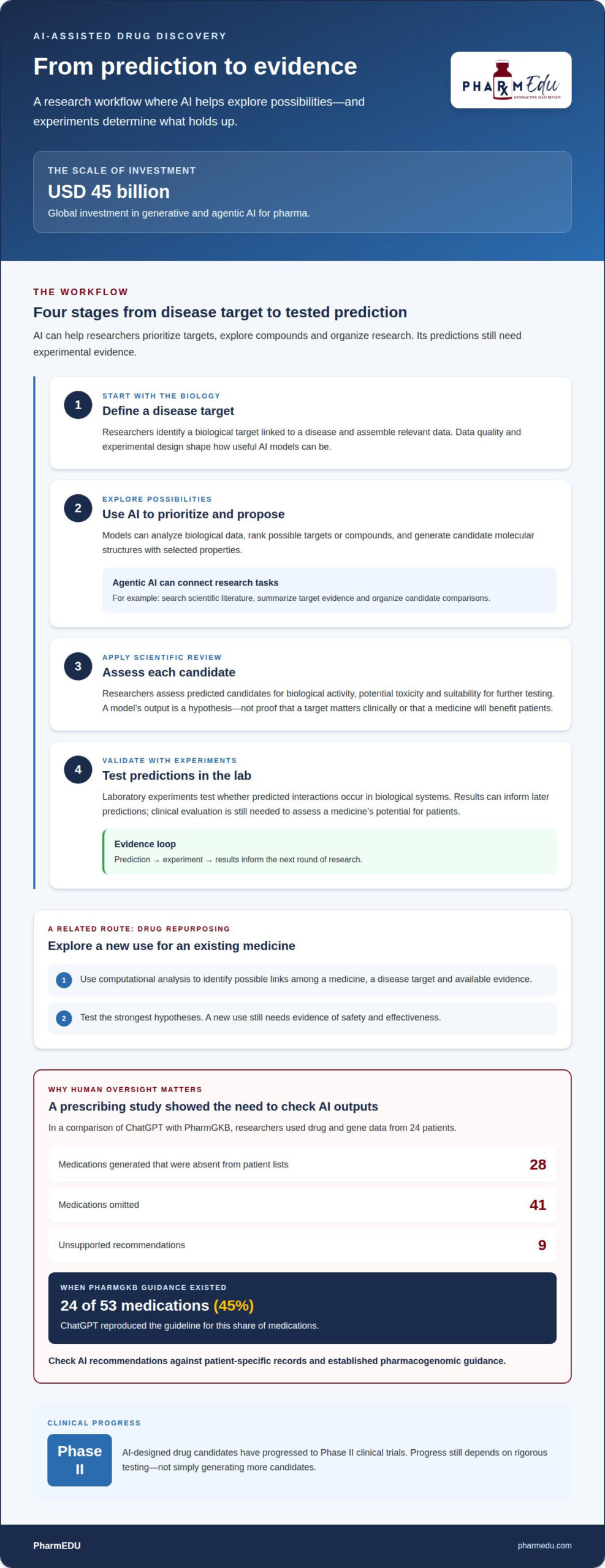
Pharmacogenomic information can help identify potential differences in drug response, but AI-supported recommendations need careful review. In a prescribing study comparing ChatGPT with PharmGKB, researchers used drug and gene data from 24 patients. ChatGPT generated 28 medications absent from the patients’ medication lists. It also omitted 41 medications and made 9 unsupported recommendations. Where a PharmGKB guideline existed, ChatGPT reproduced it for 24 of 53 medications, or 45%. These findings show why AI outputs should be assessed against patient-specific records and established pharmacogenomic guidance.
Real-world data can also strengthen medication safety monitoring. Electronic health records and other clinical information may reveal patterns in adverse reactions and treatment outcomes over time. Pharmacovigilance, the monitoring of medicine safety after approval, uses these signals to support ongoing assessment. This evidence helps clinicians and researchers understand how medicines perform beyond controlled studies.
3D-printed oral medicines offer another route toward individualized treatment. The technology can support the production of tablets with tailored characteristics, while development and clinical use still depend on evidence and regulatory review. Global revenue for 3D-printed drugs is forecast to reach USD 789 million by 2034, reflecting growing commercial interest in this manufacturing approach.
Generative and agentic AI for drug discovery
Generative AI can propose molecular structures for researchers to assess, while agentic systems can coordinate multistep research tasks. Global investment in generative and agentic AI for pharma reached USD 45 billion. These tools can help identify drug candidates, analyze disease targets, predict treatment outcomes, and reduce research timelines. Their value depends on how well predictions connect to experimental evidence.
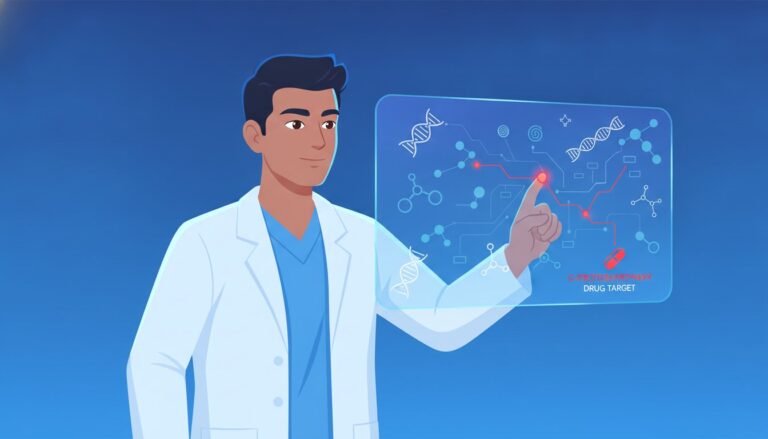
Drug discovery begins by identifying a biological target linked to a disease. AI systems can analyze biological data to help researchers prioritize targets and explore how compounds might interact with them. Generative models can then suggest candidate structures with selected properties. Researchers must still assess each candidate’s biological activity, potential toxicity, and suitability for further testing.
A practical workflow separates prediction from validation. Researchers first define a disease target and assemble relevant data. AI models then rank potential targets or compounds, and laboratory experiments test whether the predicted interactions occur in biological systems. Those results can inform later predictions, but data quality and experimental design determine how useful the models are.
Agentic AI may connect tasks that are often handled separately, such as searching scientific literature, summarizing evidence for a target, and organizing candidate comparisons. This can help research teams work through information more efficiently. It cannot establish that a target is clinically relevant or that a proposed medicine will benefit patients. Those conclusions require experimental evidence and clinical evaluation.
AI can also support drug repurposing, the evaluation of existing medicines for new uses. Researchers can use computational analysis to identify possible links among a medicine, a disease target, and available evidence, then test the strongest hypotheses. Repurposing may reduce development costs and timelines, but a new use still needs evidence of safety and effectiveness. Progress depends not on how many candidates are generated, but on whether rigorous testing advances useful ones.
Agile and convergent drug regulation
In the United States, the FDA’s 2025 draft guidance sets a credibility framework for AI-generated evidence in drug submissions. The framework makes the intended role of a model important: evidence must be assessed in relation to the specific regulatory question. For development teams, this means documenting how AI contributes to an analysis and how that contribution can be evaluated.
A sound review process distinguishes a model’s output from the evidence supporting it. For example, a predicted treatment effect needs a clear connection to the data and methods behind the prediction. Regulators can then assess whether the evidence is suitable for its intended purpose. This allows new analytical tools to inform review without treating an algorithm’s output as a regulatory conclusion.
FDA review models are also evolving to make assessment more responsive. Real-time regulatory reviews and platform-level FDA designations can accelerate drug approvals by 6 to 12 months. These mechanisms may help align regulatory input with development milestones, particularly for critical therapies. They do not remove the need to establish quality, safety, and effectiveness.
For teams working with evolving evidence, a practical step is to plan regulatory engagement around the medicine’s development pathway. They need to explain the evidence behind each decision, how methods were applied, and where uncertainty remains. Transparent clinical data can make the reasoning behind a submission easier to assess.
Regulatory priorities extend beyond the speed of review. Regulators focus on faster approvals for critical therapies, stronger safety monitoring, transparent clinical data, and personalized treatment standards. These priorities connect evidence gathered before approval with continued assessment after a medicine reaches patients.
For healthcare professionals, understanding regulatory principles helps put new therapies in context. A faster process changes the timing of review, not the need for rigorous evidence. FDA guidance and review approaches illustrate how the United States is adapting oversight as drug-development methods change.
What are the main safety, ethical, privacy, and bias risks in next-generation drug development?
Adverse drug reactions are harmful or unintended effects caused by medicines, ranging from mild side effects to serious complications. Older adults and people with chronic illnesses may face greater risks. A medicine that appears suitable in a controlled study can affect patients with complex health needs differently.
Common causes include incorrect dosage, drug interactions, allergic responses, genetic differences, and taking multiple medicines. For example, adding a treatment to an existing regimen may create an interaction with another drug. Safety assessment therefore needs to consider dose, medical history, concurrent therapies, and patient characteristics, rather than examining the medicine in isolation.
AI can introduce bias when its training data underrepresent some patient groups. A model may produce less reliable predictions for people whose characteristics differ from those in the data. In drug development, this can affect which candidates researchers prioritize or how they interpret trial results. Diverse clinical evidence and subgroup analysis can reveal gaps before findings are generalized.
Privacy risks arise when research systems use sensitive health records, genomic information, or patient registry data. Poor access controls or inappropriate sharing can expose information patients expect to remain confidential. Ethical use also requires clear explanations of how data inform research and prescribing decisions. Human review is important when an algorithm’s recommendation could affect treatment.
Responsible oversight connects these concerns across development and care. Researchers can assess data quality, examine performance across patient groups, document model limits, and monitor safety after approval. Pharmacovigilance, the monitoring of medicine safety after approval, helps identify adverse reaction patterns as real-world use grows. Healthcare professionals can strengthen their understanding of these risks through focused pharmacology learning.
PharmEDU
PharmEDU helps healthcare students and professionals build a stronger foundation in pharmacology as drug development evolves. Its curriculum covers over 100 topics through High-Yield Video Vignettes, interactive flashcards, quizzes, and case studies. These learning formats can help you review drug mechanisms, therapeutic effects, interactions, and safety concepts that support informed engagement with emerging therapies and prescribing tools.
Turn to PharmEDU when you want structured pharmacology review alongside your coursework or exam preparation. PharmEDU Monthly Subscription and PharmEDU Annual Subscription provide subscription options, while an Institutional Platform License supports organizational access. The platform is educational, helping learners strengthen knowledge rather than replacing clinical judgment or medical consultation.
Contact PharmEDU to explore the learning option that fits your pharmacology study goals.
Build the knowledge to move forward
The future of pharmacology and drug development depends not only on scientific advances, but also on professionals who can interpret evidence carefully and apply core principles as the field changes. That skill grows through consistent learning: connecting mechanisms to clinical reasoning, evaluating new claims critically, and strengthening foundational knowledge.
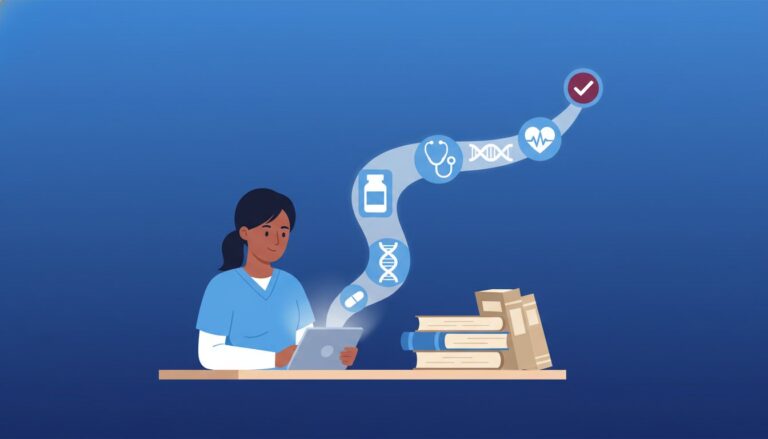
For students and healthcare professionals, a useful next step is to make pharmacology review a regular part of study or professional development, rather than an occasional catch-up task. Structured learning can make complex concepts easier to retain. PharmEDU supports continued study with focused topics and interactive formats, including video vignettes, flashcards, quizzes, and case studies.
Connect with PharmEDU about your learning goals and consider an approach that fits your next stage of study. Keep building your expertise with curiosity, sound judgment, and a lasting commitment to evidence-informed care.
Frequently Asked Questions
What are the top 10 trends shaping the future of pharma from 2026 to 2030?
A useful 10-part view includes personalized medicine, pharmacogenomics, biologics and advanced therapies, AI-assisted discovery, agentic research workflows, AI-supported prescribing, real-world evidence, decentralized trials, convergent regulation, and stronger pharmacovigilance. These trends connect drug discovery with patient-level decisions and post-approval monitoring. A promising candidate still needs relevant clinical evidence, regulatory assessment, and safety follow-up before it changes routine care.
What are the biggest trends shaping the future of pharmacology and drug development?
The future of pharmacology and drug development is taking shape through personalized therapies, AI-enabled research, regulatory adaptation, and safety evidence gathered after approval. The change is not simply about faster tools. It connects molecular and patient data with treatment selection, increasing the need to assess data quality, trial representation, and outcomes in routine care. These connections will shape how new approaches are applied.
How are AI and machine learning changing drug discovery and development?
AI and machine learning help teams analyze biological and clinical datasets, prioritize hypotheses, and compare candidate molecules before laboratory testing. Their role is to support decisions: a generated ranking can guide attention, but it does not establish clinical benefit. Computational analysis can inform research planning, while experiments and clinical evidence remain central to deciding whether a candidate advances.
How are precision medicine, genomics, and biomarkers influencing future treatments?
Precision medicine combines genomic information with biomarkers that describe disease biology or treatment response. A biomarker can help identify a patient subgroup, support trial enrollment, or track biological changes during treatment. Together, these signals help researchers define the intended patient group for a therapy and the evidence needed to demonstrate a meaningful response.
What role will biologics, gene therapies, cell therapies, and RNA drugs play in future medicine?
Biologics and advanced therapies offer distinct approaches to treating disease. Monoclonal antibodies can target specific molecules, while cell-based and gene therapies work through different biological mechanisms. RNA medicines use RNA-related processes to influence protein production. Each modality must be matched to the disease mechanism, with evidence established for safety and benefit in its intended patient group.
How can clinical trials become faster, cheaper, and more representative?
Decentralized trials may use telemedicine consultations, digital monitoring devices, home testing kits, and virtual follow-ups. These approaches can reduce travel and make participation more practical for some patients. Broader representation also depends on thoughtful outreach, accessible procedures, and protocols that reflect the populations expected to use the medicine. Efficient trial design must preserve reliable data collection and meaningful safety assessment.