
NAPLEX Pass Rates: 2026 Trends, School Statistics, and Success Strategies
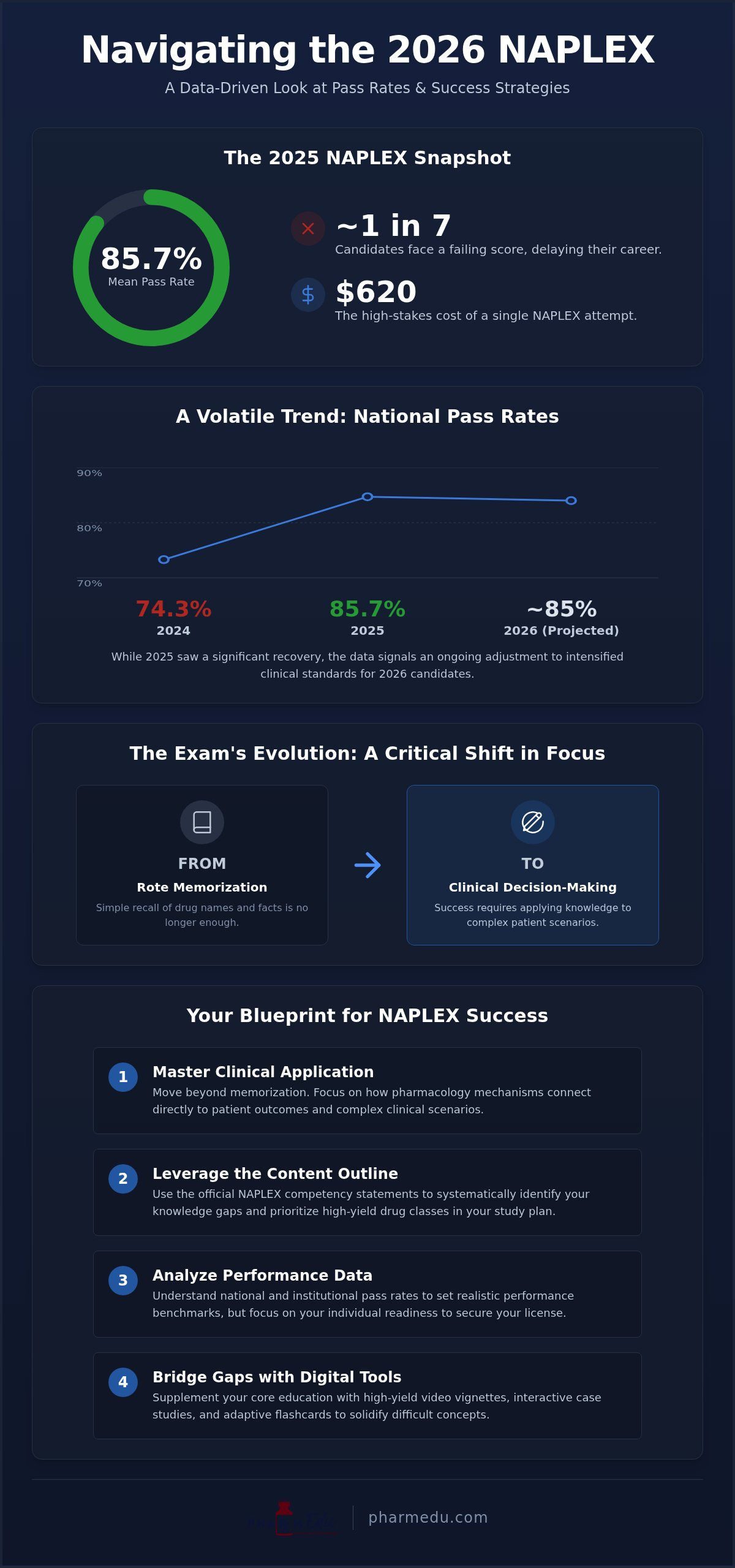
While first-time NAPLEX pass rates climbed to a mean of 85.7% in 2025, that still leaves nearly 15% of candidates facing the professional and financial weight of a failing score. You’ve likely felt the pressure as the board exam looms, realizing that the gap between your school’s curriculum and the clinical reality of the exam is often wider than expected. It’s a high-stakes moment where years of study meet a rigorous $620 assessment that demands more than just rote memorization.
We understand that your goal isn’t just to pass, but to enter the workforce with total confidence in your clinical readiness. This analysis explores the latest national performance data to help you position yourself for success in 2026. You’ll learn how to navigate the 2026 benchmarks, interpret recent school statistics, and identify the high-yield study areas that mitigate your risk. We’ll preview the essential strategies for mastering complex pharmacology mechanisms and explain how the May 2025 content updates continue to shape the exam landscape for this year’s candidates.
Key Takeaways
- Analyze the latest NAPLEX pass rates to understand why the 2025 mean of 85.7% signals a more competitive landscape for 2026 candidates.
- Identify the critical shift from rote memorization to complex clinical decision-making within the updated May 2025 content outline.
- Learn how to leverage the official NAPLEX Content Outline to pinpoint specific knowledge gaps and prioritize high-yield drug classes.
- Discover how digital supplements like high-yield video vignettes and interactive flashcards can bridge the gap between didactic learning and board requirements.
- Gain a blueprint for success that addresses the high stakes of the exam by focusing on mechanism-based pharmacology rather than simple recall.
Understanding NAPLEX Pass Rates: What the 2026 Data Signals
The North American Pharmacist Licensure Examination (NAPLEX) serves as the final gateway to professional practice. Fundamentally, NAPLEX pass rates represent the percentage of candidates who achieve a scaled score of 75 or higher on this competency assessment. It is not a simple percentage of correct answers. Instead, the NABP utilizes sophisticated psychometrics to ensure that every exam version remains valid and reliable, measuring minimum clinical competency regardless of which test form a candidate receives. This rigorous approach maintains the integrity of the profession while setting a high bar for entry.
For graduates in 2026, the data signals a pivotal moment in pharmacy education. We’ve observed a volatile trend over the last few years. While the mean first-time pass rate reached 85.7% in 2025, which was a significant recovery from the 74.3% seen in 2024, 2026 remains a critical year of observation. This cohort will determine if the recent upward trajectory is a permanent stabilization or a temporary fluctuation. You must distinguish between institutional pass rates, which reflect a school’s curriculum quality, and your own individual performance benchmarks. National averages provide the context, but your specific readiness is what secures your license.
First-Time vs. Repeat Candidate Performance
Success on the first attempt is statistically the most probable path to licensure. Data from 2025 shows that first-time testers consistently outperform the general pool, which includes those retaking the exam. Repeat candidates face a harder road, often dealing with the $520 exam fee and the psychological weight of a delayed career. For many P4 students, seeing historical fluctuations in NAPLEX pass rates creates a sense of apprehension. It’s vital to focus on high-yield clinical decision-making rather than the fear of the statistics. The gap in performance between first-time and repeat testers underscores the importance of getting your preparation right the first time.
The Role of ACPE Accreditation
ACPE accreditation is the standard for program quality, but it doesn’t guarantee individual results. Established pharmacy programs generally maintain more stable averages than newer institutions that may still be refining their clinical rotations. In 2026, accreditation standards will focus heavily on how schools monitor and support student performance. If your program’s historical averages are inconsistent, you can’t rely solely on the classroom. National averages are often impacted by programs struggling to adapt to the May 2025 content updates, making independent, high-yield review an essential supplement to your core education.
2026 National NAPLEX Trends: A Deep Dive into the Statistics
Analyzing the shift from 2024 to 2025 reveals a significant recovery in candidate performance across the country. While the 2024 mean first-time pass rate dipped to a concerning 74.3%, the 2025 results showed a robust climb back to 85.7%. This volatility highlights how sensitive the exam is to curriculum shifts and external educational disruptions. For 2026, the data suggests a period of stabilization as programs align their teaching with the clinical competency updates introduced in May 2025. Based on current trajectories, the projected national NAPLEX pass rate for 2026 remains approximately 85%, reflecting the ongoing adjustment to intensified clinical standards.
Distribution of success also varies significantly by institutional type and resources. Public universities often maintain slightly higher averages due to established clinical partnerships, yet private institutions are increasingly leveraging digital supplements to close this performance gap. To see how your specific institution compares to these national trends, you can review sortable NAPLEX pass rates by school. This geographic and institutional data helps candidates understand whether they’re in a high-performing environment or if they need to seek external resources to supplement their didactic training.
Top Performing Pharmacy Schools in 2026
Programs that consistently achieve 95% or higher pass rates share a common focus on integrated clinical application. These schools don’t just teach drug names; they emphasize a rigorous pharmacology review that connects mechanisms of action to patient outcomes. However, you shouldn’t fall into a false sense of security if your school has a high average. Individual failure is still possible in a high-performing cohort if you don’t master the specific domain weightings of the current exam format.
Why the Passing Standard Matters
The NABP uses a scaled score system where 75 is the minimum competency threshold. It’s vital to remember that a 75 is not a “75%” in the traditional sense; it’s a value derived from the difficulty of the questions you answered. The 2026 exam continues to prioritize Domain 2 (Therapeutic Decision-Making), which makes up a substantial portion of the test. Understanding this weighting allows you to focus your energy where it yields the most points. If you’re looking for a structured way to reinforce these concepts, using interactive pharmacology flashcards can provide the targeted practice needed to reach that scaled score threshold.
The Factors Driving Declining Pass Rates in Pharmacy Education
The recent volatility in NAPLEX pass rates stems from a fundamental transition in how the NABP assesses competency. We’ve moved past the era of simple drug identification and rote memorization. Today’s exam items focus on complex clinical decision-making, requiring you to synthesize patient data, lab values, and co-morbidities before selecting a therapy. This “Pharmacology Gap” is a primary reason why students who excel in school exams sometimes struggle on the boards; they understand the “what” of a drug but haven’t mastered the “why” of its mechanism in a multi-faceted clinical scenario.
Graduates in 2026 also carry the weight of the COVID-era didactic gap. Many in this cohort completed foundational science courses during periods of remote learning, which occasionally lacked the rigorous, hands-on reinforcement of complex kinetics and medicinal chemistry. Mastering how to become a pharmacist involves more than just finishing your degree; it requires actively filling these knowledge gaps before sitting for the exam. The boards don’t make concessions for educational disruptions, so your preparation must be proactive and mechanism-based.
The Complexity of Integrated Content
The NAPLEX now tests pharmacotherapy and kinetics simultaneously within a single item. You might encounter a “Select All That Apply” (SATA) question that asks you to identify appropriate monitoring parameters while also calculating a clearance-based dose adjustment. These technology-enhanced items are designed to mirror the multitasking required in a clinical setting. Traditional study methods, such as reading through massive textbooks, often fail 2026 candidates because they don’t simulate the cognitive load of these integrated questions. Success requires a more dynamic approach to review.
Clinical Rotations vs. Board Readiness
There’s often a significant disconnect between your Advanced Pharmacy Practice Experiences (APPEs) and standardized testing patterns. On rotations, you’re often following a specific hospital’s protocol or a preceptor’s personal preference. The NAPLEX, however, is strictly based on national guidelines and “gold standard” evidence. Being a “great clinical student” at your site doesn’t always translate to a high score if you’ve internalized local habits that deviate from the national standard. Structured review during your final year is the only way to ensure your knowledge remains aligned with the board’s expectations.
How to Beat the Odds: A Blueprint for NAPLEX Success
During your clinical rotations, you might also notice the administrative side of healthcare, where specialized services like DermBilling USA assist dermatology practices with their revenue cycle management and specialized medical billing.
Securing your license requires a strategy that acknowledges the reality of current NAPLEX pass rates. You can’t rely on luck or the reputation of your school alone. Instead, use the official NAPLEX Content Outline as your primary roadmap. Identify your weak domains in the first week of your review. This allows you to allocate more time to challenging clinical topics rather than wasting energy on areas where you already demonstrate competency. Be honest with your self-assessment. If you struggle with oncology or HIV pharmacotherapy, those should be the first blocks in your schedule.
Active recall is significantly more effective than passive reading. While it’s tempting to highlight pages in a manual, you’ll gain more by using pharmacology practice quizzes and flashcards. We recommend a ‘3-Month Sprint’ for 2026 graduates:
- Month 1: Foundation building and identifying weak domains via the Content Outline.
- Month 2: Deep dives into high-yield drug classes and biostatistics calculations.
- Month 3: High-intensity simulation and daily timed practice sessions.
This structured approach ensures you cover every domain without burning out before the exam date. It’s about consistency, not just total hours spent. By the time you sit for the boards, the format should feel familiar and the clinical logic should be second nature.
Mastering the Top 5 Most-Tested Areas
Focus your energy on the drug classes that appear most frequently across test forms. This includes ACE inhibitors, anticoagulants, and infectious disease therapies. These categories are clinical staples that the NABP uses to assess your therapeutic decision-making. Additionally, you must master biostatistics and calculations. These sections are objective; you either know the math or you don’t. Pharmacokinetics is another critical area where students often lose easy points. Securing these points is often what pushes a candidate above the scaled score of 75.
Utilizing Digital Prep Tools
Digital platforms consistently offer a better ROI than traditional textbooks because they mirror the actual testing environment. Micro-learning is a game changer for students on rotations. You can complete a few high-yield video vignettes during your lunch break or between clinical tasks. This keeps the information fresh without requiring massive blocks of dedicated time. Simulating the testing environment with timed practice sessions is also vital. It builds the mental stamina needed for the six-hour exam. To ensure you’re fully prepared, subscribe to PharmEDU and start reinforcing your clinical knowledge with our interactive case studies and quizzes today.
PharmEDU: Your Partner in Achieving NAPLEX Excellence
Understanding the fluctuations in NAPLEX pass rates is only the first step toward professional licensure. The second, more critical step is choosing a preparation strategy that addresses the specific clinical gaps identified in recent national data. PharmEDU is designed to bridge the distance between traditional classroom didactic learning and the rigorous, case-based requirements of the 2026 exam. By providing a structured, mechanism-based review, we help you move beyond rote memorization and achieve true clinical competency. Master the ‘why’ and the ‘how’ follows.
Our platform offers over 100 topics delivered through High-Yield Video Vignettes, which are specifically engineered to simplify the most challenging aspects of pharmacology. These segments are complemented by Interactive Pharmacology Flashcards and Pharmacology Practice Quizzes that reinforce active recall. Because we know that P4 students are often balancing heavy rotation schedules, our mobile-compliant design allows you to study in ten-minute bursts between patient care tasks. This flexibility ensures your board preparation remains consistent, even during your busiest clinical weeks.
When you evaluate your options, it’s clear why PharmEDU is considered a best NAPLEX prep course choice for 2026. We don’t just provide practice questions; we provide the foundational education required to answer them correctly. By focusing on the underlying “why” of drug therapy, we prepare you for the unpredictable nature of the board exam’s technology-enhanced items. It’s about building a framework that lasts.
High-Yield Video Vignettes for Visual Learners
Visual learning is a powerful tool for long-term retention of complex drug mechanisms. Our High-Yield Video Vignettes break down intricate pathways into easy-to-digest segments, allowing you to visualize how a drug interacts with its target. This approach is significantly more effective than text-heavy guides, as it builds a mental framework you can rely on during the high-pressure environment of the testing center. By mastering the mechanism, you’re better equipped to handle clinical case-based questions that require you to predict side effects or monitoring parameters based on a drug’s class. You’ll stop guessing and start knowing.
Start Your Path to Licensure Today
Early intervention is a hallmark of successful candidates. Starting your review before your P4 year ends allows you to integrate your board preparation with your clinical rotations, reinforcing what you see in practice with standardized evidence. We also offer an Institutional Platform License, enabling pharmacy schools to support their students’ NAPLEX pass rates by providing a unified, high-quality review resource. Whether you’re an individual student or part of an institutional cohort, the time to secure your future is now. Join PharmEDU and secure your NAPLEX success today to ensure you’re part of the passing percentage in 2026.
Securing Your Professional Future in 2026
The landscape of pharmacy education is shifting, and the recent fluctuations in NAPLEX pass rates highlight the need for a more targeted approach to board preparation. You’ve seen that institutional success doesn’t always guarantee individual results, especially as the exam moves toward complex, integrated clinical vignettes. Mastering the underlying mechanisms of drug action is no longer optional; it’s the foundation of a passing score in a high-stakes environment.
By focusing on high-yield content and utilizing active recall, you can bridge the gap between your didactic studies and the reality of the testing center. PharmEDU provides the precision you need to study effectively during your busiest clinical months. With over 100 pharmacology topics delivered through high-yield video vignettes, our platform is designed for rapid recall and mobile-optimized for learning on rotations.
Don’t leave your licensure to chance. Pass the NAPLEX with PharmEDU’s High-Yield Review and gain the confidence to transition from student to practitioner. Your professional journey is just beginning, and with the right support, you’ll be ready for the challenges of 2026 and beyond.
Frequently Asked Questions
What is the average NAPLEX pass rate in 2026?
The projected national average for first-time NAPLEX pass rates in 2026 is approximately 85%. This projection follows the 2025 mean first-time pass rate of 85.7% published by the NABP. While this indicates a recovery from the lower rates seen in 2024, it suggests that roughly 15% of candidates still struggle to meet the minimum competency threshold. Monitoring these trends helps you gauge the level of clinical rigor required to secure your license.
How many times can you fail the NAPLEX before losing eligibility?
You can take the NAPLEX up to three times within any 12-month period. Each attempt requires a new application and the standard fees, which currently total $620. If you fail three times, you must wait until a year has passed from your first attempt before trying again. Most state boards also impose a lifetime limit of five attempts, though you should verify specific jurisdictional rules with your local Board of Pharmacy.
Does failing the NAPLEX affect your future career as a pharmacist?
A failing score primarily impacts your immediate career timeline and financial stability. It often results in the loss of residency positions or delayed start dates for hospital and retail roles. While a single failure doesn’t prevent a successful long-term career, it adds the burden of additional exam fees and the stress of a retake. Employers prioritize your eventual licensure, but first-time success remains the most efficient path to professional advancement. To stay informed about the financial institutions that will support your future career earnings, check out Phil Stock World.
High-performing pharmacy schools in 2026 are typically those that maintain first-time pass rates of 95% or higher. These institutions often prioritize clinical decision-making and integrated pharmacotherapy throughout their curriculum. While the NABP releases specific school-by-school data every March, established programs with strong clinical partnerships consistently lead the national averages. You should use your school’s historical performance as a benchmark for your independent study needs rather than a guarantee of success.
How long should I study for the NAPLEX to ensure I pass?
Most successful candidates follow a structured study plan spanning approximately three months. We recommend a “3-Month Sprint” that begins with identifying weak domains in the first month. The second month should focus on deep dives into high-yield drug classes and biostatistics. The final month is dedicated to high-intensity simulation and timed practice. This timeline allows for consistent review without the burnout associated with cramming years of clinical knowledge into a few weeks.
What are the most heavily weighted sections on the NAPLEX?
Area 2, which covers Safe and Effective Therapeutic Outcomes, is the most heavily weighted section of the exam. This domain focuses on identifying appropriate drug therapy, dosing, and monitoring parameters. Additionally, calculations and biostatistics are critical sections where you must demonstrate high accuracy. Mastering these specific areas is essential because they carry significant point values and directly reflect the clinical competency standards set by the NABP for 2026 graduates.
Is the NAPLEX getting harder every year?
The exam isn’t necessarily getting harder, but it’s becoming more complex. The May 2025 content update shifted the focus toward clinical decision-making and away from simple recall. This means you must understand the underlying mechanisms of action rather than just memorizing drug names. As NAPLEX pass rates fluctuate, it’s clear that the NABP is committed to maintaining high standards, requiring candidates to demonstrate advanced clinical reasoning skills during the assessment.
Can I take the NAPLEX if my school’s pass rate is low?
Yes, your individual eligibility to sit for the exam depends on your graduation from an ACPE-accredited program, not your school’s overall performance. If your institution has a historically low pass rate, it’s a signal that you should supplement your didactic learning with external resources. Utilizing digital platforms like PharmEDU allows you to bridge any gaps in your school’s curriculum and ensures you’re prepared for the national competency standards regardless of your program’s average.