
Mastering the Boards: The Ultimate NAPLEX Pharmacology Practice Questions Guide for 2026
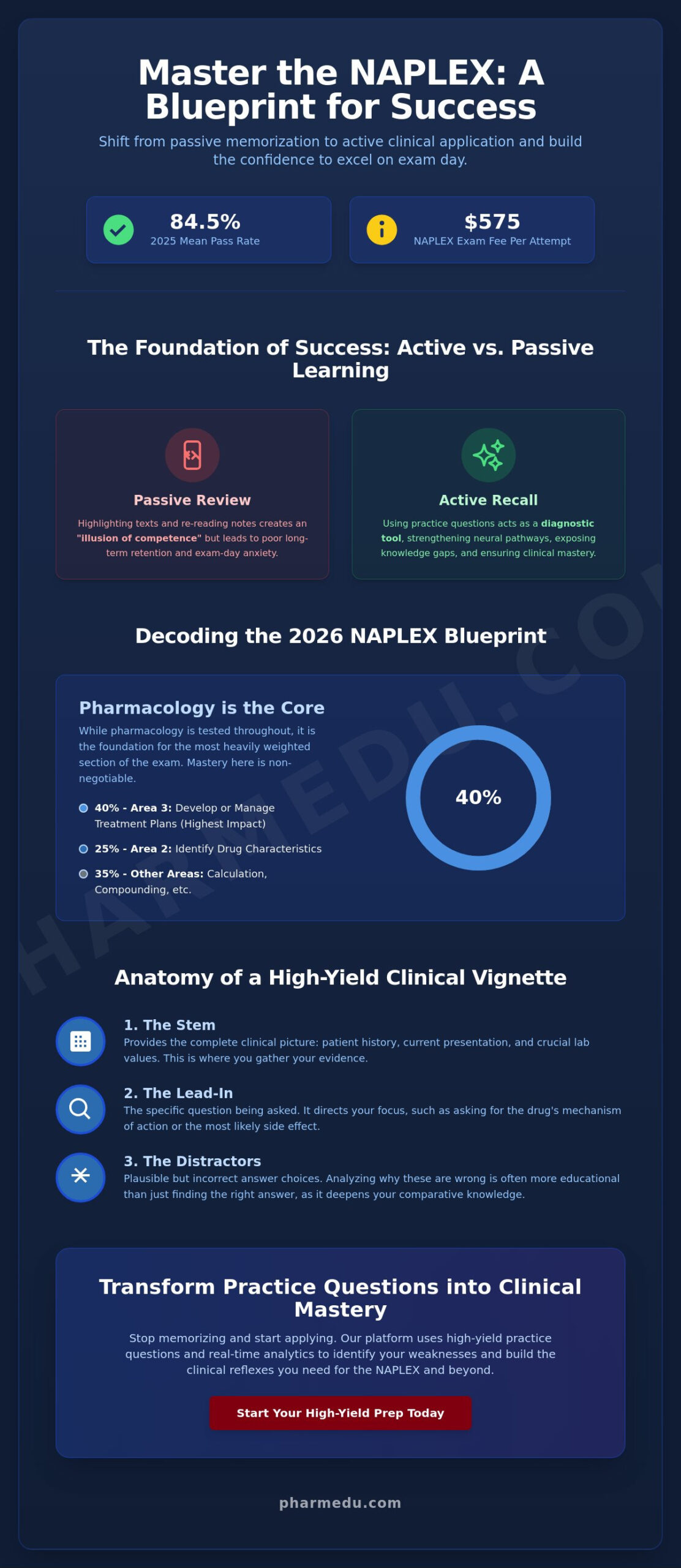
What if your study sessions didn’t just measure your memory, but actually built the clinical reflexes required to manage a complex patient case? It’s a common frustration to master a drug’s mechanism of action only to find the details slipping away when you’re faced with a multi-layered clinical scenario. With the NAPLEX exam fee at $575 per attempt and a 2025 mean pass rate of 84.5%, the stakes for your preparation are undeniably high. Integrating high-yield NAPLEX pharmacology practice questions into your daily routine is the most effective way to bridge the gap between academic theory and clinical mastery.
You deserve a preparation strategy that replaces exam anxiety with professional certainty. We’ll show you how to use practice questions as diagnostic instruments that identify your knowledge gaps before they become liabilities on exam day. This guide provides a clear roadmap for the 2026 blueprint, focusing on active learning techniques that ensure you don’t just pass the boards, but develop the long-term retention necessary for your future career as a pharmacist. By shifting from rote memorization to clinical application, you’ll gain the confidence to handle even the most challenging sections of the exam.
Key Takeaways
- Understand why high-yield NAPLEX pharmacology practice questions serve as essential diagnostic tools to bridge the gap between basic drug mechanisms and complex clinical mastery.
- Learn to deconstruct the anatomy of a clinical vignette, using lead-ins and distractors to sharpen your decision-making reflexes for the 2026 exam blueprint.
- Discover the strategic advantage of digital platforms and real-time performance analytics for identifying specific organ-system weaknesses that static textbooks cannot track.
- Implement a two-phase study schedule that balances foundational learning during rotations with intensive, subject-specific targeting during your final preparation weeks.
- Explore how micro-learning tools like video vignettes and interactive quizzes can streamline your study sessions and ensure long-term retention for professional practice.
Why Pharmacology Practice Questions are the Foundation of NAPLEX Success
Active recall isn’t just a study trend; it’s a neurological necessity for candidates preparing for the North American Pharmacist Licensure Examination (NAPLEX). Many students fall into the trap of passive review, where they spend hours highlighting textbooks and assuming familiarity equals mastery. This often creates an “illusion of competence.” You might recognize a drug name on the page, but that doesn’t mean you can safely apply its contraindications to a complex patient case under exam pressure. High-quality NAPLEX pharmacology practice questions act as diagnostic instruments. They force your brain to retrieve information actively rather than just recognizing it. This process exposes “invisible” knowledge gaps, ensuring you don’t discover a critical weakness for the first time during the actual six-hour exam.
The Science of Active Recall and Spaced Repetition
Every time you answer a clinical question, you’re building stronger neural pathways. This is the “testing effect” in action. Educational research consistently shows that students who prioritize testing over re-reading achieve higher scores and better long-term retention. To maximize this benefit, it’s best to integrate these questions with interactive pharmacology flashcards. While flashcards are excellent for memorizing drug classes and black box warnings, practice questions teach you how to synthesize that data. Spaced repetition ensures you revisit the most challenging mechanisms just as you’re about to forget them, turning short-term memorization into the professional expertise required for clinical practice.
Pharmacology in the 2026 NAPLEX Blueprint
The 2026 exam structure emphasizes clinical application over rote memorization. Pharmacology isn’t confined to a single category; it’s the thread that connects the entire blueprint. Area 2, which focuses on identifying drug characteristics, accounts for 25% of the exam. However, Area 3, “Develop or Manage Treatment Plans,” represents 40% of the scored questions. You can’t successfully manage a treatment plan without a deep understanding of therapeutic monitoring and side effect profiles. The 2025 pass rate data shows a mean score of 84.5%, proving that a structured approach works.
Consistency is your greatest asset. A longitudinal approach beats a two-week cram session every time. By engaging with NAPLEX pharmacology practice questions over an 8 to 12-week period, you allow your brain the time it needs to process the high-yield topics that appear most frequently, such as infectious diseases and cardiovascular health. This methodical preparation doesn’t just help you pass; it builds the decision-making reflexes you’ll use every day as a licensed pharmacist.
The Anatomy of High-Yield NAPLEX Pharmacology Clinical Vignettes
Understanding the architecture of a board-style question is just as vital as knowing the drug’s mechanism. A standard vignette consists of three distinct components: the stem, the lead-in, and the distractors. The stem provides the patient’s clinical history, lab values, and current presentation. The lead-in is the specific question being asked, while the distractors are the incorrect answer choices. High-quality NAPLEX pharmacology practice questions don’t use random distractors. Instead, they feature “plausible” errors, such as medications that treat the same condition but are contraindicated for the specific patient described. Analyzing why a distractor is wrong is often more educational than simply identifying the correct choice, as it forces you to differentiate between closely related therapeutic options.
The exam frequently employs “two-step” logic. You might encounter a patient presenting with hyperkalemia and a persistent dry cough. The question won’t name the medication directly. Instead, it asks for the mechanism of the drug most likely causing these symptoms. You must first identify the drug class and then recall its specific pharmacological target. This level of synthesis is exactly what the official practice exam tests. It’s a shift from simple recognition to active clinical reasoning. If you want to sharpen these skills, exploring clinical case studies can help you recognize these patterns more quickly in a high-pressure environment.
Identifying Clinical Buzzwords and Descriptions
Success on the boards often depends on your ability to decode drug descriptions when the generic name is omitted. You’ll need to recognize drug classes through patient presentation and specific lab abnormalities. For instance, common descriptions for ACE inhibitors often focus on their renal protective effects in diabetic patients or their tendency to cause angioedema. Distinguishing between a side effect and a true contraindication within a vignette is a frequent hurdle. Mastery here requires moving beyond a list of facts and understanding how a drug’s pharmacology manifests in a living patient.
Mastering Multiple-Response and Constructed-Response Questions
The 2026 blueprint continues to utilize non-traditional formats like “Select All That Apply” (SATA) and “hot-spot” items. These questions are designed to test the depth of your knowledge. In a SATA pharmacology item, you might be asked to identify all potential drug-drug interactions for a complex patient. There’s no partial credit, so your precision must be absolute. Utilizing a comprehensive pharmacy review that includes interactive, non-linear question types is essential. These digital tools prepare you for the drag-and-drop and constructed-response items that traditional paper-based methods simply cannot replicate.
Digital Q-Banks vs. Traditional Review: Choosing Your Study Weapons
The era of the heavy, static textbook is ending. While physical review books were once the gold standard, they simply can’t keep pace with the rapid updates in clinical guidelines and the adaptive nature of the 2026 exam. Digital platforms have transformed NAPLEX pharmacology practice questions from simple assessment tools into dynamic learning ecosystems. These platforms offer a multimodal advantage by linking every question to high-yield video vignettes and clinical case studies. This approach ensures that if you miss a question on beta-blockers, you aren’t just reading a paragraph of text; you’re engaging with a visual and auditory explanation that reinforces the mechanism and clinical application simultaneously.
Mobile compliance is another critical factor for the modern student. Pharmacy rotations leave little time for dedicated library sessions, making micro-learning essential. Being able to complete a five-question set on your phone during a lunch break allows for consistent, longitudinal preparation. This constant engagement prevents the “forgetting curve” from taking hold, ensuring that your knowledge remains fresh throughout your final year of study.
Performance Tracking and Weak Point Analysis
Data is your most powerful ally. Digital banks track your performance across every organ system in real-time, allowing you to stop studying what you’ve already mastered. If your analytics show a 90% accuracy rate in oncology but only 45% in infectious diseases, your study plan should shift immediately. You can use “tutor mode” to receive instant rationales while you’re learning new concepts, or switch to “timed mode” to build the mental stamina required for the board exam. Simulating exam-day pressure in 60-minute blocks helps you manage time efficiently, a skill that’s just as important as knowing the drugs themselves.
The Limitations of Physical Study Guides
The primary danger of physical study guides is their inability to update. Clinical guidelines for hypertension or diabetes can change within months, making a printed book obsolete before it even hits the shelf. Even high-quality pharmacology study guides for nursing students and pharmacists must be updated frequently to remain accurate. Most pharmacy programs are accredited by the Accreditation Council of Pharmacy Education (ACPE), which mandates a curriculum that reflects current standards of care. Digital platforms mirror this requirement by providing instant updates and rationales for every answer, ensuring you’re never learning outdated information that could lead to a wrong answer on the NAPLEX.
How to Integrate Pharmacology Practice into Your 2026 Study Schedule
A common mistake is treating board prep as a final hurdle rather than a continuous professional development process. While many guides suggest a standard 8 to 12 week window, the most successful candidates begin their preparation much earlier. By weaving NAPLEX pharmacology practice questions into your final year of pharmacy school, you transform your rotations into active learning laboratories. This longitudinal strategy prevents the burnout associated with massive cramming and ensures that complex drug mechanisms are deeply encoded in your long-term memory.
Phase 1: Longitudinal Learning on Rotations
Your P4 rotations provide the perfect context for pharmacology mastery. If you’re on a cardiology rotation, don’t study oncology; match your question bank topics to the patients you see every day. Using a mobile-compliant platform allows you to complete 5 to 10 questions during downtime or lunch breaks. It’s helpful to maintain a “missed concept” log to track patterns in your errors. Reviewing this log every weekend ensures you aren’t just doing questions, but actually closing knowledge gaps as they appear.
Phase 2 & 3: From Mastery to Stamina
As you enter the final eight weeks before your exam date, your focus must shift from learning individual topics to building testing endurance. Transition from subject-specific quizzes to 40-question mixed blocks that simulate the actual exam environment. This is the time to prioritize high-yield areas like infectious disease, cardiovascular health, and oncology, which carry significant weight in the NAPLEX blueprint. If you hit a wall with the hardest 10% of topics, such as complex HIV regimens or chemotherapy toxicities, use high-yield video vignettes to break down the concepts visually.
The “5-Questions-a-Day” rule is your best defense against the forgetting curve. Even on your busiest days, committing to five high-quality questions keeps your clinical reflexes sharp. This consistent habit builds the confidence needed to face the 225-question computer-based exam without fatigue during the six-hour testing window. Transitioning to mixed blocks of NAPLEX pharmacology practice questions helps you identify which organ systems require more attention during your final sprint. To start building your personalized study plan today, you can explore pharmacology practice quizzes that adapt to your specific learning needs.
PharmEDU: Transforming Practice Questions into Clinical Mastery
Most study platforms treat practice as an autopsy of what you’ve already failed to remember. At PharmEDU, we’ve designed a system where NAPLEX pharmacology practice questions serve as active diagnostic instruments. Our platform integrates over 100 critical pharmacology topics, each linked directly to high-yield video vignettes and interactive quizzes. This structure ensures that you aren’t just checking a box; you’re building a mental framework that connects drug mechanisms to real-world patient outcomes. By the time you reach the testing center, your clinical decision-making will be a reflex rather than a struggle.
Efficiency is the cornerstone of our methodology. We understand that P4 students are often balancing intensive rotations with their final preparation. Our 5-minute micro-learning vignettes allow you to master complex drug classes during short breaks, making consistent study possible even on the busiest clinical days. These resources are updated constantly to reflect 2026 clinical guidelines, ensuring your knowledge of infectious disease protocols and cardiovascular therapies is perfectly aligned with the current standards of care. Every clinical case study on our platform is built to mirror the 2026 NAPLEX environment, providing the most authentic preparation experience available.
A Complete Learning Ecosystem for Future Pharmacists
The journey from a student to a licensed professional is rigorous. We’ve supported candidates through every stage, from providing guidance on how to become a pharmacist to the final weeks of board preparation. Unlike platforms built by generalist programmers, our interactive tools are designed by healthcare educators who understand the specific hurdles of pharmacy licensure. This academic rigor is why pharmacy schools across the country utilize our institutional platform licenses to raise their pass rates and ensure their graduates are ready for professional practice.
Start Your Journey to NAPLEX Success
Pharmacology remains the highest ROI area for your study time. Mastering this section doesn’t just help you pass; it provides the foundation for 65% of the scored items on the exam. We offer flexible monthly and annual subscription options to fit your specific timeline, whether you’re starting a year in advance or beginning your final sprint. Don’t leave your results to chance with static materials. You can Join PharmEDU and Master Your Pharmacology Review Today to gain access to the precision tools you need for a high-confidence pass margin. Our NAPLEX pharmacology practice questions and clinical vignettes are ready to help you bridge the gap between drug mechanisms and board mastery.
Securing Your Professional Future with Clinical Precision
Mastering pharmacology is the bridge between foundational science and the patient-centered care you’ll provide as a licensed professional. By prioritizing active recall and learning to deconstruct complex clinical vignettes, you’re doing more than just preparing for a test; you’re developing the reflexes required for safe practice. Utilizing high-quality NAPLEX pharmacology practice questions within a structured, digital study schedule allows you to identify your weaknesses early and refine your knowledge with precision.
Our platform provides a complete ecosystem designed by healthcare educators for true clinical mastery. With over 100 comprehensive pharmacology topics and Red Dot-style high-yield video vignettes, you’ll have the tools necessary to bridge every knowledge gap. Success on the boards is a result of consistent, methodical preparation and the right strategic partners. It’s about turning your study hours into long-term professional retention that serves you throughout your entire career.
Start your high-yield NAPLEX pharmacology review with PharmEDU now and secure your path to licensure. You’ve worked hard for your degree; now it’s time to prove your expertise and begin your professional career with total confidence.
Frequently Asked Questions
Is a specialized pharmacology question bank necessary if I already have a general NAPLEX prep course?
A specialized pharmacology bank is essential because general prep courses often prioritize breadth over the pharmacological depth required by the 2026 blueprint. While general courses cover calculations and law, they may not provide enough high-yield NAPLEX pharmacology practice questions to master complex drug interactions. Specialized banks allow for targeted organ-system review, ensuring you don’t overlook the nuanced side effects and contraindications that frequently appear in clinical vignettes.
How many pharmacology questions should I do per day during my dedicated study period?
You should aim for 40 to 50 questions per day during your dedicated study period to build testing stamina. During your rotations, completing 5 to 10 questions daily helps maintain longitudinal retention without causing burnout. This gradual increase in volume ensures you’re prepared for the 225-question format of the actual exam while keeping your clinical reflexes sharp throughout your final year of pharmacy school.
Does the PharmEDU question bank cover the 2026 clinical guidelines for diabetes and hypertension?
PharmEDU fully integrates the 2026 clinical guidelines for chronic disease management, including the latest updates for diabetes and hypertension. Our content is reviewed by healthcare educators to ensure that every question reflects current standards of care. This commitment to accuracy prevents you from learning outdated protocols that could lead to incorrect answers on the board exam, especially in high-weight areas like cardiovascular health.
Can I access PharmEDU pharmacology practice questions on my phone during clinical rotations?
Yes, the PharmEDU platform is fully mobile-compliant, allowing you to access our NAPLEX pharmacology practice questions from any smartphone or tablet. This flexibility is vital for P4 students who need to squeeze in micro-learning sessions between patient rounds or during downtime on rotations. You can easily switch between your desktop and mobile device without losing your progress or performance analytics data.
What drug classes are considered the most high-yield for the NAPLEX Area 2?
The most high-yield classes for Area 2 include cardiovascular agents, anti-infectives, oncological medications, and endocrine treatments. These classes appear frequently because they involve complex monitoring, significant side effect profiles, and numerous drug-drug interactions. Focus your efforts on mastering the mechanisms and black box warnings for these categories, as they form the backbone of the clinical decision-making questions in the 2026 blueprint.
How do the PharmEDU video vignettes integrate with the practice quizzes?
Our high-yield video vignettes are linked directly to the rationales within our practice quizzes. If you answer a question incorrectly, you can immediately watch a short video that explains the underlying concept visually and auditorily. This multimodal approach reinforces the correct information instantly, transforming a simple mistake into a deep learning opportunity that improves long-term retention of drug mechanisms and clinical applications.
Should I focus more on drug mechanisms or clinical management questions?
You should prioritize clinical management questions, as Area 3 accounts for 40% of the scored items on the NAPLEX. While understanding drug mechanisms is the foundation, the exam focuses heavily on how you apply that knowledge to develop and manage treatment plans. Practice questions that require two-step logic, such as identifying a drug based on symptoms and then choosing the correct management strategy, are the most effective.
Do you offer institutional access for pharmacy schools and universities?
We offer comprehensive institutional platform licenses designed for pharmacy schools and universities aiming to improve their student pass rates. These licenses provide faculty with administrative dashboards to track student progress and identify cohort-wide knowledge gaps. Educational institutions can contact our support team to discuss tailored integration options that complement their existing curriculum and clinical rotation schedules while providing students with high-quality study resources.