
Pharmacology Practice Questions for NCLEX: The 2026 High-Yield Prep Guide
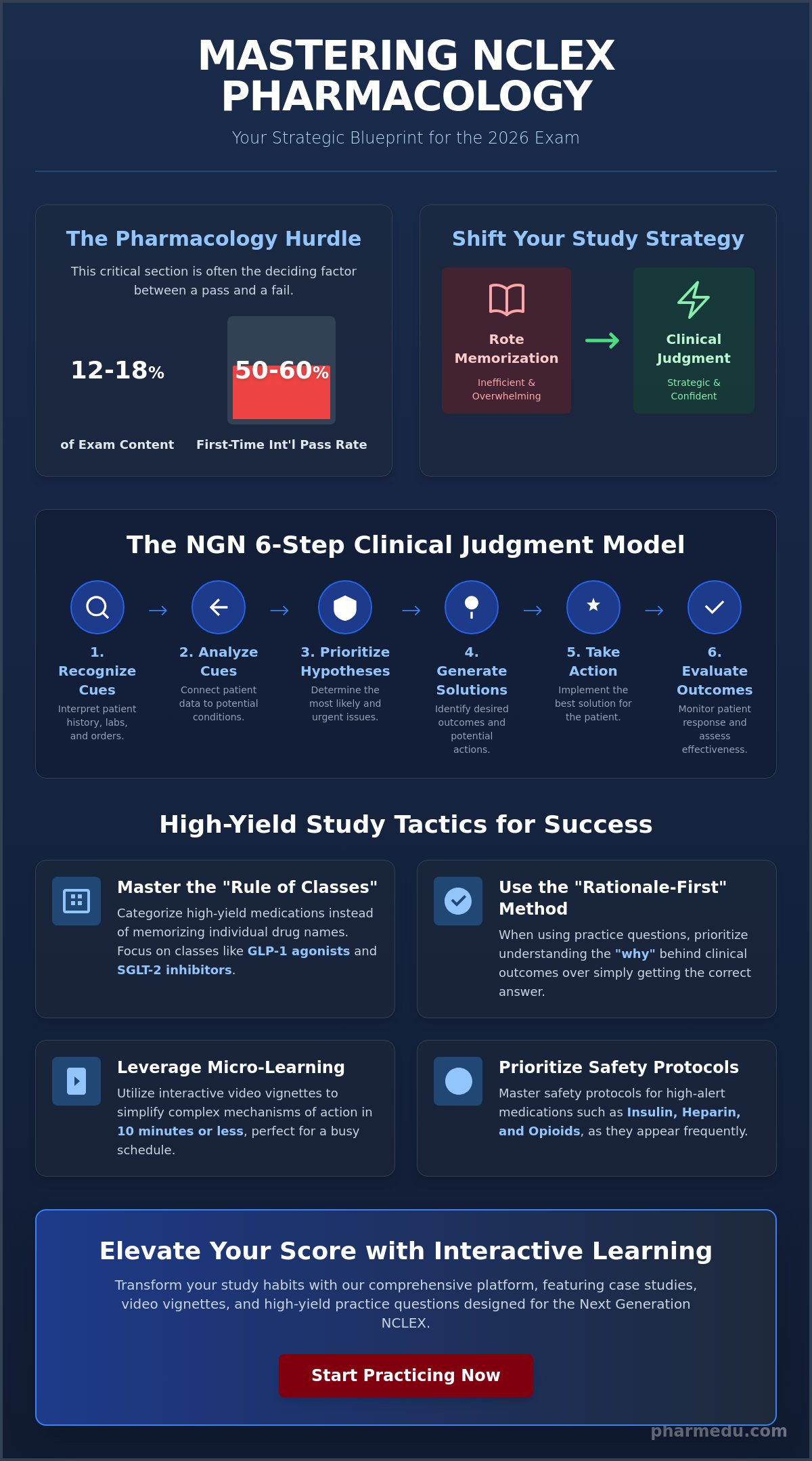
Did you know that pharmacology topics make up between 12% and 18% of your exam, yet first-time international pass rates often hover between 50% and 60%? You don’t need to memorize every single medication in existence to succeed; you need a strategy that prioritizes clinical judgment over rote recall. Our comprehensive guide to pharmacology practice questions for NCLEX provides the structured framework you need to approach the 2026 exam requirements with professional confidence.
It’s completely normal to feel overwhelmed by the sheer volume of drug names or the complexity of Next Generation NCLEX (NGN) case studies. We understand the anxiety that comes with partial credit scoring and the fear of encountering a drug you’ve never heard of before. This guide promises to transform your study habits by focusing on high-yield drug classes like GLP-1 receptor agonists and SGLT-2 inhibitors. We’ll show you how to develop a reliable system for answering questions even when the specific medication is unfamiliar. You’ll explore essential NGN question types, master critical safety protocols, and gain the clinical insights necessary to pass on your first attempt.
Key Takeaways
- Apply the six-step Clinical Judgment Measurement Model to navigate complex drug therapy case studies within the Next Generation NCLEX format.
- Master the “Rule of Classes” to efficiently categorize high-yield medications instead of relying on the exhaustive memorization of individual drug names.
- Utilize pharmacology practice questions for NCLEX through the “Rationale-First” method to prioritize understanding clinical outcomes over simple correct answers.
- Leverage micro-learning strategies and interactive video vignettes to simplify complex mechanisms of action in ten minutes or less.
Navigating the Pharmacology Section of the NCLEX in 2026
Understanding the structure of the exam is your first step toward success. In 2026, the NCLEX-RN and NCLEX-PN continue to weigh the “Pharmacology and Parenteral Therapies” category heavily, typically accounting for 12% to 18% of the total exam content. This isn’t just a small slice of the pie; it’s often the deciding factor between a pass and a fail. Many nursing graduates struggle here because they treat The Science of Pharmacology as an exercise in memorization rather than clinical application. The 2026 exam cycle demands that you move beyond simple flashcards to understand how drugs interact with specific patient pathologies in real-time.
Don’t let the statistics intimidate you. The high failure rate in this section usually stems from a lack of strategic focus. Instead of trying to memorize the entire pharmacopeia, successful candidates prioritize high-yield drug classes and their mechanisms. The shift toward clinical judgment means the test doesn’t just ask what a drug does; it asks what you, as a nurse, should do when a patient reacts to that drug. This requires a transition from rote learning to a more integrated, patient-centered approach.
What to Expect: Question Formats and Frequency
Expect a mix of traditional multiple-choice items and the more challenging Select All That Apply (SATA) questions. While dosage calculations and IV flow rates remain part of the curriculum, they are now frequently embedded within larger clinical scenarios. Using pharmacology practice questions for NCLEX allows you to simulate this environment and practice the multi-step thinking required for NGN items. You’ll encounter questions that require you to interpret lab values, identify contraindications, and prioritize nursing interventions simultaneously. In the context of the NCLEX, high-yield refers to medications and drug classes that appear with the highest frequency due to their common clinical usage or significant safety implications. Mastering these ensures you’re prepared for the bulk of the pharmacology section without wasting time on obscure substances.
Pharmacology vs. Parenteral Therapies: Knowing the Difference
The NCLEX distinguishes between basic medication administration and complex parenteral therapies. You’ll need to demonstrate mastery over safety protocols for high-alert medications like insulin, heparin, and opioids. Understanding the physiological differences between oral, intramuscular, and intravenous routes is vital for predicting onset times and potential adverse reactions. Safety isn’t just about the right dose; it’s about monitoring the patient’s response and knowing when to hold a medication. To build a solid foundation for these concepts, you can refer to The Ultimate Pharmacology Study Guide for Nursing Students in 2026 for a deeper dive into these administration standards. Proper management of IV sites, compatibility of solutions, and the management of central lines fall under the parenteral umbrella, requiring a specific set of clinical skills that go beyond simple drug knowledge.
Understanding Next Generation NCLEX (NGN) Pharmacology Questions
The transition to the Next Generation NCLEX (NGN) has fundamentally changed how medication safety is tested. It’s no longer sufficient to simply identify a drug class or its common side effects. Instead, you must apply the 6-step Clinical Judgment Measurement Model (NCJMM) to every pharmacological intervention. This model requires you to recognize cues, analyze those cues, prioritize hypotheses, generate solutions, take action, and evaluate outcomes within the context of a patient’s evolving status. According to the Official NCLEX-RN Test Plan, your ability to integrate these steps into “Pharmacological and Parenteral Therapies” is a critical measure of your readiness for safe practice.
Pharmacology is now woven into complex case studies rather than appearing only as isolated questions. You might be presented with a patient’s history, current lab results, and a list of provider orders. Your task is to determine which medication is the priority or which drug-drug interaction is causing a sudden change in the patient’s condition. By utilizing high-quality pharmacology practice questions for NCLEX that mirror this case-study format, you can bridge the gap between textbook knowledge and clinical reality. If you find these scenarios challenging, engaging with our interactive Clinical Case Studies can help you visualize the patient’s journey and the pharmacological impact of your decisions.
Approaching a pharmacology “Trend” question requires a methodical strategy. These items ask you to look at data over time to identify a medication’s effectiveness or a developing adverse reaction. Follow these steps to navigate them successfully:
- Step 1: Review the Electronic Health Record (EHR) specifically for recent medication additions or dosage adjustments.
- Step 2: Compare baseline physiological data, such as blood pressure or potassium levels, against the most recent entries.
- Step 3: Determine if the change is a therapeutic response, a known side effect, or a toxic reaction.
- Step 4: Select the nursing action that addresses the most immediate safety risk identified by the trend.
New Question Types: Matrix, Drag-and-Drop, and Bowtie
The 2026 exam uses diverse formats like matrix questions to test your understanding of drug-drug interactions across multiple variables. You might need to check boxes to indicate which symptoms are expected versus which require immediate notification of the provider. Bowtie questions are particularly high-stakes; they require you to link a specific patient condition to the correct medication in the center, with two supporting nursing actions on the left and two monitoring parameters on the right. Success in these formats depends on your ability to recognize subtle cues within the patient’s chart that signal a pharmacological conflict.
Scoring Mechanics: Why Every Choice Matters
One of the most significant changes in the NGN is the introduction of partial credit through +/- scoring. In traditional Select All That Apply (SATA) items, you either got the whole question right or wrong. Now, for many multi-response pharmacology items, you earn a point for every correct option you select, but you lose a point for every incorrect one you choose. This means guessing is no longer a neutral strategy. A common pitfall is over-selecting options because they “sound” plausible. To protect your score, only select the answers you’re certain are correct based on the clinical evidence provided in the case study.
High-Yield Drug Classes: Categorizing Your Practice Questions
Memorizing hundreds of individual drug names is a common trap that leads to burnout and exam day confusion. Instead, successful candidates utilize the “Rule of Classes.” This strategic framework focuses on the commonalities of a drug group, allowing you to predict side effects, contraindications, and nursing interventions based on a drug’s suffix or mechanism. By organizing your study around these categories, you can answer complex items even if you encounter a specific medication name you haven’t seen before. This approach is supported by the American Journal of Nursing, which emphasizes the integration of pharmacological principles into clinical practice standards.
When you work through pharmacology practice questions for NCLEX, you’ll notice that five drug classes appear with the highest frequency: antihypertensives, antibiotics, anticoagulants, psychiatric medications, and endocrine drugs. Each of these categories requires a specific safety focus. For example, psychiatric medications often carry “black box” warnings that are high-yield for the NCLEX. You must be prepared to monitor for agranulocytosis in patients taking clozapine or recognize the increased risk of suicidal ideation when a patient begins a new antidepressant regimen.
Endocrine pharmacology, particularly insulin management, is another cornerstone of the 2026 exam. You don’t just need to know the names of insulin types; you must master their peak times. The peak is the most critical nursing intervention point because it’s when the patient is at the highest risk for hypoglycemia. Practice questions will often test your ability to coordinate meal trays with the administration of rapid-acting versus intermediate-acting insulins to ensure patient safety.
Cardiovascular and Respiratory High-Yielders
Cardiovascular medications are a major component of the “Pharmacological and Parenteral Therapies” section. You should start with a deep dive into ACE Inhibitors Pharmacology to understand the “ACE” acronym: Angioedema, Cough, and Elevated potassium. Beyond ACE inhibitors, the “Big Three” monitoring meds—Beta-blockers, Calcium Channel Blockers, and Digoxin—require you to check heart rate and blood pressure before every dose. In the respiratory realm, remember the order of operations for inhalers: always administer the bronchodilator before the glucocorticoid to ensure the airway is open for the steroid to reach the lower lobes.
Anti-Infectives and Immune Modulators
Anti-infectives are often identified by their suffixes, but you must be careful with exceptions. While many antibiotics ending in “-mycin” are associated with ototoxicity and nephrotoxicity, this isn’t a universal rule. Your pharmacology practice questions for NCLEX should focus on these specific toxicities and the necessary nursing assessments, such as monitoring BUN and creatinine levels. Antivirals and antifungals also appear frequently, often focusing on long-term side effects like hepatotoxicity. Nurses must strictly monitor peak and trough levels for Vancomycin to ensure therapeutic efficacy while preventing nephrotoxicity and ototoxicity.
How to Effectively Use Pharmacology Practice Questions for NCLEX Prep
Mastering pharmacology practice questions for NCLEX requires a significant shift in your study mindset. Many students fall into the trap of simply checking their final score and moving to the next set, but the true value lies in the “Rationale-First” method. This approach prioritizes reading the detailed explanation for every answer choice, including the ones you got right. By understanding exactly why a distractor is incorrect, you reinforce your clinical reasoning and build a more robust knowledge base that applies to future scenarios.
Practice questions act as a precise diagnostic tool to identify your “Pharmacology Blind Spots.” If you consistently miss questions regarding calcium channel blockers or peak insulin times, that’s a clear signal to pause your testing and revisit that specific content. We recommend following the 50/50 Rule: spend half your study time on active content review and the other half on applying that knowledge through practice. To ensure these lessons stick, maintain a systematic remediation log. In this log, write down the one core clinical concept you misunderstood for every incorrect answer rather than just the drug name.
Test-Taking Strategies for Unknown Medications
It’s inevitable that you’ll encounter a drug name you don’t recognize on the exam. When this happens, stay calm and look for linguistic cues. Decoding drug prefixes and suffixes can often reveal the drug class. For instance, medications ending in “-sartan” are typically Angiotensin II Receptor Blockers (ARBs). If you still can’t identify the medication, apply the “Safety First” rule. Focus on the choice that prevents the most significant patient harm or addresses the highest priority safety concern. You can often eliminate distractor side effects like nausea or mild headaches, as these are common to almost all medications and rarely represent the “priority” nursing action in a safety-focused question.
Building a Daily NCLEX Pharmacology Routine
Consistency is far more effective than occasional marathon study sessions. Aim for a daily target of 25 to 50 pharmacology practice questions for NCLEX to build your mental stamina and pattern recognition. Using our Pharmacology Quizzes allows you to simulate the actual exam environment and improve your endurance. Complement this routine with interactive flashcards for quick-fire recall during short breaks throughout your day. If you’re ready to take your preparation to a professional level, you can start your PharmEDU subscription today to access our full suite of high-yield video vignettes and clinical case studies.
Elevating Your Score with PharmEDU’s Interactive Learning Platform
PharmEDU isn’t just a database of questions; it’s a structured educational ecosystem designed to replace anxiety with professional confidence. Our high-yield video vignettes simplify complex drug mechanisms by breaking them down into digestible, visual segments. This approach addresses the common struggle of memorizing hundreds of names by showing you how medications actually function within the body. Instead of sitting through hour-long lectures, our micro-learning format allows you to master a single drug class in under 10 minutes. By watching a vignette before attempting pharmacology practice questions for NCLEX, you create a visual anchor that makes the subsequent rationales much easier to synthesize and remember.
Our interactive quizzes are meticulously engineered to mirror the 2026 NGN environment. You’ll encounter the exact same bowtie, matrix, and trend question formats that define the current NCLEX-RN and NCLEX-PN standards. Precision is at the heart of our platform, which is why every subscription includes an advanced analytics dashboard. You won’t just see a final score; you’ll see a detailed breakdown of your performance across different drug categories and how you rank compared to other candidates. This data-driven approach allows you to stop guessing and start focusing your energy on the specific “blind spots” that could impact your pass rate.
Beyond the Test Bank: Clinical Case Studies
Static questions can only take you so far. Our clinical case studies require you to apply your knowledge to real-world vignettes, forcing you to prioritize nursing actions just as you would at the bedside. These studies work in tandem with our interactive flashcards and quizzes to build long-term retention rather than short-term memorization. We also understand that institutional support is vital for student success. For nursing school faculty who want to provide their cohorts with these high-quality resources, we offer Institutional Platform Licensing to ensure every student is prepared for the 2026 test plan requirements.
Start Your Pharmacology Mastery Today
The PharmEDU advantage is built on a foundation of credibility, precision, and unwavering support. We provide the tools you need to move beyond being a test-taker and start thinking like the medical professional you’re becoming. Whether you choose our 1-month access for $20 or our high-value 12-month access for just $10 per month, you’re investing in a system that prioritizes your professional growth. Use our pharmacology practice questions for NCLEX to sharpen your clinical judgment and secure your license on the first attempt. Join PharmEDU now for full access to our pharmacology review library.
Secure Your Professional Future with Strategic Preparation
Success on the 2026 exam requires a shift from passive reading to active clinical reasoning. By mastering the “Rule of Classes” and focusing on the six steps of the Clinical Judgment Measurement Model, you transform pharmacology from a hurdle into a strength. It’s vital to remember that effective study sessions prioritize the “why” behind every rationale rather than just the “what” of a correct answer. Consistently engaging with pharmacology practice questions for NCLEX that mirror the NGN format will build the mental stamina and precision needed for test day.
PharmEDU is here to support your transition from student to licensed professional. Our platform offers over 100 high-yield pharmacology topics, NGN-style interactive practice quizzes, and expert-vetted rationales paired with high-yield video vignettes. These tools work in tandem to ensure you don’t just pass the exam, but excel in your future clinical practice. Start Your PharmEDU Subscription for High-Yield NCLEX Prep today and gain the professional confidence you deserve. You’ve done the hard work of nursing school; now it’s time to claim your credentials. We’re proud to be your partner in this final, critical step toward your nursing career.
Frequently Asked Questions
How many pharmacology questions are on the NCLEX-RN in 2026?
The number of pharmacology questions varies because the NCLEX uses Computerized Adaptive Testing (CAT). You can expect pharmacological and parenteral therapies to make up approximately 12% to 18% of your total items. In a minimum-length exam of 85 questions, this equates to roughly 10 to 15 questions. If you take the maximum 150 items, you might encounter up to 27 questions in this specific category.
What are the most common drug classes tested on the NCLEX?
Antihypertensives, antibiotics, and anticoagulants remain the most frequently tested categories. In 2026, there’s an increased emphasis on newer high-yield classes like GLP-1 receptor agonists and SGLT-2 inhibitors. Psychiatric medications and endocrine drugs, particularly insulin, also appear often. Focusing on these high-yield areas when using pharmacology practice questions for NCLEX ensures you’re studying the most relevant material for the current test plan.
Do I need to know specific drug dosages for the NCLEX?
You don’t need to memorize standard dosages for every medication, but you must know therapeutic ranges for high-alert drugs. Medications like digoxin, lithium, and phenytoin have narrow therapeutic windows that are frequently tested. You’re also expected to perform dosage calculations and IV flow rate adjustments. The exam prioritizes your ability to recognize a safe dose rather than recalling every manufacturer’s specific milligram recommendation.
How does partial credit work for Next Gen NCLEX pharmacology questions?
Partial credit is awarded through a plus-minus scoring system for multi-response NGN items. You earn one point for each correct option you select and lose one point for each incorrect choice. Your total score for a question can’t drop below zero. This scoring method encourages precision and discourages blind guessing. It’s essential to only select the answers you’re confident in to protect your overall score on complex case studies.
What is the best way to memorize pharmacology for nursing students?
The most effective method is categorization through the “Rule of Classes.” Instead of memorizing individual drug names, learn the common suffixes and mechanisms of action for entire groups. Combining this with active recall through pharmacology practice questions for NCLEX helps cement the information. Use visual aids and video vignettes to understand the physiological impact of a drug class rather than relying on dry, repetitive lists.
Can I pass the NCLEX if I am weak in pharmacology?
Passing is possible if you’re weak in one area, but since pharmacology accounts for up to 18% of the exam, it’s a high-risk strategy. A poor performance here requires you to excel significantly in every other category. Instead of ignoring the subject, focus on the top five high-yield drug classes. This targeted approach allows you to secure the most common points without feeling overwhelmed by the entire pharmacopeia.
Are the practice questions on PharmEDU similar to the actual NCLEX?
Yes, PharmEDU’s questions are designed to mirror the actual 2026 NGN environment precisely. We use the same bowtie, matrix, and trend formats that you’ll see on test day. Our team of educators vets every rationale to ensure it aligns with current clinical standards. This realistic simulation helps reduce exam anxiety and prepares you for the specific logic required to navigate complex pharmacological case studies.
Should I focus on generic or brand names for the exam?
Focus exclusively on generic names during your preparation. The NCLEX uses generic medication names because brand names can vary by region and manufacturer. Learning the generic name allows you to identify the drug’s class more easily through its suffix, such as “-olol” for beta-blockers. This consistency helps ensure the exam is fair for all candidates regardless of where they attended nursing school.