

Pharmacology Mnemonics for Nursing: The 2026 High-Yield Study Guide
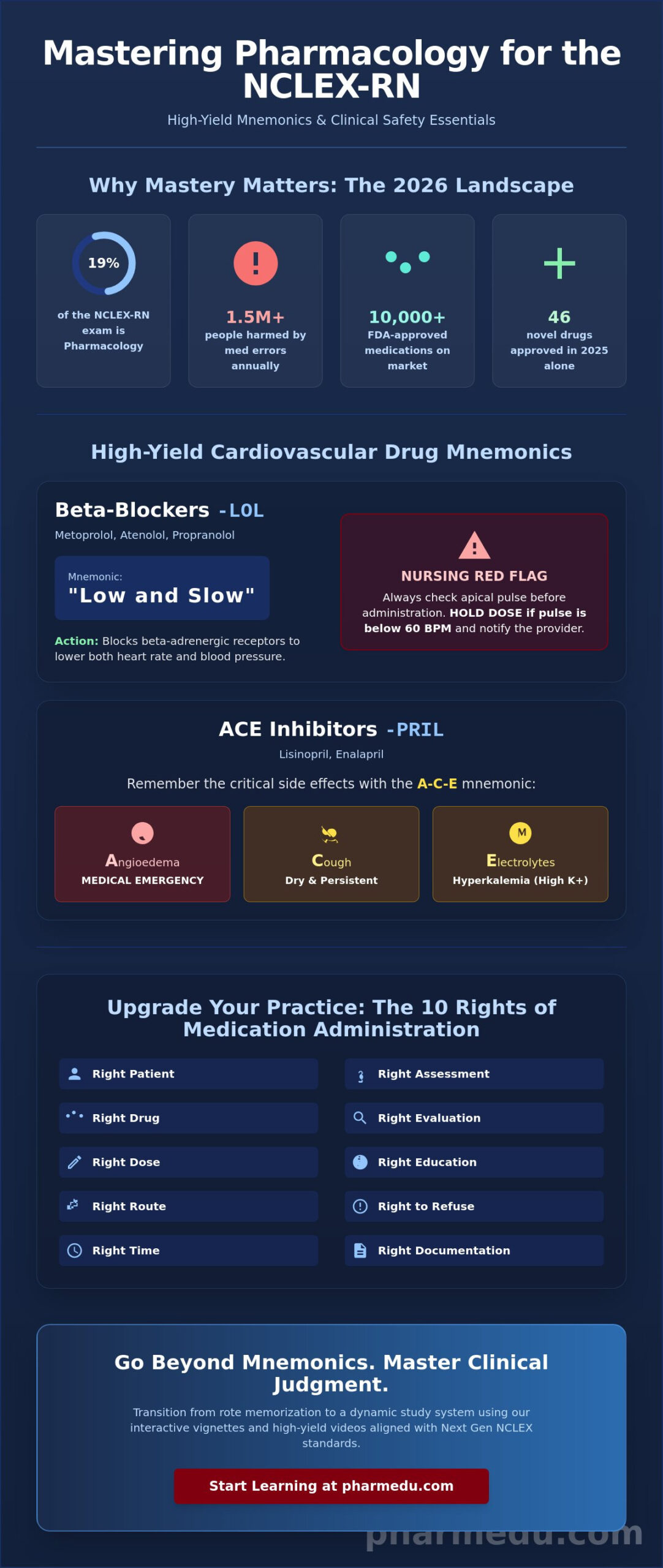
Did you know that pharmacology questions account for up to 19% of the 2026 NCLEX-RN exam, yet medication errors still harm more than 1.5 million people in the U.S. every year? It’s a staggering reality that makes mastering pharmacology mnemonics for nursing a necessity rather than a luxury. We understand that staring at the 46 novel drug approvals from 2025 feels like trying to memorize a new language while the stakes of patient safety hang in the balance. You’re likely tired of dense textbooks and the constant fear of mixing up similar-sounding medications during clinical rotations.
This guide transforms that information overload into a structured, manageable path toward mastery. We’ve designed these memory tricks to help you build the mental hooks necessary for rapid recall of drug suffixes, prefixes, and critical side effects. We’ve updated our approach to include the latest biosimilars like Omlyclo and the expanded 10 Rights of medication administration. Read on to discover the clinical pearls and memory tricks that will help you identify red flag symptoms and pass your pharmacology courses with total confidence.
Key Takeaways
- Discover how to simplify over 10,000 FDA-approved medications using high-yield pharmacology mnemonics for nursing that reduce cognitive load and improve exam recall.
- Master the “Pressure Duo” and “Low and Slow” techniques to confidently distinguish between complex cardiovascular drug classes like ACE inhibitors and beta-blockers.
- Upgrade your clinical practice from the traditional 5 Rights to the modern 10 Rights of medication administration to ensure patient safety in every rotation.
- Gain immediate clarity on high-alert medication categories, including central nervous system depressants and the “Big Guns” of antibiotic therapy.
- Learn how to transition from rote memorization to a dynamic study system using visual anchors and interactive vignettes aligned with Next Gen NCLEX standards.
Mastering Pharmacology Mnemonics for Nursing: Why Memory Aids Matter in 2026
Pharmacology mnemonics for nursing are systematic memory aids designed to categorize drug classes, side effects, and nursing considerations into retrievable mental files. As of May 2026, the sheer volume of pharmaceutical data is overwhelming. With over 10,000 FDA-approved medications currently on the market and 46 novel drugs approved by the CDER in 2025 alone, the cognitive load on nursing students has reached a breaking point. These mnemonics serve as essential mental scaffolding, bridging the gap between complex pharmacology and the underlying pathophysiology that dictates patient care.
Relying on memory aids isn’t just a shortcut; it’s a strategic necessity for reducing test anxiety. When a student encounters a “select all that apply” question on the NCLEX-RN, where pharmacology accounts for 13-19% of the total score, a well-placed mnemonic provides the clarity needed to filter out distractors. By organizing information into predictable patterns, students can improve their recall speeds and focus their energy on higher-level clinical reasoning.
The Science of Mnemonic Retention in Medical Education
The effectiveness of these tools is rooted in dual-coding theory, which suggests that the brain processes verbal and visual information through separate channels. When you pair a drug suffix with a narrative cue or a rhyme, you’re creating multiple pathways for retrieval. This is why “rhyme and reason” mnemonics consistently outperform simple list memorization in long-term retention studies. For a broader context, students often refer to a List of medical mnemonics to see how these patterns apply across different specialties. Chunking is the psychological method of grouping individual drug suffixes or prefixes into larger, meaningful categories to bypass the limitations of short-term memory.
Transitioning from Rote Memory to Clinical Judgment
While mnemonics are powerful, they represent only the first step in the “Learn-Apply-Assess” framework. A mnemonic tells you what the drug is, but it doesn’t replace the need to understand the mechanism of action (MOA). Safe practice requires knowing why a medication works, not just how to spell its class. In 2026, clinical safety standards have evolved to include the 10 Rights of medication administration, making it even more critical to move beyond simple acronyms. PharmEDU’s High-Yield Video Vignettes reinforce these mnemonic hooks by placing them within visual clinical scenarios. This approach ensures that when you’re on the floor during a rotation, the memory aid triggers an immediate understanding of the patient’s physiological response rather than just a dry definition.
High-Yield Cardiovascular and Renal Drug Mnemonics
Cardiovascular medications represent a significant portion of the 13 to 19 percent pharmacology weighting on the NCLEX-RN. Mastering pharmacology mnemonics for nursing in this category is essential because these drugs directly manage critical hemodynamics. When you’re managing a patient on a telemetry floor, you don’t have time to second-guess whether a medication will raise or lower a heart rate. You need immediate, reliable recall to ensure patient safety and clinical precision.
Beta-blockers are a perfect example of how a simple suffix provides a wealth of clinical data. When you see the “-LOL” suffix (such as Metoprolol or Atenolol), remember that it stands for “low and slow.” These agents block beta-adrenergic receptors, which effectively lowers both heart rate and blood pressure. Before administration, always check the apical pulse; if the rate is below 60 beats per minute, you must hold the dose and notify the provider. Similarly, Calcium Channel Blockers can be remembered using the phrase “Very Nice Drugs,” representing Verapamil, Nifedipine, and Diltiazem. These agents act as a “calm” for the heart and vasculature, though they require careful monitoring for peripheral edema and bradycardia.
ACE Inhibitors: The “-PRIL” Suffix and Side Effects
ACE inhibitors are the first half of the “Pressure Duo,” easily identified by the “-PRIL” suffix. To remember the most common “red flag” side effects, use the “A-C-E” mnemonic: Angioedema (a medical emergency), Cough (dry and persistent), and Electrolyte imbalance (specifically hyperkalemia). Because these drugs interfere with the renin-angiotensin-aldosterone system, they cause the body to retain potassium. You should always review the ACE inhibitors pharmacology guide for a deeper look at how these mechanisms impact renal perfusion. A key nursing intervention is checking both blood pressure and serum potassium levels before the patient takes their first morning dose.
The “Mean” Diuretics and Digoxin Toxicity
Differentiating between diuretics is a common stumbling block. Use the “S” rule: Spironolactone is Potassium-Sparing, meaning it keeps potassium in the body. In contrast, “mean” diuretics like Furosemide (a Loop diuretic) “flush” potassium out, often leading to hypokalemia. This distinction is vital when a patient also takes Digoxin. Low potassium levels significantly increase the risk of Digoxin toxicity. You can identify this toxicity using the “DIG” mnemonic: Decreased heart rate, Impaired vision (often described as yellow-green halos), and Gastrointestinal upset like nausea or vomiting. Many students find that using nursing pharmacology mnemonics helps them categorize these interactions during high-pressure clinical rotations. If you want to test your ability to spot these “red flags” in real-time, our interactive pharmacology flashcards provide the perfect environment for practice.
Navigating the Maze: Mnemonics for Antibiotics and CNS Medications
Infectious diseases and neurological disorders require a pharmacological precision that leaves no room for error. When you’re managing “Big Gun” antibiotics or potent central nervous system (CNS) agents, the volume of data can feel like a maze. Utilizing pharmacology mnemonics for nursing helps you categorize these high-potency drugs by their toxicity profiles and therapeutic windows. While penicillins and cephalosporins often share a cross-sensitivity risk of about 10%, other classes like aminoglycosides require much more rigorous monitoring to prevent permanent organ damage.
Distinguishing between CNS depressants is another common hurdle for students. Benzodiazepines, typically ending in “-pam” or “-lam,” act as the “gentler” cousin to barbiturates, which often end in “-tal.” You can remember that “Ben” (Benzodiazepines) is more common and often used for anxiety or conscious sedation, while “Barb” (Barbiturates) are the heavy hitters used for anesthesia or refractory seizures. For a deeper dive into these categories, you can explore Pharmacology Nursing Mnemonics & Tips to see how these memory anchors apply to real-world patient scenarios.
Aminoglycosides: “A Mean Old Guy” Destroys Ears and Kidneys
Aminoglycosides, such as Gentamicin and Neomycin, are known as the “Mean Old Mycin” drugs because of their significant adverse effects. The mnemonic “A Mean Old Guy” reminds you that these drugs are ototoxic (ears) and nephrotoxic (kidneys). You must monitor for tinnitus and hearing loss, as well as rising BUN and creatinine levels. The “Peak and Trough” rule is non-negotiable here; you’ll typically draw the trough level 30 minutes before the next dose and the peak level 30 minutes after the infusion is complete. Aminoglycosides have a narrow therapeutic index, meaning the difference between a life-saving dose and a toxic one is incredibly small.
Opioids: The “MORPHINE” Side Effect Acronym
Opioid analgesics are high-alert medications that require vigilant assessment. The “MORPHINE” mnemonic provides a comprehensive checklist for potential adverse reactions:
- Miosis (pinpoint pupils)
- Orthostatic hypotension
- Respiratory depression
- Physical dependence
- Histamine release (causing itching and flushing)
- Increased ICP (intracranial pressure)
- Nausea
- Euphoria
Your priority nursing assessment is always the respiratory rate. If the rate drops below 12 breaths per minute, you must prepare for intervention. In cases of acute overdose, Naloxone (Narcan) serves as the universal “reversal” agent, a critical mnemonic for any emergency or post-operative setting.
Psychiatric and Parkinson’s Medications
Managing Parkinson’s disease often involves the “ALBM” rule to remember common agents: Amantadine, Levodopa, Bromocriptine, and MAOIs. These drugs aim to increase dopamine or decrease acetylcholine levels to manage motor symptoms. When transitioning to psychiatric care, remember that Selective Serotonin Reuptake Inhibitors (SSRIs) don’t work overnight. It’s vital to educate patients that these medications typically take 4 to 6 weeks to reach full therapeutic effect, a fact that frequently appears on pharmacology exams.
Clinical Safety Mnemonics: Reducing Medication Errors in Nursing Practice
Medication errors remain a significant challenge in modern healthcare, with hospital error rates averaging 6.5 incidents for every 100 admissions. In these high-stakes environments, pharmacology mnemonics for nursing act as a critical safety net, helping you maintain precision when fatigue sets in. While the traditional “5 Rights” provided a foundational start, the 2026 nursing standards have expanded to a 10-point framework. This modern approach adds the right to refuse, right knowledge, right to challenge, right advice, and right response to the core administration process. These additions ensure that you aren’t just a passive administrator but an active advocate for patient safety.
Emergency situations require even faster cognitive retrieval. When a patient’s status deteriorates, you can “LEAN” on your emergency drug knowledge: Lidocaine, Epinephrine, Atropine, and Narcan. These are the primary agents used in various resuscitation and reversal scenarios. For patient education, the “SEA CASH” mnemonic helps you recall the warning signs of hormonal birth control complications, such as Severe leg pain, Eye problems, Abdominal pain, Chest pain, and Severe headaches. Integrating these pharmacology mnemonics for nursing into your clinical workflow transforms abstract drug facts into actionable safety protocols.
The TRAMP Framework for Safe Administration
The TRAMP checklist is a staple for every clinical rotation, standing for Time, Route, Amount (Dose), Medication, and Patient. To be truly effective, you must perform a “triple-check” of these five elements: first at the medication dispensing system, second when preparing the dose, and finally at the patient’s bedside. Don’t overlook the importance of “Right Documentation.” Recording the administration immediately after it occurs is the only way to prevent dangerous double-dosing errors during shift changes or care transitions. If you want to move beyond simple memorization and start applying these frameworks to real-world scenarios, our Pharmacology Practice Quizzes allow you to test your knowledge in a risk-free environment.
Lidocaine Toxicity and Emergency Responses
Recognizing the early signs of drug toxicity is just as vital as the administration itself. For lidocaine, remember “S-A-M-S” to identify Slurred speech, Altered central nervous system (CNS) states, Muscle twitching, and Seizures. If you encounter a patient with symptomatic bradycardia, the “IDEA” mnemonic outlines your primary pharmacological options: Isoproterenol, Dopamine, Epinephrine, and Atropine. These systematic responses are aligned with the comprehensive pharmacy review standards expected in 2026 board exams. By mastering these safety-focused anchors, you ensure that your clinical judgment remains sharp even during the most demanding shifts.
Beyond Rote Memorization: Building Your 2026 Pharmacology Study System
Rote memorization is a fragile foundation for a modern nursing career. While pharmacology mnemonics for nursing provide the necessary mental hooks, the 2026 NCLEX-RN Next Gen questions demand deep clinical judgment. You can’t just know that a drug belongs to a specific class; you’ve got to predict how it affects a patient with complex comorbidities. Static, paper-based flashcards often fail here because they lack the physiological context and interactive feedback required for modern nursing. To truly master the material, you need a system that pairs memory aids with active recall and clinical visualization.
The active recall method involves testing yourself before you feel completely ready. It’s about forcing your brain to retrieve information, which strengthens neural pathways much more effectively than passive reading. Leveraging micro-learning segments during your 15-minute clinical breaks can turn dead time into high-yield study sessions. These short bursts of focus prevent the mental fatigue that comes with marathon study sessions and help you stay sharp during long shifts.
Creating a Digital Pharmacology Toolkit
A modern toolkit uses technology to bridge the gap between theory and practice. PharmEDU’s high-yield video vignettes help you visualize a mnemonic within a specific patient case, making the side effects feel real rather than abstract. You should set up a spaced-repetition schedule for the drug classes you find most challenging, ensuring you revisit them at optimal intervals. This transition from simply recognizing a drug name to predicting a patient’s clinical outcome is the hallmark of a prepared nurse. Our pharmacology study guide for nursing students provides the structured framework needed to execute this transition successfully.
Final NCLEX Prep Strategy for 2026
As you approach your exam date, practice the “brain dump” technique. The moment you sit down for the NCLEX, write your most vital pharmacology mnemonics for nursing on your provided whiteboard. This strategy offloads the cognitive burden, allowing you to focus on the critical thinking required for complex case studies. If you’re looking ahead to advanced practice or specialized roles, aligning your knowledge with NAPLEX prep course level standards will give you a significant advantage. You have the tools and the memory anchors; now it’s time to apply the system with confidence. Your professional journey depends on this precision, and we’re here to support that growth every step of the way.
Securing Your Future as a Safe and Confident Nurse
Mastering pharmacology is the single most effective way to protect your patients and your license in an increasingly complex healthcare environment. By integrating pharmacology mnemonics for nursing with a structured study system, you’ve moved beyond simple memorization to true clinical application. You now have the tools to navigate the 13 to 19 percent of the NCLEX dedicated to pharmacology and the clinical judgment to implement the modern 10 Rights of medication administration. These mental anchors don’t just help you pass exams; they provide the safety net required to prevent errors in a field where over 1.5 million people are harmed every year by preventable mistakes.
Don’t let information overload stall your progress. You can access over 100 high-yield video vignettes, interactive NCLEX-style practice quizzes, and a mobile-compliant design built for your busy clinical schedule. Master Pharmacology with PharmEDU’s High-Yield Subscription today and turn your study time into a professional advantage. You’ve done the hard work of learning the foundations. Now, it’s time to apply this knowledge with the precision and confidence that your future patients deserve.
Frequently Asked Questions
What are the most common pharmacology mnemonics for nursing students?
Common mnemonics include SLUDGE for cholinergic crisis, representing Salivation, Lacrimation, Urination, Defecation, Gastric upset, and Emesis. Another essential tool is the “P-450” inhibitors list for managing drug-to-drug interactions. These pharmacology mnemonics for nursing help you categorize complex receptor interactions into predictable symptoms, allowing you to quickly identify whether a patient is experiencing a therapeutic effect or a life-threatening toxicity during clinical rotations.
How do I remember the difference between ACE inhibitors and ARBs?
Differentiate these by looking at the suffix: ACE inhibitors end in “-pril” while ARBs end in “-sartan.” ACE inhibitors block the conversion of Angiotensin I to II, which often leads to a persistent dry cough. In contrast, ARBs block the receptor itself and typically don’t cause this side effect. This distinction is a high-yield topic for the 13 to 19 percent of pharmacology questions found on the NCLEX-RN.
Is the TRAMP mnemonic still used in clinical practice?
The TRAMP mnemonic remains a foundational safety tool in 2026, even as it’s integrated into broader 10-point clinical workflows. It stands for Time, Route, Amount, Medication, and Patient. While modern electronic health records provide automated alerts, manually performing these checks at the bedside is still the gold standard for preventing the 1.5 million annual medication errors reported in the United States.
How can mnemonics help with NCLEX-RN Next Gen questions?
Mnemonics provide a “knowledge anchor” during the complex, multi-stage case studies featured in Next Gen questions. When you’re presented with a patient’s lab values and current medications, a mnemonic allows you to quickly filter out irrelevant data and focus on critical drug interactions. This mental organization is essential for managing the significant 13 to 19 percent pharmacology weighting on the current exam.
What is the best way to memorize antibiotic classes?
The most effective method is grouping antibiotics by their mechanisms of action and common suffixes. For instance, penicillins end in “-cillin” and cephalosporins start with “cef-,” both targeting the bacterial cell wall. Using pharmacology mnemonics for nursing, such as “A Mean Old Guy” for aminoglycosides, helps you remember specific toxicities like ototoxicity and nephrotoxicity that are unique to high-potency classes.
Can mnemonics replace the need to study the mechanism of action?
Mnemonics can’t replace the study of the mechanism of action (MOA); they serve as a retrieval cue rather than a replacement for deep understanding. While a mnemonic helps you remember a drug’s name or side effects, knowing the MOA is what allows you to apply clinical judgment in unpredictable patient scenarios. Safe practice in 2026 requires both the memory hook and the physiological “why” behind the drug.
How many “Rights of Medication Administration” should I know for the boards?
You should be familiar with the 10 Rights of Medication Administration for the 2026 boards. While the traditional 5 Rights are still core, modern exams often include the right to refuse, right documentation, right knowledge, right to challenge, and right response. Mastering all 10 ensures you’re prepared for the safety-focused questions that dominate the NCLEX pharmacology section and daily clinical practice.
Are there specific mnemonics for emergency cardiac drugs?
The “MONA” mnemonic for myocardial infarction is a critical standard: Morphine, Oxygen, Nitroglycerin, and Aspirin. Additionally, the “IDEA” mnemonic (Isoproterenol, Dopamine, Epinephrine, Atropine) is used for treating symptomatic bradycardia. These systematic responses are vital when a patient’s hemodynamic status changes rapidly, requiring you to implement immediate pharmacological intervention without any hesitation or delay.