
The Best Way to Use Flashcards for Pharmacology: A Science-Based Guide for 2026
Flashcards are not actually for learning new information; they’re a defense mechanism designed to stop you from forgetting what you’ve already studied. Many students struggle with cognitive overload because they treat their decks like digital textbooks, leading to a pile of 100+ drug classes that feel impossible to manage. If you’ve been searching for the best way to use flashcards for pharmacology, you’ve likely realized that the secret isn’t in how many cards you make, but in how you apply the “Minimum Information Principle” to your study sessions.
It’s frustrating to spend hours crafting perfect cards only to blank on a mechanism of action during a high-stakes exam. We understand that your time is your most valuable asset during clinical rotations and board prep. This guide will show you how to transform your study routine using proven active recall and spaced repetition strategies that support long-term retention. We’ll explore how to structure your cards for maximum efficiency, the benefits of digital platforms like PharmEDU, and a repeatable system that moves you from rote memorization to clinical mastery.
Key Takeaways
- Master the science of active recall to combat the Ebbinghaus Forgetting Curve and retain complex drug classes long after your initial study session.
- Implement the Minimum Information Principle as the best way to use flashcards for pharmacology, ensuring each card focuses on a single, high-yield fact to prevent cognitive overload.
- Transition from unmanageable physical decks to digital workflows that use algorithm-based scheduling to prioritize your weakest subjects automatically.
- Adopt the “First Pass” rule to ensure you’re reinforcing a deep clinical understanding rather than simply memorizing words without context.
- Leverage interactive tools like PharmEDU’s pre-made decks and video vignettes to reduce the time spent on card creation and focus your energy on active review.
The Science of Memory: Why Flashcards are Essential for Pharmacology
Pharmacology often feels like a relentless tide of drug names, mechanisms, and side effects. To manage this volume, you need more than just effort; you need a system rooted in cognitive science. Active recall is the process of deliberately challenging your brain to retrieve a piece of information from memory during the learning phase. Instead of looking at a page and recognizing a term, you’re forcing your mind to reconstruct it. This is the best way to use flashcards for pharmacology because it bridges the gap between seeing and knowing, ensuring your knowledge is accessible when you’re under pressure in a clinical setting.
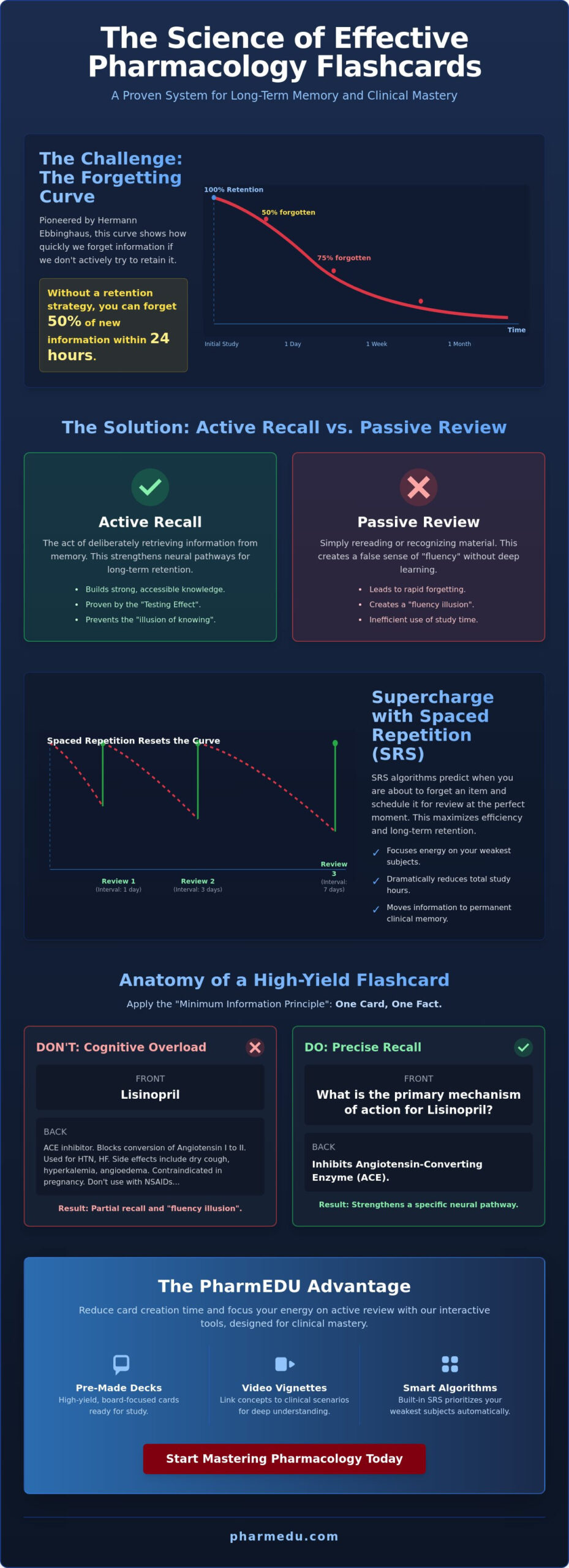
Hermann Ebbinghaus, a pioneer in memory research, described the “Forgetting Curve,” which illustrates how quickly information slips away if it isn’t reinforced. Pharmacology is uniquely susceptible to this decay because drug classes often lack intuitive connections, requiring the memorization of arbitrary prefixes and suffixes alongside complex biochemical pathways. Without a strategy, you’ll likely forget 50% of what you read within 24 hours. The objective is to move drug data from fragile short-term recognition to permanent clinical memory. This transition requires a structured approach:
- Initial comprehension of the drug’s physiological impact.
- Frequent, low-stakes testing through high-yield flashcards.
- Strategic intervals between reviews to maximize retention.
Active Recall vs. Passive Review
Many students make the mistake of reading a pharmacology study guide for nursing students repeatedly, hoping the information will stick through sheer exposure. This is passive review. While reading is necessary for the initial understanding, it doesn’t build long-term retention. The “Testing Effect” proves that the act of retrieval actually strengthens neural pathways. Every time you successfully retrieve the side effects of an ACE inhibitor without looking at your notes, you’re physically altering your brain’s architecture. Passive review often creates a “fluency illusion,” where you feel like you know the material because the text looks familiar, but you fail to recall it when the textbook is closed.
The Role of Spaced Repetition (SRS) in 2026
The modern approach to clinical education relies on The Science of Spaced Repetition. Spaced Repetition Systems (SRS) use algorithms to predict exactly when you’re about to forget a drug’s mechanism of action. By reviewing the card at that precise moment, you reset the forgetting curve. This method replaces the traditional “cramming” cycle with distributed practice, which is far more effective for board exams. Instead of wasting time on drugs you already know, SRS focuses your energy on your weakest areas, significantly reducing total study hours while improving long-term clinical memory. Adopting an SRS-driven platform is the best way to use flashcards for pharmacology if you want to ensure that life-saving information is available when you’re actually treating patients.
The Anatomy of a High-Yield Pharmacology Flashcard
Creating effective study materials requires more than just copying textbook sentences onto a digital card. The best way to use flashcards for pharmacology is to apply the “Minimum Information Principle.” This principle dictates that every card should test exactly one specific fact. When you clutter a card with multiple side effects or interactions, your brain often relies on partial recall, where you remember some details but fail to master the whole. By isolating information, you ensure that each retrieval attempt is clear and unambiguous, which builds the precision needed for clinical practice.
Structuring the front of your card is equally vital for long-term retention. Avoid broad, vague prompts like “Lisinopril.” Instead, use specific questions such as “What is the primary mechanism of action for Lisinopril?” This forces your brain to target a precise neural pathway. On the back, keep your answers concise. Focus on “must-know” board facts rather than exhaustive clinical descriptions that are better suited for a textbook. Integrating evidence-based learning strategies into your card design, such as adding iconography or visual cues, can also help link drug names to their mechanisms more effectively.
Rule 1: One Fact per Card
Avoid the temptation to create “list” cards. For instance, asking yourself to “List all six side effects of ACE inhibitors” is a recipe for cognitive fatigue and inconsistent grading. Instead, break down ACE inhibitors pharmacology into atomic units. Create one card for the mechanism of action, another for the dry cough side effect, and a third for the risk of angioedema. These “atomic” cards prevent the partial recall trap, ensuring you don’t mistakenly think you’ve mastered a drug class just because you remembered the easiest fact on a long list.
Using Mnemonics and Memory Palaces
Incorporate drug suffixes directly into your card headers to build instant associations. Recognizing that “-pril” indicates an ACE inhibitor or “-sartan” identifies an ARB allows you to group drugs logically within your mental library. You can also use “If/Then” logic for contraindications, such as “If a patient has a history of angioedema, then which antihypertensive class is contraindicated?” For complex pharmacology definitions, cloze deletion cards, which hide a specific word in a sentence, are incredibly effective for mastering clinical terminology. If you find card creation too time-consuming, using interactive pharmacology flashcards from a professional platform can provide high-yield structure without the heavy administrative burden of manual entry.
Digital vs. Physical Flashcards: Optimizing Your Workflow
Choosing between digital and physical formats is a pivotal decision for any healthcare student. While index cards have a certain nostalgic appeal, the best way to use flashcards for pharmacology in a modern curriculum involves leveraging technology to handle the sheer volume of data. Physical decks face a maintenance cost that becomes unsustainable once you surpass roughly 500 drugs. Managing that many paper cards requires manual sorting and constant shuffling. This eats into your actual study time and creates unnecessary administrative friction.
Digital platforms offer searchability and portability that paper cannot match. When you’re on a clinical rotation, having your entire pharmacopeia synced across your phone and tablet allows for micro-learning during brief breaks. You can review five cards while waiting for a preceptor or during a commute. This ensures that your review schedule remains uninterrupted, even on your busiest days. It turns “dead time” into productive sessions that reinforce your long-term retention.
The Power of Digital SRS Platforms
The real advantage of digital tools lies in their ability to automate the forgetting curve. As noted by the American College of Physicians regarding successful learning in medical school, retrieval practice is significantly enhanced by software that tracks your performance. Digital platforms allow for sophisticated tagging, letting you organize cards by organ system, drug class, or even the date of your next exam. They also allow for the integration of embedded media, such as high-yield video vignettes, which provide vital clinical context that a plain text card simply lacks.
When Physical Cards Still Make Sense
Despite the digital shift, physical cards still have a place in a hybrid workflow. They are excellent for big-picture mapping where you lay cards out on a table to visualize drug classifications and hierarchies. Physical cards also facilitate peer-quizzing and group study sessions where passing cards back and forth creates a more interactive environment. However, the manual sorting required is a significant drawback. If you spend 20 minutes organizing cards for every hour of studying, you’re losing nearly a quarter of your productivity. Ultimately, the best way to use flashcards for pharmacology is to adopt a system that minimizes time spent on organization and maximizes time spent on active retrieval.
Advanced Strategies: Integrating Cards into a Clinical Schedule
Integrating flashcards into a clinical schedule requires more than just discipline; it demands a tactical approach to your daily routine. The ‘First Pass’ Rule is the most critical guideline here: never create or review a card for a concept you don’t fully understand. If you’re memorizing that a drug causes a specific side effect without knowing the underlying physiological reason, you’re building a house on sand. This foundational understanding is the best way to use flashcards for pharmacology because it transforms a list of isolated facts into a resilient web of clinical knowledge. When you understand the ‘why,’ the ‘what’ becomes much easier to retain.
To maintain this system without burning out, you must implement strict time-blocking. Separate your “Review” sessions from your “New Card” sessions. Reviews should happen when your brain is fresh, ideally first thing in the morning, to ensure you never fall behind on your spaced repetition schedule. Creating new cards or learning new drug classes is a different cognitive task that requires deep focus and should be scheduled separately. If you find yourself facing a massive backlog of reviews, don’t panic. Prioritize the oldest cards first and limit the number of new cards you introduce until the backlog is cleared. Linking these cards to clinical case studies ensures that the information remains grounded in real-world patient care rather than abstract theory.
From Video Vignette to Flashcard
The PharmEDU approach streamlines this process by pairing high-yield video vignettes with interactive flashcards. Instead of transcribing a textbook, you watch a concise clinical scenario that explains the mechanism and application of a drug class. Immediately after the video, you engage with the related cards to encode the information while it’s still fresh. To extract cards effectively from a lecture, focus on the ‘clinically relevant’ pearls mentioned by the instructor, such as unique contraindications or first-line indications, rather than trying to capture every minor detail. This immediate transition from passive watching to active retrieval is the best way to use flashcards for pharmacology to ensure long-term retention.
Flashcards on the Wards
Clinical rotations offer unique opportunities for “micro-learning.” You can use the minutes spent in elevators or commuting to knock out a quick burst of reviews on your mobile device. This habit prepares you for morning rounds and protects you from being caught off guard during clinical ‘pimping’ sessions by senior staff. As you transition from simple recall to complex clinical decision-making, these strategies become the foundation for professional success, whether you’re researching how to become a pharmacist or preparing for a residency. To bridge the gap between study and practice, subscribe to PharmEDU today and access our comprehensive library of interactive pharmacology tools.
PharmEDU: The Ultimate Interactive Flashcard Platform
While understanding the cognitive science of active recall is essential, the practical implementation of these strategies is where most healthcare students encounter friction. The best way to use flashcards for pharmacology in a modern clinical environment is to utilize a platform that integrates these principles into a seamless, professionally curated ecosystem. PharmEDU provides a comprehensive solution that eliminates the administrative burden of card creation, allowing you to focus entirely on mastery and retention. Our platform features high-yield pharmacology decks integrated with over 100 specialized topics, ensuring that your study sessions are both broad in scope and deep in clinical relevance.
The platform is designed with a mobile-compliant interface to support micro-learning during the unpredictable hours of a clinical rotation. Whether you have five minutes between patient consultations or a longer break during a shift, you can access interactive pharmacology flashcards that sync across all your devices. For educators and program directors, PharmEDU offers an Institutional Platform License that includes robust tracking tools. These features allow faculty to monitor student progress in real time, ensuring that entire cohorts are meeting the necessary benchmarks for board exam readiness and clinical safety.
Why Pre-Made Cards Beat DIY
The traditional advice to “make your own cards” often collapses under the weight of a heavy pharmacology curriculum. Students frequently report saving over 100 hours of data entry per semester by switching to PharmEDU’s pre-made decks. Beyond time savings, using professionally developed cards ensures you’re studying expert-vetted content. You won’t risk memorizing outdated dosing guidelines or incorrect mechanisms of action. Every card on our platform follows the ‘Minimum Information Principle’ discussed earlier, providing consistent formatting that prevents the cognitive fatigue associated with poorly structured, amateur decks.
Join the PharmEDU Community
Success in pharmacology requires a multi-modal approach that goes beyond simple memorization. By joining the PharmEDU community, you gain access to a full suite of educational tools, including pharmacology practice quizzes and clinical case studies that provide the necessary context for the facts you’ve learned. Our high-yield video vignettes serve as the perfect ‘first pass’ before you dive into retrieval practice, creating a logical flow from initial understanding to long-term retention. We offer flexible subscription options tailored to individual learners and university programs alike. Start your PharmEDU subscription today and master pharmacology with the most efficient, science-based tools available in 2026.
Mastering Clinical Pharmacology in 2026
Transitioning from passive recognition to active mastery requires a shift in how you approach your study materials. By prioritizing the “Minimum Information Principle” and leveraging automated spaced repetition algorithms, you protect your clinical knowledge against the natural decay of the forgetting curve. Integrating these evidence-based strategies into your clinical schedule is the best way to use flashcards for pharmacology. It’s not just about passing an exam; it’s about ensuring patient safety through reliable, long-term recall of drug mechanisms and contraindications.
Modern healthcare education demands tools that keep pace with your schedule. PharmEDU provides an integrated ecosystem featuring over 100 high-yield topics, interactive case studies, and pharmacology practice quizzes. Our mobile-compliant design supports micro-learning segments, allowing you to reinforce your knowledge during clinical rotations or commutes. Start Your High-Yield Pharmacology Review with PharmEDU and transform your study routine into a repeatable system for professional success. You’ve the potential to master this complex field; let’s help you get there with precision and confidence.
Frequently Asked Questions
How many pharmacology flashcards should I study per day?
Aim for 20 to 50 new cards daily while prioritizing all due reviews to maintain your spaced repetition schedule. This prevents a backlog from becoming unmanageable and overwhelming. The best way to use flashcards for pharmacology is to treat reviews as a non-negotiable daily task rather than a marathon session. Consistency ensures that drug data moves steadily into long-term memory without causing cognitive fatigue.
Is Anki better than Quizlet for pharmacology board prep?
Anki is generally superior for long-term retention due to its dedicated spaced repetition algorithm, whereas Quizlet often focuses on recognition-based learning. Many users in 2026 have expressed frustration with Quizlet, reflected in its 1.4/5 star rating on Trustpilot, due to previously free features moving behind paywalls. Professional platforms like PharmEDU offer a more structured, high-yield alternative specifically designed for healthcare students.
Should I include side effects and contraindications on the same card?
No, you should always separate side effects and contraindications into distinct cards to avoid the partial recall trap. Applying the Minimum Information Principle ensures that your brain focuses on one specific retrieval task at a time. For example, create one card for the “dry cough” side effect of ACE inhibitors and a separate card for the “pregnancy” contraindication. This precision is vital for clinical safety.
When is the best time to start using flashcards during the semester?
Start using flashcards on the very first day of your pharmacology course. Don’t wait until the weeks leading up to your board exams or midterms to begin your reviews. By starting early, you flatten the forgetting curve and reduce the daily review load. Early adoption allows you to integrate new drug classes incrementally, which is the best way to use flashcards for pharmacology throughout a busy semester.
Can flashcards help with clinical reasoning or just memorization?
Flashcards primarily aid memorization, but they can support clinical reasoning if you use “If/Then” scenarios or cloze deletions. For instance, a card could ask for the first-line treatment for a patient with both hypertension and diabetes. This forces you to apply your knowledge of drug classes to a clinical context. Pairing cards with interactive case studies further strengthens this bridge between theory and practice.
What should I do if I get a flashcard wrong three times in a row?
If you miss a card three times, it is considered a “leech” and you should stop reviewing it immediately to re-study the underlying concept. Persistent failure suggests you haven’t properly encoded the information during your first pass. Step back and watch a high-yield video vignette or read a clinical case study to understand the “why” behind the fact. Once the concept is clear, you can resume testing.
Is it better to make my own flashcards or use pre-made ones?
Using pre-made, expert-vetted cards is often more efficient than making your own, especially when managing hundreds of drug classes. While some claim making cards helps with learning, it often results in over 100 hours of administrative data entry. PharmEDU’s interactive flashcards follow strict formatting rules and are vetted for accuracy, ensuring you aren’t memorizing outdated information or poorly structured prompts.
How do I avoid ‘flashcard burnout’ during a long study season?
Avoid burnout by using time-blocking and taking advantage of mobile-compliant micro-learning segments. Instead of sitting for a three-hour session, break your reviews into ten-minute bursts during clinical rotations or commutes. This distributed practice keeps your mind fresh and prevents the psychological weight of a massive backlog. Remember that the goal is consistent, long-term retention, not short-term exhaustion.