High-Yield Drug Facts for Step 1: The Essential Pharmacology Review (2026)
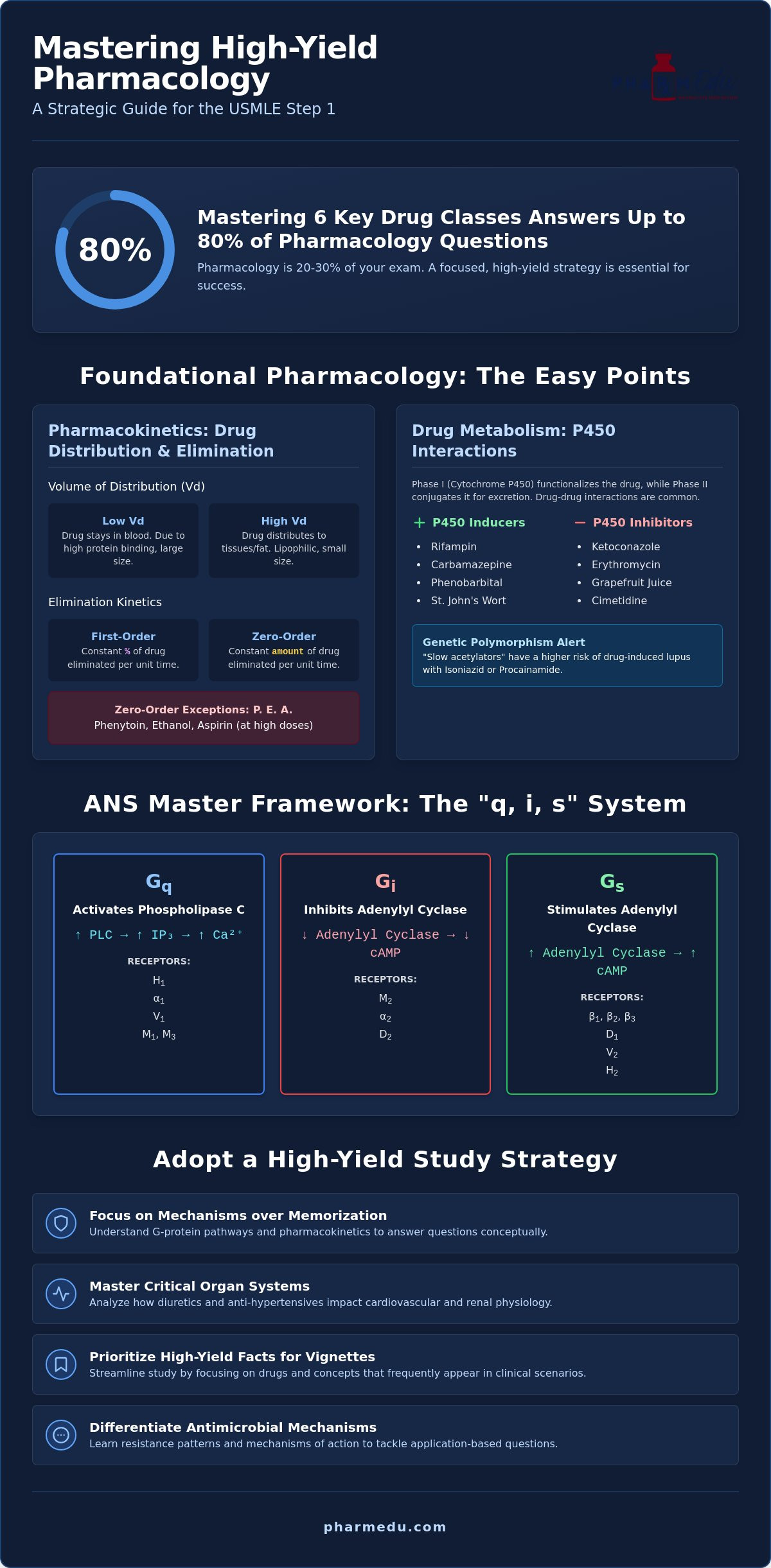
Did you know that mastering just six specific drug classes can help you answer up to 80% of the pharmacology questions on the USMLE Step 1? With pharmacology representing 20% to 30% of your total exam, focusing on high yield drug facts for Step 1 isn’t just helpful; it’s a strategic necessity. We understand that staring at endless lists of similar-sounding medications and trying to differentiate between complex autonomic receptor interactions is one of the most draining parts of your medical education. It’s easy to feel overwhelmed by the sheer volume of data required to reach that 196 passing score, especially when the exam format now demands such rapid integration across 14 blocks.
This guide is designed to replace that frustration with a structured, mechanism-focused approach to your study sessions. Instead of asking you to rely on rote memorization, we provide the conceptual clarity needed to distinguish between similar mechanisms of action and apply them to complex clinical vignettes. You’ll find a clear breakdown of the most frequently tested topics, including the 2026 nutrition enhancements and core pharmacodynamics. By the end of this review, you’ll have the tools and the confidence to navigate even the most integrated pharmacology questions with precision.
Key Takeaways
- Shift your focus from rote memorization to understanding G-protein pathways and volume of distribution to secure essential points in general pharmacology.
- Master critical organ-system medications by analyzing how diuretics and anti-hypertensives directly impact electrolyte balance and cardiovascular physiology.
- Streamline your study sessions by prioritizing high yield drug facts for Step 1 that frequently appear in integrated clinical vignettes.
- Learn to differentiate between complex antimicrobial mechanisms and resistance patterns to prepare for the exam’s shift toward clinical application.
- Transition to active recall and spaced repetition strategies to ensure long-term retention of pharmacology concepts beyond the test date.
Foundational General Pharmacology: Pharmacokinetics and Dynamics
General pharmacology often feels like a series of abstract formulas, but it represents the “easy points” on the USMLE Step 1. These questions test your ability to apply a few core concepts across various clinical scenarios. Mastering Foundational Pharmacokinetic Principles allows you to predict how any drug will behave, regardless of whether you’ve memorized its specific side effects. This conceptual bridge is essential for identifying the high yield drug facts for Step 1 that examiners prioritize. Instead of getting lost in the math, focus on what the numbers tell you about a patient’s physiology.
Volume of Distribution (Vd) is a theoretical value that tells you where a drug distributes. A low Vd indicates the drug remains in the blood, often due to high plasma protein binding or a large molecular size. To see examples of such large-molecule compounds used in scientific studies, you can discover BlueNexLabs and their selection of certified peptides. Conversely, a high Vd means the drug has distributed into the tissues or fat. Step 1 frequently tests this by asking you to calculate a dose based on a patient’s weight and the drug’s distribution characteristics. Similarly, understanding clearance and half-life is vital for determining how long a drug stays active. The math here matters because it dictates how you manage patient safety and therapeutic efficacy without relying on guesswork.
Elimination Kinetics and Dosing Strategies
Most drugs follow first-order elimination, where a constant fraction of the drug is cleared per unit of time. However, you must recognize the exceptions that follow zero-order kinetics, such as Phenytoin, Ethanol, and Aspirin at high doses. In these cases, a constant amount of the drug is eliminated, making toxicity much more likely as plasma levels rise. When calculating doses in clinical vignettes, remember that a loading dose is used to reach the target concentration quickly, while the maintenance dose replaces what is lost through clearance. Steady state is the equilibrium point reached when the rate of drug administration equals the rate of drug elimination, a process that typically requires four to five half-lives.
Drug Metabolism and Enzyme Interactions
Drug metabolism is a two-step process that prepares substances for excretion. Phase I involves functionalization via the Cytochrome P450 system, while Phase II involves conjugation to make the drug polar and water-soluble. You must memorize the P450 inducers, like Rifampin and Carbamazepine, and inhibitors, such as Ketoconazole and Erythromycin. These interactions are a staple of high yield drug facts for Step 1 because they explain common drug-drug interactions. Additionally, be aware of genetic polymorphisms, like slow acetylators; these individuals are at a higher risk of drug-induced lupus when taking medications like Isoniazid or Procainamide.
The Autonomic Nervous System (ANS) Master Framework
The Autonomic Nervous System (ANS) serves as the functional backbone of medical pharmacology. Rather than memorizing isolated lists, you should focus on the physiological balance between the sympathetic and parasympathetic divisions. This section highlights the high yield drug facts for Step 1 that allow you to predict systemic responses based on receptor selectivity. Mastering the ANS requires a deep dive into how receptors translate signals into cellular actions. As outlined in a rigorous Academic Pharmacology Curriculum, the focus should be on the molecular mechanisms that underpin therapeutic effects.
G-Protein Coupled Receptors (GPCRs) are the primary drivers of autonomic signaling. You can simplify these complex pathways using the “q, i, s” framework. Gq-coupled receptors (H1, alpha-1, V1, M1, and M3) activate phospholipase C, leading to increased intracellular calcium. Gi-coupled receptors (M2, alpha-2, and D2) inhibit adenylyl cyclase, decreasing cAMP levels. Finally, Gs-coupled receptors (Beta-1, Beta-2, Beta-3, D1, V2, and H2) stimulate adenylyl cyclase to increase cAMP. Understanding this logic is more efficient than rote memorization. It’s the difference between guessing and knowing how a drug will affect a patient’s heart rate or vascular tone.
Cardiovascular Reflexes and ANS Integration
Step 1 examiners love testing the baroreceptor reflex. When a drug causes significant vasoconstriction via alpha-1 receptors, the resulting rise in mean arterial pressure triggers a reflex bradycardia to maintain homeostasis. Conversely, a Beta-2 agonist that causes vasodilation will drop blood pressure, leading to reflex tachycardia. A classic board favorite is “epinephrine reversal.” If you give an alpha-blocker before epinephrine, the alpha-mediated vasoconstriction is lost, leaving only Beta-2 mediated vasodilation. This results in a paradoxical drop in blood pressure. Visualizing these receptor interactions can be difficult through text alone. Many students find that high-yield video vignettes help bridge the gap between abstract pathways and clinical logic.
ANS Toxidromes: Recognition and Management
Recognizing toxidromes is essential for both the exam and clinical practice. Organophosphate poisoning creates a cholinergic crisis, which you can identify using the DUMBBELLS mnemonic: Diarrhea, Urination, Miosis, Bronchospasm, Bradycardia, Excitation of skeletal muscle, Lacrimation, Lethargy, and Salivation. Treatment involves Atropine to block muscarinic effects and Pralidoxime to regenerate acetylcholinesterase. On the opposite end, anticholinergic toxicity (like Atropine overdose) presents with the classic “Mad as a hatter, red as a beet” symptoms. Differentiating these from sympathomimetic toxicity is vital; look for the presence or absence of sweat to distinguish between the two. You can reinforce these high yield drug facts for Step 1 through active recall and pattern recognition.
High-Yield Organ System Pharmacology: CV, Renal, and CNS
Organ system pharmacology requires you to bridge the gap between basic physiology and clinical management. Examiners rarely ask for a drug name in isolation. Instead, they expect you to predict how a medication alters a system’s equilibrium. Identifying high yield drug facts for Step 1 in these categories involves mastering the “if-then” logic of therapeutic interventions. For example, knowing how a drug affects cardiac output is only half the battle; you must also anticipate the compensatory renal response. Resources like the In2Med Pharmacology Review provide excellent organ-system breakdowns that align with these rigorous board requirements.
Cardiovascular pharmacology is a cornerstone of the exam. You’ll need to be proficient in the four classes of anti-arrhythmics and the multi-drug regimens used for heart failure. ACE inhibitors, beta-blockers, and aldosterone antagonists are not just items on a list; they are tools used to prevent cardiac remodeling and improve survival. For a deeper dive into one of the most tested classes in this category, consult our ACE Inhibitors Pharmacology Guide. Understanding these systemic interactions is what separates a passing score from a top-tier result.
Diuretics: Sites of Action and Electrolyte Shifts
Diuretics are frequently tested because they combine renal physiology with complex electrolyte management. Loop diuretics, such as Furosemide, inhibit the Na+/K+/2Cl- cotransporter in the thick ascending limb, which leads to decreased calcium reabsorption. In contrast, Thiazides inhibit the Na+/Cl- cotransporter in the distal convoluted tubule and actually increase calcium reabsorption. This distinction is a classic board trap. Potassium-sparing diuretics like Spironolactone act in the collecting duct and are vital for preventing the hypokalemia often seen with other diuretics. Additionally, you should know that Acetazolamide is used for glaucoma and altitude sickness, while Mannitol remains the primary choice for reducing intracranial pressure.
CNS Pharmacology: Neurotransmitters and Side Effects
The complexity of the central nervous system is simplified on Step 1 by focusing on neurotransmitter balance. Anti-psychotics work primarily by blocking dopamine receptors, but this leads to extrapyramidal symptoms (EPS) like dystonia and akathisia. Parkinson’s treatments aim to restore that dopamine balance through various mechanisms. When studying anesthetics, remember that potency is inversely proportional to the Minimum Alveolar Concentration (MAC). Solubility, or the blood:gas partition coefficient, determines the speed of induction; a lower coefficient means the drug works faster. Finally, distinguish between opioid overdose, characterized by pinpoint pupils and respiratory depression, and withdrawal, which presents with mydriasis, yawning, and rhinorrhea. These distinctions are essential high yield drug facts for Step 1 that appear across multiple blocks.
Antimicrobials and Antineoplastics: Mechanisms and Resistance
Antimicrobials and antineoplastics represent a significant portion of the USMLE Step 1 because they require you to understand how drugs selectively target non-human or malignant cells. These medications often share a common goal: disrupting the molecular machinery required for replication. Success in this category depends on your ability to link specific mechanisms to clinical side effects and emerging resistance patterns. These are the high yield drug facts for Step 1 that frequently appear in multi-step questions where the initial diagnosis is only the first hurdle. You’ll need to know not just what the drug does, but how the target cell attempts to survive the intervention.
Antibiotics are typically grouped by their cellular target. Cell wall inhibitors like penicillins and cephalosporins disrupt peptidoglycan cross-linking, while protein synthesis inhibitors target either the 30S or 50S ribosomal subunits. DNA disruptors, such as fluoroquinolones, inhibit topoisomerases to prevent replication. Antineoplastics follow a similar logic but target rapidly dividing human cells. Alkylating agents cross-link DNA, antimetabolites like Methotrexate interfere with S-phase synthesis, and microtubule inhibitors arrest the cell cycle in mitosis. Understanding these pathways is crucial because resistance often involves simple modifications, such as the production of beta-lactamases or the upregulation of efflux pumps that eject the drug before it can act.
Antibiotic Toxicity ‘Buzzwords’
The boards rely heavily on classic clinical associations for antibiotic side effects. Aminoglycosides are notorious for causing both ototoxicity and nephrotoxicity, while tetracyclines are avoided in children due to permanent teeth discoloration and bone growth inhibition. You’ll likely see questions about Vancomycin causing “Red Man Syndrome” due to rapid histamine release or Chloramphenicol leading to “Gray Baby Syndrome” in neonates who lack the necessary liver enzymes for glucuronidation. A disulfiram-like reaction occurs when medications like Metronidazole or certain cephalosporins inhibit acetaldehyde dehydrogenase, causing severe nausea and flushing if the patient consumes alcohol during treatment.
Chemotherapy-Specific Side Effects
Chemotherapy agents have unique, organ-specific toxicities that you must distinguish to answer management questions correctly. Doxorubicin is linked to dilated cardiomyopathy, while Bleomycin and Busulfan are associated with life-threatening pulmonary fibrosis. Cisplatin carries a high risk of ototoxicity and nephrotoxicity; you’ll often see Amifostine mentioned as a protective agent. Cyclophosphamide is the primary culprit behind hemorrhagic cystitis, a condition managed by administering Mesna. Finally, you must differentiate between the vinca alkaloids: Vincristine causes peripheral neuropathy, while Vinblastine is primarily known for bone marrow suppression. To master these complex associations through active recall, you can use our interactive pharmacology flashcards to reinforce these high yield drug facts for Step 1.
Strategic Step 1 Prep: How to Integrate High-Yield Drug Facts
Preparing for the USMLE Step 1 in a pass/fail environment requires a fundamental shift in your study philosophy. It isn’t enough to simply recognize drug names in a list; you must be able to deploy high yield drug facts for Step 1 within the strict 30-minute window of each 20-question block. Active recall is the most effective way to ensure this knowledge is accessible under the time pressure of the 2026 exam format. By using vignettes and practice questions, you learn to identify the subtle patterns examiners use to disguise common mechanisms. This mastery of Pharmacology doesn’t just help you pass Step 1; it builds the clinical foundation necessary for success on the Step 2 CK and your future clerkships.
Spaced repetition is your best defense against the “forgetting curve” that often plagues medical students. Instead of cramming hundreds of drugs in a single weekend, consistent, daily exposure to high-yield concepts ensures long-term retention. Practice questions are particularly valuable here. They force you to differentiate between similar drugs, such as the various classes of diuretics discussed in previous sections, by placing them in a clinical scenario. This method helps you recognize that Step 1 pharmacology success is less about what you can memorize and more about what you can apply.
Utilizing PharmEDU for Step 1 Success
Our platform is designed to facilitate this active learning process through specialized micro-learning segments. You can leverage High-Yield Video Vignettes to visualize complex pathways, making the mechanism of action for drugs like monoclonal antibodies or G-protein coupled receptors easier to recall than a static diagram. Daily sessions with Interactive Pharmacology Flashcards ensure that high yield drug facts for Step 1 remain fresh through structured spaced repetition. Finally, reviewing our Clinical Case Studies allows you to see medications used in the exact board-style context you’ll face on test day, bridging the gap between basic science and clinical logic.
Final Countdown: The Last Week of Pharm Review
During your final week of preparation, your focus should narrow significantly to maximize efficiency. This isn’t the time for exploring new concepts; it’s the time for high-intensity reinforcement of core principles. Spend your remaining hours reviewing the “Top 100” drugs and the Cytochrome P450 inducer and inhibitor lists. Re-examine the autonomic receptor maps to ensure you can predict reflex heart rate changes without hesitation. To ensure you have every resource at your disposal during this critical window, start your PharmEDU subscription today and unlock our full library of board-focused pharmacology content.
Elevate Your Pharmacology Performance for the 2026 Step 1
Mastering the USMLE Step 1 requires more than just a passing familiarity with drug names. You’ve seen how general principles like Volume of Distribution and the “q, i, s” framework for GPCRs provide the logical foundation needed to solve complex vignettes. By shifting your focus toward these high yield drug facts for Step 1 and prioritizing mechanism over rote memorization, you’ll be able to navigate the integrated questions that define the current exam landscape. Whether you’re differentiating between antimicrobial toxicities or predicting cardiovascular reflex responses, success comes down to consistent, active engagement with the material.
We’ve built a platform that respects your time and supports your professional journey. With micro-learning segments designed for busy students and interactive flashcards for active recall, our comprehensive review of 100+ high-yield topics ensures you’re never studying in a vacuum. You don’t have to face this challenge alone. Master Step 1 Pharmacology with PharmEDU’s High-Yield Video Library and gain the clarity you need to excel. You’ve already done the hard work of getting here; now it’s time to secure the result you deserve. Stay focused, stay disciplined, and trust your preparation.
Frequently Asked Questions
What are the most tested drug classes on USMLE Step 1?
Autonomics, Cardiovascular, Antimicrobials, Renal, CNS, and Antineoplastics are the most frequently tested drug classes. These six categories account for nearly 80% of pharmacology-related questions on the exam. Focusing on these high yield drug facts for Step 1 allows you to prioritize the mechanisms that dictate clinical outcomes across multiple organ systems, helping you build a cohesive framework rather than memorizing isolated facts.
How should I study pharmacology for a Pass/Fail Step 1 exam?
Focus on conceptual understanding and mechanism of action rather than exhaustive lists. Since the exam moved to pass/fail in 2022, the emphasis has shifted toward integrating pharmacology with pathophysiology and clinical decision-making. You should prioritize active recall and practice questions that require you to predict systemic responses. This approach ensures you’re prepared for the integrated nature of the 2026 exam format.
Is it necessary to memorize all the drug names in First Aid?
No, it’s more effective to master the “prototype” drug for each class and understand their shared characteristics. The USMLE Step 1 focuses on representative drugs and those with unique clinical profiles or high-yield toxicities. Attempting to memorize every single name mentioned in review books can lead to cognitive overload. Instead, focus on the drugs that appear most frequently in your practice question banks.
What is the best way to remember Cytochrome P450 inducers and inhibitors?
Use mnemonic devices and group drugs by their clinical function to simplify these complex lists. For example, remembering that Rifampin and Carbamazepine are chronic medications often helps categorize them as inducers. Visualizing these interactions through clinical case studies can also reinforce these high yield drug facts for Step 1 by showing how they impact patient therapy in real-time scenarios rather than abstract lists.
How many pharmacology questions are on the USMLE Step 1?
Pharmacology typically accounts for 20% to 30% of the 280 questions on the exam. Under the structural changes implemented in May 2026, you’ll encounter these questions across 14 blocks of 20 questions each. This distribution means you’ll see approximately 56 to 84 pharmacology-related items throughout your testing day. This significant weighting makes it one of the most critical subjects for reaching the 196 passing score.
Can I pass Step 1 without mastering the Autonomic Nervous System?
It’s extremely difficult to pass without a strong grasp of the Autonomic Nervous System (ANS). ANS principles are foundational to cardiovascular, renal, and respiratory pharmacology. Examiners frequently use ANS receptors to test your understanding of reflex arcs and systemic homeostasis. Skipping this section could cost you a significant percentage of points that are often considered straightforward once you master the underlying physiology.
What are the highest-yield side effects to know for the boards?
Focus on “buzzword” toxicities that are unique to specific medications and appear frequently in clinical vignettes. Examples include the pulmonary fibrosis associated with Bleomycin, the cardiotoxicity of Doxorubicin, and the disulfiram-like reaction of Metronidazole. These specific associations are high-yield because they allow for clear, objective testing. Understanding these unique profiles helps you quickly narrow down your options when faced with complex multi-step questions.
How does PharmEDU differ from other pharmacology review books?
PharmEDU offers a dynamic, digital alternative to static textbooks by focusing on visualization and active recall. While books provide lists, our platform uses High-Yield Video Vignettes to help you visualize mechanisms of action and Interactive Pharmacology Flashcards for efficient daily review. This approach is specifically designed for busy students who need to master 100+ topics through micro-learning segments rather than relying on passive reading.