Last Minute Pharmacology Review: High-Yield Guide for 2026 Board Exams
What if the secret to conquering your 2026 boards isn’t about cramming more data, but about mastering the specific prototypes that examiners prioritize? We understand that as the testing window for the American Board of Clinical Pharmacology approaches this July, the sheer volume of information can feel paralyzing. It’s easy to get lost in a sea of similar drug names or second-guess the nuances between adverse reactions and expected side effects. This last minute pharmacology review serves as your focused, high-yield guide to the most critical concepts, ensuring you spend your final hours of study on the facts that matter most.
You’ll master the essential drug classes and mechanisms, including the latest 2026 updates like the American College of Physicians’ living guidelines for obesity management and the new Cardiovascular-Kidney-Metabolic syndrome protocols. We’ve distilled complex pharmacokinetics into actionable memory hacks and clear lists designed for rapid recall. By the end of this guide, you’ll have a structured roadmap of high-yield topics and the clinical confidence needed to navigate even the most challenging vignettes on exam day.
Key Takeaways
- Implement the 80/20 rule and the prototype method to focus on the essential 20% of drugs that account for the majority of board exam questions.
- Streamline your last minute pharmacology review by mastering high-yield cardiovascular and endocrine classes through their common suffixes and prefixes.
- Identify critical “never events” by memorizing Black Box Warnings and precise therapeutic ranges for drugs like Lithium and Warfarin.
- Utilize proven acronyms and memory hacks to ensure fast, accurate recall of emergency protocols and drug mechanisms during high-pressure scenarios.
- Prepare a strategic 24-hour “brain dump” list of essential lab values and formulas to maximize your efficiency the moment the exam timer starts.
The Strategy: How to Conduct a High-Yield Pharmacology Review
Effective preparation for the 2026 boards requires a shift from exhaustive reading to strategic prioritization. Success doesn’t come from memorizing the thousands of drugs currently in circulation; it comes from identifying the patterns that appear most frequently in clinical vignettes. A successful last minute pharmacology review hinges on your ability to filter noise and focus on high-yield content. This means recognizing that not all medications are created equal in the eyes of an examiner. To understand the foundational science behind these medications, it’s helpful to revisit the basics of What is Pharmacology? and how drug-receptor interactions dictate clinical outcomes.
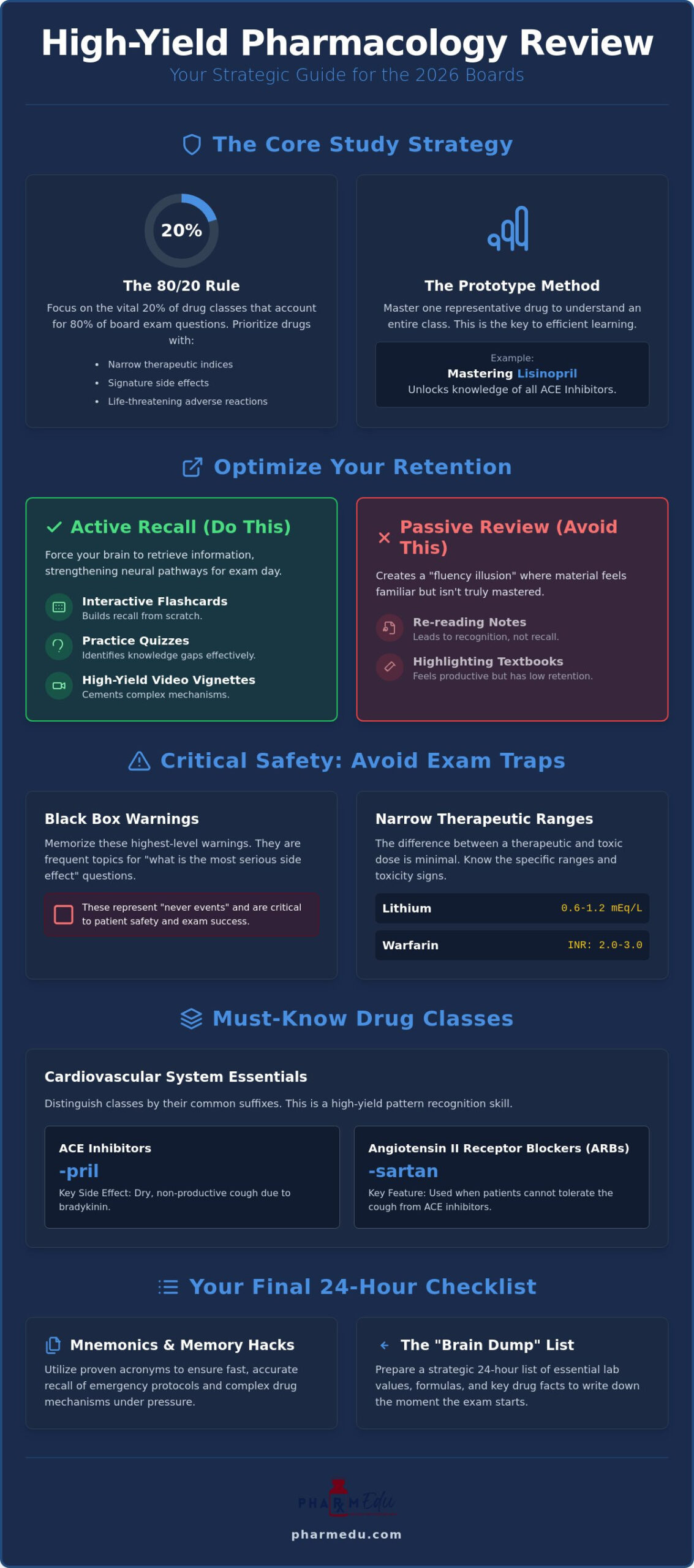
High-yield topics represent the intersection of clinical frequency and exam popularity. Examiners rarely test obscure medications; they prefer drugs that have significant clinical impact, narrow therapeutic windows, or life-threatening adverse reactions. Instead of studying every individual drug, you should utilize the Prototype Method. By mastering one representative drug for an entire class, such as Lisinopril for ACE inhibitors, you automatically understand the mechanism of action, contraindications, and side effects for every other drug in that category. This efficiency is vital when you’re short on time and need to maximize every study hour.
The 80/20 Rule for Pharmacology Exams
The Pareto Principle applies perfectly to medical education. Approximately 20% of drug classes account for 80% of board questions. Your priority should be medications with narrow therapeutic indices, such as Lithium or Warfarin, where the difference between a therapeutic dose and a toxic dose is minimal. You should also focus on drugs with “signature” side effects, like the dry cough associated with ACE inhibitors or the orange-colored secretions caused by Rifampin. These unique markers are the “hooks” examiners use to test your knowledge. Focus your energy on these high-stakes medications rather than broad, low-impact lists.
Active Recall vs. Passive Review
Passive reading is the enemy of retention during the final 48 hours before an exam. Highlighting a textbook or re-reading notes creates a “fluency illusion” where you feel you know the material because it looks familiar. True mastery requires active retrieval. PharmEDU’s pharmacology study guide provides a structured framework to help you identify specific knowledge gaps before they become exam-day errors. Integrating a last minute pharmacology review with active tools ensures you’re prepared for the pressure of the testing center.
- Interactive Flashcards: These force your brain to retrieve information from scratch, strengthening neural pathways for faster recall.
- Practice Quizzes: Don’t wait until you feel “ready” to test yourself. Quizzing identifies what you don’t know, which is more valuable than confirming what you already do.
- High-Yield Video Vignettes: Visual and auditory cues help cement complex mechanisms that are difficult to grasp through text alone.
Leveraging these interactive tools ensures you aren’t just looking at the information; you’re using it. This active engagement is the only way to build the mental stamina required for a multi-hour board exam. By forcing your brain to work during your review, you ensure it performs when the timer starts.
Must-Know Drug Classes: The Heavy Hitters of 2026 Boards
Mastering specific drug classes is the core of any effective last minute pharmacology review. While the total number of approved medications continues to grow, board exams consistently prioritize a select group of “heavy hitters” that have significant clinical implications. Focusing your energy on these categories allows you to build a solid foundation that covers the majority of potential test questions. It’s not about memorizing every drug; it’s about understanding the prototypes that define these essential classes.
Cardiovascular System Essentials
Cardiovascular medications are a staple of clinical vignettes. You must distinguish between ACE Inhibitors, identifiable by the “-pril” suffix, and Angiotensin II Receptor Blockers (ARBs), which end in “-sartan.” A deep understanding of ACE Inhibitors is critical, particularly their signature side effect of a dry, non-productive cough caused by bradykinin accumulation. If a patient develops this cough or the more severe angioedema, they’re typically switched to an ARB.
Beta-blockers, or the “-olols,” require careful attention to their receptor selectivity. You shouldn’t miss the contraindication for non-selective beta-blockers in patients with asthma or COPD, as blocking Beta-2 receptors can trigger bronchospasm. When reviewing diuretics, distinguish between loop diuretics like Furosemide, which can cause significant potassium depletion, and potassium-sparing agents like Spironolactone. These electrolyte shifts are high-yield targets for examiners.
Endocrine pharmacology has seen recent updates, particularly with the 2026 guidelines highlighting GLP-1 receptor agonists like semaglutide for obesity management. However, you must still master insulin types and their onset times. Rapid-acting insulins like Lispro work within 15 minutes, while long-acting versions like Glargine provide a steady basal rate without a peak. For oral hypoglycemics, focus on the “big three”: Metformin (decreases hepatic glucose production), Sulfonylureas (stimulate insulin secretion), and TZDs (increase insulin sensitivity).
Antimicrobials and Resistance
Antimicrobial questions often focus on cross-sensitivity and specific toxicities. A common exam trap involves the relationship between Penicillins and Cephalosporins; approximately 1% to 10% of patients with a Penicillin allergy may exhibit cross-reactivity with first-generation Cephalosporins. You should also be able to differentiate Vancomycin’s “Red Man Syndrome,” which is a rate-dependent infusion reaction, from a true IgE-mediated anaphylactic allergy. Aminoglycosides like Gentamicin require diligent monitoring due to their well-documented risks of ototoxicity and nephrotoxicity. If you find these distinctions difficult to memorize, utilizing interactive pharmacology flashcards can significantly speed up your retention of these critical safety facts.
Finally, central nervous system medications, specifically SSRIs and SNRIs, are frequently tested. The most dangerous complication to recognize is Serotonin Syndrome, an emergency characterized by mental status changes, autonomic hyperactivity, and neuromuscular abnormalities. This often occurs when multiple serotonergic agents are combined, making the “washout period” between switching medications a vital clinical fact for your review.
Critical Safety: Avoiding Common Exam Traps
Board examiners prioritize patient safety above all else. In a last minute pharmacology review, you must focus on the medications that carry the highest risk of clinical harm. This includes mastering Black Box Warnings, which are the FDA’s most serious warnings for drugs that can cause life-threatening risks. You should also be wary of Look-Alike, Sound-Alike (LASA) drugs, such as Hydralazine versus Hydroxyzine. These are common traps designed to test your attention to detail and clinical precision. Identifying these nuances prevents the kind of catastrophic errors that examiners look for when assessing your readiness for practice.
Toxicology and Antidotes
Rapid recall of antidotes is a non-negotiable skill for exam day. You should be able to instantly pair a toxin with its reversal agent. For example, Naloxone reverses opioid overdose, while Acetylcysteine is the primary intervention for Acetaminophen toxicity. Early recognition of toxicity is equally vital. Digoxin toxicity often presents with gastrointestinal distress followed by visual disturbances, specifically the classic yellow halos around lights. A narrow therapeutic index, as seen with medications like Phenytoin, means the therapeutic dose is dangerously close to the toxic dose; this requires meticulous blood level monitoring to avoid systemic toxicity.
- Acetaminophen: Acetylcysteine
- Opioids: Naloxone
- Benzodiazepines: Flumazenil
- Warfarin: Vitamin K
- Heparin: Protamine Sulfate
- Iron: Deferoxamine
Adverse Effects vs. Side Effects
Distinguishing between an expected side effect and a dangerous adverse reaction is a core competency. While a dry mouth might be an expected side effect of an anticholinergic, Steven-Johnson Syndrome (SJS) is a life-threatening adverse reaction. SJS often presents as a severe skin rash and mucosal sloughing. Sulfonamides, Phenytoin, and Allopurinol are the primary culprits for this reaction. Additionally, pregnancy categories remain high-yield. Teratogenic drugs, specifically those in Category X, carry a proven risk of fetal abnormality and must be avoided entirely during pregnancy. Common examples include statins, methotrexate, and finasteride. By categorizing these risks, you can quickly navigate complex vignettes that ask for the next best step in patient care.
Safe practice is the foundation of professional credibility. When you utilize interactive tools like Pharmacology Practice Quizzes, you simulate the high-stakes decision-making required to avoid these common traps. This active engagement during your last minute pharmacology review ensures that safety facts aren’t just memorized but are ready for clinical application under pressure.
Pharmacology Mnemonics and Memory Hacks for Fast Recall
Memorization is often the most daunting part of any last minute pharmacology review. However, your brain isn’t built to store isolated facts in a vacuum; it thrives on patterns and associations. By using “cheat codes” like suffixes and prefixes, you can categorize medications almost instantly, even when faced with a drug name you haven’t seen in weeks. This systematic approach transforms a list of random words into a structured database of clinical knowledge. When you combine these naming conventions with vivid mental anchors, you create a retrieval system that holds up under the pressure of a timed board exam.
The Power of Suffixes
Suffixes are the most reliable way to identify a drug’s class and primary mechanism. For instance, the “-statin” suffix immediately identifies HMG-CoA reductase inhibitors used for lipid management, while “-prazole” points directly to Proton Pump Inhibitors (PPIs). Understanding these patterns is essential for efficiency, but you must also prioritize suffixes that carry significant safety warnings. A classic example is the “-afil” suffix for PDE5 inhibitors like Sildenafil. You must remember the dangerous, potentially fatal interaction between these drugs and nitrates, which can cause profound hypotension. While most suffixes are consistent, you should also prepare for exceptions. Medications like Amiodarone or Digoxin don’t follow standard naming conventions and require their own dedicated mental compartments.
Creating Your Own Mental Anchors
The most effective mnemonics are often the weirdest ones. Logical associations are easily forgotten because they don’t stand out, but vivid, strange, or even humorous imagery sticks in the long-term memory. For the Autonomic Nervous System, a simple but powerful anchor is the “1 heart, 2 lungs” rule. This reminds you that Beta-1 receptors are primarily in the heart, while Beta-2 receptors are in the lungs. This prevents the common exam error of confusing the indications for cardiac versus respiratory medications. To solidify these connections, many students find that High-Yield Video Vignettes provide the visual and auditory context necessary to turn a dry drug mechanism into a memorable clinical story.
- MONA: Morphine, Oxygen, Nitroglycerin, Aspirin; the standard protocol for initial myocardial infarction care.
- CHOP: Cyclophosphamide, Hydroxydaunorubicin, Oncovin, Prednisone; a high-yield chemotherapy regimen for lymphoma.
- P-450 Inducers: Use the “Grip” acronym (Griseofulvin, Rifampin, Itraconazole, Phenytoin) to remember drugs that speed up metabolism.
Don’t let the sheer volume of information derail your preparation. Strengthening your recall through these proven methods is the most efficient way to spend your final study hours. To access a library of structured memory aids and interactive practice tools, explore our PharmEDU Annual Subscription for a comprehensive and successful last minute pharmacology review.
Your Final 24-Hour Checklist: From Panic to Passing
The final 24 hours before your boards are about mental state management and precision rather than acquiring new knowledge. Your last minute pharmacology review should shift from deep study to high-speed retrieval and physical preparation. A tired brain cannot effectively access the drug-receptor interactions or mechanism patterns you’ve worked so hard to master. Prioritizing seven to eight hours of sleep and maintaining steady nutrition is a clinical necessity for cognitive performance during the American Board of Clinical Pharmacology testing period, which runs from July 1 to August 31, 2026.
One of the most effective tools for the start of the exam is the “Brain Dump” strategy. The moment the timer begins and you’re provided with scratch paper, write down the most volatile information. This includes the therapeutic ranges for narrow-index drugs discussed earlier and essential lab values that act as your clinical compass. Having a visual reference prevents simple calculation errors when you’re under pressure. Key values to include are:
- Potassium (K+): 3.5 to 5.0 mEq/L (Critical for diuretics and ACE inhibitors)
- Sodium (Na+): 135 to 145 mEq/L (Essential for Lithium monitoring)
- INR: 2.0 to 3.0 (Target range for standard Warfarin therapy)
- Creatinine: 0.6 to 1.2 mg/dL (A primary indicator for renal drug clearance)
The Morning-Of Routine
On the morning of the exam, avoid the “parking lot cram” that often leads to increased cortisol and decreased focus. Instead, perform a light review of your three weakest drug classes using Interactive Pharmacology Flashcards. This keeps the terminology fresh without inducing unnecessary anxiety. If you’re looking for a final comparison of study methods, our analysis of a comprehensive pharmacy review highlights how digital platforms outperform traditional textbooks in these high-stakes final hours.
Pharmacology Board Exam Day Tips
During the exam, your attention to detail is your best defense against traps. Examiners frequently use negative phrasing, so you must read every question carefully for words like “except,” “not,” or “contraindicated.” If you encounter an unfamiliar drug name, don’t panic. Look at the suffix or prefix to identify its class, as this remains the most reliable safety net for any last minute pharmacology review. Finally, trust your first instinct on drug interactions. Statistical evidence suggests that your initial clinical judgment is often correct, and second-guessing frequently leads to changing a right answer to a wrong one.
By utilizing the PharmEDU toolkit of Pharmacology Practice Quizzes and high-yield vignettes, you’ve replaced panic with a structured, actionable strategy. You’ve mastered the prototypes, identified the safety traps, and prepared your mind for the rigors of the 2026 boards. You’re now ready to transition from a candidate to a board-certified professional.
Mastering the Final Countdown to Board Certification
You’ve moved beyond the overwhelming volume of traditional textbook data to a focused strategy based on high-yield prototypes and critical safety markers. By prioritizing the 80/20 rule and implementing active recall, you’ve turned your final preparation hours into a precise clinical tool. Success on the 2026 boards isn’t just about the breadth of your knowledge; it’s about how accurately you can retrieve that information under the pressure of a timed exam environment.
Integrating a structured last minute pharmacology review into your final 24 hours ensures that your mental anchors and memory hacks remain sharp. PharmEDU supports your professional advancement with expert-led video vignettes and interactive pharmacology flashcards designed for maximum efficiency. Our mobile-ready platform allows you to refine your knowledge during any study session, ensuring you’re prepared for every clinical vignette you’ll encounter. You’ve done the work to understand the mechanisms; now it’s time to demonstrate that expertise.
Start your PharmEDU high-yield review now and pass your boards with confidence!
You have the strategy, the tools, and the dedication required to succeed. Trust your preparation and step into your testing center with the clinical certainty you’ve earned through your hard work. We’re proud to be your partner in this final step toward your professional goals.
Frequently Asked Questions
How can I study pharmacology in one day?
You can maximize a single day of study by prioritizing the “prototype” drugs for the most common classes. Focus on cardiovascular, endocrine, and antimicrobial agents rather than trying to memorize every obscure medication. Using high-yield video vignettes for rapid visual reinforcement is far more effective than passive reading. This approach ensures your last minute pharmacology review targets the 20% of content that typically accounts for 80% of exam questions.
What are the most common drug classes on the NAPLEX?
Cardiovascular medications, endocrine therapies, and antimicrobials consistently dominate board exams. You should expect heavy emphasis on ACE inhibitors, beta-blockers, and insulins. Anticoagulants and CNS agents like SSRIs are also frequent topics because they require precise therapeutic drug monitoring and carry significant safety risks. Mastering these categories provides a solid foundation that covers the majority of clinical vignettes you’ll encounter on the NAPLEX.
How do I distinguish between look-alike sound-alike drugs?
Distinguishing between Look-Alike, Sound-Alike (LASA) drugs requires focus on “Tall Man” lettering and distinct clinical indications. For example, you can differentiate Prednisone from Prednisolone by their specific metabolic pathways or use cases. Always look for the suffix first; it’s your most reliable tool for categorization. If you’re stuck, use the patient’s symptoms in the vignette to work backward toward the drug’s intended therapeutic effect.
What are the most important lab values to know for pharmacology?
Potassium, Sodium, INR, and Creatinine are the most critical values for pharmacological assessment. These numbers dictate whether a dose is therapeutic or toxic for medications with narrow indices like Digoxin or Lithium. For instance, knowing that hypokalemia increases the risk of Digoxin toxicity is a high-yield fact. These values aren’t just numbers; they’re essential indicators that guide safe clinical decision-making and drug administration during your boards.
How do I remember drug suffixes easily?
The most efficient way to remember suffixes is to group them by their physiological impact. Instead of memorizing them individually, link them to a “master” prototype drug for that class. For example, associate “-sartan” with Losartan to instantly recall the entire ARB family. This systematic categorization during a last minute pharmacology review creates a mental map that allows for faster retrieval when you’re under the time constraints of the exam.
What should I do if I see a drug I’ve never heard of on the exam?
Don’t panic if you encounter an unfamiliar drug; instead, look for familiar prefixes or suffixes. Most medications belong to established classes that follow specific naming conventions. If the name is completely unique, analyze the patient’s presentation and the provided lab results. Examiners often use an obscure drug to test your understanding of a general pharmacological principle, such as a specific enzyme interaction or a common side effect.
Are PharmEDU’s flashcards updated for 2026 standards?
PharmEDU’s Interactive Pharmacology Flashcards are fully updated to meet 2026 standards. This includes the latest American College of Physicians’ guidelines for obesity management and the new multisociety recommendations for Cardiovascular-Kidney-Metabolic syndrome. We ensure our content reflects current FDA approvals from 2025 and early 2026, providing you with the most accurate and relevant information for your upcoming board exams. You can trust that our materials align with current professional requirements.