Pharmacist Specialties in 2026: A Comprehensive Guide to Career Paths and Board Certification
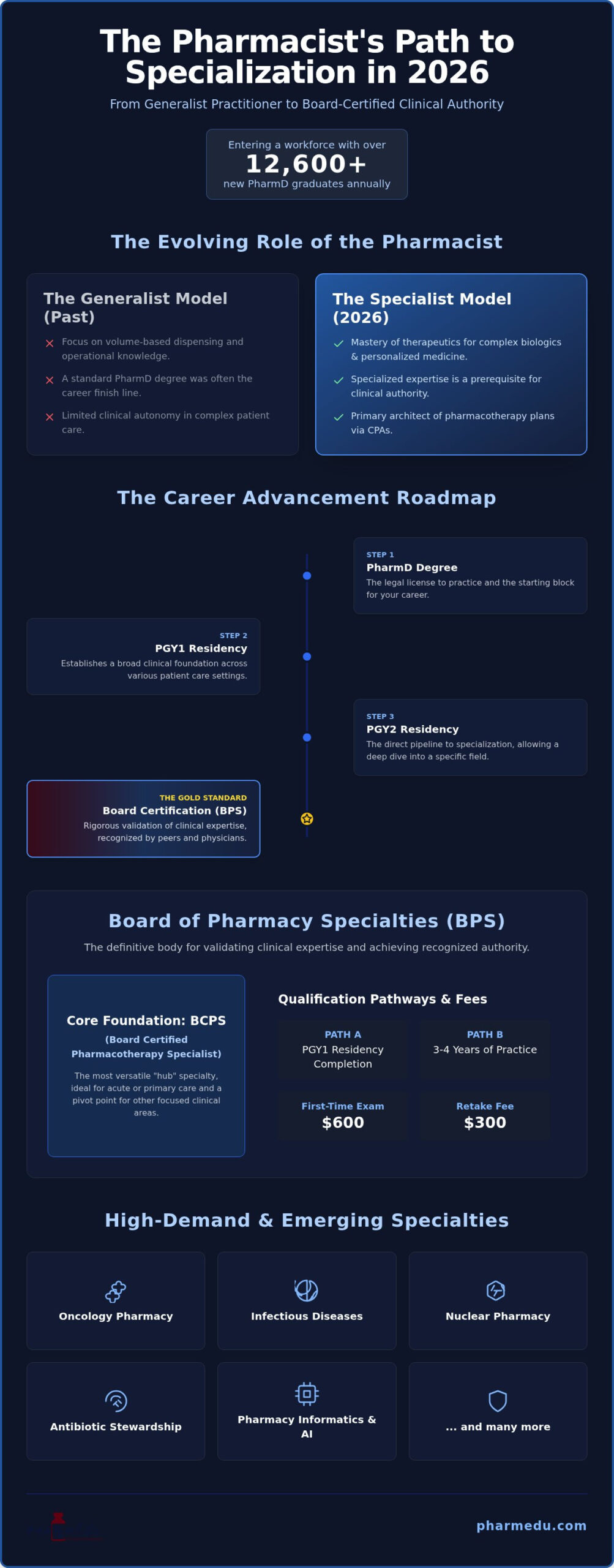
In a professional landscape where over 12,600 new PharmD graduates enter the workforce annually, a standard degree is no longer the finish line; it’s just the starting block. The industry’s shift from volume-based dispensing to therapeutic mastery is accelerating, making the selection of pharmacist specialties the most critical decision for your career trajectory in 2026. It’s understandable if you feel overwhelmed by the rigor of specialty exams or uncertain about the true ROI of a PGY2 residency. Many practitioners struggle to distinguish between a specific job setting and the formal board-certified expertise that commands clinical authority.
This comprehensive guide will clarify that confusion and provide a structured roadmap for your professional advancement. You’ll explore the diverse world of pharmacist specialties, ranging from clinical oncology to nuclear pharmacy, while learning the exact educational requirements for each role. We’ll break down the top 10+ BPS certifications and share proven strategies for mastering high-level clinical content. By the end of this article, you’ll have the clarity needed to transition from a generalist to a recognized specialist with confidence.
Key Takeaways
- Understand how the shift toward complex biologics and personalized medicine is making specialized expertise a prerequisite for clinical authority in 2026.
- Identify the most versatile Board of Pharmacy Specialties (BPS) certifications, starting with the BCPS as a core foundation for advanced practice.
- Explore high-demand pharmacist specialties ranging from oncology and infectious diseases to emerging, tech-driven roles in pharmacy informatics and AI.
- Learn why standard pharmacy school notes aren’t enough for board-level mastery and how high-yield video vignettes can bridge the gap.
- Discover the specific educational pathways and clinical requirements needed to transition into non-traditional roles like nuclear pharmacy or antibiotic stewardship.
The Modern Landscape of Pharmacist Specialties in 2026
The definition of a pharmacist specialty has evolved significantly by 2026. It’s no longer just a niche interest; it’s a rigorous, focused area of practice that demands clinical expertise far exceeding general Pharm.D. training. While a doctor of pharmacy degree provides the legal license to practice, a specialty represents a commitment to therapeutic mastery within a specific patient population or disease state. This transition from “dispensing knowledge” to “therapeutic management” is a direct response to a healthcare system that is becoming increasingly complex.
The rapid rise of complex biologics and personalized medicine has rendered the generalist model insufficient for high-acuity care. In 2026, therapeutic mastery in areas like pharmacogenomics or immunology is what separates a practitioner from a dispenser. A critical distinction lies between your work environment and your clinical specialty. While retail or hospital roles describe your physical setting, pharmacist specialties define your level of clinical authority. This distinction is vital because specialization directly correlates with higher salary potential, greater job security against automation, and significantly more clinical autonomy in a consolidating market.
From Generalist to Specialist: The Career Evolution
The path to specialization typically begins with a PGY1 residency, which establishes a broad clinical foundation across various patient care settings. However, it’s the PGY2 residency that serves as the direct pipeline to board certification and true specialized practice. If you’re currently reviewing our guide on how to become a pharmacist, you’ll see that the transition from generalist to specialist is becoming the standard for those seeking leadership roles in clinical settings. This second year of training allows you to dive deep into a specific field, preparing you for the high-yield requirements of board exams.
The Impact of Collaborative Practice Agreements (CPAs)
Collaborative Practice Agreements (CPAs) have transformed the pharmacist’s role into that of a mid-level provider. In many states, specialized pharmacists now have the authority to initiate or modify drug therapy under a protocol, effectively managing chronic conditions or acute interventions. This level of responsibility requires the deep, evidence-based knowledge found in Board-certified pharmacy specialties. On multidisciplinary rounding teams, the specialist isn’t just a consultant; they’re the primary architect of the patient’s pharmacotherapy plan, ensuring that complex medication regimens are both safe and effective.
Board of Pharmacy Specialties (BPS): The Gold Standard of Certification
The Board of Pharmacy Specialties (BPS) serves as the autonomous division of the American Pharmacists Association and remains the definitive body for validating clinical expertise. In 2026, BPS certification isn’t just an addition to your resume; it’s a rigorous validation of your ability to provide high-level patient care. While many pharmacists work in diverse settings, becoming board-certified signifies a level of competence that peers and physicians respect. It transitions your professional identity from a general practitioner to a recognized authority in a specific therapeutic area.
The Board Certified Pharmacotherapy Specialist (BCPS) is the most versatile core of pharmacist specialties. It focuses on the broad management of drug therapy across various disease states, making it an ideal starting point for those in acute or primary care. Unlike more niche certifications, the BCPS credential provides a flexible foundation. It proves you can manage complex patients with multiple comorbidities, which is a common requirement in hospital-based roles. You’ll find that having this “hub” specialty makes it easier to pivot into more focused clinical areas later in your career.
The 2026 exam landscape is more accessible but remains intellectually demanding. First-time BPS certification carries a $600 application fee, while those who need to retake an exam within a year pay a reduced fee of $300. You can qualify for these exams through two primary routes: completing a PGY1 residency or accumulating three to four years of practice experience, depending on the specific specialty. Testing has shifted toward more flexible, computer-based formats. For example, the BCCP specialty offers specific windows, such as the September 1-21, 2026, testing period, allowing you to plan your study schedule with precision.
Top BPS Recognized Specialties
Several clinical areas have seen a surge in demand as healthcare systems prioritize measurable outcomes. Ambulatory Care Pharmacy (BCACP) focuses on chronic disease management in outpatient clinics, while Critical Care Pharmacy (BCCCP) targets high-stakes medication management in ICUs. Pediatric Pharmacy (BCPPS) ensures safe dosing for the most vulnerable populations. All these paths require a rock-solid understanding of drug mechanisms. Reviewing a pharmacology guide is a mandatory first step before attempting these rigorous board exams.
The ROI of Board Certification
Specialization is a strategic financial and professional move. According to the Occupational Outlook Handbook, the demand for pharmacists in hospitals and outpatient centers is growing faster than in traditional retail. Board-certified specialists often command higher salaries and are prioritized for clinical director or leadership roles. Once you’re certified, you’ll manage your credential with a $125 annual maintenance fee during the first six years of your cycle. If you’re struggling with the doctoral-level concepts required for these exams, PharmEDU’s high-yield video vignettes can help you master complex therapeutic topics efficiently.
Top Clinical Specialties: Deep Dives into Patient Care Roles
Clinical pharmacist specialties represent the pinnacle of direct patient care within the profession. Unlike general practice, these roles require a granular understanding of pathophysiology and the ability to interpret complex clinical data in real-time. In 2026, the demand for pharmacist specialties is driven by the increasing complexity of therapeutic regimens. Whether you’re managing toxicities in an infusion center or adjusting vasopressors in the ICU, your role is to ensure that every medication choice is optimized for the individual patient’s physiology.
Oncology pharmacy is currently navigating a “Biologics Revolution.” It’s no longer just about calculating body surface area for traditional chemotherapy protocols; it’s about managing the intricate side-effect profiles of monoclonal antibodies and checkpoint inhibitors. Specialists in this field must understand the molecular targets of therapy to prevent life-threatening immune-related adverse events. Similarly, Infectious Disease pharmacists serve as the front line of antibiotic stewardship. They manage multi-drug resistance by applying advanced pharmacokinetic principles to ensure that even the most difficult-to-treat infections are met with effective, safe dosing strategies.
Cardiology and psychiatric pharmacy also offer high-impact career paths. Cardiology specialists manage advanced heart failure and the delicate balance of anticoagulation therapies, often in high-acuity settings. Psychiatric pharmacists bridge a critical gap in mental health, optimizing medication management for patients with complex neuropsychiatric conditions where trial-and-error is often the norm. These roles require not just clinical knowledge, but the ability to communicate “high-yield” therapeutic recommendations to a multidisciplinary team.
The Science of Specialized Care
Mastering specialized care requires revisiting the fundamentals with a new level of precision. For instance, an Infectious Disease or Cardiology pharmacist must have an expert-level grasp of ACE inhibitors and their specific renal implications. Understanding how these drugs interact with a patient’s declining kidney function is critical for preventing acute kidney injury in the ICU. This scientific depth extends to pharmacokinetics in emergency medicine, where rapid-sequence intubation or code situations demand instant, accurate dosing decisions based on fluid status and drug distribution.
Daily Life in a Clinical Specialty
A day in the life of a clinical specialist is defined by intellectual rigor and patient advocacy. An Oncology pharmacist might start their morning reviewing lab results for a dozen patients scheduled for immunotherapy, looking for subtle shifts in liver enzymes or thyroid function. By midday, they’re collaborating with physicians to adjust protocols based on the latest clinical trial data. These daily interactions aren’t just about checking orders; they’re about making high-stakes decisions that directly influence patient survival and quality of life. Using PharmEDU’s Interactive Pharmacology Flashcards can help you keep these rapidly evolving drug classes fresh as you prepare for this level of practice.
Non-Traditional & Emerging Pharmacy Careers
While clinical roles remain the backbone of the profession, 2026 has seen a surge in non-traditional pharmacist specialties that operate outside the traditional hospital or retail setting. These roles often prioritize systems-level impact, technological integration, or the industrial development of new therapies. For many practitioners, these paths offer a unique way to apply doctoral-level knowledge without the pressures of direct, high-volume patient bedside care. They represent the growing versatility of the Pharm.D. degree in a tech-driven economy.
Pharmacy informatics has evolved from simple database management into a high-level intersection of data science and artificial intelligence. Informatics specialists now design the AI-driven clinical decision support systems that prevent medication errors before they occur. Similarly, nuclear pharmacy remains a highly specialized niche where practitioners handle radiopharmaceuticals for diagnostic imaging and therapy. This role requires a unique blend of pharmacy knowledge and radiation safety expertise, making it one of the most technically demanding pharmacist specialties. Practitioners in this field must be comfortable working with radioactive isotopes and ensuring precise delivery for oncology and cardiology diagnostics.
The pharmaceutical industry offers diverse avenues in Medical Affairs, Research and Development (R&D), and Regulatory Affairs. In these roles, pharmacists act as the scientific bridge between clinical data and commercial strategy. They ensure that new drugs are developed safely and that clinical trials meet rigorous regulatory standards. For those who prefer a hands-on approach to personalized medicine, compounding pharmacy continues to grow. These specialists create customized formulations for patients who cannot use mass-produced medications, often working in specialized facilities that meet strict USP standards to ensure the safety of unique dosage forms.
The Rise of Digital Health and AI
The integration of digital health is no longer a futuristic concept. Pharmacists are now leading the implementation of AI-driven dosing algorithms, particularly for narrow therapeutic index drugs. This expertise is also fueling the growth of tele-pharmacy. Specialists in this area provide remote clinical consultations for rural healthcare facilities, ensuring that patients in underserved regions benefit from high-level pharmacotherapy oversight without needing a physical specialist on-site. This role requires a mastery of digital communication and a deep understanding of remote monitoring technologies.
Veterinary Pharmacy: A Growing Niche
Veterinary pharmacy has emerged as a distinct and respected career path. It involves mastering the pharmacotherapy of companion animals and livestock, where dosing and drug metabolism can differ wildly from human physiology. Achieving the status of a Diplomate of the International College of Veterinary Pharmacists requires a deep commitment to this cross-species science. It’s an ideal path for those looking to combine a love for animal health with rigorous pharmacological expertise. Whether you’re entering the pharmaceutical industry or a tech-driven niche, you can master the foundational science with PharmEDU’s high-yield video vignettes, which simplify complex drug mechanisms for any specialty.
Mastering Specialty Exams with PharmEDU’s Expert Resources
Specializing in the pharmacy profession requires a level of clinical nuance that standard Pharm.D. curricula often only touch upon. While your university notes were sufficient for passing semester finals, they rarely provide the depth needed for the rigorous BPS exams. These board certifications test your ability to apply evidence-based medicine to complex, multi-system patient cases. This is where many candidates feel overwhelmed by the sheer volume of clinical guidelines and therapeutic updates. To bridge this gap, PharmEDU’s High-Yield Video Vignettes transform dense, doctoral-level pharmacotherapy into manageable, visual segments. By visualizing complex mechanisms of action, you can master high-stakes pharmacist specialties like cardiology or infectious diseases with precision.
A comprehensive pharmacy review is essential for moving beyond rote memorization toward true clinical mastery. In 2026, relying solely on physical textbooks is often a recipe for burnout due to the rapid pace of medical advancement. Digital platforms allow you to carry an entire clinical library in your pocket. Using Interactive Pharmacology Flashcards during short breaks in a clinical shift helps you maintain a clinical edge. This ensures that drug-class mastery becomes second nature rather than a stressful chore. This structured approach is what separates successful board candidates from those who struggle with the transition to specialized practice.
Strategic Study for the NAPLEX and Beyond
The journey toward board certification starts much earlier than most realize. Building a strong foundation with a high-quality NAPLEX prep course is the first step in supporting your future specialization. If you master the fundamentals of pharmacology during your licensure prep, the jump to pharmacist specialties feels like a natural progression. For residents facing 60-hour work weeks, micro-learning is the only sustainable strategy. PharmEDU’s platform is designed for efficiency. It allows you to absorb high-yield clinical content in 10-minute intervals between patient rounds or staff meetings. Efficiency is the key to consistency.
Institutional Support for Specialty Training
Securing Your Clinical Authority in a Specialized Future
The transition from a generalist to a specialist is the most significant investment you can make in your professional longevity. As this guide has shown, pharmacist specialties are the primary drivers of clinical authority in 2026, offering a path toward greater autonomy and higher patient impact. By mastering the rigorous standards of the Board of Pharmacy Specialties, you ensure that your expertise remains indispensable in an increasingly complex therapeutic environment. Whether you’re pursuing oncology, informatics, or ambulatory care, the key is to move beyond passive learning toward true clinical mastery.
Achieving this level of expertise doesn’t have to be an administrative burden. PharmEDU supports your journey with over 100 high-yield video vignettes and NAPLEX-aligned study tools that simplify doctoral-level pharmacotherapy. Our mobile-compliant micro-learning segments are specifically designed for busy residents and practitioners who need to maintain a clinical edge without burning out. Elevate your clinical expertise with PharmEDU’s high-yield pharmacology library today. You have the talent and the ambition to lead; we provide the precision tools to help you get there.
Frequently Asked Questions
What is the highest-paying pharmacist specialty in 2026?
Oncology, nuclear pharmacy, and pharmaceutical industry roles such as Medical Affairs typically command the highest salaries in the profession. These positions require either high technical expertise or operate within the high-margin corporate sector where clinical mastery is valued for research and strategy. Salary growth is also exceptionally strong in pharmacogenomics and managed care as personalized medicine becomes the standard of care.
Do I need a residency to become a specialized pharmacist?
You don’t strictly need a residency to specialize, but it remains the most direct path to board certification and clinical authority. Most BPS exams allow you to qualify with three to four years of practice experience in a specific field if you haven’t completed a PGY1 or PGY2. However, many health systems prioritize residency-trained candidates for high-acuity roles because of the intensive clinical hours those programs provide.
How many board-certified pharmacy specialties are there currently?
The Board of Pharmacy Specialties currently recognizes 15 distinct certifications that validate advanced clinical knowledge. These range from foundational areas like pharmacotherapy to highly focused fields such as solid organ transplant and emergency medicine. The number of pharmacist specialties continues to grow as the healthcare landscape demands deeper expertise in managing complex biologics and multi-system disease states.
Can I change my pharmacy specialty later in my career?
Yes, pharmacists can transition between specialties by accumulating relevant clinical experience or pursuing a new certification cycle. While your initial residency might be in one area, many practitioners pivot by working in a different clinical environment and then sitting for a new BPS exam. Continuous education and high-yield review tools make it possible to adapt your career path as industry demands shift.
What is the difference between a clinical pharmacist and a retail pharmacist?
Clinical pharmacists focus on therapeutic management and direct patient care in hospital or clinic settings, whereas retail pharmacists primarily manage medication dispensing and community health counseling. Clinical roles often involve working under collaborative practice agreements to initiate or modify drug therapy as part of a multidisciplinary team. Retail roles are increasingly focusing on point-of-care testing and immunization, though they remain centered on the community pharmacy setting.
Is the BPS exam harder than the NAPLEX?
Most practitioners consider BPS exams significantly more difficult than the NAPLEX because they test high-level clinical application rather than foundational safety and law. While the NAPLEX ensures you’re safe to practice as a generalist, specialty exams require you to make complex therapeutic decisions based on the latest evidence-based guidelines. Success requires a mastery of pharmacokinetics and pathophysiology that goes far beyond entry-level pharmacy school requirements.
What are the requirements for the BCPS exam?
To sit for the BCPS exam, you must hold an active pharmacy license and have completed either a PGY1 residency or three years of clinical practice experience. This certification is one of the most versatile pharmacist specialties, proving your ability to manage patients with multiple comorbidities in acute or primary care settings. The initial application fee is $600, with a $300 retake fee if you don’t pass on your first attempt.
How does pharmacy informatics differ from traditional pharmacy?
Pharmacy informatics focuses on the technological infrastructure and data science used to manage medications rather than direct bedside patient interaction. Specialists in this field design AI-driven clinical decision support systems and manage electronic health records to prevent systemic medication errors. It’s a non-traditional path that requires a unique blend of pharmacological knowledge and computer science expertise to improve patient safety at scale.