
The Ultimate NAPLEX Study Plan for 2026: A High-Yield 8-Week Schedule
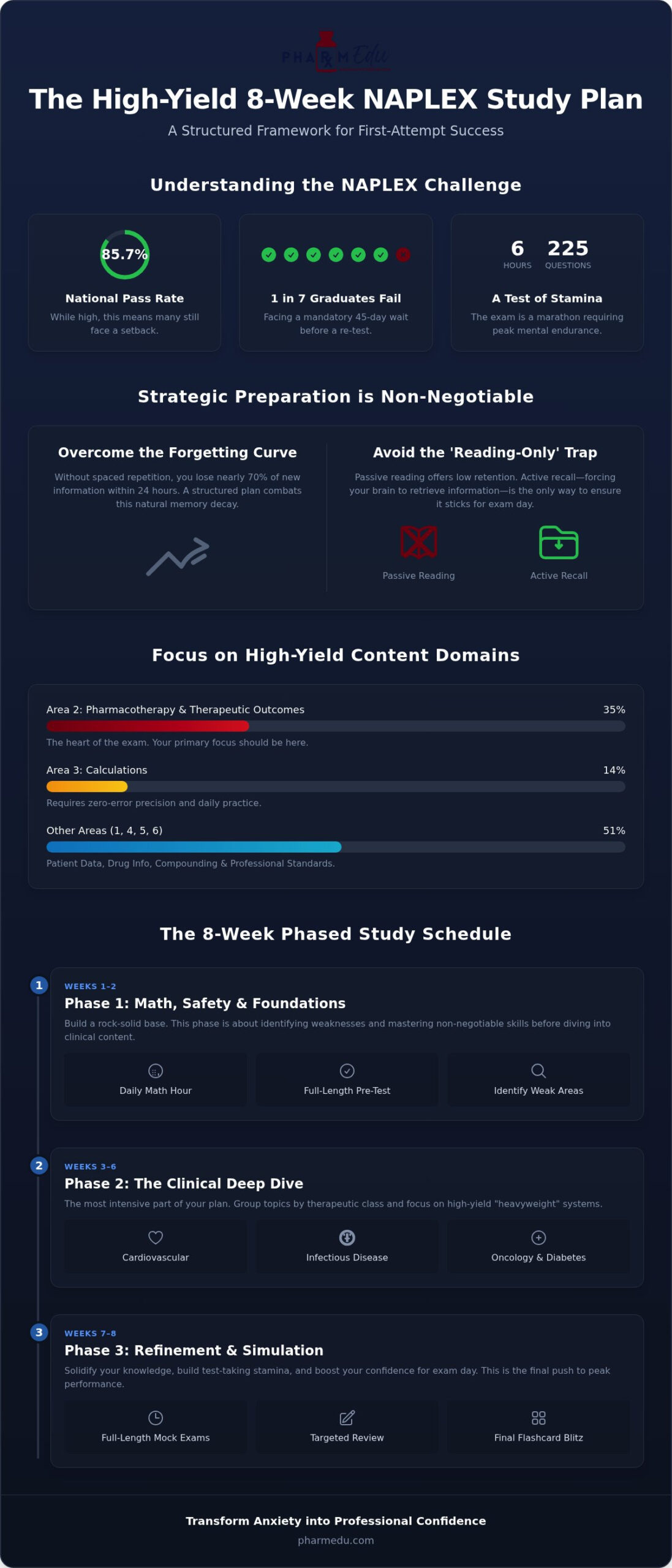
While the 2025 NAPLEX pass rate rose to 85.7%, that still means nearly one in seven pharmacy graduates faces the crushing weight of a “Fail” notification and a mandatory 45-day waiting period. You’ve spent four years mastering complex therapeutics, yet staring at a 1,000-page textbook often feels more like drowning than studying. It’s completely normal to feel overwhelmed when trying to build a NAPLEX study plan that balances clinical cases and high-stakes calculations with the demands of a residency or a full-time career.
This guide provides a structured, high-yield framework designed to transform that anxiety into professional confidence through active recall and targeted pharmacology review. We’ve distilled the essential competencies into a manageable 8-week schedule that replaces passive reading with high-impact digital tools like video vignettes and interactive flashcards. By focusing on the most tested NABP content domains, you’ll develop the precision needed to pass on your first attempt. We’ll explore exactly how to organize your daily sessions to maximize retention and ensure your transition from student to licensed pharmacist is both seamless and successful.
Key Takeaways
- Learn how to divide your preparation into a phased, 8-week schedule that prioritizes foundational calculations before moving into complex clinical systems.
- Discover how a structured NAPLEX study plan utilizes active recall to combat the forgetting curve and ensure long-term retention of over 400 essential medications.
- Master efficient study habits by integrating micro-learning sessions and high-yield video vignettes into your daily routine, maximizing productivity during commutes or breaks.
- Identify high-yield drug classes and clinical topics to focus your energy where it matters most, avoiding the common trap of information overload from massive textbooks.
- Gain the professional confidence to pass the exam on your first attempt by replacing passive reading with interactive pharmacology flashcards and practice quizzes.
Why a Structured NAPLEX Study Plan is Essential in 2026
The NAPLEX isn’t a test of how much you can remember; it’s a measure of how safely you can practice. For aspiring licensed pharmacists, the exam serves as a rigorous final hurdle that demands more than just a quick review of lecture notes. In 2026, the NABP has intensified the focus on clinical decision-making and patient-centered care, making a deliberate NAPLEX study plan more critical than ever. Attempting to cram information for over 400 distinct medications is a recipe for failure due to the “forgetting curve.” This psychological phenomenon suggests that without spaced repetition, we lose nearly 70% of new information within 24 hours. A structured plan overcomes this by building stamina for the grueling 6-hour, 225-question session, ensuring you don’t succumb to test-taking fatigue in the final hour.
Understanding the 2026 NAPLEX Content Domains
The exam is divided into six primary competency areas that test everything from patient information evaluation to pharmacy provider requirements. However, these areas aren’t weighted equally. Your preparation should reflect the actual exam structure:
- Area 2 (Pharmacotherapy): This is the heart of the exam, covering about 35% of the content.
- Area 3 (Calculations): Often the most stressful section, it accounts for approximately 14% and requires zero-error precision.
- Area 1, 4, 5, and 6: These cover patient data, drug characteristics, compounding, and professional standards.
By aligning your NAPLEX study plan with these official competency statements, you avoid the trap of spending too much time on low-yield topics. Instead, you focus your energy on the clinical systems and mathematical foundations that carry the most weight.
The Dangers of a ‘Reading-Only’ Approach
Passive reading is the most common pitfall for candidates. While it feels productive to highlight a textbook, this method offers low retention rates when faced with complex, board-style application questions. You must transition from academic learning to clinical application immediately. Integrating practice questions from day one forces your brain to retrieve information actively, which is the only way to ensure it sticks. Using high-yield resources that emphasize active recall will help you bridge the gap between knowing a drug’s mechanism and applying it to a multi-step clinical vignette. Success requires moving beyond “what” a drug is to “how” it’s used in a specific patient scenario.
The 8-Week NAPLEX Study Schedule: A Phased Approach
Success on the North American Pharmacist Licensure Examination (NAPLEX) requires more than just intelligence; it demands a tactical division of labor. An 8-week NAPLEX study plan provides the ideal window to move from foundational concepts to advanced clinical application without hitting the wall of mental exhaustion. This timeframe allows you to respect the complexity of the material while maintaining the momentum needed for a 6-hour testing session. We’ve structured this schedule into three distinct phases that prioritize high-yield topics while leaving room for the cognitive recovery necessary for long-term retention.
Weeks 1-2: Math, Safety, and Foundations
Your first two weeks should focus on the “non-negotiables.” Calculations account for a significant portion of the exam, and errors here are often the primary reason candidates fail. Dedicate a “Math Hour” every single day to master milliequivalents, flow rates, and alligations until they become second nature. Simultaneously, you’ll establish your baseline by taking a full-length practice pre-test. This phase isn’t about perfection; it’s about identifying your weakest areas in federal law and medication safety protocols before you dive into the clinical weeds. Starting with a solid foundation ensures that simple errors don’t undermine your clinical knowledge later.
Weeks 3-6: The Clinical Deep Dive
This is the most intensive part of your NAPLEX study plan. You’ll group topics by therapeutic class to help your brain build logical connections between drugs with similar mechanisms of action. Focus your energy on “heavyweight” systems like Cardiovascular and Infectious Disease, as these appear frequently in clinical vignettes. When tackling complex subjects like HIV, Oncology, and Diabetes, you’ll find that using a structured pharmacology study guide helps simplify drug class memorization. Don’t just read; apply the knowledge by answering at least 20 to 30 practice questions per therapeutic area to bridge the gap between theory and board-style application.
The final two weeks, Phase 3, are reserved for high-yield review and full-scale simulations. This is where you polish your knowledge and practice the physical stamina required for the exam. To prevent burnout, the “Sunday Reset” is mandatory. Taking one full day off each week isn’t a luxury; it’s a strategic necessity that allows your brain to consolidate information. If you’re looking to streamline your clinical review during these intense weeks, Interactive Pharmacology Flashcards can turn small windows of “dead time” into productive study sessions.
Prioritizing Content: High-Yield vs. Low-Yield Topics
Effective preparation isn’t about reading every page of a reference book. It’s about strategic prioritization. The 80/20 rule applies perfectly to your NAPLEX study plan; roughly 80% of your points will come from 20% of the core concepts. In the context of the 2026 blueprints, high-yield content is defined as the core clinical competencies, safety protocols, and foundational calculations that represent the highest percentage of the NABP content domains. While it’s tempting to spend hours on “orphan” topics like rare metabolic disorders, your time is better spent elsewhere. Master the common disease states first. If you encounter an obscure topic, give it a brief overview rather than a deep dive. This ensures you don’t starve the sections that actually determine your pass/fail status.
The Non-Negotiables: Med Safety and Calculations
You simply won’t pass without clinical math proficiency. Pharmaceutical calculations are the bedrock of the exam, and the NABP expects zero-error precision. Beyond numbers, Area 1 (Patient Assessment) often trips up students who overlook small details in patient profiles. You must be vigilant about the top safety errors tested, specifically high-alert medications and look-alike/sound-alike (LASA) drugs. These safety standards are deeply rooted in the pharmacy education standards that shaped your doctoral curriculum. Practice identifying these errors in clinical case studies to build the “safety-first” mindset the examiners require. Missing a calculation or a safety red flag is often more detrimental than forgetting a rare drug interaction.
Clinical Powerhouses: ID, Cardio, and Endocrine
Three therapeutic areas dominate the clinical landscape of the exam. For Infectious Disease, you must master the “antibiotic ladder” and bug-drug matches. Knowing which antibiotic covers Pseudomonas or MRSA is mandatory. Cardiology requires a firm grasp of the 2026 hypertension and anticoagulation guidelines. You’ll need to know when to initiate a DOAC versus warfarin and how to manage the transition. Finally, Endocrine focuses heavily on insulin management. Clinical pearls regarding the onset and duration of various insulin types, along with the nuances of oral hypoglycemics like SGLT2 inhibitors, are frequent exam targets. Using tools like Pharmacology Practice Quizzes can help reinforce these specific clinical pearls through repeated exposure. Focus your deep dives here, as these topics provide the highest return on your study investment.
Daily Study Tactics: Micro-Learning and Active Recall
Linear reading is the quickest path to cognitive fatigue. Instead of forcing your way through dense chapters, your NAPLEX study plan should leverage the “Pomodoro for Pharmacy” technique. Set a timer for 50 minutes of deep concentration on a core clinical system. Once the timer rings, shift to a 10-minute high yield med review to refresh your memory on drug classes. This structured rhythm prevents the mental stagnation common in long-form study and keeps your focus sharp throughout the day.
Micro-learning allows you to reclaim “dead time” during your daily routine. Listening to clinical vignettes during a commute or gym session reinforces concepts without requiring a desk and a textbook. Before starting a new topic, use active recall by attempting practice questions first. This “pre-testing” primes your brain to identify and retain critical details during your actual study session. To truly master a concept, apply the “Teach-Back” method. Explaining a complex mechanism of action to a friend or family member forces you to simplify and clarify your own understanding, ensuring the knowledge is deeply embedded.
Using Digital Flashcards Effectively
Spaced repetition is the most effective way to combat the forgetting curve mentioned earlier. By using digital platforms, you can automate your review schedule so that difficult concepts appear more frequently. Prioritize the “Top 200” medications, focusing on their black box warnings and unique side effect profiles. Customizing these decks allows you to bypass information you’ve already mastered, ensuring every minute spent on your NAPLEX study plan is optimized for your specific needs. This targeted approach prevents the “information overload” that often leads to pre-exam anxiety.
Simulation: The Importance of Practice Exams
The 225-question marathon requires more than just clinical knowledge; it requires physical and mental endurance. Taking full-length, timed quizzes is the only way to build the stamina needed for a six-hour exam. After each session, perform a forensic analysis of your wrong answers. Distinguish between genuine knowledge gaps and “silly” reading errors caused by fatigue. Mimic test center conditions by removing all distractions, silencing your phone, and strictly adhering to official break times. This level of simulation ensures that the actual exam environment feels familiar rather than intimidating on the day of the test.
Ready to put these tactics into practice? Access our Pharmacology Practice Quizzes to begin your high-yield simulation today.
Optimizing Your Prep with PharmEDU’s High-Yield Resources
Executing a successful NAPLEX study plan requires tools that match the speed and complexity of modern pharmacy practice. While traditional textbooks often bury critical information in dense, 100-page chapters, PharmEDU focuses on precision. Our platform covers over 100 essential pharmacology topics, distilling them into manageable segments that simplify the naplex prep course experience. By using high-yield video vignettes, you can visualize complex drug interactions and mechanisms of action that are often difficult to grasp through text alone. This digital-first approach doesn’t just help you pass an exam; it uses clinical case studies to bridge the gap between being a student and becoming a practicing professional.
Mobile-Compliant Learning for Busy Grads
The transition from pharmacy school to residency or a full-time position doesn’t leave much room for marathon study sessions at a desk. We designed our platform to be fully mobile-compliant, allowing you to fit micro-learning into the natural breaks in your day. Whether you’re on a commute or between rounds, you can access Interactive Pharmacology Flashcards or take quick knowledge checks via our Pharmacology Practice Quizzes. Your progress syncs automatically across all your devices. This ensures your NAPLEX study plan stays on track without requiring you to carry heavy reference books or printed notes wherever you go.
Comprehensive Review vs. Micro-Learning
Cognitive load is one of the biggest hurdles for candidates facing the 2026 exam. When you’re forced to digest massive amounts of data at once, retention naturally drops. PharmEDU solves this by prioritizing high-yield vignettes over exhaustive, academic prose. These focused segments allow you to master one therapeutic class at a time, significantly reducing the risk of study burnout. You’ll find that focusing on the most relevant clinical pearls makes the information stick longer and more effectively. If you’re ready to move past outdated study methods and embrace a more efficient way to prepare, Explore PharmEDU’s subscription plans today.
Securing Your Professional Future in 2026
Your journey to becoming a licensed pharmacist culminates in these final eight weeks of preparation. Success doesn’t require memorizing every page of a textbook; it demands a strategic NAPLEX study plan that prioritizes high-yield clinical concepts and rigorous calculation mastery. By moving through the foundational, clinical, and simulation phases, you’ll replace exam-day anxiety with the precision and confidence of a professional.
Active recall and micro-learning are your most effective defenses against the forgetting curve. PharmEDU supports this modern approach with 100+ high-yield pharmacology topics and mobile-ready video vignettes that fit into your busy schedule. You can reinforce your knowledge anytime with interactive flashcards and pharmacology practice quizzes, ensuring you’re ready for the 225-question marathon. Start your high-yield NAPLEX review with PharmEDU now!
You’ve already done the hard work throughout pharmacy school. Now, it’s time to refine that knowledge and cross the finish line. We’re here to ensure you pass on your first attempt and begin your career with total confidence.
Frequently Asked Questions
How many hours a day should I study for the NAPLEX?
Aim for 4 to 6 hours of high-quality, focused study each day. It’s more effective to have shorter, intense sessions with active recall than to spend 10 hours passively reading a textbook. If you’re following a structured NAPLEX study plan, you should prioritize therapeutic areas where you’re weakest while maintaining daily calculation practice. Incorporate short breaks every hour to prevent cognitive fatigue and keep your retention rates high throughout your preparation.
Is 6 weeks enough time to study for the NAPLEX if I work full-time?
Pharmacotherapy and Calculations remain the most critical areas, as they account for nearly half of the total exam content. Specifically, Area 2 (Pharmacotherapy) represents approximately 35% of the questions. You should focus heavily on “clinical powerhouses” like Infectious Disease, Cardiovascular health, and Endocrine systems. Mastering these high-yield topics, along with the zero-error math required in Area 3, provides the strongest statistical path toward achieving a passing result on your first attempt.
How do I handle calculation questions if I’m not good at math?
Mastering calculations requires consistent, daily repetition rather than occasional deep dives. Start by perfecting the foundational math, such as milliequivalents, flow rates, and alligations. Dedicate the first hour of every study session to practice problems until the formulas become second nature. If a specific concept is difficult, use visual aids or step-by-step video tutorials to break down the process. Precision is mandatory, as Area 3 accounts for roughly 14% of the exam.
Should I use RxPrep or PharmEDU for my NAPLEX study plan?
While RxPrep is a traditional choice, PharmEDU is specifically designed for the modern learner who needs to balance study with residency or work. Our platform replaces 1,000-page textbooks with high-yield video vignettes and interactive quizzes that focus on active recall. This micro-learning approach reduces cognitive load and prevents the burnout often associated with dense academic prose. It’s an ideal digital companion for a 2026 candidate seeking a more efficient, mobile-ready preparation experience.
What happens if I fail the NAPLEX on my first attempt?
If you don’t pass on your first try, you must wait 45 days before you can retake the exam. You’ll also need to pay the $520 exam fee and the $100 application fee again. Candidates are limited to a maximum of five attempts total to pass the NAPLEX. Use the mandatory waiting period to analyze your performance report and adjust your study tactics, focusing specifically on the competency areas where your performance was below the passing standard.
How often should I take full-length practice exams?
You should take at least three full-length practice exams during your 8-week schedule. Take the first at the beginning of Week 1 to establish a baseline and identify weaknesses. Schedule the second during Week 4 to measure your progress through the major clinical systems. Finally, take a third exam during Week 7 to simulate the 6-hour marathon and build the physical stamina required for the 225-question session at the testing center.
Can I pass the NAPLEX using only flashcards and practice questions?
While flashcards and practice questions are powerful active recall tools, they work best when paired with clinical context. You need to understand the “why” behind a drug’s mechanism of action to answer complex clinical vignettes. Using a platform like PharmEDU ensures that your practice questions are supported by high-yield video vignettes. This combination helps you transition from simple brand/generic memorization to the advanced clinical decision-making that the 2026 NABP blueprints demand for licensure.