

Respiratory Pharmacology for NCLEX: The High-Yield 2026 Study Guide
With the NCLEX-RN first-time pass rate for U.S. educated candidates reaching 86.8% in early 2026, the pressure to master complex clinical judgment has never been more intense. It’s completely understandable if you feel overwhelmed when trying to distinguish between a fast-acting rescue inhaler and a long-term maintenance agent, or if you’re struggling to memorize the narrow therapeutic ranges for xanthines. Mastering respiratory pharmacology for NCLEX isn’t just about rote memorization. It’s about knowing exactly which nursing action takes priority when a patient is experiencing an acute asthma attack.
This guide is designed to bridge the gap between textbook theory and the clinical reality of the Next-Gen NCLEX. You’ll gain a clear framework for categorizing every major respiratory drug class alongside the safety priorities that protect your patients. We’ll explore the 2026 GINA and GOLD guideline updates, provide memorization shortcuts for drug endings, and walk through NGN-style prioritization scenarios. By the end of this study session, you’ll have the tools and the confidence to answer even the most challenging respiratory questions with precision.
Key Takeaways
- Learn to categorize essential medications using the BAM and SLM mnemonics to simplify your study of respiratory pharmacology for NCLEX.
- Differentiate between rapid-acting rescue inhalers and long-term maintenance therapies to correctly identify priority nursing actions during acute attacks.
- Master the critical “B before S” administration sequence and proper MDI technique to ensure maximum therapeutic benefit for your patients.
- Understand the safety priorities and therapeutic monitoring required for high-risk drug classes like methylxanthines and glucocorticoids.
- Gain confidence in answering Next-Gen NCLEX prioritization questions by applying clinical judgment to respiratory drug administration.
Mastering Respiratory Pharmacology for the NCLEX: High-Yield Overview
Respiratory pharmacology focuses on the pharmacological management of airway patency and gas exchange. For nursing students, this is a high-stakes area of study because it directly relates to the most critical component of patient care: the ability to breathe. When you approach respiratory pharmacology for NCLEX, you aren’t just memorizing drug names. You’re learning how to intervene when a patient’s physiological compensation fails. These medications are primarily tested under the “Physiological Adaptation” category, which accounts for a significant portion of the exam. The NCSBN expects you to demonstrate clinical judgment by identifying which drugs stabilize a patient in crisis and which ones maintain long-term health.
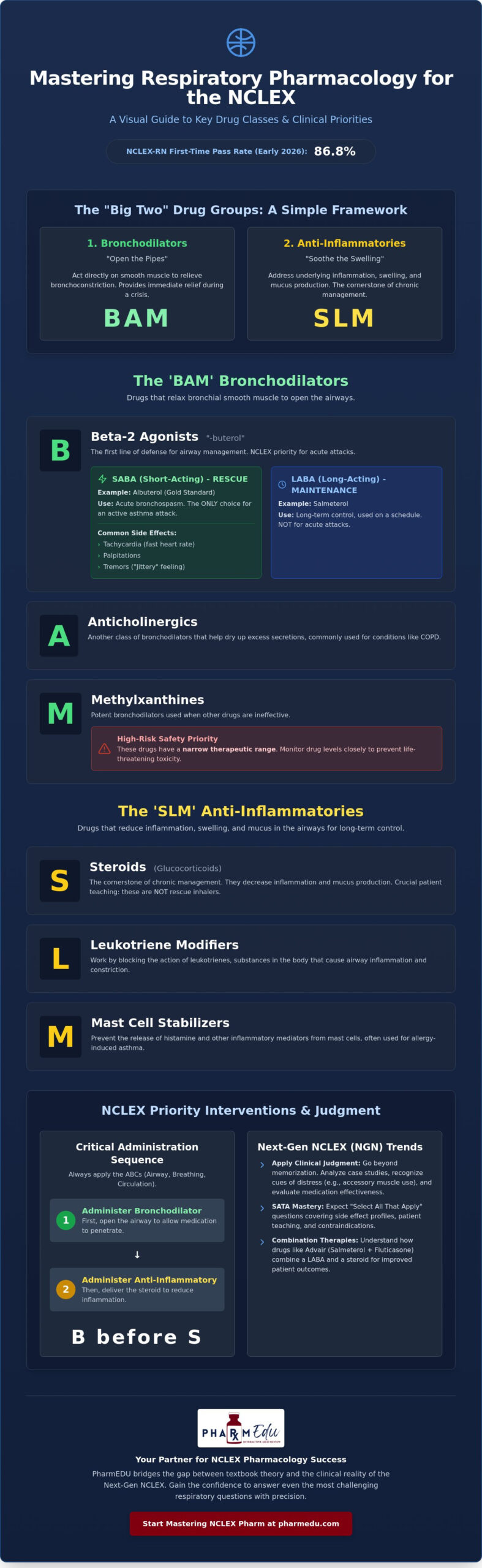
To simplify this vast topic, we categorize respiratory drugs into the “Big Two” groups. First, there are the Bronchodilators, often remembered by the “BAM” mnemonic: Beta-2 agonists, Anticholinergics, and Methylxanthines. These drugs act directly on the smooth muscles of the airways to “open the pipes.” The second group consists of Anti-inflammatories, or the “SLM” drugs: Steroids, Leukotriene modifiers, and Mast cell stabilizers. These agents address the underlying swelling and mucus production. A comprehensive Respiratory Pharmacology Overview shows that while bronchodilators provide immediate relief, anti-inflammatories are the cornerstone of chronic management. NCLEX questions frequently test your ability to distinguish between these roles, especially in emergency scenarios where “Rescue” medications must always take priority over “Maintenance” agents.
The Airway vs. Inflammation Framework
Understanding the difference between bronchoconstriction and inflammation is essential for accurate prioritization. Bronchoconstriction is a mechanical narrowing of the airways caused by muscle tightening. In contrast, inflammation involves mucosal swelling and excess mucus production. Patients with chronic conditions like COPD or asthma usually require both drug classes to stay stable. From a testing perspective, always apply the “Airway, Breathing, Circulation” (ABC) framework. If a patient is wheezing and gasping, you don’t reach for a slow-acting steroid. You grab the rapid-acting bronchodilator to ensure the airway is physically open before addressing the inflammation.
Next-Gen NCLEX (NGN) Respiratory Trends in 2026
The 2026 NCLEX test plan emphasizes clinical judgment over simple recognition. You’ll likely encounter case studies where you must recognize “cues” of respiratory distress, such as accessory muscle use or paradoxical chest movement, and determine if they’re expected findings or signs of medication failure. “Select All That Apply” (SATA) questions remain a staple for side effect profiles, particularly for drugs with narrow therapeutic ranges. Expect to see questions involving combination therapies like Advair, which mix a bronchodilator and a steroid. In these NGN formats, your success depends on your ability to analyze how these two distinct mechanisms work together to improve patient outcomes.
The ‘BAM’ Bronchodilators: Beta-2 Agonists, Anticholinergics, and Methylxanthines
Bronchodilators are pharmacological agents that relax bronchial smooth muscle to increase airway diameter, facilitating easier ventilation and gas exchange. When you’re studying respiratory pharmacology for NCLEX, the “BAM” mnemonic is your most reliable tool for categorizing these drugs. It stands for Beta-2 Agonists, Anticholinergics, and Methylxanthines. Each of these classes plays a distinct role in managing obstructive conditions like asthma and COPD, but they differ significantly in their onset of action and clinical priorities. Understanding these differences is the key to correctly answering NGN-style questions about which medication to administer first during a respiratory crisis.
Beta-2 Agonists: The “Buterols”
Beta-2 adrenergic agonists are the first line of defense in airway management. Albuterol is the “gold standard” rescue medication. It’s a short-acting beta agonist (SABA) with a rapid onset, making it the only appropriate choice for acute bronchospasm. Patients often report feeling “jittery” after administration. You must recognize these expected side effects, which include tachycardia, palpitations, and tremors. In contrast, Salmeterol is a long-acting beta agonist (LABA). It’s used for maintenance and has a slow onset. A classic NCLEX trap involves a patient using Salmeterol during an acute attack; you must remember that it won’t work fast enough to save them. Additionally, always check for beta-blockers like Propranolol on a patient’s med list. These drugs can cause bronchoconstriction and effectively cancel out the benefits of beta-agonists.
Anticholinergics and Methylxanthines
Anticholinergics, specifically the “tropiums” like Ipratropium and Tiotropium, work by blocking acetylcholine receptors. This action prevents bronchoconstriction and reduces secretions. Because they block the parasympathetic “rest and digest” response, they cause “dry” side effects. Students often memorize the “4 Can’ts” to identify these: can’t see (blurred vision), can’t pee (urinary retention), can’t spit (dry mouth), and can’t poop (constipation). These are frequently featured in “Select All That Apply” questions. To keep these mechanisms and side effects straight, utilizing Interactive Pharmacology Flashcards can help reinforce active recall during your study sessions.
Methylxanthines, such as Theophylline, represent the “M” in BAM. These drugs have a narrow therapeutic range, typically between 10 and 20 mcg/mL. If a patient’s levels exceed 20, they’re at high risk for severe toxicity, which manifests as tonic-clonic seizures and life-threatening arrhythmias. You must educate patients to limit their intake of caffeine and other stimulants, as these can exacerbate the drug’s effects and increase the risk of toxicity. On the NCLEX, any mention of a patient on Theophylline who develops a new tremor or tachycardia should immediately trigger a request for a serum drug level check.
Anti-Inflammatory Agents: Glucocorticoids and Leukotriene Modifiers
While bronchodilators focus on the mechanical opening of the airways, anti-inflammatory agents address the underlying physiological triggers that cause chronic obstruction. In the framework of respiratory pharmacology for NCLEX, we utilize the “SLM” mnemonic to organize these essential maintenance medications. This stands for Steroids, Leukotrienes, and Mast cell stabilizers. Unlike the “BAM” drugs, these agents do not provide immediate relief during a crisis. Instead, they work over days or weeks to reduce mucosal edema, decrease mucus production, and suppress the immune system’s inflammatory response. Recognizing this delay in therapeutic effect is a frequent testing point for clinical judgment.
Corticosteroids: The “Sones” and “Ides”
Glucocorticoids such as Beclomethasone, Fluticasone, and Prednisone are the most potent anti-inflammatories available for respiratory care. Inhaled corticosteroids (ICS) are the preferred route for long-term asthma management because they deliver the medication directly to the target tissue, which significantly reduces systemic side effects. However, they introduce a unique local risk: oral candidiasis, commonly known as thrush. You must teach patients to rinse their mouth with water and spit after every dose to prevent fungal overgrowth. For systemic steroids like Prednisone, the nursing priority shifts to metabolic and endocrine safety. These drugs must always be tapered slowly. Stopping them abruptly can lead to a life-threatening adrenal crisis, as the body’s natural cortisol production has been suppressed during therapy.
Leukotriene Modifiers and Safety
Leukotriene modifiers, primarily Montelukast, provide long-term prophylaxis by blocking the inflammatory chemicals the body releases when encountering an allergen. A helpful way to remember their function is that the “Lukast” drugs “L”ook at “L”eukotrienes. These medications are typically administered in the evening because asthma symptoms and leukotriene production often peak during the night. While they are generally well-tolerated, you must be aware of the significant Black Box Warning regarding neuropsychiatric events. Patients may experience serious mood changes, including agitation, aggression, and suicidal ideation. If a patient or family reports these cues, it’s a priority finding that requires immediate provider notification.
Mast cell stabilizers, such as Cromolyn, represent the final piece of the SLM category. These drugs prevent the release of histamine, making them particularly effective for exercise-induced asthma. For the NCLEX, remember that Cromolyn is a “pre-game” medication; it should be administered 15 to 30 minutes before physical activity. It won’t stop an attack once it starts, but it’s an invaluable tool for maintaining a patient’s quality of life. Mastering these distinctions between immediate rescue and long-term control is a fundamental requirement for success in respiratory pharmacology for NCLEX.
Priority Nursing Interventions and Patient Education
Clinical application is often where students struggle most with respiratory pharmacology for NCLEX. Success on the exam requires you to move beyond drug names and focus on how these medications are safely administered in a real world setting. You aren’t just a dispenser of pills; you’re the final safety check and the primary educator for the patient. Mastering the nuances of inhaler technique and the specific order of operations is essential for ensuring therapeutic effectiveness and preventing life threatening complications.
The Inhaler Sequence and Spacer Use
The sequence of administration is a classic high yield testing point. When a patient is prescribed both a bronchodilator and a corticosteroid, you must always administer the bronchodilator first. Waiting 5 minutes between the two different inhalers allows the airways to physically dilate, which significantly improves the absorption of the subsequent steroid. Think of it this way: bronchodilators “open the door” so steroids can “clean the house.” To further optimize delivery, encourage the use of a spacer. This device suspends the medication, allowing it to reach the lower airways rather than simply hitting the back of the throat. For those looking to master these clinical scenarios, our Clinical Case Studies provide a deep dive into these prioritization decisions.
Proper Metered Dose Inhaler (MDI) technique involves several critical steps that you must be able to teach and evaluate. The patient should shake the inhaler, exhale completely, and then inhale the medication slowly and deeply. A common mistake is exhaling too soon; the patient must hold their breath for a full 10 seconds to allow the drug particles to settle in the alveoli. If the patient is using a dry powder inhaler (DPI), remind them not to shake it, as this can spill the pre loaded dose.
Assessment and Evaluation of Effectiveness
Determining if a respiratory medication is effective requires looking for specific clinical cues. You’re looking for an improved O2 saturation, a decrease in the work of breathing, and clearer lung sounds upon auscultation. Conversely, you must be hyper vigilant for the “Silent Chest.” If a patient who was previously wheezing suddenly has no audible breath sounds but continues to show signs of distress, they’ve likely progressed to status asthmaticus. This is a medical emergency that requires immediate notification of the provider.
Clinical judgment also involves knowing what to prioritize. On the NCLEX, you might be asked to choose between a patient with a respiratory rate (RR) of 30 and a patient complaining of a “jittery” feeling and a heart rate of 110 after an albuterol treatment. The patient with the RR of 30 is your priority. Tachypnea indicates a failure to maintain gas exchange, whereas tachycardia and tremors are expected, non-urgent side effects of beta-agonists. Finally, always include education on oral hygiene for patients using inhaled steroids. Rinsing the mouth and spitting after use is the only way to prevent the development of oral candidiasis, or thrush.
Furthermore, clinical judgment extends to assessing lifestyle choices that impact lung function. For patients who choose to buy disposable vape Dubai from retailers like Vape Emirates, nurses should provide evidence-based education regarding how these habits may influence airway inflammation and the efficacy of their respiratory pharmacology regimen.
PharmEDU: Your Partner for NCLEX Pharmacology Success
Mastering respiratory pharmacology for NCLEX requires more than just memorizing a list of medications. It demands a deep understanding of how these drugs interact with human physiology in high-pressure clinical environments. PharmEDU provides a structured, digital environment that transforms complex pharmacological concepts into manageable learning modules. Our high-yield video vignettes break down intricate drug mechanisms into visual narratives, making it easier to visualize how a bronchodilator “opens the door” for a steroid. By moving beyond static text, we help you build the clinical judgment necessary to navigate the 2026 Next-Gen NCLEX (NGN) with confidence. As you refine your digital study habits, exploring the range of digital goods at TMPirates.com can provide additional tools to support your academic journey.
Active recall is the cornerstone of long-term retention. To support this, we’ve developed Interactive Pharmacology Flashcards that allow you to test your knowledge of drug endings, therapeutic ranges, and priority nursing actions. When combined with our clinical case studies, these tools prepare you for the multifaceted scenarios you’ll encounter on exam day. Because our platform is fully mobile-compliant, you can engage in micro-learning during clinical breaks or commutes, ensuring your respiratory pharmacology for NCLEX review fits seamlessly into a busy schedule.
Why Students Choose PharmEDU Over Traditional Textbooks
Traditional textbooks often present information in a dense, linear format that’s difficult to digest. Students are increasingly pivoting toward Pharmacology Practice Quizzes that offer immediate feedback and rationales. Our “Board-Style” questions are meticulously crafted to mimic the actual exam environment, focusing on the prioritization and safety concerns that examiners emphasize. Whether you’re at home or on the go, you can access a comprehensive Pharmacology Study Guide that distills essential information into high-yield takeaways.
Start Your 2026 NCLEX Review Today
Preparation is the key to overcoming testing anxiety and achieving professional licensure. Whether you’re seeking structured NAPLEX Prep or focused nursing board review, our curriculum is designed to support your success. Students who utilize our interactive curriculum consistently report higher confidence levels when facing complex pharmacological questions. Don’t leave your results to chance. Join PharmEDU now for full access to our Respiratory Pharmacology curriculum and take the next step in your professional journey.
Elevate Your Clinical Judgment for the 2026 Boards
Success on the Next-Gen NCLEX depends on your ability to apply the BAM and SLM frameworks under pressure. You now understand that opening the airways with a bronchodilator must always precede the administration of an anti-inflammatory steroid to ensure maximum drug delivery. You’ve also learned to identify life threatening cues like the “silent chest” or the narrow therapeutic window of methylxanthines that requires vigilant serum monitoring. Mastering respiratory pharmacology for NCLEX is a journey of shifting from basic memorization to sophisticated clinical application.
PharmEDU is here to support that transition with over 100 high-yield video vignettes and interactive NGN-style quizzes that are trusted by nursing and pharmacy students nationally. Our platform removes the administrative burden of study planning so you can focus on what matters most: patient safety and board readiness. Master NCLEX Pharmacology with PharmEDU Subscriptions today to ensure you have the precision and confidence required to pass your exams on the first attempt. You’ve done the hard work of learning the science; now it’s time to refine your judgment and secure your professional future.
Frequently Asked Questions
What is the priority nursing action for a patient in acute respiratory distress?
The priority nursing action is the administration of a short-acting beta-agonist (SABA), such as Albuterol, to provide immediate bronchodilation. In an emergency, you must follow the ABC framework, prioritizing airway patency and breathing over long-term maintenance. While you assess oxygen saturation and lung sounds, your immediate pharmacological goal is to resolve the acute bronchospasm using a rapid-acting rescue medication.
Can a patient use Salmeterol as a rescue inhaler during an asthma attack?
No, Salmeterol is a long-acting beta-agonist (LABA) and must never be used for acute respiratory relief. It has a slow onset of action that is insufficient for reversing sudden bronchoconstriction. A common NCLEX trap involves scenarios where a patient mistakenly reaches for their maintenance inhaler during a crisis. You must educate patients that only SABAs like Albuterol are appropriate for rescue situations.
What is the therapeutic range for Theophylline and what are signs of toxicity?
The therapeutic range for Theophylline is 10 to 20 mcg/mL. Any value exceeding 20 mcg/mL is considered toxic and requires immediate intervention. Early signs of toxicity often include persistent nausea and restlessness, while severe toxicity can manifest as life-threatening cardiac arrhythmias and tonic-clonic seizures. Frequent serum drug level monitoring is the standard of care for patients on this methylxanthine.
Why must a patient rinse their mouth after using a fluticasone inhaler?
Rinsing the mouth with water and spitting after administration is essential to prevent the development of oral candidiasis, or thrush. Fluticasone is a corticosteroid that suppresses the local immune response in the oral cavity, creating an environment where fungal overgrowth can occur. This simple teaching point is a high-yield safety priority when studying respiratory pharmacology for NCLEX to ensure patient compliance and comfort.
How does the NCLEX test the difference between Beta-1 and Beta-2 agonists?
The exam tests your ability to distinguish between cardiac effects (Beta-1) and pulmonary effects (Beta-2). A helpful mnemonic is that you have “1 heart and 2 lungs.” When answering questions about respiratory pharmacology for NCLEX, remember that while Beta-2 agonists primarily target the lungs, they often cause secondary Beta-1 stimulation. This explains why patients taking Albuterol frequently experience tachycardia and tremors as expected side effects.
What is the correct sequence for administering a bronchodilator and a corticosteroid?
You must always administer the bronchodilator first, wait five minutes, and then administer the corticosteroid. This “B before S” sequence ensures that the airways are physically dilated before the steroid is inhaled. By opening the bronchioles first, you allow the anti-inflammatory medication to reach deeper into the lung tissue, which significantly improves the overall therapeutic effectiveness of the treatment plan.
Are there any specific contraindications for anticholinergic respiratory medications?
Anticholinergics like Ipratropium are generally contraindicated in patients with narrow-angle glaucoma or benign prostatic hyperplasia (BPH). Because these medications block the parasympathetic response, they can increase intraocular pressure and worsen urinary retention. When reviewing a patient’s medical history, you must identify these conditions as high-risk factors that could lead to severe complications if anticholinergic therapy is initiated without caution.
How do leukotriene modifiers like Montelukast differ from rescue inhalers?
Montelukast is a maintenance medication used for long-term prophylaxis and does not provide immediate relief during an attack. Unlike rescue inhalers that work within minutes, leukotriene modifiers can take several days to reach therapeutic effectiveness. They are typically administered in the evening to prevent nocturnal asthma symptoms and exercise-induced bronchospasm, focusing on preventing inflammation rather than treating an active respiratory crisis.