

Medication Calculation Practice for Nurses: The 2026 Guide to Mastery
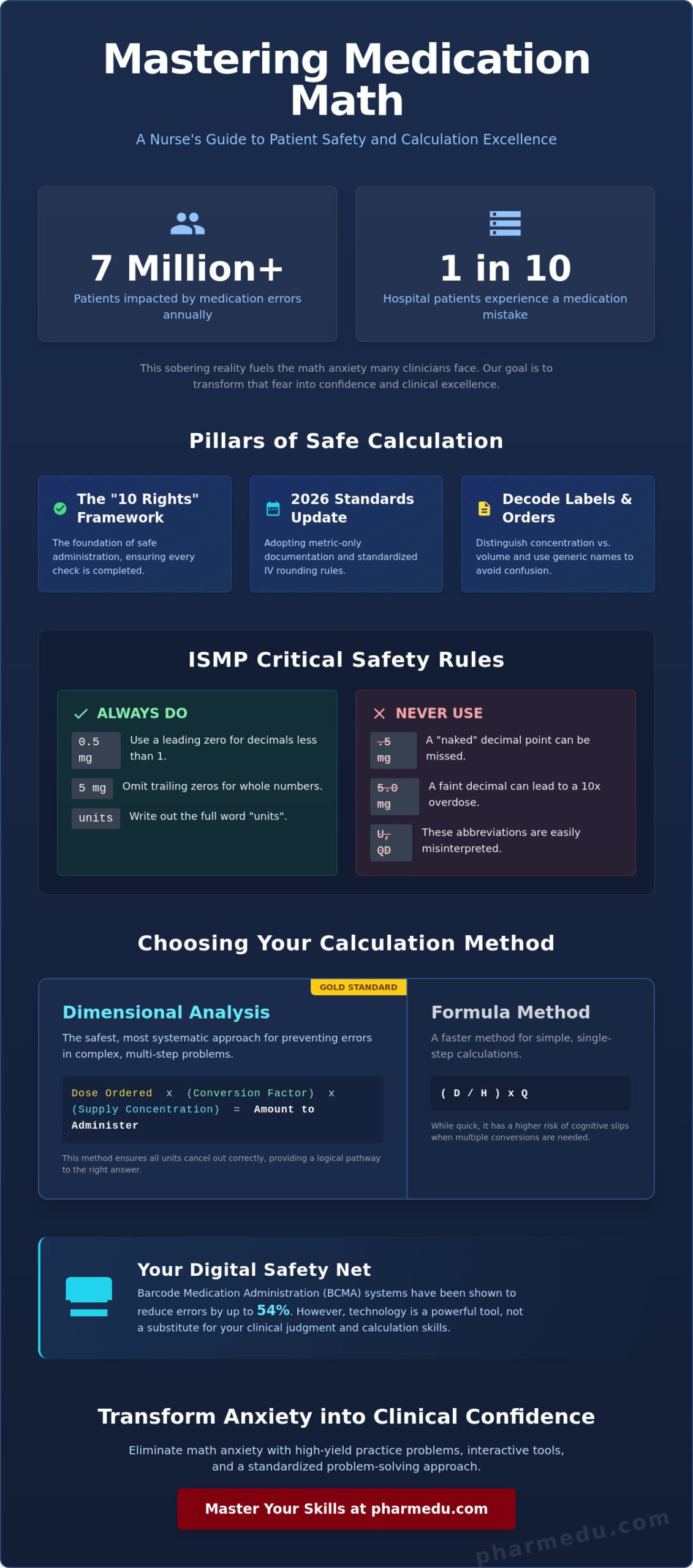
Did you know that medication errors impact more than 7 million patients every year, with one in ten hospital patients experiencing a mistake during their stay? It’s a sobering reality that fuels the deep-seated math anxiety many clinicians feel when performing medication calculation practice for nurses under urgent time pressures. You aren’t alone if the sight of a conversion factor or a high-stakes titration calculation makes your heart race; the fear of a simple decimal point error is a heavy burden to carry on a busy shift.
We understand that you want to feel certain, not just “close enough,” when administering life-saving treatments. Our goal is to transform that fear into clinical excellence by providing a structured framework that prioritizes critical thinking over rote memorization. This guide promises to help you master high-yield dosage calculation methods and tackle practice problems that mirror the complexity of modern healthcare environments.
We’ll provide a comprehensive overview of the 2026 standards for metric-only weight documentation, standardized rounding rules for IV pumps, and the updated “10 Rights” framework for medication administration. By establishing a consistent, logical approach to every calculation, you’ll gain the professional confidence needed to pass your exams and ensure the highest level of patient safety.
Key Takeaways
- Understand why precise calculation acts as a critical safety bridge between a prescription and patient administration to prevent life-threatening sentinel events.
- Compare leading dosage calculation methods and learn why dimensional analysis remains the gold standard for medication calculation practice for nurses during complex, multi-step problems.
- Develop clinical proficiency by working through high-yield scenarios that cover oral, parenteral, and weight-based dosing requirements.
- Master the technical distinctions between infusion pump rates and gravity drips to ensure accuracy in high-stakes intravenous therapy.
- Discover how digital tools and high-yield video vignettes can help you standardize your problem-solving approach and eliminate math anxiety in the clinical setting.
The Fundamentals of Medication Calculation and Patient Safety
Medication calculation serves as the essential bridge between a physician’s prescription and the safe administration of a drug. It is a critical thinking process that transforms a written order into a tangible clinical action. Accuracy here is non-negotiable; even a minor decimal error can lead to a sentinel event, which refers to an unexpected occurrence involving death or serious physical or psychological injury. Understanding fundamental dosage concepts is the first step in ensuring these tragedies don’t occur. When you engage in medication calculation practice for nurses, you aren’t just doing math; you’re verifying that the therapeutic intent matches the patient’s physiological needs.
Metric System Mastery and Unit Conversions
Modern healthcare runs exclusively on the metric system because its decimal-based structure allows for precise adjustments. You’ll primarily work with grams (g), milligrams (mg), and micrograms (mcg). A solid grasp of these conversions is vital: 1 g equals 1,000 mg, and 1 mg equals 1,000 mcg. Safety protocols from the Institute for Safe Medication Practices (ISMP) are strict about how these numbers are recorded. You must never use “trailing zeros.” Writing “2.0 mg” instead of “2 mg” is a dangerous practice; a faint decimal point could lead a colleague to administer 20 mg instead, resulting in a 10-fold overdose. Always lead with a zero for decimals, such as “0.5 mg,” but never follow a whole number with one.
Decoding Drug Labels and Physician Orders
Reading a drug label requires a discerning eye and total focus. You must distinguish between the “concentration,” which is the amount of drug per mL (e.g., 50 mg/mL), and the “total volume” in the vial (e.g., 10 mL). Confusing these two numbers is a frequent source of calculation errors. Additionally, always prioritize the generic name over the trade name. Many medications have similar-sounding brand names that can lead to confusion during a busy shift. In 2026, regulatory bodies have strictly enforced the “Do Not Use” abbreviation list. You should never use “U” for units or “QD” for daily; these must be written out in full to prevent misinterpretation and ensure patient safety.
Mastering the Methods: Dimensional Analysis vs. The Formula Method
Selecting a calculation strategy isn’t just about reaching the correct numerical result; it’s about building a repeatable, error-resistant workflow. Most nursing curricula focus on two primary techniques to bridge the gap between a written order and a patient’s dose. While both methods can lead to the same answer, they offer different levels of protection against cognitive slips. Your choice should align with the complexity of the task and your own logical preferences to ensure safety at the bedside.
Effective medication calculation practice for nurses often begins with choosing a “home base” method. Some clinicians prefer the speed of a simple formula for routine oral medications, while others rely on a more comprehensive system for high-alert infusions. Consistency is the key to mastery. By sticking to one primary method, you reduce the mental load required to set up a problem, which is especially helpful during high-pressure clinical situations or timed examinations.
Dimensional Analysis: The Gold Standard for Accuracy
Many educators consider dimensional analysis for medication calculation to be the safest approach available. It works like a train track; you line up all your variables, including conversion factors, in a single linear equation. By aligning units so they cancel each other out, you ensure that your final answer is expressed in the correct measurement, such as milliliters or tablets. This method is particularly favored for complex, multi-step problems because it prevents you from forgetting to convert grams to milligrams or pounds to kilograms. You don’t have to memorize separate formulas for different types of drugs; one logical structure handles everything from simple pills to complex weight-based titrations.
The Formula Method: Desired over Have (D/H x Q)
The Formula Method is a popular choice for quick, single-step calculations. It relies on the simple equation: (Desired Dose / Have on Hand) x Quantity = X. A common mnemonic to remember this under pressure is “Doctor’s order over Have on hand, then multiply by the volume.” It’s an efficient tool for routine tasks, such as determining how many 500 mg tablets to give when the order is for 1,000 mg. However, this method has significant limitations. It doesn’t inherently account for unit conversions. If the order is in grams and the supply is in milligrams, you must perform a separate calculation first. This extra step introduces a “silent” opportunity for error, which makes it less ideal for critical care or pediatric settings where precision is paramount.
While DA provides a robust safety net for complex scenarios, the Formula Method offers speed for the basics. If you’re still deciding which path to take, our High-Yield Video Vignettes provide visual breakdowns of both methods in real-world clinical scenarios. Mastering these techniques transforms math from a source of anxiety into a professional tool for patient advocacy.
High-Yield Medication Calculation Practice Problems
Mastering theory is only the first step toward clinical excellence. To truly build confidence, you must apply these concepts to realistic scenarios that mirror the fast-paced environment of a modern hospital. Engaging in consistent medication calculation practice for nurses helps bridge the gap between classroom knowledge and bedside safety. These problems focus on high-yield drug classes and incorporate the 2026 NCLEX “Next Generation” approach, which emphasizes clinical judgment over simple memorization. By modeling your reasoning through a “think aloud” process, you’ll learn to spot potential errors before they reach the patient, which is the most effective way of preventing medication administration errors.
Oral Dosage Calculations: Tablets and Suspensions
Problem 1: The physician orders Digoxin 0.125 mg PO daily. The pharmacy provides 0.25 mg scored tablets. How many tablets will you administer?
Think Aloud Rationale: I’ll start by identifying that the “Desired” dose (0.125 mg) is exactly half of the “Have” dose (0.25 mg). Since the tablet is scored, it’s safe to split. I’ll calculate 0.125 / 0.25 = 0.5 tablets. I’ll double-check that the dose is appropriate for this high-alert medication before proceeding.
Problem 2: A pediatric patient is prescribed 250 mg of an antibiotic suspension. The label reads 0.5 g per 10 mL. How many mL should be given?
Think Aloud Rationale: First, I must convert 0.5 g to 500 mg so my units match. Now, using medication calculation practice for nurses logic, I see that 250 mg is half of 500 mg. Therefore, I need half of the 10 mL volume. The answer is 5 mL. For pediatric oral liquids, always use an oral syringe and round to the nearest 0.1 mL per 2026 safety standards.
Parenteral and Syringe Calculations
Injections require a higher level of precision because the drug enters the bloodstream more rapidly. When solving for volume, always visualize the syringe you’ll use. For volumes less than 1 mL, a 1 mL tuberculin syringe is the standard to ensure accuracy to the hundredth decimal place. If the volume is between 1 mL and 3 mL, a standard 3 mL syringe is appropriate.
Problem 3: You need to administer 5,000 units of Heparin subcutaneously. The vial is labeled 10,000 units/mL. How many mL will you draw up?
Think Aloud Rationale: I’ll set this up by dividing the Desired (5,000) by the Have (10,000) and multiplying by the volume (1 mL). This results in 0.5 mL. I’ll use a 1 mL syringe to ensure I can see the 0.5 mL mark clearly. Remember, insulin is a unique case; it’s measured strictly in units using a dedicated insulin syringe, and you should never convert those units into mL, as this is a frequent source of fatal errors.
Advanced Calculations: IV Flow Rates and Weight-Based Dosing
Intravenous therapy represents one of the highest-risk areas in clinical practice. Unlike oral medications that undergo first-pass metabolism, IV drugs enter the systemic circulation immediately, leaving no room for error. This reality makes advanced medication calculation practice for nurses a cornerstone of patient safety. Whether you’re titrating a potent vasopressor in the ICU or administering maintenance fluids on a surgical floor, your ability to toggle between electronic pump settings and manual gravity calculations is a life-saving skill.
Current 2026 safety standards emphasize that high-alert medications require a formal independent double-check by a second licensed professional. This protocol is mandatory for substances like insulin, heparin, and concentrated electrolytes. For specific drugs like vincristine, modern standards now require dilution in a minibag rather than a syringe to prevent fatal administration errors. These layers of protection, combined with your mathematical precision, form the ultimate defense against the medication errors that impact millions of patients annually.
IV Infusion and Drop Factor Calculations
When using an electronic infusion pump, your final answer will always be in mL/hr. Per 2026 rounding rules, these rates are typically set to a whole number unless a decimal precision is specifically ordered for pediatric or neonatal patients. However, if a pump fails or is unavailable, you must calculate the gravity flow rate in drops per minute (gtt/min). This requires knowing the “drop factor” of your tubing, which is found on the packaging. Macrodrip sets usually deliver 10, 15, or 20 gtt/mL, while microdrip sets deliver 60 gtt/mL.
The “Magic 60” rule is a helpful shortcut for microdrip tubing: since there are 60 minutes in an hour and the drop factor is 60, the mL/hr rate is identical to the gtt/min. For other sets, use the formula: (Total Volume in mL / Time in minutes) x Drop Factor = gtt/min. Remember that you cannot count a fraction of a drop; gravity drips must always be rounded to the nearest whole number to ensure consistent delivery over the prescribed time.
Pediatric Weight-Based Dosing (mg/kg)
In pediatrics and neonatology, weight-based dosing is the primary safety barrier. The Institute for Safe Medication Practices (ISMP) mandates that patient weight must be documented exclusively in metric units to prevent conversion mistakes. The process follows a logical three-step sequence. First, convert the patient’s weight from pounds to kilograms by dividing by 2.2. Second, multiply the weight in kilograms by the ordered dose (mg/kg). Finally, solve for the volume based on the concentration available. Always compare your final result against the “Safe Dose Range” listed in your drug reference; if the order falls outside these parameters, you must clarify it with the provider before administration.
Mastering these advanced scenarios requires repetition and high-fidelity simulation. You can sharpen your skills by taking our Pharmacology Practice Quizzes, which feature real-world IV titration and pediatric dosing scenarios designed for the modern clinician.
Elevating Your Nursing Practice with PharmEDU’s Interactive Tools
Mastering complex math isn’t a one-time event; it’s a skill that requires consistent refinement and the right digital mentor. PharmEDU serves as that reliable partner, providing a structured environment where theory meets clinical application. We’ve designed our platform to move beyond the dry, academic approach of traditional textbooks. By providing medication calculation practice for nurses that is both rigorous and accessible, we help you build the “math muscle memory” necessary to perform flawlessly under the pressures of a 12-hour shift. Our High-Yield Video Vignettes simplify complex equations by breaking them down into logical, visual steps that prioritize safety and clarity.
Long-term retention is the greatest challenge for many clinicians. It’s easy to memorize a formula for an exam, but it’s much harder to recall that information during a midnight code. To combat this, we’ve developed Interactive Pharmacology Flashcards that focus on the most critical unit conversions and high-alert drug protocols. These tools use active recall to ensure that foundational knowledge remains sharp, allowing you to focus your mental energy on patient assessment rather than struggling with basic metric shifts.
Micro-Learning for the Modern Nursing Student
We know that your schedule is demanding. Traditional study blocks aren’t always feasible when you’re balancing clinical rotations, lectures, and personal responsibilities. PharmEDU solves this by offering micro-learning modules designed for 5 to 10 minute study segments. Our platform is fully mobile-compliant, making it easy to engage in medication calculation practice for nurses during a commute or a quick break. We use a Case Study approach that places every calculation within a real-world clinical context. This dedication to quality education is shared by organizations like Focused EDU Staffing Group, which provides K-12 school districts with essential teacher staffing and substitute placement services. You won’t just solve for X; you’ll determine the dose for a patient with specific vital signs and a unique medical history, mirroring the clinical judgment required in modern practice.
Institutional Support for Nursing Programs
Beyond individual mastery, PharmEDU provides robust solutions for nursing schools and healthcare organizations. Many universities now use our Institutional Platform License to track student progress and identify specific areas where a cohort may be struggling. This data-driven approach allows educators to provide targeted support before students reach their final board exams. Our standardized practice quizzes are meticulously updated to reflect the 2026 NCLEX standards, ensuring that every student is prepared for the rigors of professional licensing. Whether you’re a student seeking individual excellence or an educator looking for a reliable tracking tool, we’re here to support your journey. Join PharmEDU today to master medication calculations and more.
Mastering Clinical Precision for 2026 and Beyond
Developing a reliable framework for dosage calculations is more than a requirement for passing your exams; it’s a lifelong commitment to patient advocacy. You’ve explored how standardized methods like dimensional analysis provide a safety net against cognitive slips and how 2026 standards prioritize metric-based precision. By integrating these strategies into your daily workflow, you move from a place of math anxiety to a position of clinical authority. Consistent medication calculation practice for nurses ensures that your focus remains exactly where it belongs: on the safety and recovery of the individuals in your care.
PharmEDU serves as your digital mentor, offering a comprehensive library of over 100 high-yield pharmacology topics. Our platform features micro-learning video vignettes and interactive tools designed to fit into your busy clinical schedule. We’re proud to be a trusted resource used by leading nursing and pharmacy programs to prepare the next generation of healthcare leaders. Start your PharmEDU subscription and ace your next pharmacology exam. You’ve already taken the first step toward mastery, and we’re here to ensure you succeed at every stage of your professional journey.
Frequently Asked Questions
What is the easiest way to learn medication calculations?
Dimensional Analysis is widely considered the most effective method because it provides a consistent, logical structure for every problem. By setting up your units first and “cancelling” them out, you ensure the final answer is in the correct format, such as tablets or mL. This system acts as a built-in safety check during medication calculation practice for nurses, significantly reducing the risk of forgetting a necessary metric conversion.
Are calculators allowed on the NCLEX for dosage questions?
Yes, the NCLEX provides an on-screen calculator for all candidates to use during the examination. However, relying on technology without understanding the underlying math can lead to dangerous “entry errors” that compromise patient safety. You should always estimate your answer mentally first; if your result suggests an unrealistic dose like 15 tablets, it’s a major red flag that something went wrong in the calculation process.
What is the “Desired over Have” formula?
The “Desired over Have” formula is a simplified tool for solving straightforward, one-step dosage problems. The equation is (Desired Dose / Dose on Hand) x Quantity = Volume to Administer. For instance, if a doctor orders 500 mg and you have 250 mg tablets available, the math is (500/250) x 1 tablet = 2 tablets. While efficient, this formula is best reserved for simple tasks where no complex unit conversions are required.
How do I convert milligrams (mg) to micrograms (mcg)?
Converting milligrams to micrograms requires multiplying the value by 1,000 or moving the decimal point three places to the right. For example, a 0.5 mg dose becomes 500 mcg. Conversely, to go from a smaller unit to a larger one, you simply divide by 1,000. Mastery of these 1,000-fold shifts is essential for medication calculation practice for nurses, as a single decimal error can lead to a catastrophic 10-fold or 100-fold overdose.
What are the “Six Rights” of medication administration?
The Six Rights are a foundational safety framework consisting of the Right Patient, Right Medication, Right Dose, Right Route, Right Time, and Right Documentation. While calculation practice specifically ensures the “Right Dose,” it must be performed within this broader context of care. In 2026, these manual checks are almost always supplemented by Barcode Medication Administration (BCMA) technology to provide an extra layer of defense against human error.
How do you calculate IV drip rates?
To calculate a manual IV drip rate in drops per minute, use the formula: (Total Volume in mL / Time in Minutes) x Drop Factor. The drop factor is determined by your specific IV tubing, such as 10, 15, or 60 gtt/mL. If you are using an electronic infusion pump, the math is simpler: Total Volume / Total Hours = mL/hr. Always verify whether the order requires a gravity drip or a pump before beginning your calculation.