

Mastering NAPLEX Math Questions: High-Yield Formulas and Practice Strategies for 2026
A single misplaced decimal point on your exam can cost you more than just a few points. It can cost you $520 in resit fees and months of career delay. Mastering NAPLEX math questions isn’t just about basic arithmetic; it’s about developing the clinical precision required to ensure patient safety in a high-pressure environment. We understand that the volume of formulas can feel overwhelming, especially when you’re facing a six-hour, 225-question exam where you can’t go back to change an answer once it’s submitted.
You’ve worked too hard throughout pharmacy school to let a rounding error stand between you and your license. This guide will unlock the secrets to the calculation section with expert strategies and a foolproof system for unit conversions. We’ll provide you with a clear framework for identifying which formula to use for complex word problems and the exact rounding rules you need for the 2026 cycle. By the end of this article, you’ll have the confidence to approach every calculation with the accuracy of a seasoned practitioner. We’ll help you build the precision-focused mindset necessary to pass the NAPLEX on your first attempt and move forward in your professional journey.
Key Takeaways
- Understand the critical weight of the calculation competency statements and how the “no-partial-credit” fill-in-the-blank format impacts your testing strategy.
- Master the essential formulas for alligations, milliequivalents, and milliosmoles to tackle various NAPLEX math questions with speed and precision.
- Implement the “Golden Rule” of rounding to protect your score from decimal errors and ensure consistency across multi-step pharmaceutical calculations.
- Learn a structured framework for deconstructing complex word problems, allowing you to isolate relevant clinical data and choose the most efficient equation setup.
- Discover how leveraging Pharmacology Practice Quizzes and high-yield video vignettes can streamline your study process and boost your confidence before test day.
Understanding the NAPLEX Calculations Blueprint
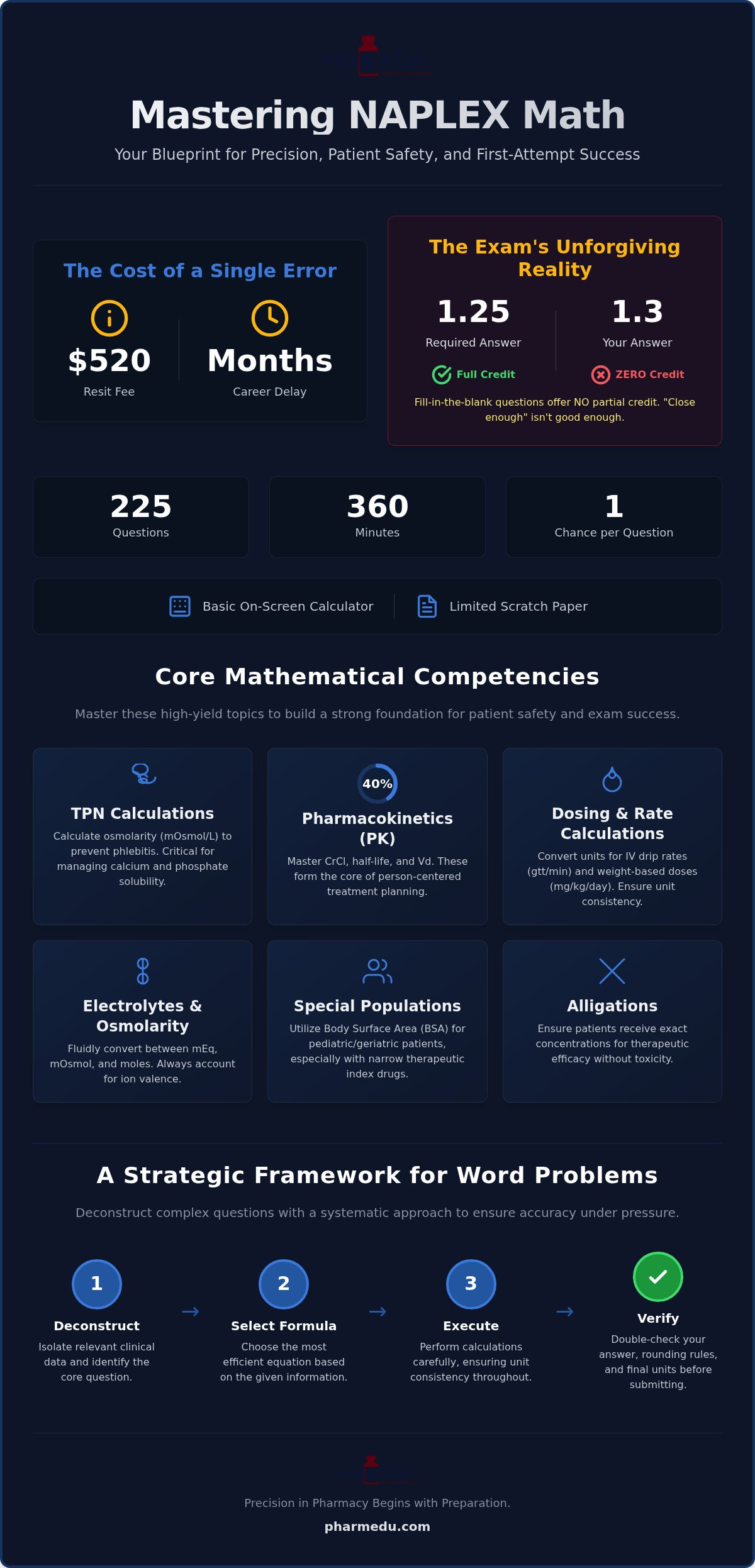
The North American Pharmacist Licensure Examination (NAPLEX) serves as the final gatekeeper for the pharmacy profession. Within its five-domain structure, mathematical proficiency is a non-negotiable requirement for licensure. The NABP emphasizes math as a core safety competency because errors in the pharmacy often stem from calculation failures. Transitioning from a student mindset to practitioner precision requires a psychological shift where you are no longer solving for a grade, but for the safety of a human life. This shift is most evident in the “no-partial-credit” reality of the exam. If a fill-in-the-blank question requires an answer of 1.25 and you enter 1.3, you receive zero points. There is no room for “close enough” in clinical practice, and NAPLEX math questions reflect this high standard.
The Scope of NAPLEX Math
Candidates often feel overwhelmed by the sheer volume of formulas, but the exam focuses on high-yield topics like Total Parenteral Nutrition (TPN), Pharmacokinetics (PK), and pediatric dosing. You’ll encounter a mix of multiple-choice questions and constructed-response items that require you to type your answer into a box. These fill-in-the-blank NAPLEX math questions test your ability to follow specific rounding instructions without the safety net of seeing a list of options. You must be prepared to handle various units, from milliosmoles to milliequivalents, while maintaining absolute accuracy. Calculation competency serves as the indispensable foundation of patient safety in the professional practice of pharmacy.
The On-Screen Calculator and Testing Environment
The Pearson VUE testing environment provides an on-screen calculator that is intentionally basic. It lacks the advanced features of the scientific calculators you likely used in pharmacy school. You’ll also be provided with a whiteboard or scratch paper for your work, but these tools have limited space. Time management becomes a critical factor in your success. With 225 questions to answer in 360 minutes, you must decide how many seconds to invest in each calculation. Rushing leads to errors, but lingering too long on a single problem can jeopardize your ability to finish the exam. Developing a systematic approach to these problems is the only way to ensure you stay on track without sacrificing the precision your future patients deserve.
Core Mathematical Competencies: From Alligations to Pharmacokinetics
Success on the exam requires more than memorizing formulas; it demands the ability to apply them within complex clinical narratives. While basic arithmetic is the tool, clinical judgment is the driver. For example, when you encounter NAPLEX math questions involving the alligation method, you aren’t just mixing fluids. You’re ensuring a patient receives the exact concentration required for therapeutic efficacy without toxicity. Similarly, pharmacokinetic calculations like Creatinine Clearance (CrCl), half-life, and Volume of Distribution (Vd) aren’t just variables in a vacuum. They are the mathematical representations of how a specific patient’s body interacts with a medication, making them essential for the 40% of the exam dedicated to person-centered treatment planning.
Electrolytes and Osmolarity
The trinity of electrolyte math, milliequivalents, milliosmoles, and moles, represents one of the most high-yield areas of the foundational knowledge domain. You must be able to convert between these units with absolute fluidness. A common pitfall is failing to account for the valence of an ion when converting milligrams to milliequivalents. In Total Parenteral Nutrition (TPN) scenarios, calculating the osmolarity (mOsmol/L) is a critical safety step to prevent phlebitis or dangerous osmotic shifts. Pay close attention to calcium and phosphate solubility limits; exceeding these can lead to life-threatening precipitates, a scenario frequently tested to evaluate your commitment to patient safety.
Dosing and Rate Calculations
Dosing calculations bridge the gap between a written order and actual administration. Whether you’re determining an IV drip rate in gtt/min or calculating a weight-based dose in mg/kg/day, unit consistency is your best defense against error. Pediatric and geriatric populations require extra vigilance, often necessitating Body Surface Area (BSA) calculations for narrow therapeutic index drugs. Mastering these multi-step problems is easier when you’ve practiced with realistic scenarios. Engaging with Pharmacology Practice Quizzes can help you internalize these workflows, ensuring that unit conversions become second nature during the high-stakes environment of the six-hour exam. This level of preparation transforms a potentially overwhelming NAPLEX math questions section into a showcase of your clinical readiness.
The Precision Mandate: Mastering Rounding and Unit Conversions
Precision in pharmaceutical calculations is the thin line between therapeutic success and a sentinel event. While you might have identified the correct clinical path, your final answer depends entirely on how you handle the numbers after the decimal point. The National Association of Boards of Pharmacy (NABP) maintains a strict “Precision Mandate” that catches many candidates off guard. It’s not enough to know the math; you must follow the specific protocols for how those numbers are presented in the final answer box. A correct formula with incorrect rounding results in zero points. This reality makes the final steps of your calculation just as critical as the initial setup.
NABP Rounding Standards
The “Golden Rule” of NAPLEX math questions is simple: never round intermediate steps. If you’re performing a three-step calculation, carry every decimal place your on-screen calculator provides until you reach the very end. Rounding too early causes “rounding drift,” where your final answer falls outside the accepted range. For the 2026 exam cycle, pay close attention to the specific instructions provided in each prompt. If a question asks for the nearest tenth, your answer must have one decimal place (e.g., 12.4). If it asks for a whole number, you must round according to standard mathematical rules unless the clinical scenario dictates otherwise.
- Rounding Up: Standard practice for numbers 5 and above.
- Rounding Down: Standard practice for numbers 4 and below.
- Clinical Practicality: When calculating doses for items that cannot be split, such as capsules or drops, you must provide a whole number. You can’t dispense 1.5 capsules or 10.2 drops.
Unit Conversion Traps
The most common errors on the exam aren’t failures of logic, but failures of decimal placement. Converting micrograms (mcg) to milligrams (mg) or grams (g) requires absolute focus. A single decimal slip results in a ten-fold or hundred-fold dosing error, which is a major safety violation. Beyond the metric system, you must also be comfortable with apothecary units that occasionally appear in NAPLEX math questions despite being less common in modern clinical settings. You should memorize the following high-yield conversions before test day:
- 1 grain (gr) = 65 mg (unless specified as 64.8 mg for specific drugs)
- 1 ounce (oz) = 28.35 g (weight) or 29.57 mL (volume)
- 1 pound (lb) = 454 g
- 1 teaspoon (tsp) = 5 mL
- 1 tablespoon (tbsp) = 15 mL
Handling these “old school” units with the same rigor as your metric conversions ensures that no question, regardless of its terminology, can derail your progress. Accuracy in these foundational units is what separates a prepared candidate from one who is simply guessing.
Strategic Preparation: How to Approach Complex Multi-Step Problems
Complex pharmaceutical calculations often arrive wrapped in layers of clinical “noise.” A patient’s age, weight, and history might all be present in the prompt, but only two variables may be required to solve the specific problem. Succeeding with NAPLEX math questions requires a disciplined approach to deconstruction. You must learn to strip away irrelevant data and focus on the core objective. While some students rely on unreliable shortcuts shared in online forums, these often fail when the problem parameters shift slightly. Instead, you need a robust, repeatable workflow that works every time, regardless of how the question is framed.
Whether you prefer dimensional analysis or ratio-proportion, the key is consistency. Dimensional analysis is often superior for multi-step problems because it tracks units throughout the entire process, significantly reducing the risk of a conversion error. Regardless of your chosen method, your scratch paper should be your greatest ally. Develop a consistent layout for your work so that if you need to pause and return to a problem, you can easily follow your own logic without starting from scratch.
A Five-Step Framework for Math Success
To minimize errors and build confidence, apply this five-step framework to every calculation you encounter:
- Step 1: Identify the goal. Look at the final answer box first. Does it require mL, mg, or drops? Knowing the target unit prevents you from stopping the calculation too early or going too far.
- Step 2: List the known variables. Extract the numbers from the prompt and convert them to consistent units immediately. Don’t mix grams and milligrams in the same equation.
- Step 3: Select the appropriate formula. Choose the method that best fits the data provided, whether it’s an alligation grid or a specific pharmacokinetic equation.
- Step 4: Execute the calculation. Use the on-screen calculator and avoid all intermediate rounding to maintain the precision mandate discussed in previous sections.
- Step 5: Final check against clinical reality. Does the answer make sense? If your calculation suggests a patient needs 500 tablets for a single dose, you’ve likely made a decimal error.
Time Management During Math Sections
Momentum is vital during the six-hour exam. If a particular math problem feels like a “black hole” for your time, use the flag and skip strategy. It’s better to secure points on three straightforward clinical questions than to spend ten minutes struggling with one complex calculation. Reducing anxiety comes through repetitive practice of high-yield topics until the formulas become muscle memory. For a broader look at how to structure your entire study plan, consult The Best NAPLEX Prep Course Guide. Mastering NAPLEX math questions is a marathon of accuracy, not a sprint of speed. To ensure you’re fully prepared for the 2026 cycle, consider starting a PharmEDU Monthly Subscription to access interactive practice quizzes that mirror the real testing environment.
Elevating Your Prep with PharmEDU’s Interactive Math Modules
Mastering the intricacies of pharmaceutical calculations requires more than just reading a list of formulas; it demands active engagement with the material. Traditional study methods often leave students feeling isolated when they hit a wall on a complex pharmacokinetic problem. PharmEDU bridges this gap by serving as a digital mentor, providing the structured support necessary to turn academic knowledge into board-certified precision. By focusing on the most challenging NAPLEX math questions, our platform ensures that your study time is spent on high-yield content that directly impacts your ability to pass on the first attempt.
Our approach is built on the principle of micro-learning, allowing you to master one specific math concept per day. This structured methodology reflects the same commitment to academic excellence seen in leading international institutions like oakmeadow.ac.th, where students develop the foundational skills necessary for success in rigorous professional fields. Whether you’re on a short break during rotations or commuting, our mobile-compliant design ensures that precision-focused practice is always within reach. This consistent, bite-sized exposure helps transition your skills from theoretical understanding to the clinical performance required by the NABP. Instead of cramming hundreds of formulas in a single weekend, you’ll build the muscle memory needed to handle the “no-partial-credit” reality of the exam with total confidence.
For many pharmacy students, seeing a calculation solved in real-time is far more effective than deciphering a static page in a manual. Our High-Yield Video Vignettes simplify complex PK math by walking you through the logic of each step, from initial unit conversion to the final rounding. This visual breakdown is especially helpful for multi-step problems where the risk of a decimal error is highest. We also integrate these calculations into our Clinical Case Studies, allowing you to see how math functions in a real patient scenario. When you compare these dynamic tools to traditional methods, it’s clear why a Comprehensive Pharmacy Review favors digital platforms over print in 2026. Digital learning provides the agility to update content as exam standards evolve, ensuring you’re always studying the most current protocols.
Join the PharmEDU Community
The journey to licensure is a significant professional milestone, and you shouldn’t have to navigate the administrative and academic hurdles alone. By accessing a PharmEDU Monthly Subscription, you gain full entry to our library of interactive Pharmacology Practice Quizzes. These quizzes provide immediate feedback, explaining not just which answer is correct, but the clinical rationale behind the math. For those still in their final year, we also offer an Institutional Platform License that supports entire pharmacy schools, ensuring that every graduate enters the workforce with the same high standard of mathematical precision. Don’t let a single decimal point stand between you and your career. Start your PharmEDU Monthly Subscription today and master NAPLEX math through a platform designed by healthcare educators who understand exactly what it takes to succeed.
Secure Your Professional Future Through Precise Practice
Success on the 2026 exam hinges on moving past basic memorization to embrace practitioner-level precision. By internalizing the NABP rounding standards and applying a structured framework to complex NAPLEX math questions, you transform a high-pressure section into a predictable sequence of clinical steps. Accuracy in intermediate steps is non-negotiable; a single decimal error is the difference between a correct entry and a lost point. Your ability to deconstruct word problems and identify relevant variables is what will ultimately ensure patient safety and exam success.
You don’t have to face this academic challenge without a reliable partner. PharmEDU provides a comprehensive library covering over 100 pharmacology topics through high-yield video vignettes. Our mobile-compliant design allows for seamless study during busy rotations, while our interactive quizzes provide the real-time feedback necessary to bridge the gap between theory and board-certified performance. Master NAPLEX Math with PharmEDU’s High-Yield Video Vignettes and gain the confidence you need to excel.
Your years of dedication in pharmacy school have prepared you for this professional milestone. With the right strategic tools and a commitment to precision, you’re well on your way to passing the NAPLEX on your first attempt and beginning your career as a licensed pharmacist.
Frequently Asked Questions
How many math questions are on the NAPLEX?
There isn’t a fixed number of math items, but they typically comprise a significant portion of the “Foundational Knowledge” and “Medication Use Process” domains. These sections each account for 25% of the overall exam. Most candidates report encountering 30 to 40 calculation-based questions during their session. Since the exam is adaptive in nature within its specific competency areas, the exact count varies. You should be prepared for math to appear throughout the six-hour window.
Does the NAPLEX provide a formula sheet during the exam?
No, the NABP does not provide a formula sheet during the examination. You’re expected to have high-yield formulas, such as alligations, CrCl, and milliequivalent conversions, fully memorized before arriving at the testing center. Relying on your memory ensures you can move efficiently through the 225 questions without searching for references. Mastering these formulas through repetitive practice is the only way to ensure they become second nature during the high-stress environment of the board exam.
What happens if I round my intermediate answers on the NAPLEX?
Rounding your intermediate answers often leads to “rounding drift,” which results in a final value that falls outside the scoring range. The NABP requires absolute precision. You must carry all decimal places provided by the on-screen calculator until you reach the final step of the problem. Only round at the very end based on the specific instructions provided in the question prompt. Failing to follow this rule is a common reason for missing points on multi-step NAPLEX math questions.
Can I use my own calculator for the NAPLEX?
You cannot bring your own calculator into the Pearson VUE testing center. The exam provides a basic on-screen calculator for all mathematical items. This digital tool lacks advanced scientific functions, so it’s important to practice with a standard four-function calculator during your preparation. Familiarizing yourself with the layout and limitations of the on-screen interface will help you avoid technical frustration and maintain your momentum during the six-hour testing session.
Which math topics are most “high-yield” for the NAPLEX?
High-yield topics include Total Parenteral Nutrition (TPN) osmolarity, alligations, and pharmacokinetic variables like Creatinine Clearance. You’ll also encounter frequent items involving milliequivalent to milligram conversions and weight-based dosing for pediatric or geriatric patients. These areas are prioritized because they directly impact patient safety and clinical outcomes. Focusing your study on these core competencies ensures you’re prepared for the most heavily weighted sections of the updated 2026 competency statements.
What is the best way to practice NAPLEX math questions?
The most effective strategy involves active recall and repetitive problem-solving using tools that mirror the actual exam environment. Engaging with Pharmacology Practice Quizzes allows you to identify specific weaknesses in your calculation logic. Additionally, watching High-Yield Video Vignettes helps you visualize the step-by-step deconstruction of complex word problems. This combination of visual learning and interactive practice builds the precision-focused mindset necessary to handle the “no-partial-credit” reality of these NAPLEX math questions.
How do I handle math questions that don’t specify rounding rules?
If a question doesn’t provide specific rounding instructions, you should generally follow standard mathematical rules or clinical practicality. For example, doses for items like capsules, tablets, or drops must always be expressed as whole numbers since these cannot be safely divided in a pharmacy. For other calculations, rounding to the nearest tenth is a common default, but you should always look for context clues within the prompt that might indicate a specific level of precision required.
Are there partial credits for multi-step math problems?
There is no partial credit for any calculation-based item on the exam. Most NAPLEX math questions use a constructed-response or fill-in-the-blank format, meaning your final answer must be exactly correct to earn points. This “all-or-nothing” scoring system emphasizes the need for absolute accuracy in every conversion and calculation step. It’s why mastering the rounding protocols and double-checking your work for common-sense clinical reality is so vital for a passing score.