
Pharmacology Exam Questions and Answers: The 2026 High-Yield Study Guide
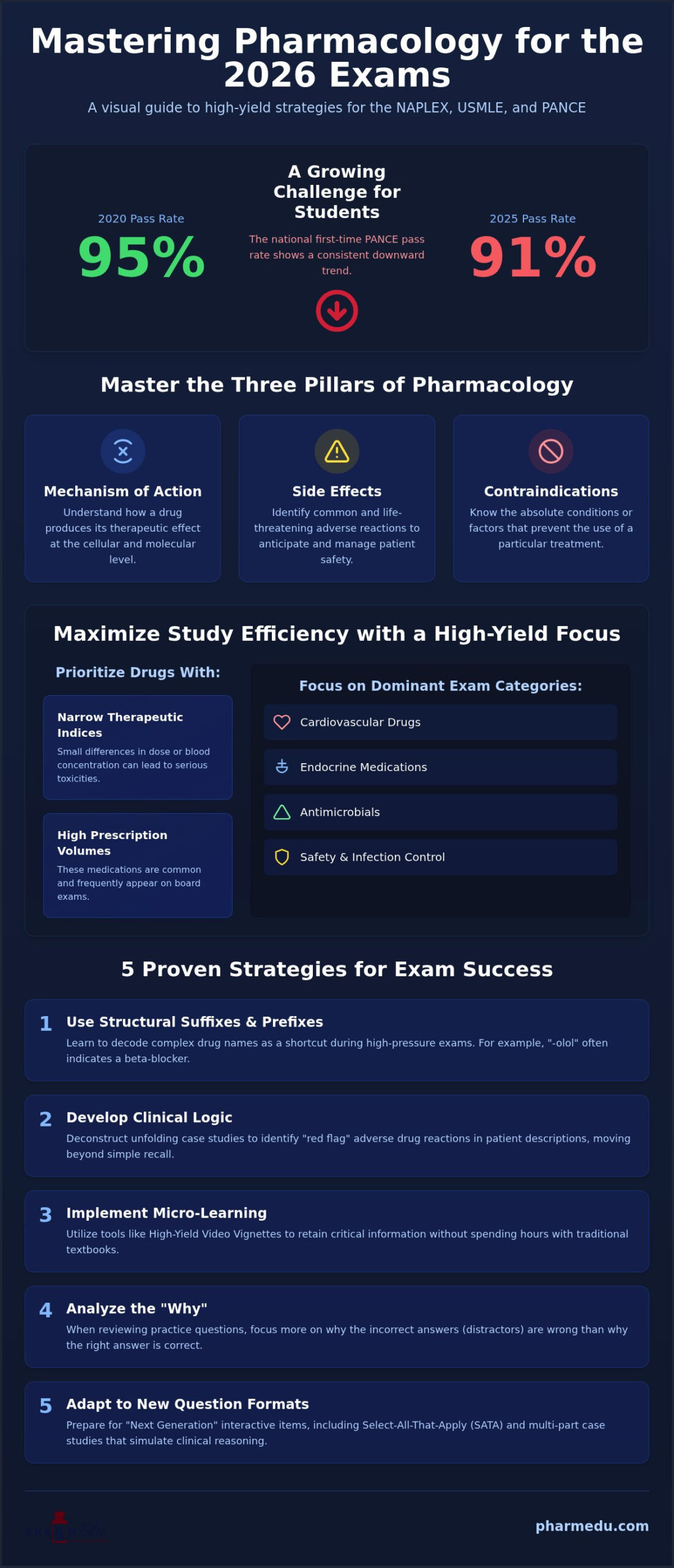
The national first-time PANCE pass rate has seen a consistent slide from 95% in 2020 to 91% in 2025. This downward trend highlights a growing challenge for healthcare students who must master an ever-expanding pharmacopoeia using effective pharmacology exam questions and answers. It’s no secret that pharmacology is often the most daunting hurdle for candidates. The sheer volume of drug names, combined with the pressure of applying theoretical knowledge to complex clinical case studies, can leave even the most dedicated students feeling overwhelmed. You aren’t alone if the thought of failing your board certification causes significant anxiety.
This guide provides the high-yield resources you need to bridge the gap between rote memorization and clinical mastery. We’ve curated a study resource that focuses on the mechanisms of action for major drug classes and proven test-taking strategies. You’ll learn how to approach the five-domain structure of the NAPLEX or the rigors of the USMLE Step 1 with confidence. We’ll explore expert-curated questions, detailed rationales, and the logic required to improve your test-taking speed and accuracy for the 2026 exam cycle.
Key Takeaways
- Prioritize high-yield topics by focusing on drugs with narrow therapeutic indices and high prescription volumes to maximize your study efficiency.
- Master the three fundamental pillars of pharmacology-mechanism of action, side effects, and contraindications-to reason through any clinical scenario.
- Learn to use structural suffixes and prefixes as a shortcut to decode complex pharmacology exam questions and answers during high-pressure board exams.
- Develop the clinical logic needed to deconstruct unfolding case studies and identify “red flag” adverse drug reactions in patient descriptions.
- Implement micro-learning strategies using High-Yield Video Vignettes to retain critical information without spending hours with a traditional textbook.
Mastering Pharmacology Exam Questions: What to Expect in 2026
High-yield study involves a strategic focus on drugs with narrow therapeutic indices or high prescription volume. These are the medications where a small error in dosage or a missed interaction leads to significant patient harm. To succeed, you must master the three core pillars of every drug class: its mechanism of action, its common or life-threatening side effects, and its absolute contraindications. Understanding these fundamentals allows you to build a framework that applies to thousands of individual agents without the need for exhaustive, repetitive memorization.
Modern exams in 2026 have moved away from simple recall. You’ll encounter multiple-choice questions, select-all-that-apply (SATA) formats, and complex unfolding case studies. Success depends on understanding the “rationales” behind each answer. Simple answer-checking won’t suffice; you must understand why a specific option is the priority in a clinical setting. This analytical approach is what separates a passing score from a failing one. When you review pharmacology exam questions and answers, pay closer attention to why the distractors are incorrect than why the right answer is correct.
The Evolution of Board Exams: NAPLEX and NCLEX Trends
The 2026 testing environment prioritizes clinical decision-making over memorization. Modern NAPLEX prep courses are redesigning their curriculum to mirror this shift toward patient safety. “Next Generation” question types in 2026 are defined as interactive, multi-part items that simulate real-time clinical reasoning by requiring candidates to synthesize data from electronic health records before selecting a therapy. This shift ensures that candidates can provide a comprehensive overview of pharmacology in a real-world setting, rather than just reciting facts from a textbook. You’re no longer just identifying a drug; you’re managing a patient’s entire medication profile.
Key Categories That Dominate Exam Papers
While the syllabus is vast, certain categories consistently dominate the exam landscape. Cardiovascular drugs, endocrine medications, and antimicrobials typically account for the largest percentages of pharmacology exam questions and answers. Examiners are also placing a growing priority on “Safety and Infection Control,” reflecting the global focus on antibiotic stewardship and medication error prevention. Utilizing a specialized pharmacology study guide for nursing students helps you categorize your study time effectively. By focusing on these high-weight sections, you ensure you spend the most effort on the topics that appear most frequently. This targeted approach reduces the overwhelming feeling of having to learn every drug in existence.
High-Yield Drug Classes: Sample Questions and Rationales
Mastering high-yield drug classes is the foundation of scoring well on professional certifications. Understanding the Pharmacology Fundamentals ensures you aren’t just memorizing names but understanding the physiological impact of each intervention. National boards frequently test the Autonomic Nervous System (ANS), specifically the contrast between Adrenergic (sympathetic) and Cholinergic (parasympathetic) responses. Adrenergic agonists like epinephrine trigger “fight or flight” mechanisms, while cholinergic agents focus on “rest and digest” functions. Questions often ask you to predict side effects based on these receptors, such as tachycardia from beta-1 stimulation or bronchoconstriction from muscarinic activation.
Antimicrobial questions typically group drugs by their mechanism. You’ll need to distinguish between cell wall synthesis inhibitors, like Penicillins and Cephalosporins, and protein synthesis inhibitors, such as Aminoglycosides and Tetracyclines. In the endocrine section, focus shifts to insulin kinetics. You must know that rapid-acting insulin like Lispro has an onset within 15 minutes, whereas long-acting Glargine provides a peakless 24-hour basal coverage. Reviewing these through pharmacology exam questions and answers helps solidify the timing required for patient education and safety.
Cardiovascular Pharmacology Sample Questions
Sample Question: A patient taking Digoxin for heart failure reports nausea and seeing yellow-green halos around lights. Laboratory results show a potassium level of 3.1 mEq/L. Why does this electrolyte level increase the risk of toxicity?
Rationale: Hypokalemia significantly increases Digoxin risk because potassium and Digoxin compete for the same binding sites on the Na+/K+ ATPase pump. When serum potassium is low, more binding sites are available for Digoxin to occupy, which enhances its effects and leads to toxicity even if the drug level is within the traditional therapeutic range. To manage this, ACE inhibitors are often used in heart failure because they reduce afterload by blocking the production of Angiotensin II, a potent vasoconstrictor, thereby decreasing systemic vascular resistance and cardiac workload without the same toxicity profile as Digoxin.
Neurological and Psychiatric Medications
Sample Question: Why is a 14-day “washout period” required when switching a patient from a Monoamine Oxidase Inhibitor (MAOI) to a Selective Serotonin Reuptake Inhibitor (SSRI)?
Rationale: This period is vital to prevent Serotonin Syndrome, a potentially fatal condition caused by excessive serotonin accumulation in the synaptic cleft. MAOIs irreversibly inhibit the enzyme that breaks down serotonin; starting an SSRI too soon leads to a dangerous surge in serotonin levels. Another common pitfall involves Lithium dosing. Questions often focus on the narrow therapeutic index and the fact that low sodium levels or dehydration can decrease Lithium clearance, leading to rapid toxicity. If you find these interactions complex, practicing with Pharmacology Practice Quizzes can help you recognize these patterns quickly during the actual exam.
Clinical Application: Deconstructing Complex Case Study Questions
Deconstructing pharmacology exam questions and answers requires more than just knowing drug names; it demands the ability to synthesize clinical data in real-time. The “Unfolding Case Study” format is the gold standard for testing this skill in 2026. In these scenarios, a single piece of new information, like a sudden drop in blood pressure or a spike in serum creatinine, can instantly shift your medication priority. You’ve got to recognize “Red Flags” within patient descriptions to ensure safety. For instance, a patient on an ACE inhibitor who develops a dry cough is a common exam scenario, but a patient developing angioedema is a medical emergency that requires immediate intervention.
Understanding how to prioritize patients is a key component of mastering pharmacology exam questions and answers. Examiners often ask which patient you should see first. The answer usually lies with the patient at the highest risk of a life-threatening adverse drug reaction. If one patient has a minor side effect from an antidepressant and another has suspected anaphylaxis from an antibiotic, the choice is clear. This level of reasoning is why interdisciplinary collaboration is so vital. Nurses often identify the physical symptoms of toxicity first, while pharmacists provide the deep dive into medication reconciliation to find the culprit.
Analyzing Patient Lab Values in Pharmacology
Interpreting lab results is a non-negotiable skill for modern exams. You’ll frequently see questions involving renally cleared drugs like Vancomycin or Gentamicin. If the BUN and Creatinine levels are elevated, the GFR is likely decreased, necessitating a dose reduction or an extended interval to prevent nephrotoxicity. Similarly, monitoring AST and ALT is critical for hepatotoxic agents like Isoniazid or Acetaminophen. A sample question might present a patient with a GFR of 30 mL/min and ask you to adjust their medication dose accordingly. You can find more examples of this logic in Pharmacology2000.com Practice Questions to sharpen your interpretation skills.
Recognizing Drug-Drug and Drug-Food Interactions
Interactions are a staple of clinical case studies. The classic “Grapefruit Juice” scenario involves the inhibition of the CYP3A4 enzyme, which can lead to toxic levels of drugs like Statins or Calcium Channel Blockers. Another frequent flyer is the interaction between Warfarin and Vitamin K rich foods like spinach or kale. You’ll need to explain to patients that consistency in diet is more important than total avoidance. First-pass metabolism significantly reduces the bioavailability of oral medications because they are partially inactivated by the liver before reaching systemic circulation. To master these nuances, exploring our Clinical Case Studies provides the immersive practice needed for board success.
5 Proven Strategies to Answer Pharmacology Questions Correctly
Success with pharmacology exam questions and answers often depends on clinical logic rather than brute memorization. When you encounter an unfamiliar drug name, don’t panic. Instead, move from the specific name to the general mechanism by identifying the drug class first. If you can categorize a medication, you instantly unlock a wealth of knowledge about its expected therapeutic effects and potential adverse reactions. Visualizing the pathophysiology at the cellular level is equally vital. If you understand how a drug changes the cell, such as how a beta-blocker occupies a receptor to prevent catecholamine binding, the side effects like bradycardia become predictable rather than just another fact to memorize.
Board exams like the NAPLEX or NCLEX frequently require you to select the “most correct” answer. This strategy involves prioritizing patient safety above all else. Use the ABC (Airway, Breathing, Circulation) framework to determine which medication intervention is the highest priority. Additionally, analyze the distractors. Examiners include specific incorrect options because they represent common student mistakes or related drug classes. By understanding why the other three options are there, you can confirm your choice with greater certainty and avoid falling for cleverly designed traps.
Decoding Drug Suffixes
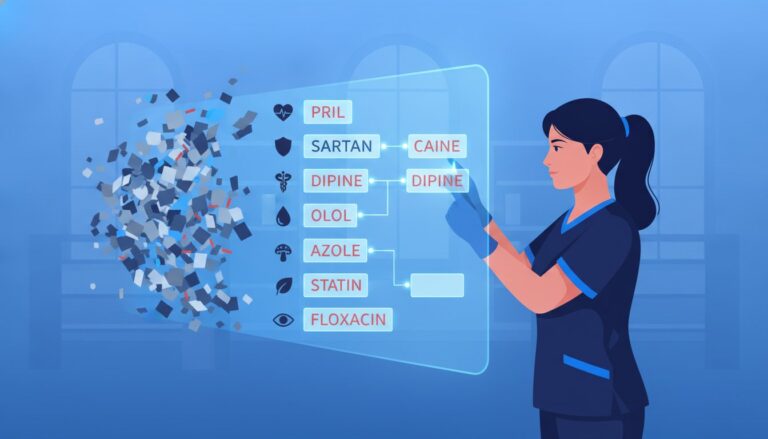
Linguistic markers are your most powerful tool for rapid identification. Mastering these ten common suffixes allows you to categorize hundreds of drugs instantly:
- -olol: Beta-adrenergic blockers (e.g., Metoprolol)
- -pril: ACE inhibitors (e.g., Lisinopril)
- -sartan: Angiotensin II receptor blockers (e.g., Losartan)
- -tidine: H2 receptor antagonists (e.g., Famotidine)
- -prazole: Proton pump inhibitors (e.g., Omeprazole)
- -statin: HMG-CoA reductase inhibitors (e.g., Atorvastatin)
- -dipine: Calcium channel blockers (e.g., Amlodipine)
- -afil: PDE5 inhibitors (e.g., Sildenafil)
- -cillin: Penicillin antibiotics (e.g., Amoxicillin)
- -floxin: Fluoroquinolone antibiotics (e.g., Ciprofloxacin)
Be careful with exceptions. While many antibiotics end in “-mycin,” they aren’t all the same. For example, Azithromycin is a macrolide, while Vancomycin is a glycopeptide with a completely different safety profile and monitoring requirements. You must also remain vigilant about “look-alike, sound-alike” (LASA) drugs. Medications like Hydralazine and Hydroxyzine serve entirely different purposes, and misidentifying them on an exam is a frequent source of lost points.
The Process of Elimination for SATA Questions
Select-All-That-Apply (SATA) questions are notoriously difficult because they don’t offer partial credit. The most effective way to approach these is to treat each option as an individual True/False statement. Don’t look at the options as a group. Instead, ask yourself if each specific side effect or contraindication applies to the drug in the stem. A common trap is the inclusion of a minor side effect that is technically possible but exceptionally rare; examiners usually stick to high-yield, common, or life-threatening reactions. Our comprehensive pharmacy review builds this specific mental muscle by providing practice sets that mirror these rigorous testing formats. To start refining your accuracy today, explore our Pharmacology Practice Quizzes and master the art of the SATA format.
Elevate Your Board Prep with PharmEDU’s Interactive Platform
Mastering pharmacology exam questions and answers requires more than just passive reading; it requires active engagement with the material. PharmEDU’s High-Yield Video Vignettes transform complex drug interactions into visual stories that stay with you long after the video ends. By seeing the pathophysiology in motion, you move beyond rote memorization and develop the clinical intuition needed for high-stakes exams. These vignettes break down the mechanism of action into digestible, logical steps, ensuring you understand the “why” behind every clinical decision. This visual approach is particularly effective for visual learners who struggle with dense, text-only resources.
Busy clinical rotations don’t leave much room for four-hour study sessions. Our platform is built on the power of micro-learning, offering 5-minute segments that fit perfectly between patient rounds or during a quick commute. This efficiency is why medical and pharmacy schools utilize our Institutional Platform License to track student progress and ensure everyone is meeting professional benchmarks. Transitioning from pharmacology theory to real-world practice has never been more seamless. Our mobile-compliant design allows you to review high-yield concepts wherever you are, turning idle time into productive study sessions that build your confidence.
Why PharmEDU Beats Traditional Textbooks
Traditional textbooks are static. In a field that moves as fast as pharmacology, a book published two years ago might already be outdated regarding new FDA approvals or changed black box warnings. Our digital platform provides real-time updates, ensuring you’re always studying the most current data available. While paper flashcards have their place, our Interactive Pharmacology Flashcards use data-driven repetition to focus your energy on the specific drugs you find most challenging. This targeted approach saves hours of unnecessary review and ensures you are fully prepared for the specific pharmacology exam questions and answers you’ll face in 2026.
Getting Started: Your Path to Board Success
Your journey doesn’t end with passing the boards. Whether you’re choosing a PharmEDU Monthly Subscription for a final push or a PharmEDU Annual Subscription for long-term mastery, our resources are designed to support your entire pharmacist career guide trajectory. Professional excellence requires a commitment to continuous learning and staying updated with the latest scientific results. We take the administrative burden of staying current off your shoulders so you can focus on patient care. Join PharmEDU today and start your free trial to experience a more efficient, modern way to prepare for your professional future.
Secure Your Professional Future in 2026
Mastering the clinical logic behind pharmacology is the most reliable way to navigate board certifications with confidence. Success isn’t about memorizing every drug name in existence; it’s about understanding how to apply mechanisms and rationales to complex, unfolding patient scenarios. By utilizing linguistic patterns and prioritizing safety through the ABC framework, you’ll be prepared to tackle even the most difficult pharmacology exam questions and answers on your first attempt.
Transitioning from academic theory to clinical excellence requires a partner that keeps pace with evolving scientific results. PharmEDU offers over 100 high-yield topics and expert-led video vignettes designed to simplify your study process and improve retention. With national institutional licensing available, we provide the structured, digital education necessary for modern healthcare professionals to excel. Start Your Pharmacology Mastery with PharmEDU Subscriptions today. You’ve already done the hard work of learning the science; now let us help you cross the finish line and achieve your board certification.
Frequently Asked Questions
What are the most common pharmacology topics on the NAPLEX?
Cardiovascular, endocrine, and infectious disease medications consistently appear as the most frequent topics on the NAPLEX. Specifically, the “Person-Centered Assessment and Treatment Planning” domain accounts for 40% of the exam as of May 2025. You should focus on high-volume drug classes like ACE inhibitors, statins, and anticoagulants. Mastering these areas ensures you’re prepared for the largest portion of the exam database and the clinical scenarios you’ll face.
How can I memorize drug names more effectively for my exam?
Focusing on structural suffixes and prefixes is the most effective way to memorize drug names. Instead of rote memorization for thousands of agents, learn the “-olol” and “-sartan” rules to categorize drugs instantly. PharmEDU’s Interactive Pharmacology Flashcards use spaced repetition to help you focus on the drugs you find most difficult. This method transforms a chaotic list of names into a manageable, logical system that sticks.
Are pharmacology exam questions mostly multiple choice?
While multiple-choice remains a staple, modern boards are increasingly using “Next Generation” question types. These include select-all-that-apply and unfolding case studies that require you to synthesize data from an electronic health record. Practicing with a diverse range of pharmacology exam questions and answers helps you adapt to these interactive formats. You’ll need to demonstrate clinical judgment rather than just identifying a correct drug name from a list.
How do I answer “Select All That Apply” (SATA) pharmacology questions?
Treat each option in a SATA question as an individual True/False statement to avoid being overwhelmed. Evaluate every choice independently against the drug in the question stem. Don’t look for a specific number of correct answers; instead, ask if each specific side effect or contraindication is a recognized high-yield fact. This methodical approach reduces the anxiety often associated with these complex, multi-part items during high-pressure certifications.
What is the best way to study for a pharmacology final in one week?
Focus exclusively on high-yield drug classes and use micro-learning segments to maximize a one-week study window. Don’t try to read an entire textbook. Instead, use PharmEDU’s High-Yield Video Vignettes to grasp mechanisms quickly. Spending your limited time on cardiovascular and antimicrobial topics will yield the highest return on investment. Combine this with Pharmacology Practice Quizzes to identify and bridge your knowledge gaps immediately before the test.
Can I use PharmEDU for both nursing and pharmacy school?
PharmEDU is designed to support students across all healthcare disciplines, including nursing, pharmacy, and medicine. While the focus of your exam might vary, the underlying pharmacology exam questions and answers rely on the same fundamental science. Our platform covers over 100 high-yield topics that are essential for the NCLEX, NAPLEX, and PANCE. The micro-learning format adapts easily to any professional curriculum or clinical rotation schedule you follow.
What are high-yield drug classes?
High-yield drug classes are those with narrow therapeutic indices, high prescription volumes, or significant safety concerns. Medications like Digoxin, Warfarin, and Lithium are frequently tested because minor errors in their management can lead to severe patient harm. Antimicrobials and endocrine drugs are also considered high-yield due to their clinical prevalence. Prioritizing these classes ensures that your study time is spent on the concepts most likely to appear on your board certification.
Is there a difference between pharmacology questions on NCLEX vs. USMLE?
NCLEX questions prioritize patient safety and nursing implementation, while USMLE questions focus more on molecular mechanisms and pathophysiology. A nursing student might be asked about the priority assessment before giving a beta-blocker. In contrast, a medical student might be asked about the specific receptor signaling pathway involved. Despite these different angles, both exams require a deep understanding of drug classes and their clinical impacts to achieve a passing score.