
Mastering Pharmacology: 2026 Study Guide
What if you could predict a drug’s side effects and contraindications without ever opening a thousand-page textbook? Most healthcare students feel buried under a mountain of disconnected facts, struggling to link complex pathophysiology to specific drug actions. It’s a common frustration to spend hours memorizing a mechanism only to have it vanish from your memory forty-eight hours later. This pharmacology study guide offers a more efficient path forward by treating pharmacology as a language of logic rather than a list of names to be memorized.
We understand that your goal isn’t just to pass an exam; it’s to build a foundation for safe clinical practice. This guide provides a structured framework to help you categorize high-yield medications based on their core mechanisms. By mastering the underlying logic, you’ll stop relying on rote memorization and start making the connections necessary for long-term retention. We’ll walk through a systematic approach to drug classes, examine the most critical high-yield concepts, and provide the tools you need to approach your board exams with absolute confidence.
Key Takeaways
- Shift your focus from rote memorization to a logic-based framework that makes drug mechanisms and side effects intuitive.
- Master the core principles of pharmacokinetics and pharmacodynamics to predict drug behavior without constant textbook reference.
- Learn how to use this pharmacology study guide to categorize hundreds of medications using the power of drug suffixes and prototype frameworks.
- Implement proven study techniques like active recall and spaced repetition to overcome the forgetting curve and ace your board exams.
- Discover the advantages of transitioning from heavy textbooks to digital micro-learning tools designed for busy clinical rotations.
Why a Logic-Based Pharmacology Study Guide is Your Key to Success
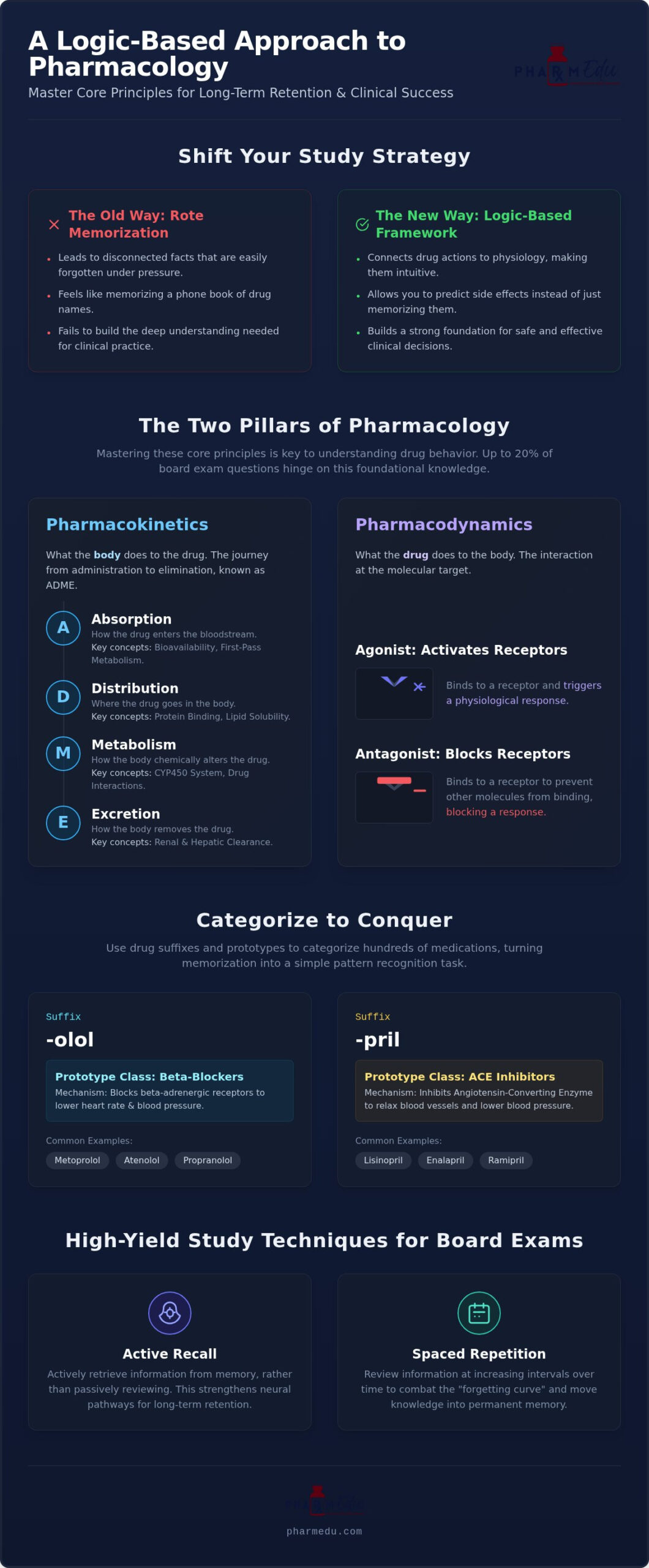
Pharmacology isn’t a phone book of drug names. It’s a map of biological interactions. A truly effective pharmacology study guide functions as a strategic framework rather than a simple list. It connects the “why” of physiology to the “how” of drug action. When you understand how a specific receptor works, you don’t have to memorize a long list of side effects. You can predict them. This logic-first approach transforms a daunting subject into a manageable, structured system.
Rote learning feels safe until you’re sitting for a high-stakes board exam. Under pressure, isolated facts often vanish because they lack a conceptual anchor. Moving from a student mindset to a clinician’s perspective requires deep understanding. Real patients don’t present as multiple-choice questions. They present with complex pathophysiology that requires logical intervention. This transition is where many students struggle, but mastering the logic early ensures long-term clinical success and patient safety.
The Science of High-Yield Learning
High-yield content focuses on the medications you’ll encounter most often in practice and on exams like the NAPLEX or NCLEX. Identifying “must-know” information involves looking for drugs with narrow therapeutic indexes or those that represent an entire class as prototypes. Clinical vignettes test this knowledge by asking you to apply logic to a patient scenario. This application proves you’ve mastered the comprehensive overview of pharmacology rather than just its vocabulary. By focusing on these high-impact areas, you maximize your study efficiency and exam readiness.
Overcoming Information Overload in Healthcare Education
Textbooks are often exhaustive, but they aren’t always efficient for daily review. To filter massive chapters into actionable notes, organize your pharmacology study guide by body system rather than alphabetical drug names. This structure mirrors how you’ll encounter patients in a clinical setting, making the information more relevant. Establishing a predictable study routine also provides a psychological buffer against the stress of healthcare education. It allows for better focus and ensures that you’re making consistent progress without feeling overwhelmed by the sheer volume of data.
Core Principles: Understanding Pharmacokinetics and Pharmacodynamics
Foundational principles aren’t just academic hurdles; they’re the building blocks of clinical decision-making. Educators often estimate that nearly 20% of pharmacology-related board exam questions hinge on your grasp of kinetics and dynamics. If you don’t understand how a drug moves, you can’t safely prescribe it. This section of your pharmacology study guide focuses on the technical pillars that support every medication class you’ll study. Mastering these concepts early prevents the need for repetitive rote memorization later.
ADME: The Journey of a Drug Through the Body
Pharmacokinetics describes the journey of a drug from administration to elimination. It’s often summarized by the acronym ADME, representing the four critical stages of drug movement. Understanding these stages allows you to predict how a drug will behave in different patient populations.
- Absorption: This is how the drug enters the bloodstream. Bioavailability is the key metric here, especially when comparing oral versus intravenous routes where first-pass metabolism plays a significant role.
- Distribution: Once in the blood, where does the drug go? Factors like protein binding and lipid solubility determine if a drug reaches the central nervous system or remains sequestered in the plasma.
- Metabolism: This is how the body chemically alters the drug. The Cytochrome P450 (CYP450) enzyme system is a board favorite because it’s the primary site for dangerous drug-drug interactions.
- Excretion: Finally, the body must remove the drug. Understanding renal and hepatic clearance is vital for adjusting doses in patients with organ impairment to avoid toxicity.
Mechanism of Action: The ‘Why’ Behind the ‘What’
Pharmacodynamics explores the interaction between drugs and their molecular targets. It’s the “why” behind the clinical effect. By visualizing receptor interactions, you can predict both therapeutic outcomes and adverse reactions. Agonists bind to a receptor to trigger a physiological response, while antagonists bind to block that response. This simple binary covers a vast majority of drug actions.
Understanding a drug’s mechanism allows you to predict its side effect profile with high accuracy. For instance, if you know a medication blocks beta-1 receptors in the heart, you can logically anticipate a decrease in heart rate and blood pressure. For a deeper dive into these chemical relationships, explore Pharmacology: The Comprehensive Guide to the Science of Drugs.
A final critical safety concept is the Therapeutic Index (TI). This represents the ratio between a drug’s toxic dose and its effective dose. Drugs with a narrow TI, such as warfarin or digoxin, require precise monitoring because the margin for error is incredibly small. If you need a way to test your retention of these pillars, our Interactive Pharmacology Flashcards offer an efficient way to drill these high-yield facts during your clinical rotations.
Categorization Strategies: Moving Beyond Rote Memorization
Rote memorization is often the primary reason students feel overwhelmed by pharmacology. A high-quality pharmacology study guide leverages the predictable patterns in drug nomenclature to reduce the cognitive load. Suffixes are the linguistic keys to this field. For instance, seeing “-olol” immediately identifies a beta-blocker, while “-pril” denotes an ACE inhibitor and “-statin” indicates an HMG-CoA reductase inhibitor. Instead of learning fifty individual drugs, you learn five rules that cover hundreds of medications. This systematic approach ensures that even when you encounter a drug name you’ve never seen before, you can identify its class and predict its behavior based on its name alone.
Creating “Drug Class Profiles” is a superior alternative to individual drug cards. A profile summarizes the shared mechanism, common suffixes, and class-wide contraindications. This mental shift from “one drug, one fact” to “one class, one system” is what separates top-performing students from those who struggle with information overload. It builds a mental filing cabinet where new information can be stored logically rather than floating as an isolated, easily forgotten fact.
Mastering the Autonomic Nervous System (ANS)
The ANS is the logical starting point for any pharmacology study guide because its influence spans the cardiovascular, respiratory, and gastrointestinal systems. If you master the “fight or flight” (adrenergic) versus “rest and digest” (cholinergic) responses, the pharmacology of multiple body systems follows naturally. Adrenergic agonists generally increase heart rate and cause bronchodilation, while cholinergic drugs often slow the heart and increase secretions. Understanding these physiological foundations allows you to predict side effects like dry mouth or tachycardia. These are frequent board exam favorites because they test your ability to apply physiology to drug action.
The Prototype Method: Study Smarter, Not Harder
The prototype method involves selecting one representative drug for an entire class and learning it deeply. Once you understand Lisinopril, you understand the mechanism, contraindications, and side effects of almost every other medication in that category. This approach allows you to apply your knowledge to rare or newer drugs without starting your research from zero. It’s a highly efficient way to manage the vast volume of data required for clinical practice. For a detailed breakdown of this specific class, see our ACE Inhibitors Pharmacology Guide. By focusing your energy on the prototype, you gain the “high-yield” knowledge needed to navigate complex clinical vignettes with ease.
High-Yield Study Techniques for Board Exam Preparation
Passive reading is the most common pitfall in healthcare education. While highlighting a textbook might feel productive, it’s actually one of the least effective methods for long-term retention. To truly master the material, your pharmacology study guide must transition from a static document into an interactive tool. Success on high-stakes exams like the NAPLEX or NCLEX requires a shift toward active learning strategies that force your brain to retrieve information rather than simply recognizing it on a page.
Active Recall and Spaced Repetition
Active recall is the practice of testing your knowledge before you feel fully prepared. Instead of reading about beta-blockers again, cover your notes and try to list their primary indications and contraindications from memory. This process of deep retrieval strengthens neural pathways and reveals exactly where your knowledge gaps exist. It’s much better to fail a self-test now than to struggle during a board exam.
Spaced repetition is the logical partner to active recall. It addresses the “forgetting curve,” a psychological phenomenon where memory of new information decays rapidly unless it’s reviewed at specific intervals. By timing your reviews to occur just as you’re about to forget a concept, you cement it into your long-term memory. Our Interactive Pharmacology Flashcards use this principle to ensure you’re drilling the most difficult topics at the optimal frequency for retention.
Mnemonics and Visual Cues
Mnemonics serve as effective “mental hooks” for arbitrary facts that don’t always fit into a logical framework. For example, remembering that “Loop diuretics lose everything” can help you recall that they cause the depletion of potassium, sodium, and calcium. However, use these tools carefully. Over-reliance on complex acronyms can lead to confusion if you forget what the letters represent. Visual cues and “memory palaces” are often more robust, allowing you to associate drug classes with specific physical locations or vivid mental images.
If you’re looking for strategies tailored to the nursing perspective, check out The Ultimate Pharmacology Study Guide for Nursing Students. This resource provides specialized tips for integrating pharmacological knowledge into patient care plans and safety protocols.
Finally, practicing with clinical case studies is the ultimate way to bridge the gap between theory and practice. Case studies force you to apply your pharmacology study guide knowledge to a patient scenario, requiring you to prioritize interventions and identify potential drug interactions in real-time. To sharpen these skills, we recommend engaging with Pharmacology Practice Quizzes that simulate the format and rigor of national certification exams.
Leveraging Digital Platforms for Pharmacology Mastery
The traditional approach to medical education is evolving rapidly. While heavy textbooks were once the standard, modern students require a pharmacology study guide that matches the pace of clinical practice. Digital platforms have transformed the way we consume complex information by breaking it down into manageable segments. This shift toward micro-learning allows you to absorb high-yield concepts during short breaks between patient rounds, making your study time more efficient and less overwhelming.
Mobile-compliant design isn’t just a convenience; it’s a necessity for those in clinical rotations. Accessing your study materials on a smartphone or tablet ensures that you can verify a mechanism of action or a drug interaction in real-time. This immediate application of knowledge reinforces learning far better than studying a book hours after the clinical encounter has ended. It turns every clinical interaction into a potential learning opportunity.
Quality control is another critical factor. Many free platforms rely on crowdsourced flashcards that may contain outdated or inaccurate information. In a field as strictly regulated as pharmacology, relying on unverified data is a significant risk. Professional platforms provide expert-vetted content designed by healthcare educators. This ensures that your study time is spent on accurate, board-relevant material that aligns with current clinical guidelines and national exam standards.
High-Yield Video Vignettes: Visualizing Drug Action
Visual learning is often more efficient than reading dense text. Watching a five-minute video can frequently replace twenty pages of textbook reading by distilling a drug’s mechanism into a clear, visual narrative. Seeing clinical scenarios play out in video format helps you connect pathophysiology to drug action more effectively. PharmEDU’s high-yield video vignettes are specifically engineered to target the most frequently tested board topics, allowing you to master complex concepts in a fraction of the time required by traditional methods.
The Future of Professional Review: Subscriptions vs. Textbooks
Digital platforms offer a level of currency that physical books cannot match. When drug guidelines change or new medications are approved, digital content is updated instantly. A physical textbook is often outdated by the time it reaches the shelf. Additionally, a monthly subscription is a far more cost-effective investment than purchasing multiple reference books that require constant replacement. For a more detailed comparison of these two approaches, refer to our Comprehensive Pharmacy Review: Digital Platforms vs. Traditional Textbooks.
Interactive quizzes provide the real-time feedback necessary for efficient study. Instead of guessing your progress, you receive immediate data on your weak areas. This allows you to adjust your focus and spend more time on the topics that actually need improvement. By leveraging these digital tools, you aren’t just studying harder; you’re studying with a level of precision that traditional methods simply can’t provide.
Take Command of Your Pharmacological Expertise
Mastering pharmacology is a journey from memorizing lists to understanding biological systems. By prioritizing the logic of drug mechanisms and utilizing the prototype method, you build a foundation that withstands the pressure of board exams. This pharmacology study guide has provided the framework to help you move beyond short-term recall and toward clinical mastery. When you connect pathophysiology directly to drug action, you aren’t just preparing for a test; you’re preparing for a career in safe, effective patient care.
Success in 2026 requires more than just traditional textbooks. It demands modern, high-yield tools that fit into a busy healthcare schedule. With an expert-designed curriculum covering over 100 essential topics, you can focus on what truly matters for your career. Our mobile-compliant platform ensures that your study materials are always within reach, whether you’re in the library or on clinical rotations. It’s time to replace information overload with structured, actionable knowledge.
You have the potential to excel in your board exams and provide exceptional care to your future patients. Take the next step in your professional development with confidence and precision.
Frequently Asked Questions
How do I start studying pharmacology as a beginner?
Begin by mastering the autonomic nervous system and basic physiology. Understanding how the body functions naturally makes drug effects and mechanisms much more intuitive. Use a pharmacology study guide that emphasizes these physiological links rather than just listing drug names. This approach ensures you’re building a structured mental framework that supports more complex topics as you progress through your healthcare curriculum.
What are the most important drug classes to know for the NAPLEX or NCLEX?
Focus your energy on high-yield classes such as cardiovascular agents, anticoagulants, antimicrobials, and endocrine medications. These categories are frequently tested because they involve critical safety protocols and medications with narrow therapeutic indexes. Prioritize learning the prototype drug for each class to maximize your study efficiency and prepare for the complex clinical vignettes you’ll encounter during your board certification.
How can I remember drug suffixes and what they mean?
Remembering suffixes requires identifying linguistic patterns within drug nomenclature. Group medications by their common endings to identify their class and mechanism instantly. For example, medications ending in “-pril” are always ACE inhibitors, while those ending in “-sartan” are ARBs. This strategy turns a massive vocabulary list into a series of logical rules, making it easier to identify unfamiliar drugs during high-pressure exams.
Are online pharmacology study guides better than traditional textbooks?
Digital platforms provide significant advantages because they stay up-to-date with rapidly changing clinical guidelines. A digital pharmacology study guide often includes interactive elements like video vignettes and practice quizzes that provide immediate feedback. These tools are also more cost-effective and mobile-compliant, allowing you to study efficiently during clinical rotations without the burden of carrying heavy physical reference books.
How often should I review my pharmacology flashcards for maximum retention?
Review your flashcards using a spaced repetition schedule to ensure long-term retention. This involves testing yourself at increasing intervals, such as one day, three days, and then one week after initial learning. This method specifically targets the forgetting curve, ensuring that information moves into your long-term memory. Regular, short bursts of active recall are far more effective than long, infrequent cramming sessions.
What is the best way to prepare for pharmacology board exam questions?
The most effective preparation involves a combination of active recall and clinical case studies. Don’t just read about drug interactions; apply that knowledge to realistic patient scenarios. This method forces you to prioritize interventions and identify potential safety risks, which mirrors the actual structure of national board exams. Practicing with professional-grade quizzes helps you become familiar with the rigor and format of the test.
How do I connect drug mechanisms to their specific side effects?
Connecting mechanisms to side effects is a matter of logical deduction based on receptor activity. If you know a drug blocks a specific receptor, the side effects will generally be the opposite of that receptor’s normal physiological activity. For instance, an anticholinergic drug blocks “rest and digest” functions, leading to predictable effects like dry mouth or constipation. Mastering the receptor’s role allows you to predict side effects without rote memorization.
Can I use a pharmacology study guide for nursing and pharmacy school simultaneously?
Yes, foundational pharmacological principles are universal across all healthcare disciplines. Whether you’re in nursing or pharmacy school, the core mechanisms, pharmacokinetics, and drug classes remain consistent. While nursing students might focus more on administration and pharmacy students on chemistry, a high-quality study resource provides the essential logic-based framework that benefits both professional paths during their certification journey.