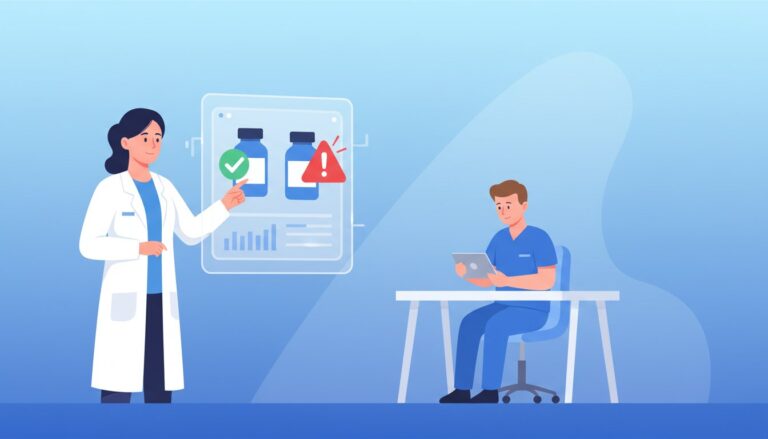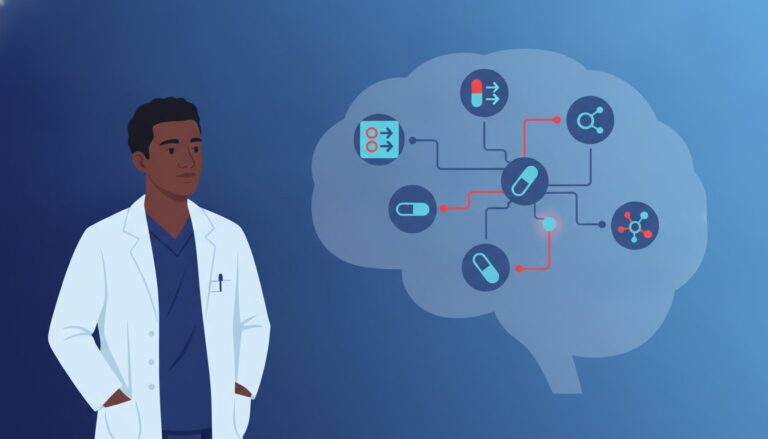
Strategic Guide to Preparing for a Pharmacology Final Exam in 2026
What if the secret to acing your pharmacology final isn’t memorizing more drug names, but rather understanding fewer concepts more deeply? When you’re preparing for a pharmacology final exam, it’s easy to feel paralyzed by information overload, especially with the 2026 environment bringing hundreds of brand-name price increases and new Medicare out-of-pocket caps to consider. You’ve likely spent hours confused by similar-sounding medications, struggling to see how abstract pharmacokinetics connects to the practical realities of modern clinical practice.
We understand that the pressure to perform is immense, and the traditional method of rote memorization often fails when you’re faced with complex clinical scenarios. This guide provides a high-yield study methodology that moves beyond simple lists, helping you build a structured framework to ace your exam with confidence. We’ll show you how to identify high-yield topics and master the mechanisms that matter most; this ensures you pass with a high score while developing the professional precision your career requires.
Key Takeaways
- Shift from rote memorization of hundreds of individual drugs to a class-based framework to significantly reduce cognitive load and improve retention.
- Implement a structured 7-day roadmap for preparing for a pharmacology final exam that prioritizes high-yield systems and clinical connections.
- Transition from passive review to active recall techniques to ensure you can retrieve complex drug information accurately under exam pressure.
- Identify prototype drugs for each class to anchor your understanding of mechanisms, side effects, and contraindications across similar medications.
Why Pharmacology Finals Feel Overwhelming (And How to Pivot)
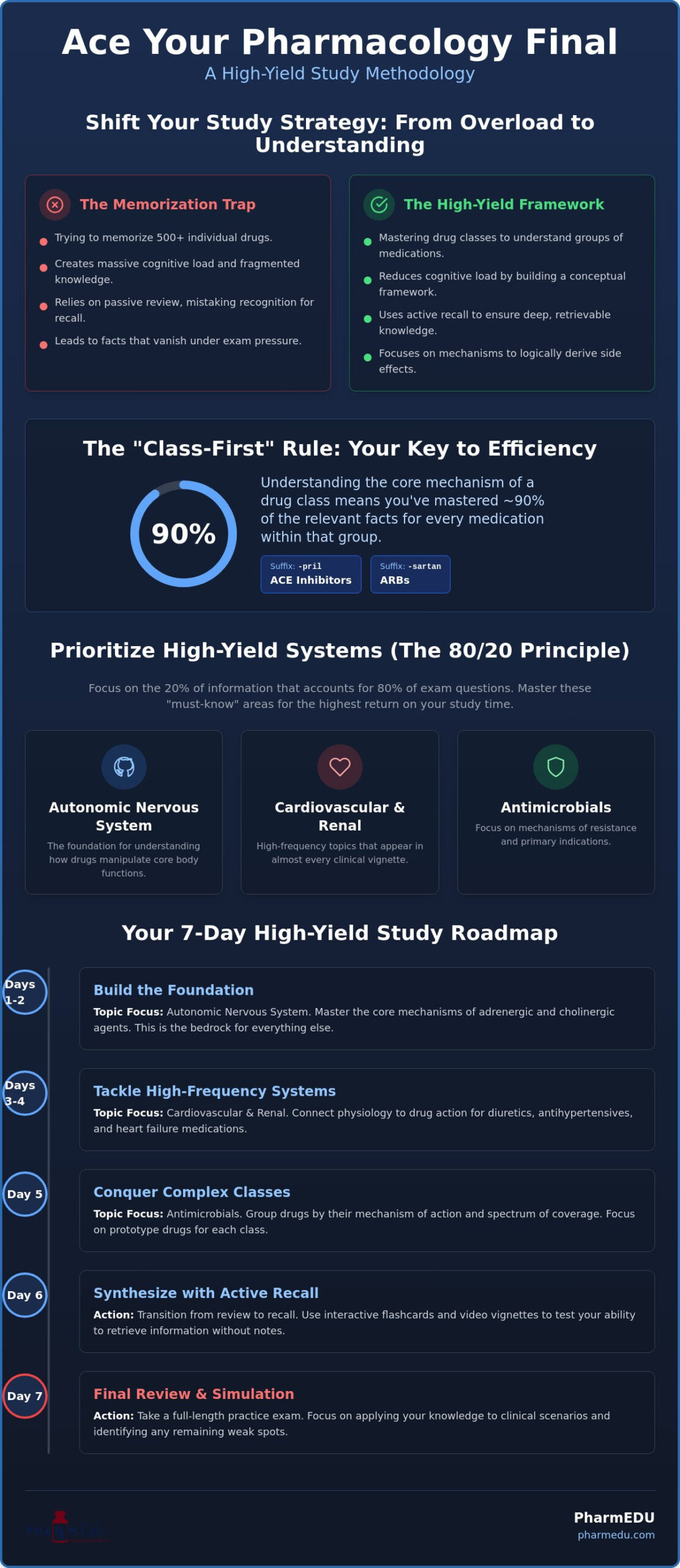
Preparing for a pharmacology final exam often feels like trying to drink from a firehose. Students face a daunting list of over 500 individual medications, each with its own mechanism, side effect profile, and contraindication. This “memorization trap” creates a massive cognitive load that standard note-taking simply can’t resolve. Instead of building a functional understanding, many learners end up with a fragmented collection of facts that vanish the moment they sit down for the test. To succeed, you must stop treating the subject as a dictionary of drugs and start viewing it as a logical system of clinical interventions.
A comprehensive overview of pharmacology reveals that the discipline is built on predictable biological rules. By shifting your focus from “what is the name?” to “how does this alter physiology?”, you reduce the burden on your memory. This is where a digital mentor becomes invaluable. By filtering out low-yield academic fluff, a structured platform helps you focus on the concepts that actually appear on the final. The goal isn’t just to know facts; it’s to understand clinical application well enough to make safe, accurate decisions under pressure.
The Problem with Rote Memorization
Drug names are often arbitrary strings of letters. Without a conceptual “hook,” your brain naturally discards them to save space. Many students mistake “recognition” for “recall.” You might recognize a drug name while scanning your notes, but that doesn’t mean you can recall its specific receptor affinity during a multiple-choice question. The brain processes pharmacodynamic concepts much more efficiently than raw data. If you understand how a beta-blocker interacts with the sympathetic nervous system, you don’t need to memorize every side effect for every medication ending in “-olol.” You can derive them logically based on the drug’s mechanism.
The High-Yield Philosophy
Success in 2026 requires a high-yield approach. This means identifying the 20% of information that accounts for 80% of exam questions. You don’t have time to master rare orphan drugs used in a tiny fraction of the population. Instead, prioritize the “must-know” drug classes. Focus your energy on the following areas:
- Autonomic Nervous System: The foundation for understanding how drugs manipulate core body functions.
- Cardiovascular and Renal Systems: High-frequency topics that appear in almost every clinical vignette.
- Antimicrobials: Focusing on mechanisms of resistance and primary indications.
Setting realistic expectations is key. Your goal for the final exam is to demonstrate clinical safety and foundational knowledge. Using tools like High-Yield Video Vignettes and Interactive Pharmacology Flashcards ensures you spend your limited study time on the topics that guarantee the highest return on investment.
The High-Yield Framework: Mastering Drug Classes Over Individual Names
Preparing for a pharmacology final exam doesn’t require the brute-force memorization of five hundred unique drug profiles. Instead, successful students apply the “Class-First” Rule. This principle suggests that once you understand the core mechanism of a drug class, you’ve already mastered approximately 90% of the relevant facts for every medication within that group. For example, learning the pathophysiology of the renin-angiotensin-aldosterone system allows you to predict the effects, side effects, and contraindications for all ACE inhibitors and ARBs simultaneously.
Linguistic shortcuts are your best allies in this process. Suffixes like “-pril” for ACE inhibitors or “-sartan” for angiotensin II receptor blockers provide immediate context. You aren’t just looking at a random string of letters; you’re identifying a functional category. When searching for high-quality pharmacology teaching resources, you’ll see that professional educators prioritize these structural patterns because they reduce cognitive fatigue. Using Interactive Pharmacology Flashcards that are specifically organized by class can help you cement these connections without the chaos of randomized, unlinked data sets.
To anchor your knowledge, focus on “prototype” drugs. Choose one “star” medication for each class, such as Metoprolol for beta-blockers or Furosemide for loop diuretics, and learn its profile deeply. This prototype serves as a mental lighthouse. When you encounter a less common drug in the same class on your exam, you can simply refer back to your prototype to deduce the correct answer. This method transforms your study sessions from a frantic search for facts into a methodical exercise in logical deduction.
Grouping by Mechanism of Action (MOA)
Understanding the MOA is the ultimate predictive tool. If you know a drug blocks a specific cellular target, the side effects and contraindications often become self-explanatory. Beta-blockers provide a perfect illustration. By blocking beta-1 receptors in the heart, they slow the heart rate, which logically leads to the clinical pearl of monitoring for bradycardia. If they also block beta-2 receptors in the lungs, they can cause bronchoconstriction, making them risky for patients with asthma. Visual organizers that map these drugs to their cellular targets help you see these relationships at a glance.
Identifying Clinical Pearls
Exam writers love “testable” information, often referred to as clinical pearls. These are the unique characteristics that distinguish a drug from its peers. For instance, the “red man syndrome” associated with rapid Vancomycin infusion or the specific discoloration of urine caused by Rifampin are classic high-yield facts. Pay close attention to Black Box Warnings and drugs with a narrow therapeutic index, such as Digoxin or Warfarin. Connecting these pharmacological quirks back to the underlying pathophysiology ensures deeper retention and better performance when you’re preparing for a pharmacology final exam.
Active Recall vs. Passive Review: Which Study Method Actually Works?
Passive review is a common trap. When you’re preparing for a pharmacology final exam, it’s tempting to spend hours re-reading textbooks, highlighting paragraphs, or watching lecture recordings on loop. These activities feel productive because they create a sense of familiarity with the material. However, familiarity is not the same as mastery. Passive review fails to build the neural pathways required for high-pressure retrieval. To truly succeed, you must switch to active recall, which is the practice of forcing your brain to retrieve information from memory without the aid of notes.
The “testing effect” is a well-documented psychological phenomenon showing that the act of taking a test, even a practice one, improves long-term retention more than additional study time. This is why resources like the IUPHAR Pharmacology Education Project emphasize structured learning over simple reading. By challenging yourself to remember a drug’s mechanism or side effects before looking at the answer, you strengthen the connection to that information. Spaced repetition serves as the gold standard here; it ensures you revisit difficult concepts at increasing intervals to prevent the natural decay of memory over time.
Implementing Active Recall
One of the most effective ways to start is the “brain dump” method. Take a blank piece of paper and write down everything you can remember about a specific drug class, such as anticoagulants. Once you’ve exhausted your memory, check your notes to see what you missed. Using Interactive Pharmacology Flashcards is another powerful way to force this retrieval process. Don’t be discouraged when you get a practice question wrong. In fact, getting an answer incorrect is often a superior learning moment because it highlights a specific gap in your knowledge that your brain is now primed to fill.
The Science of Micro-Learning
Cognitive fatigue is real. Research suggests that 20-minute “sprints” of intense focus are far more effective than 4-hour cram sessions. When preparing for a pharmacology final exam, break your day into these manageable segments. You can use High-Yield Video Vignettes to tackle a complex topic, such as the coagulation cascade, in a digestible bite. This approach also allows you to utilize “dead time” during your day. Whether you’re commuting or waiting in line, a quick five-minute recall session on your mobile device keeps your brain engaged with the material without the burnout associated with traditional studying.
A 7-Day Roadmap for Your Pharmacology Final Exam Prep
A week might seem insufficient to master an entire semester of drug data, but a structured approach makes it manageable. When you’re preparing for a pharmacology final exam, the goal is to maximize your time by prioritizing the systems that appear most frequently on tests. This 7-day roadmap moves from foundational systems to complex integration, ensuring you don’t waste energy on low-yield details. By following a methodical progression, you prevent the cognitive burnout often caused by disorganized, last-minute cramming.
The first half of the week is dedicated to the “Deep Dive.” On Days 1 and 2, focus on the Autonomic Nervous System, Cardiovascular, and Renal pharmacology. These are the cornerstones of the subject. On Days 3 and 4, tackle the denser topics like Neuropharmacology, Antimicrobials, and Endocrine drugs. Use this time to build summary tables that highlight the prototype drugs we discussed earlier. This structure helps you visualize the high-yield territory:
- Days 1-2: Foundation and High-Yield Systems (ANS, Cardiovascular, Renal).
- Days 3-4: Complex Systems (Neuro, Antimicrobials, Endocrine).
- Day 5: Integration and Case Studies.
- Day 6: Mock Exams and Weak Point Identification.
- Day 7: Light Review and Mental Preparation.
Day 1-4: The Deep Dive
Prioritize chapters based on their exam weighting. If you’re in a clinical program, utilizing a pharmacology study guide for nursing students can help you filter for specific nursing considerations like patient education and monitoring. Summary tables for each major class should include the mechanism of action, the prototype drug, and at least two clinical pearls. These tables are far superior to traditional linear notes because they allow you to see the logical connections between drug classes and physiological responses at a single glance.
Day 5-7: Refining Your Knowledge
Day 5 is for integration. This is when you stop looking at drug classes in isolation and start looking at clinical case studies to see how drugs interact in a patient scenario. On Day 6, take mock exams to identify your remaining weak points. Use Pharmacology Practice Quizzes to simulate the actual test environment, which is essential for managing exam-day anxiety. Pay special attention to “Look-Alike, Sound-Alike” (LASA) drugs, such as hydralazine versus hydroxyzine, which are common traps when preparing for a pharmacology final exam. Day 7 should be reserved for light review and mental preparation. Avoid learning new material; focus on reinforcing what you already know to build your confidence.
If you want to ensure your study sessions are as efficient as possible, explore PharmEDU’s annual subscription to access curated quizzes and case studies that match this high-yield roadmap.
Leveraging PharmEDU to Streamline Your Final Exam Review
Preparing for a pharmacology final exam requires more than just effort; it requires a reliable professional infrastructure. Many students fall into the trap of using crowdsourced flashcard decks that are often riddled with errors or lack essential clinical context. PharmEDU functions as a curated pharmacology mentor, providing a streamlined experience that removes the guesswork from your review. By housing High-Yield Video Vignettes, Interactive Pharmacology Flashcards, and Practice Quizzes within a single, mobile-compliant ecosystem, the platform allows you to transition seamlessly between learning and testing without the friction of managing multiple disconnected resources.
Why PharmEDU Beats Traditional Textbooks
Textbooks are notoriously inefficient for the final weeks of exam prep. Digesting a 50-page chapter can consume an entire afternoon, yet much of that content is academic fluff that rarely appears on a high-stakes test. In contrast, PharmEDU’s 5-minute video vignettes focus exclusively on the high-yield mechanisms and clinical pearls that matter most. Because the medical field is dynamic, the platform ensures all content reflects 2026 clinical standards and the latest regulatory changes. The built-in progress tracking further optimizes your schedule by highlighting your specific weak points. This ensures you spend every minute of your 7-day roadmap where it’s needed most rather than reviewing material you’ve already mastered.
Next Steps: Beyond the Final
Success on your final is a significant milestone, but it’s also a vital step in your professional journey. The conceptual framework you build today is the same one you’ll use for board exams and, eventually, in direct patient care. Specialized resources, such as the ACE Inhibitors Pharmacology Guide, provide the depth needed for specific high-frequency topics without overwhelming you with unnecessary data. Institutional-grade content provides a level of precision that free, peer-generated tools simply cannot match. This gives you the security that the facts you’re memorizing are accurate, up-to-date, and strictly test-ready.
You now have a strategic methodology, a clear 7-day plan, and an understanding of how to pivot away from the memorization trap. The only thing left is to execute your strategy with the best tools available. Don’t let information overload or disorganized notes stand in the way of your career goals. Start your PharmEDU subscription today and ace your final!
Securing Your Success on Exam Day and Beyond
Preparing for a pharmacology final exam doesn’t have to be a battle against an overwhelming list of drug names. By shifting your focus toward drug classes and mastering prototype medications, you transform a chaotic study process into a logical, high-yield system. Remember that active recall through testing is far more effective than passive reading. A structured 7-day roadmap will help you maintain your focus without burning out, ensuring you cover the most critical physiological systems first.
You have the strategy; now you need the right professional tools to execute it. PharmEDU provides an expert-curated curriculum designed for 2026 standards, featuring High-Yield Video Vignettes for rapid review and Interactive Flashcards for efficient active recall. These resources are built to take the cognitive burden off your shoulders, allowing you to focus on clinical excellence. You’ve put in the hard work throughout the semester. Now, refine that knowledge and walk into your exam with the confidence of a prepared professional. Join PharmEDU and Master Pharmacology Today and secure the high score you deserve.
Frequently Asked Questions
How many hours a day should I study for a pharmacology final?
Most students find that three to five hours of focused, high-yield study per day is sufficient when following a structured plan. It’s more effective to engage in short, twenty-minute micro-learning sprints rather than ten-hour marathons that lead to cognitive fatigue. Quality of retrieval matters more than the total number of hours spent staring at a page.
What are the most common drug classes that appear on pharmacology finals?
The Autonomic Nervous System (ANS), Cardiovascular, and Antimicrobial drug classes typically represent the highest percentage of exam questions. These systems are foundational to clinical practice and appear frequently in complex clinical vignettes. Endocrine and Neuropharmacology are also high-frequency topics that require significant attention during your review.
Is it better to study alone or in a group for pharmacology?
Studying alone is generally superior for the initial encoding of mechanisms and building summary tables. However, group study is highly effective for the active recall phase. Testing your peers on prototype drugs or walking through clinical case studies together can reveal gaps in your knowledge that you might miss when studying in isolation.
How do I stop mixing up drugs that have similar names?
Focus on the functional suffixes and prefixes of the drug names rather than attempting to memorize the entire string of letters. This linguistic approach helps you categorize medications into their proper classes immediately. For example, identifying the “-pril” suffix tells you it’s an ACE inhibitor, which helps you avoid confusing it with drugs from unrelated classes that might sound similar.
Should I focus more on mechanisms of action or side effects?
You should prioritize the mechanism of action (MOA) because it logically predicts the majority of a drug’s side effects and contraindications. When you are preparing for a pharmacology final exam, understanding the “why” behind a drug’s function reduces the need for rote memorization. If you master the MOA, you can often deduce the side effects during the exam through logical reasoning.
What happens if I start preparing for my pharmacology final only 3 days before?
A three-day window requires a radical shift toward high-yield prototypes while ignoring rare or low-frequency medications. You must focus exclusively on the most heavily weighted systems like the ANS and Cardiovascular groups. Use High-Yield Video Vignettes to quickly capture essential clinical pearls and spend the rest of your time on practice quizzes to simulate the exam environment.
Are online pharmacology review courses worth the investment compared to textbooks?
Online platforms are usually more efficient for final preparation because they are specifically designed to filter out academic fluff. While textbooks are excellent for deep reference, digital resources offer progress tracking and interactive tools that are vital when preparing for a pharmacology final exam. These platforms also ensure the content reflects the most current 2026 clinical standards.
How does PharmEDU help with pharmacology board exam prep after finals?
The platform uses an institutional-grade curriculum that aligns with professional licensure requirements, making your final exam prep a direct investment in your future boards. By using Clinical Case Studies and Practice Quizzes now, you are building the clinical reasoning skills necessary for high-stakes professional exams. This ensures your knowledge remains practical and retrievable long after the final is over.