
What to Do If You Fail a Pharmacology Exam: A Step-by-Step Recovery Plan
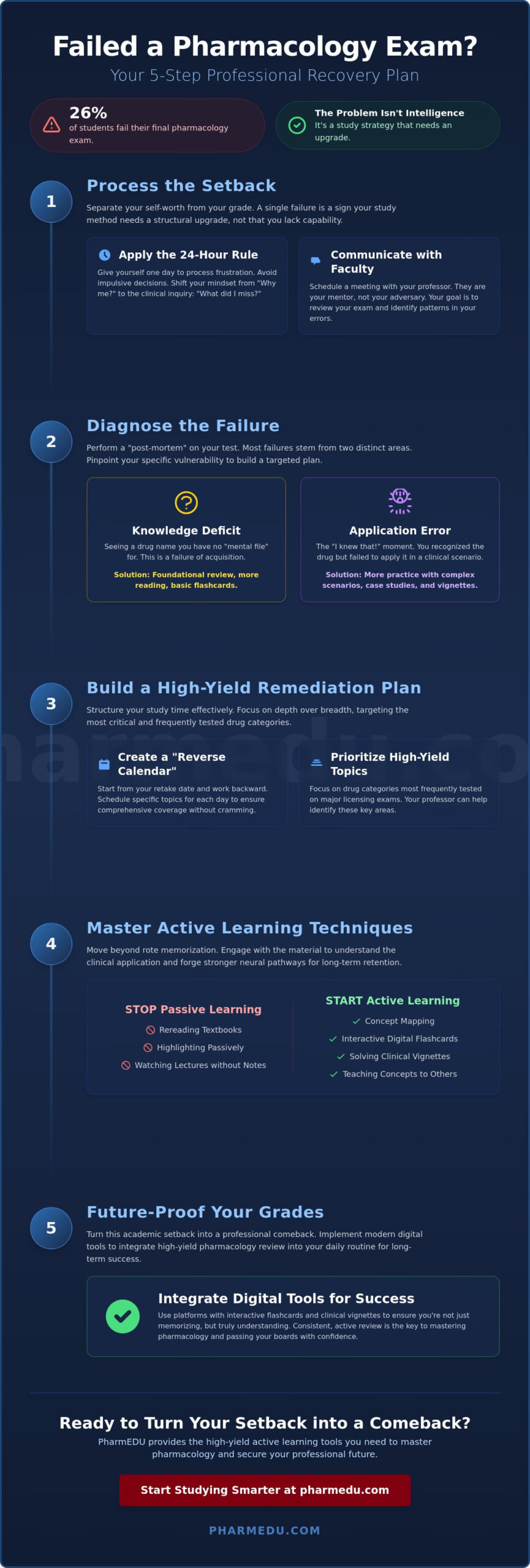
Did you know that while overall nursing course pass rates are high, nearly 26% of students fail their final pharmacology examination? This statistic highlights a hard truth in medical education: pharmacology is often the steepest hurdle between a student and their professional license. If you are currently staring at a failing grade, it’s natural to feel overwhelmed by the mountain of drug data or the fear of being dismissed from your program. You aren’t alone in this struggle, and your intelligence isn’t the problem; usually, the issue lies in a study strategy that prioritizes rote memorization over clinical application.
We understand the pressure you are under and are here to help you navigate what to do if you fail a pharmacology exam to ensure your next attempt is a success. This article provides a structured recovery plan designed to turn your academic setback into a professional comeback. We will walk through a logical framework for diagnosing your specific knowledge gaps, mastering complex drug classes through high-yield active learning, and managing test-taking anxiety so you can walk into your retake with restored confidence and a clear path to graduation.
Key Takeaways
- Learn how to differentiate between a core knowledge deficit and a test-taking strategy error to pinpoint exactly where your previous study plan fell short.
- Establish a clear roadmap for what to do if you fail a pharmacology exam, including the creation of a “Reverse Calendar” to structure your remediation before the retake.
- Master high-yield active learning techniques, such as concept mapping, to move beyond rote memorization and understand the clinical application of drug classes.
- Discover how to prioritize your study time by focusing on the drug categories most frequently tested on major professional licensing examinations.
- Implement digital tools like interactive flashcards and clinical vignettes to integrate pharmacology review into your daily routine and ensure long-term academic success.
Processing the Setback: Immediate Steps After a Failed Pharmacology Exam
Seeing a failing grade on a pharmacology exam is a visceral experience that often triggers a “fight or flight” response. You might feel like your clinical career is over before it truly began, but this moment is a professional challenge, not a permanent label. Understanding what to do if you fail a pharmacology exam begins with separating your self-worth from your academic transcript. Pharmacology is notoriously difficult due to the sheer volume of drug classes and mechanisms; a single failure is often a sign that your information architecture needs a structural upgrade rather than a lack of capability.
Your first administrative task is to consult your program’s student handbook. Every nursing or pharmacy program has specific “rules of engagement” regarding retakes, remediation, and academic standing. You need to know the deadlines for requesting a re-examination and the impact this grade has on your progression. Once you have the facts, you can move from a state of panic to a state of planning. Securing your previous exam paper or a digital breakdown is the most critical step in this phase, as it serves as the primary diagnostic tool for your recovery.
The 24-Hour Rule for Academic Recovery
Give yourself exactly one day to process the frustration and clear the mental fog. During this 24-hour window, don’t make any impulsive decisions like withdrawing from the course or changing your major. Use this time to move your mindset from “Why did this happen to me?” to a more clinical inquiry: “What specific concepts did I miss?” Emotional clarity is a prerequisite for the analytical work that follows. Once the initial sting fades, you can approach the problem with the precision of a healthcare professional.
Communicating with Faculty Effectively
Schedule a mandatory meeting with your professor or academic advisor immediately. Approach this interaction with the mindset that they are a mentor, not an adversary. Your goal is to review your exam in detail to identify patterns in your errors. Analyzing your mistakes is a powerful way to leverage the testing effect, as it forces you to engage with the material you find most challenging. Knowing what to do if you fail a pharmacology exam requires this level of granular detail; you can’t fix a leak if you don’t know which pipe is broken.
During the review, ask focused questions to guide your remediation:
- Which drug classes represented the majority of my incorrect answers?
- Was my failure due to a lack of core knowledge or a misunderstanding of how to apply that knowledge to clinical scenarios?
- How much weight will these specific missed concepts carry on the final or the board exams?
- Can you provide a breakdown of my performance by mechanism of action versus side effects?
Diagnosing the Failure: Identifying Your Learning Gaps and Test-Taking Errors
Recovering from a poor result requires a clinical approach to your own performance. When determining what to do if you fail a pharmacology exam, you must first perform a post-mortem on the test itself. Many students instinctively assume they simply didn’t study enough hours, but the reality is often more nuanced. A failure usually stems from one of two distinct areas: a lack of foundational knowledge or an inability to apply that knowledge under the pressure of a timed environment. By categorizing your mistakes, you can build a remediation plan that targets your specific vulnerabilities rather than repeating the same ineffective habits.
Knowledge Deficit vs. Application Errors
A knowledge deficit occurs when you encounter a drug name or class on the exam and realize you have no mental file for it. This is a failure of acquisition. In contrast, an application error is more frustrating; it’s the “I knew that!” moment. You recognized the drug, but you couldn’t navigate the clinical scenario or identify the correct priority nursing intervention. Distinguishing between these two is vital. If your errors were primarily application-based, you don’t need more reading; you need more practice with complex scenarios. Reviewing established pharmacology study tips from academic experts can help you transition from simple identification to higher-level clinical reasoning.
Analyze your incorrect answers to see if a pattern emerges. Did you consistently miss questions regarding the mechanism of action, or was the struggle centered on contraindications and life-threatening side effects? If you find yourself bogged down in “low-yield” trivia like rare drug-drug interactions while missing “high-yield” concepts like ACE inhibitor side effects, your prioritization is off. To bridge this gap, integrating Clinical Case Studies into your review can help you see how these drugs function in a real-world patient context.
The Pitfalls of Passive Studying
Many students fall into the trap of passive studying, which includes highlighting textbooks, re-reading notes, or watching lectures without taking notes. These methods create an “illusion of competence.” You feel like you understand the material because it looks familiar on the page, but your brain hasn’t actually practiced retrieving that information. When considering what to do if you fail a pharmacology exam, you must evaluate your study environment. Were you actively quizzing yourself, or were you just moving your eyes across a page? Success in pharmacology requires active engagement and constant self-testing to ensure the information is retrievable during an exam.
Finally, assess your test-taking behavior. Did you run out of time, or did you finish early but second-guess your initial instincts? Second-guessing is often a symptom of “near-knowledge,” where you know enough to narrow the options to two but not enough to confidently select the right one. Improving your time management and trusting your first choice are just as important as memorizing the drug classes themselves.
Building a High-Yield Remediation Plan: How to Study Smarter for the Retake
A successful remediation plan is not built on more hours; it’s built on better architecture. Knowing what to do if you fail a pharmacology exam involves moving away from linear studying. Instead, create a “Reverse Calendar.” Mark your retake date and work backward to the present day. This method prevents the common mistake of spending two weeks on the first chapter and only two hours on the last. By allocating specific days to high-priority drug classes, you ensure that no critical information is left to chance. Your schedule should balance content review with daily practice questions to build the mental stamina required for the actual test environment.
Prioritizing Drug Classes by Impact
Not all drug classes are created equal in the eyes of examiners. To maximize your efficiency, you must focus first on the “Big Five” categories that dominate board exams like the NCLEX or NAPLEX: Cardiovascular, Neuro, Antimicrobials, Endocrine, and Respiratory medications. Mastering the prototypes within these classes provides a foundation that makes learning individual drugs much easier. For instance, if you understand how a prototype ACE inhibitor works, you don’t need to memorize every drug ending in “-pril” from scratch. To streamline this process, you can use The Ultimate Pharmacology Study Guide for Nursing Students in 2026 to identify the core competencies and high-yield topics most likely to appear on your retake.
Implementing Spaced Repetition and Active Recall
If you want to move complex drug data into your long-term memory, you need to ditch the highlighter. Passive reading won’t help you during a high-stakes exam. Instead, implement spaced repetition by scheduling reviews of difficult topics at 1-day, 3-day, and 7-day intervals. This technique forces your brain to work harder to retrieve information, which strengthens the neural pathways. Using tools like Interactive Pharmacology Flashcards ensures you are practicing active recall rather than just recognizing familiar text on a page.
When you feel confident in the theory, apply that knowledge using Clinical Case Studies. Seeing how a diuretic behaves in a real-world patient with heart failure provides a mental “hook” that rote memorization cannot offer. Finally, incorporate Pharmacology Practice Quizzes into your daily routine. These quizzes help you identify remaining weak spots and ensure you are comfortable with the phrasing of application-based questions. Understanding what to do if you fail a pharmacology exam means shifting your focus from “finishing the book” to “mastering the concepts” through consistent, active engagement.
Master Active Learning: Techniques to Retain Complex Drug Information
Another powerful tool is the “Teach-Back” method. If you can explain the mechanism of action of a beta-blocker to a non-medical friend so they actually understand it, you’ve mastered the concept. You should also utilize suffix and prefix patterns to categorize drugs quickly. Recognizing that “-olol” indicates a beta-blocker or “-pril” signifies an ACE inhibitor allows you to identify a drug’s class and general side effect profile instantly. This pattern recognition reduces the cognitive load during the exam, giving you more mental energy to tackle complex clinical scenarios.
Beyond Mnemonics: Understanding the ‘Why’
Many students rely solely on mnemonics, but these memory tricks often fail if you don’t understand the underlying physiology. If you understand exactly which receptor a drug targets, you don’t have to memorize a long list of side effects; you can predict them. For instance, knowing how a drug interacts with the sympathetic nervous system tells you exactly what will happen to a patient’s heart rate and blood pressure. For those who need to strengthen their scientific foundation, referring to the comprehensive guide to the science of drugs can provide the clarity needed to stop memorizing and start understanding. This shift in perspective is the most effective strategy for what to do if you fail a pharmacology exam, as it ensures you are building a professional knowledge base rather than a temporary memory bank.
Visual and Interactive Learning Tools
Pharmacology is a dynamic subject that often requires visual representation to fully grasp. High-Yield Video Vignettes are excellent for visualizing drug-receptor interactions and complex kinetics that are difficult to understand through text alone. These micro-learning segments break down dense information into manageable five-minute chunks, making it easier to stay focused. Additionally, interactive Pharmacology Practice Quizzes simulate the actual exam environment, helping you build the stamina and confidence required for your retake. By incorporating these digital tools, you bridge the gap between abstract theory and the clinical practice you will face in your career.
Ready to transform your study habits and master drug classes with ease? Explore PharmEDU High-Yield Video Vignettes to start your recovery today.
Future-Proofing Your Grades: Using PharmEDU to Ensure Long-Term Success
Passing your retake is the immediate priority, but the ultimate goal is to build a knowledge base that carries you through board exams and into clinical practice. Knowing what to do if you fail a pharmacology exam involves more than just a one-time fix; it requires a permanent shift in how you manage information. Integrating PharmEDU’s 100+ high-yield topics into your weekly study routine ensures that you are constantly reinforcing core concepts rather than cramming them. By utilizing the platform’s tracking tools, you can identify rising weak spots in specific drug classes before they ever manifest as a failing grade on a transcript.
Consistency is often the hardest part of medical education. To combat this, leverage mobile-compliant Interactive Pharmacology Flashcards to turn “dead time”—such as your commute or the minutes between lectures—into productive review sessions. This habit moves drug data from short-term recognition into long-term retrieval. When you stop “surviving” each unit and start “mastering” the material, the anxiety associated with testing begins to dissipate, replaced by the confidence of a prepared healthcare professional.
The Power of Micro-Learning for Busy Students
Burnout is a significant risk when you are trying to recover from an academic setback. PharmEDU helps you avoid this by breaking down dense pharmacological data into digestible, high-impact High-Yield Video Vignettes. These micro-learning segments allow you to tackle complex kinetics or interactions in manageable five-minute windows. After watching, you can use Pharmacology Practice Quizzes to get immediate feedback on your comprehension. This method aligns your study habits with modern comprehensive pharmacy review standards, which favor active, digital-first learning over traditional, passive textbook reading.
Preparing for Boards While Passing Your Course
The most effective strategy for what to do if you fail a pharmacology exam is to look toward your final licensing requirements. Whether you are preparing for the NCLEX or the NAPLEX, your course material is the foundation for those high-stakes assessments. PharmEDU’s Clinical Case Studies prepare you for “Next Gen” style exam questions by forcing you to prioritize patient safety and clinical outcomes. This dual approach ensures that as you pass your current course, you are simultaneously checking off the competencies required for your professional certification.
Don’t let one exam define your career. Start your PharmEDU subscription today to master pharmacology for good.
Transforming Your Academic Setback into Clinical Mastery
Understanding what to do if you fail a pharmacology exam is the first step toward becoming a more resilient and knowledgeable practitioner. Success in this demanding field requires modern tools that match the complexity of the material. PharmEDU provides a comprehensive platform designed by healthcare educators, featuring over 100 high-yield drug topics, interactive flashcards, and realistic practice quizzes. These resources are built to bridge the gap between academic theory and clinical safety, ensuring you are prepared for both your course finals and professional board certifications.
Stop guessing and start mastering with PharmEDU’s high-yield pharmacology review.
Your clinical career is built on persistence and the ability to adapt. Take this moment to reset your strategy, refocus your energy, and move forward with the confidence that you are fully prepared for the challenges of clinical practice.
Frequently Asked Questions
Is it common to fail a pharmacology exam in nursing or pharmacy school?
Yes, it is remarkably common. Descriptive studies of nursing students show that while overall course pass rates remain high, failure rates for the final examination component specifically can range from 19% to 26%. The complexity of drug interactions and the high volume of data make this one of the most challenging hurdles in medical education. You are certainly not alone in this experience.
What is the best way to memorize hundreds of different drugs quickly?
The most effective strategy is to focus on drug prototypes and class patterns rather than individual medications. By mastering one “prototype” drug for each class and learning common suffixes, such as -olol for beta-blockers, you can predict the mechanisms and side effects of dozens of related drugs. This categorical approach significantly reduces cognitive load and improves your ability to recall information during high-pressure exams.
How should I talk to my professor about my failing grade?
Schedule a formal meeting and approach the conversation with a professional, diagnostic mindset. Instead of asking for extra credit, ask to review your exam to identify specific patterns in your errors, such as a struggle with mechanisms of action versus side effects. This shows accountability and a commitment to professional growth. Faculty members are much more likely to support students who seek to understand their knowledge gaps.
Can I still become a pharmacist or nurse if I fail one pharmacology class?
Yes, a single failure does not end your clinical career. Most professional programs have established remediation pathways that allow students to retake the course or exam after a setback. While you are navigating what to do if you fail a pharmacology exam, focus on the fact that many successful healthcare providers have faced academic challenges and used them to build a stronger foundation for their practice.
What are the most common reasons students fail pharmacology?
Failure typically stems from passive study habits, such as re-reading notes, and an over-reliance on rote memorization instead of comprehension. Students often struggle to transition from knowing “what” a drug is to “how” it affects a patient in a clinical scenario. Additionally, test-taking anxiety and poor time management during the exam contribute significantly to poor results even when the student has put in the hours.
How many hours a day should I study for a pharmacology retake?
Quality of study is more important than quantity, but most experts suggest two to three hours of active engagement daily during remediation. This time should be split between content review and practice questions. Consistency is key; studying in shorter, high-intensity blocks using spaced repetition is far more effective for long-term memory than “marathon” sessions that often lead to mental fatigue and burnout.
Are flashcards or textbooks better for learning pharmacology?
Flashcards are generally superior for active recall, while textbooks are better for initial deep dives into complex pathophysiology. When deciding what to do if you fail a pharmacology exam, shift your focus toward interactive tools like digital flashcards. These require you to produce answers from scratch, which is more effective for exam preparation than moving your eyes across a page of text without engagement.
What should I do if I have extreme test anxiety during pharmacology exams?
Address test anxiety with a combination of mastery and physiological regulation. Improving your confidence through daily practice quizzes can reduce the fear of the unknown. During the exam, focus on steady breathing and use a systematic approach to each question to stay grounded. If anxiety remains debilitating, consult your school’s student health services for professional support and to discuss potential academic accommodations.