
Connecting Pathophysiology to Pharmacology: The Key to Clinical Mastery in 2026
Your ability to save a life doesn’t depend on how many drug names you can recite; it depends on how well you understand why those drugs work. Most healthcare students feel buried under endless spreadsheets of mechanisms, yet they still struggle to apply that knowledge when a patient’s pathology becomes complex. This disconnect happens because we often treat disease and treatment as separate entities. By connecting pathophysiology to pharmacology, you create a conceptual bridge that transforms rote memorization into intuitive expertise, allowing you to see the logical flow from cellular dysfunction to therapeutic intervention.
We understand that the pressure to perform on the NAPLEX or NCLEX can make deep understanding feel like a luxury you can’t afford. However, mastering this intersection is the only way to navigate the clinical landscape of 2026, where managing patients on newly negotiated medications like Eliquis or Jardiance requires precise knowledge. This article provides a structured framework to help drug classes finally click. You’ll learn to predict side effects based on underlying mechanisms and build the decision-making skills required for modern, evidence-based practice.
Key Takeaways
- Understand the fundamental synergy between disease mechanisms and drug actions to transition from memorizing lists to predicting clinical outcomes.
- Explore how receptor dynamics and enzymatic pathways serve as the molecular bridge that dictates where and how treatments intervene.
- Adopt the “First Principles” method to reduce complex drug classes to basic biological rules, ensuring better retention for board exams like the NAPLEX or NCLEX.
- Implement a structured four-step framework for connecting pathophysiology to pharmacology that starts with mastering baseline physiology.
- Leverage high-yield video vignettes and clinical case studies to visualize the direct link between cellular dysfunction and therapeutic success.
The Synergy of Pathophysiology and Pharmacology: Why One Cannot Exist Without the Other
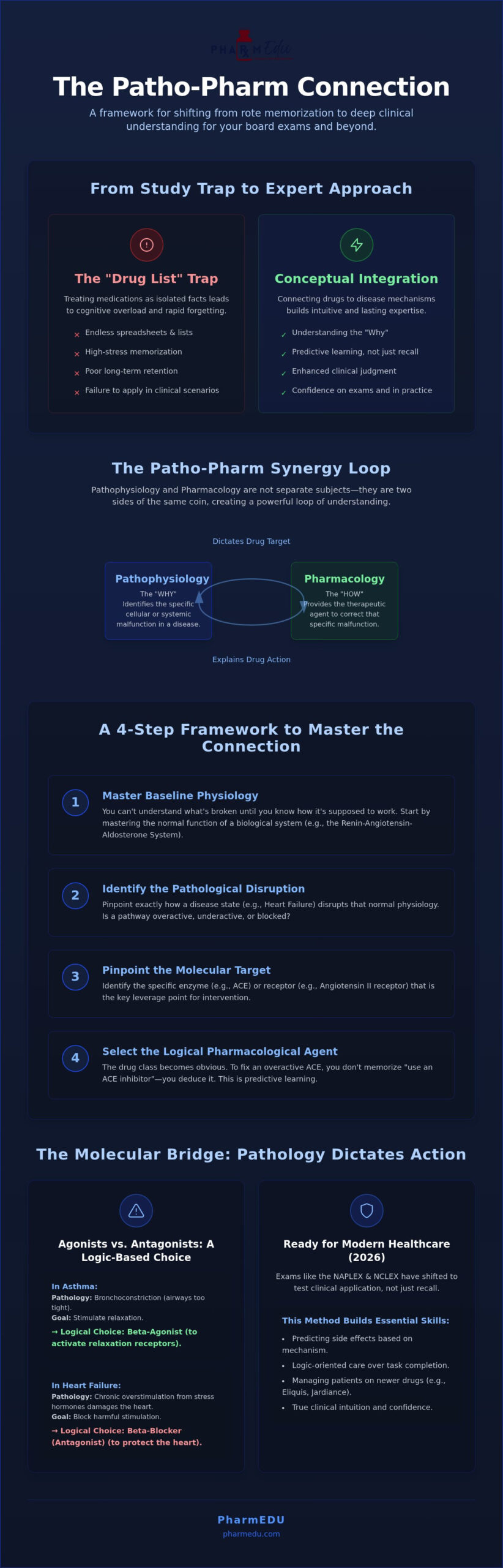
Understanding the human body in a state of health is the foundation of medicine, but clinical mastery requires a deep dive into what happens when those systems fail. Pathophysiology examines the specific biological and physical manifestations of disease, focusing on how “normal” physiology is disrupted. Pharmacology, by contrast, focuses on how exogenous substances act on those same pathways to restore or modify function. These two disciplines don’t just overlap; they’re two sides of the same coin.
When you focus on connecting pathophysiology to pharmacology, you begin to see the “Patho-Pharm” loop. If you identify the specific molecular “lesion” or malfunction in a disease, the pharmacological target becomes obvious. Studying these subjects in isolation is a primary cause of cognitive overload and rapid forgetting. Without the context of the disease, a drug mechanism is just an abstract fact. When you link them, the disease state provides the “Why,” making the drug’s “How” much easier to retain.
Breaking the Cycle of Rote Memorization
Many students fall into the “Drug List” trap, attempting to memorize hundreds of medications as isolated data points. This approach is a recipe for failure on high-stakes exams. Instead, use conceptual anchoring. Treat the disease state as a mental “folder” where you store relevant drug information. If you understand the hyperactive renin-angiotensin system in heart failure, you don’t need to memorize that ACE inhibitors are used; you’ll predict it. This predictive learning is the ultimate benefit of connecting pathophysiology to pharmacology in your daily study routine.
The Role of Clinical Judgment in 2026 Healthcare
The healthcare environment of 2026 demands logic-oriented care over simple task completion. Modern board exams like the NAPLEX and NCLEX have shifted their focus significantly toward clinical application. They test whether you can apply basic science to a complex patient scenario, not just recall a brand name. Clinical intuition is the intersection where a deep understanding of disease mechanisms meets a precise knowledge of drug action. Mastering this link ensures you’re prepared for the reality of modern practice, where understanding the underlying logic is safer and more effective than following a static list.
The Molecular Bridge: How Disease States Dictate Drug Targets
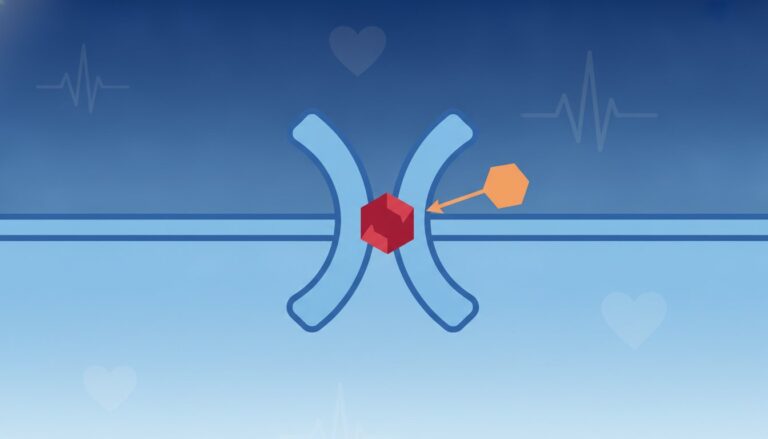
The interaction between a drug and its target is frequently described as a lock and key mechanism. However, in a diseased state, the “lock” itself often changes shape, density, or function. Receptors are dynamic structures that respond to their environment. In chronic disease states, we see receptor expression shift through upregulation or downregulation. For example, constant exposure to a ligand can lead a cell to reduce its receptor count to protect against overstimulation. Understanding these molecular shifts is the secret to connecting pathophysiology to pharmacology in a way that sticks. You aren’t just memorizing a drug; you’re learning how it interacts with a moving target.
Enzymatic pathways represent another critical component of this bridge. When a cellular process becomes “broken” or overactive, drugs are designed to inhibit or restore that specific machinery. It’s also vital to account for secondary messengers. A drug may bind to a primary receptor, but the resulting intracellular cascade often triggers systemic effects. This explains why a medication intended for the cardiovascular system might have unintended consequences in the renal or pulmonary systems. By analyzing these cascades, you can predict side effects rather than simply memorizing them from a list.
Agonists vs. Antagonists in Pathological Contexts
Deciding whether to stimulate or block a receptor depends entirely on the underlying pathology. A logic-based approach makes these choices clear. In asthma, the pathophysiology involves bronchoconstriction; therefore, we use beta-agonists to stimulate relaxation of the smooth muscle. In contrast, chronic heart failure involves a harmful, long-term flood of stress hormones. In this context, we use beta-blockers to protect the heart from overstimulation. The goal is always to find a drug with high selectivity and affinity for the diseased target to reduce off-target effects and improve patient safety.
Pharmacokinetics vs. Pharmacodynamics in Disease
Disease states fundamentally alter both what the drug does to the body (pharmacodynamics) and what the body does to the drug (pharmacokinetics). Hepatic or renal pathophysiology can significantly impair drug metabolism and excretion, which increases the risk of toxicity. Many integrated programs, such as the Pathophysiology and Pharmacology for Nursing curriculum, emphasize that you cannot separate the dose from the patient’s organ function. You must learn to adjust high-yield drug doses based on pathophysiological markers like glomerular filtration rate. To see how these adjustments work in a practical setting, reviewing Clinical Case Studies can help turn these complex molecular concepts into actionable clinical knowledge.
Memorization vs. Conceptual Integration: A Framework for Boards
Cramming is a high-risk strategy that often fails during high-stakes exams like the NAPLEX. When you rely on isolated memory, stress causes those fragile data points to evaporate. Conceptual integration offers a more resilient alternative. By connecting pathophysiology to pharmacology, you leverage the “First Principles” method. This involves stripping a drug class down to its most basic biological rule. Instead of memorizing that ACE inhibitors cause a dry cough as a random fact, you link it to the accumulation of bradykinin in the lungs. This neurobiological connection anchors new information to existing disease knowledge, ensuring it remains accessible when the clock is ticking. This method also reduces “interference,” where similar-sounding drugs like “statins” or “prils” get confused because they lack a distinct biological anchor.
The Efficiency Gap: Rote vs. Conceptual
The difference in study efficiency is stark. Rote memorization requires constant repetition because it lacks context. Conceptual integration, however, provides an “Aha!” moment where drug classes finally make sense. Once you understand the biological logic, your recall accuracy under stress improves significantly. The neurobiology of learning suggests that we retain information longer when it’s attached to a “pre-existing” mental schema, such as your knowledge of how a healthy kidney functions. The following table illustrates how this shift in perspective changes your study burden.
| Approach | Memorizing Side Effects | Predicting Side Effects from Patho |
|---|---|---|
| Mental Effort | High (Isolated facts) | Low (Logical deduction) |
| Exam Performance | Prone to “interference” | Highly accurate |
| Long-term Retention | Poor (Weeks) | High (Years) |
Board Exam Strategy: Deciphering the Question Stem
Modern board questions aren’t simple recall tasks. They are clinical vignettes designed to test your ability to apply knowledge in real-world scenarios. Success requires identifying the pathophysiological clues hidden in the stem. If a patient presents with specific lab values or symptoms, those are the keys to the correct pharmacological choice. Understanding the mechanism of action allows you to eliminate distractors that might sound plausible but don’t address the underlying disease state. For those looking to refine these skills, a comprehensive pharmacology board review can provide the structured practice needed to master these vignettes. By connecting pathophysiology to pharmacology, you stop guessing and start calculating the correct clinical response based on physiological logic.
4 Steps to Connect Pathophysiology to Pharmacology in Your Studies
Most students treat these subjects as separate silos, but clinical success in 2026 requires a unified approach. Textbooks often present information in isolation, leaving you to build the bridge yourself. By following a structured four-step framework, you can turn a daunting drug list into a logical map of human biology. This method moves you away from the “Drug List” trap and toward a deeper, more resilient understanding of patient care. It’s about seeing the patient’s body as a system where every intervention has a clear, biological reason.
Step 1 & 2: Building the Foundation
You can’t understand a “broken” system without a clear mental map of its healthy state. Step one is mastering the baseline physiology. If you don’t know how a healthy kidney manages electrolytes, you won’t understand why a diuretic is necessary or dangerous. Step two involves identifying the “broken link.” You must pinpoint exactly what went wrong in the disease process. Using visual aids to compare the “Normal” vs. “Abnormal” state is highly effective here. Focus on the rate-limiting step in physiological pathways, as this is usually where pathology strikes. Most clinical scenarios revolve around three core themes: inflammation, ischemia, and dysregulation. By identifying which theme is at play, you can quickly narrow down the likely pharmacological interventions.
Step 3 & 4: Applying the Pharmacology
After you’ve identified the malfunction, your next task is mapping the intervention. Step three requires you to determine where a drug can “fix” or bypass the broken link. Categorize your medications by their biological target rather than just their generic name. This shift in perspective is the key to connecting pathophysiology to pharmacology. When you understand that a drug targets a specific receptor or enzyme involved in the disease, the reason for its use becomes self-evident. Step four is predicting the “ripple effect,” or side effects. This is the “Side Effect Logic.” For example, if you block acetylcholine to treat a GI hypermotility issue, you’ll naturally anticipate dry mouth or blurred vision because those receptors exist in other tissues. You aren’t memorizing a list; you’re tracing a biological path.
Applying this four-step method consistently builds the clinical intuition needed for modern practice. For those in high-pressure programs, using a pharmacology study guide for nursing students can provide the structure needed to implement this framework effectively. If you’re ready to move beyond rote memorization, you can start practicing these connections today with our Pharmacology Practice Quizzes to test your clinical intuition and board readiness.
Bridging the Gap with PharmEDU: High-Yield Tools for 2026
PharmEDU acts as a digital mentor, providing a structured platform where 100+ high-yield pharmacology topics are organized to emphasize the underlying disease state. Instead of presenting drugs in a vacuum, our framework excels at connecting pathophysiology to pharmacology by anchoring every therapeutic action to a physiological “why.” This approach ensures you aren’t just memorizing names; you’re understanding the logic behind every intervention. By focusing on the direct link between cellular dysfunction and drug action, we help you build a professional foundation that lasts well beyond your final exam.
Our High-Yield Video Vignettes allow you to visualize the molecular target, turning abstract concepts into clear, mental images. Seeing the drug bind to a receptor within a diseased cell creates a stronger memory trace than reading text alone. This is supplemented by Interactive Pharmacology Flashcards that move beyond simple identification. They challenge you to explain why a drug works in a specific pathological context. Finally, our Clinical Case Studies provide the ultimate test. They force you to connect the dots in complex, real-world scenarios that mirror the modern healthcare environments you’ll face in 2026.
Micro-Learning for the Modern Student
Traditional 60-minute lectures often lead to cognitive fatigue and poor long-term retention. PharmEDU addresses this by utilizing 10-minute micro-learning segments. These high-yield vignettes are easier to digest. They fit. Because the platform is mobile-compliant, you can reinforce the Patho-Pharm connection between patient rounds or during a commute. Our platform serves as a reliable partner throughout your professional journey, removing the administrative burden of finding quality study materials. We integrate spaced repetition principles to ensure these critical links move from your short-term memory into your long-term clinical intuition, providing the safety and precision expected in professional practice.
From Coursework to Board Certification
The transition from classroom learning to passing the NAPLEX or NCLEX requires a shift in logic. PharmEDU is designed to prepare you for this exact transition. Our Pharmacology Practice Quizzes mirror the clinical vignettes found on national boards, prioritizing application over simple recall. By consistently connecting pathophysiology to pharmacology through our practice tools, you develop the pattern recognition needed for board-level success. Universities also find Institutional Platform Licenses beneficial, as the structured content helps improve pass rates by standardizing high-quality, integrated education across the curriculum. This systematic approach ensures that every student is equipped with the practical knowledge required for licensure.
Start your PharmEDU subscription today and master the bridge between Patho and Pharm.
Master the Future of Clinical Practice
Mastering the intersection of disease and drug action is the definitive way to move beyond the stress of rote memorization. As explored throughout this guide, the secret to long-term retention lies in understanding the biological logic that governs patient care. By consistently connecting pathophysiology to pharmacology, you develop a predictive mindset that allows you to identify therapeutic targets and anticipate systemic side effects with precision. This conceptual bridge is what separates a student from a master clinician.
PharmEDU is here to support your professional journey with over 100 high-yield topics designed by healthcare educators for board exam success. Our mobile-compliant micro-learning segments ensure that you can reinforce these critical links whenever your schedule allows. Whether you’re preparing for the NAPLEX, the NCLEX, or your first day on the wards, the right digital mentor makes all the difference. You have the potential to transform your clinical intuition; it’s simply a matter of using the right framework.
Unlock Clinical Mastery with PharmEDU’s High-Yield Video Library
Frequently Asked Questions
What is the difference between pathophysiology and pharmacology?
Pathophysiology is the study of how disease processes disrupt normal physiological functions in the body. Pharmacology focuses on how drugs and other exogenous substances interact with biological systems to alter or restore those functions. While pathophysiology identifies the “broken” cellular machinery, pharmacology provides the “repair” mechanism. Mastering both involves connecting pathophysiology to pharmacology to understand how a specific drug’s mechanism of action addresses the underlying cause of a patient’s symptoms.
Why is it important to learn pathophysiology before pharmacology?
Learning pathophysiology first creates a mental framework or “target” for the drug information that follows. Without understanding the disease state, drug mechanisms remain abstract facts that are difficult to retain. By establishing what the “normal” state looks like and how it’s failed, you can logically predict which pharmacological interventions are necessary. This sequence reduces the cognitive load of rote memorization by providing a clear biological purpose for every medication you study.
Can I pass the NAPLEX by just memorizing drug names and classes?
Passing the NAPLEX or NCLEX requires more than simple recall; it demands the ability to apply knowledge to complex clinical vignettes. Modern board exams are designed to test clinical intuition rather than rote memory. If you can’t explain why a drug is appropriate for a specific patient based on their lab values and symptoms, you’ll likely struggle with distractors. Success comes from connecting pathophysiology to pharmacology to navigate these logic-based scenarios effectively.
How do I create a concept map for pharmacology?
To create an effective concept map, start with the disease state at the center and branch out into its primary pathophysiological mechanisms. From each mechanism, draw a link to the drug class that targets it. Include the specific receptor or enzyme involved and the resulting physiological effect. This visual approach helps you see the “lock and key” relationship clearly. It also makes it easier to predict side effects by identifying where those same receptors exist elsewhere. This systematic mapping is the foundation used by companies like Evabiotic to develop focused support for physiological transitions such as menopause.
High-yield classes often include medications with significant clinical impact or complex mechanisms. In 2026, students should focus on:
- Anticoagulants such as Eliquis and Xarelto.
- SGLT2 inhibitors like Jardiance and Farxiga.
- GLP-1 agonists and DPP-4 inhibitors like Januvia.
- Biologics used in chronic inflammatory states.
Understanding the underlying pathology these drugs address is essential for predicting their therapeutic effects and potential toxicities during high-stakes exams.
How does PharmEDU help students who are struggling with pharmacology?
PharmEDU provides high-yield digital tools designed to bridge the gap between coursework and board exams. Our platform features over 100 topics delivered through micro-learning video vignettes that visualize the Patho-Pharm link. We offer interactive flashcards and clinical case studies that move students away from “drug list” memorization toward logic-based understanding. By acting as a digital mentor, we help you build a professional foundation that makes complex drug classes finally click.
Is there a specific study schedule I should follow to connect these two subjects?
The most effective schedule involves integrated study sessions rather than treating the subjects as separate days. When you review a disease state, immediately follow it with the pharmacology used to treat it. This “Patho-Pharm” loop reinforces the biological connection in real-time. Aim for short, focused sessions of 10 to 15 minutes using micro-learning segments. This approach leverages spaced repetition, ensuring that the conceptual bridge becomes a permanent part of your clinical intuition.