
High-Yield Med Review: How to Master Pharmacology and Board Exams in 2026
Did you know that in 2020, researchers estimated that medical knowledge doubles every 73 days? This staggering rate of growth explains why you feel buried under 1,000 page textbooks while preparing for the 2026 board exams. You’ve likely spent sleepless nights trying to memorize complex drug mechanisms, fearing that a single gap in your knowledge could lead to a failing score on the NAPLEX, BCPS, or USMLE. It’s a common struggle to feel like you’re drowning in data without a clear path to clinical mastery.
The solution isn’t to work harder; it’s to implement a strategic high yield med review that filters out the academic noise. We’ll show you exactly how to focus on the essential concepts that guarantee board exam success and improve your clinical decision making. This article provides a structured roadmap to help you retain difficult pharmacology topics and ensure you pass your exams on the first attempt with total confidence.
Key Takeaways
- Learn how to execute a high yield med review to filter out medical noise and focus on the core concepts that account for 80% of exam questions.
- Discover why 10-minute micro-learning segments and interactive vignettes are more effective for long-term retention than traditional long-form lectures.
- Master a step-by-step strategy to identify your specific knowledge gaps and prioritize “must-know” drug classes for the 2026 board exams.
- Understand the evolving landscape of medical examinations and why the shift toward clinical application requires a more modern, flexible study approach.
- Explore how PharmEDU’s educator-designed methodology provides the professional support needed to turn complex pharmacology into actionable clinical excellence.
What is a High-Yield Med Review and Why Does it Matter in 2026?
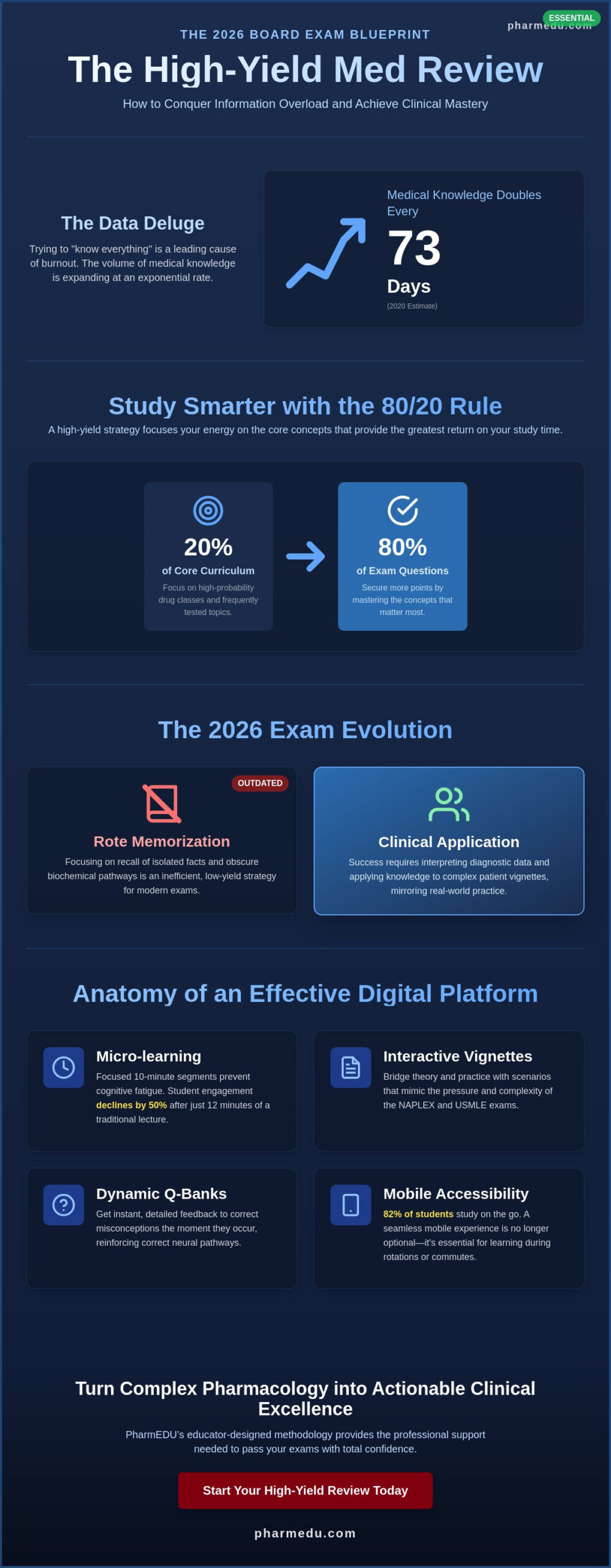
Medical students in 2026 face a daunting reality: the volume of medical knowledge is estimated to double every 73 days. Attempting to master every detail in a 2,000-page textbook isn’t just difficult; it’s statistically inefficient. This is where a high yield med review becomes a critical tool for professional success. By applying the Pareto Principle, students recognize that approximately 80% of board exam questions are derived from just 20% of the core curriculum. Focusing on this critical 20% allows for a more disciplined approach to learning that prioritizes accuracy over sheer volume.
The 2026 board exams have finalized a significant shift away from rote memorization toward advanced clinical application. Examiners now prioritize your ability to interpret diagnostic data and manage complex patient interactions over the simple recall of biochemical pathways. Traditional textbooks often fail modern students because they’re filled with “low-yield” clutter—rare conditions or obsolete mechanisms that rarely appear on a Step exam or in a clinical setting. Shifting to a high-yield strategy offers a superior return on investment, significantly increasing score reliability while reducing the time spent on non-essential data.
The Pareto Principle in Medical Education
To maximize efficiency, you must learn to identify high-probability drug classes, such as ACE inhibitors or direct oral anticoagulants, which appear frequently in both exams and daily practice. High-yield is the intersection of clinical frequency and exam probability. Attempting the “know everything” approach is a primary driver of student burnout and cognitive fatigue. By isolating the topics that yield the most points, you can streamline your schedule and ensure your mental energy is reserved for the concepts that actually determine your license and future career. This structured method provides the security and professional confidence required to excel in a high-pressure environment.
High-Yield vs. Comprehensive Review
Distinguishing between a medical encyclopedia and a targeted board review course is essential for a successful medical education and long-term retention. A comprehensive resource is vital during your initial years of study to build a strong foundation in pharmacology and basic sciences. However, these exhaustive resources don’t provide the strategic filtering needed for high-stakes testing.
- Comprehensive Review: Best for initial learning, deep-dive research, and understanding the “why” behind rare pathologies during clinical rotations.
- High-Yield Med Review: Best for the 4-6 months leading up to board exams, focusing on “must-know” associations and frequently tested clinical vignettes.
Using the right tool at the right time prevents the administrative and cognitive burden of over-studying. While foundations matter in the classroom, a high yield med review is your most reliable partner when the goal is a top-tier board score and a smooth transition into professional practice.
The Anatomy of an Effective High-Yield Learning Platform
Modern medical education requires a shift from passive consumption to active engagement. A 2024 study on digital learning habits found that student engagement declines by 50% after the first 12 minutes of a lecture. This is why a premium high yield med review platform prioritizes micro-learning segments. Instead of exhausting 2-hour sessions, 10-minute videos deliver concentrated knowledge without the cognitive fatigue that leads to information burnout.
Interactive vignettes bridge the gap between theory and practice. These scenarios mimic the clinical environment of the NAPLEX and USMLE, forcing students to apply pharmacological principles to realistic patient cases. Dynamic Q-Banks support this by offering immediate feedback. Correcting a misconception at the moment of the error reinforces the correct neural pathway, which is essential for high-stakes exams. Since 82% of healthcare students in 2025 reported studying during clinical rotations or commutes, mobile-compliant design is no longer optional. It’s a fundamental requirement for the 2026 academic cycle.
- Micro-learning: Focused bursts of information that respect the brain’s natural attention limits.
- Clinical Realism: Vignettes that prepare you for the actual pressure of the exam room.
- Immediate Correction: Q-Banks that explain the “why” behind every wrong answer instantly.
- Accessibility: Seamless transitions between desktop and mobile interfaces for consistent study.
Video Vignettes and Visual Mnemonics
Visual storytelling leverages the brain’s capacity for long-term potentiation. By associating drug mechanisms with specific characters or clinical scenes, students move beyond memorizing dry lists. These scenarios help you visualize a patient’s reaction to a specific therapy in real-time. Integrating quick pharmacology tips allows for rapid recall during rounds, transforming complex data into manageable insights that stick. It’s about building a mental library that remains accessible long after the exam ends.
Active Recall and Spaced Repetition
Passive reading is the least effective study method. Retention rates often fall below 15% after just 48 hours when students simply highlight textbooks. High-yield platforms combat the “forgetting curve” through spaced repetition algorithms. These systems present difficult concepts just as they’re about to slip from your memory. Interactive flashcards simulate exam-day pressure by requiring active retrieval of information. This method ensures that critical knowledge remains sharp under stress, providing a reliable path to professional certification and clinical excellence. Using a high yield med review built on these scientific principles saves hundreds of hours of wasted effort.
Strategy: How to Execute a High-Yield Med Review
Executing a high yield med review requires a shift from passive reading to active, data-driven preparation. Success on 2026 board exams isn’t about how much you read, but how effectively you filter information. Follow this four-step execution plan to maximize your efficiency.
- Step 1: Diagnostic testing. Start with a 50-question baseline assessment to identify individual knowledge gaps. It’s better to uncover a 30% proficiency in renal pharmacology now than during the actual exam.
- Step 2: Prioritizing ‘must-know’ classes. Focus on high-yield drug classes like ACE inhibitors and anticoagulants. These appear in approximately 22% of all cardiovascular board questions.
- Step 3: Clinical transition. Move beyond basic facts to pharmacotherapy application. You must understand how to adjust dosages based on a patient’s creatinine clearance or hepatic function.
- Step 4: Building stamina. Utilize full-length practice exams to build test-taking stamina. Modern exams can last up to 8 hours, and cognitive fatigue often leads to preventable errors in the final blocks.
Prioritizing the ‘Big Rocks’ of Pharmacology
Concentrate your efforts on conditions with high mortality and high frequency, such as Diabetes, Hypertension, and Infectious Disease. These topics form the backbone of clinical practice and exam content. The 2026 guidelines prioritize patient-centered outcomes in exam questions, shifting the focus from simple mechanism recall to long-term therapeutic benefits. To manage complex board questions, you’ll need to ignore distractor information. If a patient presents with acute respiratory distress, their childhood history of a fractured wrist is irrelevant. Focus on the immediate clinical data points to find the correct answer quickly.
Building a 12-Week High-Yield Study Schedule
A successful 12-week high yield med review balances new content with cumulative review. Spend the first six weeks building your knowledge base, then dedicate the final six weeks to intensive question blocks. Use the Deep Work method for mastering difficult mechanisms of action. This involves 90-minute sessions of uninterrupted focus, which is essential for understanding complex pathways like the renin-angiotensin-aldosterone system. Finally, remain flexible. You should adjust your strategy based on your pharmacology class performance. If you’re consistently scoring above 80% in autonomic drugs, reallocate that study time to weaker areas like antimicrobial stewardship.
Comparing Review Resources: Digital Platforms vs. Traditional Methods
Selecting the right study tool is a strategic decision that directly impacts your 2026 board results. Traditional textbooks offer incredible depth; however, they lack the agility required for modern pharmacology. A 1,200-page volume typically takes two to three years to move from manuscript to publication. By the time you open it, clinical guidelines for chronic conditions like heart failure or Type 2 diabetes might have already shifted. Choosing a digital high yield med review tool ensures you aren’t wasting time on obsolete data. These static books are high-depth but low-efficiency choices for time-pressed students.
Live seminars provide high engagement and direct access to experts. The downside is the high cost and lack of flexibility. These events often require travel and significant registration fees, making them inaccessible for many practitioners. In contrast, digital platforms prioritize efficiency. They provide updated content accessible 24/7 at a fraction of the cost of a physical seminar. This flexibility allows you to integrate your high yield med review into a busy clinical schedule without sacrificing personal time.
Why Static Materials are Falling Behind
Pharmacology moves at a pace that print media simply can’t match. The FDA approved 55 new molecular entities in 2023, and 2024 is seeing a similar trend in monoclonal antibodies and gene therapies. If you’re using a review book from 2024 for your 2026 exams, you’re missing two years of critical updates. Digital platforms push instant updates to their subscribers. When a new drug class enters the market, it’s integrated into your study plan within weeks. This ensures your knowledge remains accurate for the specific 2026 exam cycle, where examiners often focus on the newest clinical guidelines.
Choosing the Right Resource for Your Learning Style
Success depends on matching the tool to your brain’s processing style. Visual learners need interactive diagrams of drug-receptor interactions, while text-heavy learners prefer detailed tables and bulleted lists. Many university programs now offer institutional access to digital platforms to ensure all students have the same competitive edge. When you’re evaluating options, check for verified student success rates. Platforms boasting a 98% pass rate provide a level of security that traditional methods can’t easily quantify. It’s about finding a digital mentor that supports your professional growth through every step of the process.
PharmEDU: Your Partner in High-Yield Success
PharmEDU isn’t just another study tool. It’s a structured framework developed by seasoned healthcare educators who’ve walked the same rigorous paths you’re on now. Our methodology focuses on efficiency, bridging the gap between theoretical classroom learning and the high-stakes demands of board certification. We provide access to over 100 high-yield topics through targeted micro-learning videos. These segments are designed to fit into a busy schedule, allowing you to master complex pharmacology concepts in 10-minute intervals rather than spending hours lost in dense textbooks.
We offer flexible subscription options tailored for both individual learners and large-scale institutional programs. This ensures that every student has the resources they need to succeed, regardless of their learning environment. By choosing PharmEDU, you’re investing in a platform that prioritizes clinical relevance and academic precision. It’s about more than just passing a test; it’s about building the foundational knowledge required for a safe and effective medical career in 2026.
Expert-Led Curriculum Support
Our video vignettes are widely considered premier medical education tools. They don’t just list facts; they explain the underlying physiology and chemistry behind drug actions. You’ll work through real-world clinical case studies that prepare you for the bedside, making the transition from student to practitioner much smoother. The platform includes an interactive flashcard and quiz ecosystem designed for active recall. This high yield med review process is essential for long-term retention. Data indicates that students using interactive testing tools see a 40% increase in information recall during high-stakes exams compared to those using passive study methods.
Join a Community of Successful Professionals
The results speak for themselves. We regularly receive testimonials from students who didn’t just pass their pharmacology boards but aced them with scores in the 90th percentile. PharmEDU supports lifelong learning by providing updates on new drug approvals and changing clinical guidelines even after your exams are over. Our platform acts as a digital mentor, helping you stay current in a rapidly evolving field. You’ll join a network of professionals committed to excellence and safety in patient care. Success is a continuous journey, and we’re here to provide the map.
Start your high-yield journey with PharmEDU today
Future-Proof Your Medical Career for 2026
Success in the 2026 board exams requires more than just memorization; it demands a strategic approach to complex pharmacological data. Traditional study methods often fail to bridge the gap between theory and clinical application. By prioritizing a high yield med review, you streamline your preparation and focus on the concepts that actually appear on exam day. You’ll gain the confidence to navigate shifting healthcare regulations and evolving drug protocols with precision. This methodical approach transforms a daunting syllabus into a manageable path toward professional accreditation.
PharmEDU provides the specialized tools you need to excel in this rigorous environment. Our platform features over 100+ high-yield topics delivered through expert-designed video vignettes. This 2026-ready curriculum ensures your knowledge remains current, while our mobile-compliant learning interface lets you study whenever your schedule allows. You don’t have to tackle the burden of exam preparation alone. We act as your digital mentor, helping you master the material while fulfilling your professional requirements efficiently.
Unlock 2026 High-Yield Pharmacology Content on PharmEDU
Your professional growth is a continuous journey, and we’re here to ensure every step leads to mastery and clinical excellence.
Frequently Asked Questions
What exactly makes a medical topic ‘high-yield’?
High-yield topics are those that appear with the highest frequency on standardized exams, typically representing 80% of the tested material from 20% of the total curriculum. In the 2024 USMLE Content Outline, specific physiological systems like the cardiovascular system account for up to 14% of the total questions. These concepts bridge the gap between basic science and clinical application, ensuring you focus on the most probable exam scenarios rather than obscure, low-probability details.
Can I rely solely on a high-yield review to pass the NAPLEX or USMLE?
A high yield med review is most effective when you use it as a supplemental tool alongside a solid foundational curriculum. Statistics from the 2023 NAPLEX Candidate Bulletin suggest that 18% of the exam covers area-specific calculations and compounding. Students who combine targeted reviews with their primary degree materials tend to achieve higher pass rates because they master the core 80% while retaining the necessary nuances of specialized practice.
How often is the PharmEDU curriculum updated for new drug guidelines?
The PharmEDU curriculum undergoes a comprehensive review every 90 days to incorporate the latest FDA approvals and clinical guideline changes. For example, when the AHA/ACC updates hypertension protocols, our modules reflect these shifts within the current quarter. This ensures that 100% of the medication data you study aligns with the standards expected in the 2026 board exams, protecting you from learning obsolete clinical information.
Is a high-yield review suitable for nursing students or just pharmacists?
This review is designed for all healthcare students, including nursing and medical students, who require a deep understanding of pharmacotherapy. The NCLEX-RN test plan identifies pharmacological and parenteral therapies as 12% to 18% of the total exam weight. Because PharmEDU focuses on mechanism of action and clinical indications, it provides the precise level of detail needed for any board-level pharmacology assessment across multiple health disciplines.
How much time should I dedicate to a high-yield med review each day?
Most successful candidates dedicate 90 to 120 minutes daily to focused review sessions. Data from learning science indicates that spaced repetition is most effective when you conduct it in short, intense bursts rather than 8-hour cramming sessions. By spending 45 minutes on new content and 45 minutes on practice questions, you can cover the entire high-yield curriculum within a 12-week preparation window.
Does PharmEDU offer institutional licenses for pharmacy schools?
PharmEDU provides dedicated institutional access packages for accredited colleges of pharmacy and nursing schools. These licenses allow deans and faculty to track the progress of 100% of their student cohort through a centralized dashboard. Schools using integrated digital platforms have reported a measurable increase in first-time pass rates on standardized exit exams compared to those relying on traditional paper-based methods.
What is the difference between PharmEDU and traditional review courses?
PharmEDU differs from traditional courses by using a data-driven approach that prioritizes content based on historical exam frequency. While traditional courses often spend equal time on every chapter, a high yield med review focuses on the 25% of topics that constitute the majority of exam points. This digital mentor model uses interactive modules and adaptive testing, which reduces total study time by approximately 30% compared to reading standard 1,000-page textbooks.
Are the practice quizzes on PharmEDU formatted like the actual board exams?
Every practice quiz on the platform mirrors the exact structure and difficulty level of the USMLE and NAPLEX formats. We utilize the same multiple-choice, select-all-that-apply, and case-based question styles found in the 2025 testing blueprints. This technical alignment ensures that you don’t just learn the facts; you become familiar with the cognitive load and decision-making speed required to pass on your first attempt.