How to Learn Drug Classifications Fast: The Ultimate 2026 Study Strategy
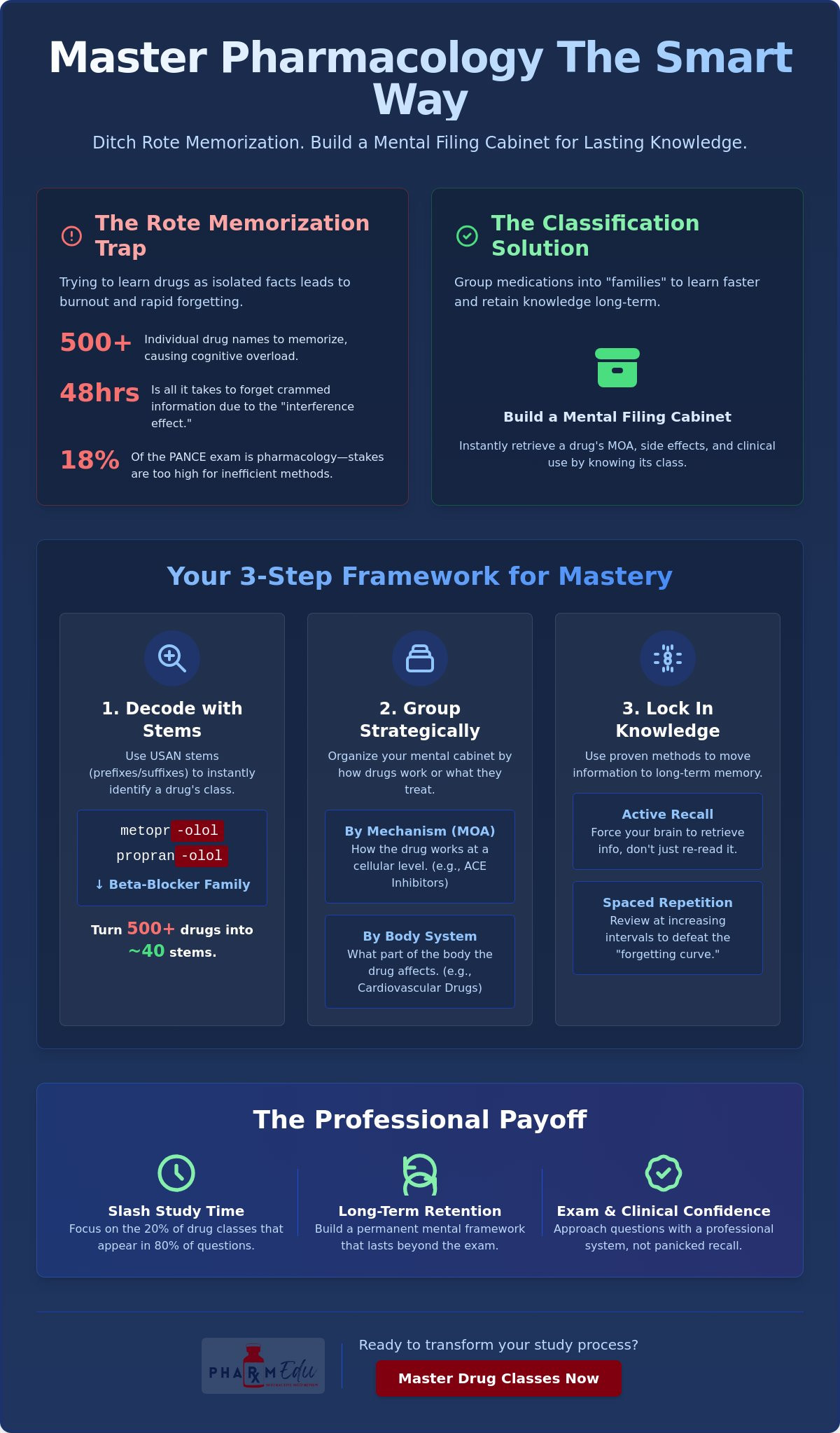
Pharmacology accounts for approximately 18% of the PANCE, yet many students still approach the subject by trying to memorize over 500 individual drug names as isolated facts. It’s an exhausting process that often leads to mixing up similar-sounding medications or forgetting everything just 48 hours after a high-stakes cram session. If you’re struggling with how to learn drug classifications fast, you’ve likely realized that rote memorization is a recipe for burnout. We understand that the pressure to perform is high, especially when the first-time pass rate for exams like the NAPLEX sat at 85.7% in 2025. You need a reliable, professional framework that turns a mountain of data into a manageable, logical map of modern medicine.
This guide will show you how to master the art of grouping medications by mechanism and stem to slash your study time and retain pharmacology long-term. We’ll move beyond the frustration of individual flashcards and help you build a permanent mental filing system for every drug class. By shifting your focus to medication families with shared names and occupations, you’ll gain the confidence needed for both board exams and real-world clinical settings. We break down high-yield strategies that replace frantic memorization with structured, professional expertise.
Key Takeaways
- Transition from memorizing isolated facts to building a structural mental filing cabinet that organizes drugs by their shared therapeutic characteristics.
- Utilize the USAN Stem Method to decode drug names instantly, allowing you to identify a medication’s class simply by its suffix or prefix.
- Discover how to learn drug classifications fast by alternating between Body System and Mechanism of Action (MOA) approaches to suit both clinical rotations and board exams.
- Implement evidence-based techniques like active recall and spaced repetition to overcome the forgetting curve and ensure long-term knowledge retention.
- Establish a structured 4-week mastery schedule that prioritizes high-yield drug classes and integrates them into a professional clinical mindset.
Why Rote Memorization Fails and How Classification Saves Time
Your brain isn’t designed to hold hundreds of disconnected data points. When you try to memorize 500+ medications as individual items, your cognitive load spikes, leading to rapid forgetting. This is the core of the ‘Mental Filing Cabinet’ theory. If you throw thousands of loose papers onto an office floor, you’ll never find the specific information you need during a crisis. However, if you organize those papers into labeled drawers, retrieval becomes instant. Understanding drug classification systems provides those essential drawers. Instead of seeing “Lisinopril” as a lone entity, you see it as a member of the ACE inhibitor family, which immediately tells you its indications, side effects, and nursing considerations.
Mastering how to learn drug classifications fast requires a fundamental shift in your perspective. You aren’t just studying drugs; you’re studying patterns. We categorize medications by their chemical structure, their physiological effects, or their clinical utility. By focusing on these groups, you can apply the 80/20 rule of pharmacology. In most medical curricula and board exams, roughly 20% of drug classes account for 80% of the questions you’ll face. By mastering the core families first, you create a professional foundation that makes learning rare medications much easier. You stop asking “What is this specific drug?” and start asking “What family does this belong to?”
Mechanism of Action vs. Therapeutic Class
The Dangers of ‘Cramming’ Without a System
Cramming without a structural framework creates a phenomenon called the ‘interference’ effect. This happens when similar-sounding names like “prednisone” and “propranolol” get tangled in your short-term memory because they lack a distinct mental home. Without a classification system, your brain lacks the “hooks” necessary to move information into long-term storage. This leads to the common frustration of forgetting everything 48 hours after a test. Using a structured approach prevents cognitive overload and keeps your mental filing cabinet orderly. For a deeper dive into tailored strategies for your specific path, check out The Ultimate Pharmacology Study Guide for Nursing Students in 2026.
The Stem Method: Using Suffixes and Prefixes as Shortcuts
Generic drug names aren’t random strings of letters. They’re meticulously crafted by the United States Adopted Names (USAN) Council to provide a clear, professional shorthand for a medication’s pharmacological identity. This linguistic framework is the secret to how to learn drug classifications fast. Instead of viewing “metoprolol” as a unique word to memorize, you see the “stem” that links it to a massive family of medications. This approach turns a daunting list of 500 drugs into a manageable collection of roughly 30 to 40 stems. When you master the stem, you master the entire family’s mechanism, side effects, and nursing considerations in one stroke.
The “stem” is the specific syllable or group of letters that identifies the drug’s class. While most students focus on the end of the name, these markers can appear as prefixes, infixes, or suffixes. Suffixes are generally the most high-yield because they act like a family’s last name. However, you must be wary of “trap” names. For example, glucagon and insulin are both critical for glucose management, but they don’t share a common stem. Relying on sound alone without understanding the official USAN logic can lead to dangerous mix-ups in clinical settings. Practicing these linguistic patterns with interactive pharmacology flashcards can help you build the muscle memory needed to spot these stems instantly.
High-Yield Suffixes You Must Know
To build your professional foundation, start with the most common suffixes found on board exams and in daily practice. In the cardiovascular system, focus on -olol for Beta-blockers, -pril for ACE inhibitors, and -sartan for Angiotensin II Receptor Blockers (ARBs). For infectious diseases, learn to recognize -cillin for Penicillins and -floxin for Fluoroquinolones. Neurological medications often use -pam or -lam for Benzodiazepines. These substances are frequently monitored under DEA drug schedules due to their potential for dependence, making their identification even more critical for patient safety.
Middle and Prefix Stems for Advanced Learning
Advanced learners look beyond the suffix to find clues at the start or middle of a name. The prefix cef- is a universal marker for cephalosporin antibiotics, spanning multiple generations from cefazolin to ceftriaxone. Similarly, the -statin- middle stem identifies HMG-CoA reductase inhibitors used to manage cholesterol. By recognizing these prefixes and infixes, you can accurately predict the class and primary mechanism of a drug even if you’ve never seen that specific name before. This level of pattern recognition is what separates a student who crams from a professional who understands the underlying science of pharmacology.
Organizing by Body System vs. Mechanism of Action
Choosing the right organizational framework is a critical step in mastering how to learn drug classifications fast. Students often struggle because they use the same study method for every environment, but clinical rotations and basic science exams require different mental models. The Body System approach organizes drugs by the anatomical area they affect, such as the cardiovascular or respiratory systems. This is indispensable during patient care when you need to quickly identify all medications a patient is taking for a specific condition. It helps you see the “big picture” of a patient’s treatment plan and anticipate potential drug-drug interactions within a single system.
Conversely, the Mechanism of Action (MOA) approach is superior for pharmacology coursework and foundational sciences. This method groups drugs by how they interact with specific receptors or enzymes at a cellular level. By focusing on the MOA, you create a logical “Drug Grid” where side effects and contraindications become predictable consequences of the drug’s action rather than random facts to be memorized. For instance, if you understand that a drug blocks a specific receptor in the autonomic nervous system, you can logically deduce its effects on heart rate and digestion. For those seeking a deeper dive into these scientific foundations, NCI Drug Dictionary offers an authoritative reference for verifying complex mechanisms across various therapeutic classes.
The Prototype Drug Strategy
The most efficient way to handle large drug families is to anchor your knowledge to a single “Prototype Drug.” Instead of trying to learn every detail for ten different ACE inhibitors, you master Lisinopril as the representative for the entire class. You learn its mechanism, common side effects, and nursing priorities in depth. Once you have this professional foundation, you only need to memorize the unique “exceptions” for the other drugs in that family. This strategy can reduce the total volume of facts you need to memorize by up to 70%, allowing you to focus your energy on high-yield information that is most likely to appear on boards.
Cross-System Medications
Some medications are professionally challenging because they fit into multiple categories. Aspirin is a classic example, functioning as both a non-steroidal anti-inflammatory drug (NSAID) and an anti-platelet agent. To master these “multi-tasking” medications, we recommend using clinical case studies that place the drug in different patient scenarios. This practical application helps you understand why a drug is chosen for its anti-platelet properties in a cardiac patient versus its analgesic properties in a post-operative setting. You can find structured guidance on navigating these complexities in Pharmacology: The Comprehensive Guide to the Science of Drugs, which provides a roadmap for integrating these cross-system medications into your clinical mindset.
The PharmEDU Method: Active Recall and Spaced Repetition
Passive study methods like re-reading textbooks or highlighting notes are among the least effective ways to master complex medical data. Research consistently demonstrates that active recall, the process of forcing your brain to retrieve information without looking at the answer, is up to three times more effective than passive review. When you engage in active retrieval, you strengthen the neural pathways associated with that knowledge. This is a cornerstone of how to learn drug classifications fast. Instead of looking at a list of beta-blockers, you should challenge yourself to name three drugs in that class and their primary receptor targets before checking your references.
To ensure this information moves from short-term memory to long-term professional expertise, you must combat the “Forgetting Curve.” This natural cognitive decline suggests we lose a significant portion of new information within 48 hours if it isn’t reinforced. Spaced repetition solves this by scheduling reviews at increasing intervals. Modern digital tools automate this process, ensuring you revisit high-yield drug classes exactly when your brain is about to forget them. Combining these sessions with High-Yield Video Vignettes allows you to visualize drug interactions and clinical scenarios, providing a multi-sensory approach that anchors the classification system in your mind.
Efficiency is vital for busy healthcare students. Adopting a micro-learning strategy, where you focus on 10-minute high-yield bursts throughout the day, often yields better results than marathon four-hour study sessions. This keeps your focus sharp and prevents the cognitive fatigue that leads to mixing up similar drug stems or mechanisms. To manage this fatigue, some students find that a brief mental reset with a game on PlayDravo during their breaks helps them return to their studies with a clearer, more focused mind.
Effective Use of Interactive Flashcards
Traditional “front-and-back” flashcards that simply pair a drug name with its class are often a waste of time. They don’t reflect the complexity of board exams or clinical practice. Instead, you should use “Contextual” cards. For example, a card might present: “Patient with a dry cough taking an antihypertensive; what is the likely drug class?” This forces you to connect the drug class to its clinical side effects. You can jumpstart this process by leveraging PharmEDU’s pre-made Interactive Pharmacology Flashcards, which are designed to build these professional associations quickly.
Simulated Testing and Quizzes
Transitioning from flashcards to Pharmacology Practice Quizzes is essential for exam readiness. A highly effective technique is the “Pre-Test Effect,” which involves taking a quiz before you even start studying a new drug class. This identifies your baseline knowledge and highlights your weakest links in the classification hierarchy. By struggling to answer a question early on, your brain becomes more receptive to the correct information when you eventually encounter it in your study materials. This targeted approach ensures you aren’t wasting time on concepts you already master, focusing instead on the areas that will most impact your scores.
Ready to transform your study habits with evidence-based tools? Start your 7-day free trial of PharmEDU today and access our full suite of high-yield resources.
Next Steps: Mastering Drug Classes for Your Boards
Mastering pharmacology isn’t a sprint. It’s a systematic construction of professional knowledge. To truly understand how to learn drug classifications fast, you must transition from theoretical understanding to a structured execution phase. A 4-week mastery schedule allows you to distribute the cognitive load, focusing on high-yield classes that carry the most weight on professional board exams. By the end of this period, your goal is to move beyond simple recall. You should be able to look at a patient’s chart and see the pharmaceutical logic behind every prescription without hesitation.
Integrating these classifications into your clinical mindset is what separates a student from a practitioner. When you’re on rotations, practice identifying the stems of every new medication you encounter. Ask yourself how the drug’s mechanism explains the patient’s symptoms or side effects. Digital platforms play a pivotal role here by providing the consistency needed to maintain board-ready knowledge in a fast-paced environment. PharmEDU acts as your digital mentor, offering the precision and support required to navigate the complexities of modern pharmacology with confidence.
Building a Personalized Study Plan
Your study plan should be data-driven and focused on your individual needs. Start by identifying your “Red Zone” classes. These are the families, like anti-arrhythmics or complex immunosuppressants, that you consistently mix up or find difficult to categorize. Allocate more time to these challenging areas while maintaining a baseline review of high-yield cardiovascular and endocrine classes. Base your time allocation on the specific weighting of each class on the NAPLEX or NCLEX to maximize your score potential. For a detailed breakdown of how to structure your final review, consult The Best NAPLEX Prep Course Guide: How to Pass in 2026.
How PharmEDU Accelerates Your Learning
PharmEDU is engineered for the modern healthcare student who values efficiency and scientific accuracy. We provide over 100 high-yield topics delivered in micro-segments, allowing you to master drug classifications in short, focused bursts that fit your busy schedule. Our Clinical Case Studies bridge the gap between the classroom and the clinic, showing you exactly how these drug classes behave in real-world scenarios. This practical application reinforces your mental filing cabinet and builds the confidence needed for clinical practice. If you’re ready to stop drowning in drug names and start mastering the science, start your PharmEDU Monthly Subscription today and master drug classes in half the time.
Elevate Your Professional Pharmacology Expertise
Mastering how to learn drug classifications fast is about building a professional framework that replaces panic with precision. By shifting from rote memorization to the structural logic of drug stems and mechanism-based grouping, you create a mental filing system that lasts throughout your career. Utilizing evidence-based techniques like active recall and spaced repetition ensures that your knowledge remains board-ready and clinically relevant, even under the pressure of a high-stakes exam environment.
PharmEDU is your partner in this educational journey, providing the tools you need to succeed. With a 4.8/5 student satisfaction rating, our platform offers mobile-compliant micro-learning segments and expert-led High-Yield Video Vignettes designed for the busy professional. You don’t have to navigate the complexities of modern pharmacology alone. Take the next step in your professional development today and build the confidence you need for every patient interaction.
Unlock 100+ High-Yield Pharmacology Topics with PharmEDU
Your success on the boards and in the clinic starts with a smarter strategy. We believe in your potential to master these complex concepts and excel in your healthcare career.
Frequently Asked Questions
What is the fastest way to memorize drug classifications?
The most efficient way to master how to learn drug classifications fast is to stop memorizing individual names and start identifying official USAN stems. By grouping medications into families based on suffixes like -olol or -pril, you reduce hundreds of isolated facts into a few dozen manageable patterns. Combining this linguistic approach with active recall sessions ensures you aren’t just recognizing names on a page but actually retrieving information from your long-term memory.
How do I remember drug suffixes and prefixes?
Remembering these markers requires consistent exposure through spaced repetition rather than one-time cramming. Using digital tools to review high-yield stems at increasing intervals prevents the natural forgetting curve from erasing your progress. It’s also helpful to connect each stem to a specific physiological action. For example, associate “-sartan” with the renin-angiotensin-aldosterone system so the name immediately triggers a mental map of the drug’s role in blood pressure regulation.
What are ‘Prototype Drugs’ and how do they help in pharmacology?
Prototype drugs are representative medications that serve as the primary example for an entire pharmacological class. By mastering one drug, such as Lisinopril for ACE inhibitors, you establish a professional baseline for the entire family. Instead of relearning side effects for every new drug in the class, you only need to identify the unique exceptions or differences that distinguish them from the prototype. This strategy significantly reduces cognitive load.
Is it better to study drugs by body system or by class?
It’s best to use both methods depending on your current objective. Studying by class or mechanism of action is superior for pharmacology coursework because it emphasizes scientific logic. However, organizing by body system is more effective for clinical rotations. This dual approach is a professional secret for how to learn drug classifications fast while also preparing for real-world bedside decision-making and ensuring high standards of patient safety.
How many drug classes do I actually need to know for the boards?
While there are hundreds of medications, focusing on the top 30 to 40 high-yield drug classes will cover the vast majority of board exam questions. Exams like the NAPLEX or NCLEX prioritize medications that are commonly prescribed or have significant safety profiles. By mastering these core categories first, you build a foundation that allows you to logically deduce information about rarer drugs you might encounter during the test.
Can mnemonics actually help with long-term drug retention?
Mnemonics can be useful as temporary “hooks” for difficult names, but they shouldn’t replace a deep understanding of pharmacology. Professional retention comes from understanding the underlying science and linguistic stems. While a clever phrase might help you pass a quiz tomorrow, it often fails in a clinical setting when you need to recall a drug’s mechanism under pressure. Use mnemonics sparingly to supplement a logic-based study system.
What is the difference between a therapeutic class and a pharmacologic class?
A therapeutic class describes what the drug does clinically, such as “antihypertensive” for lowering blood pressure. A pharmacologic class describes the specific cellular mechanism, such as “beta-blocker.” Understanding the difference is vital for answering board questions that use one term to distract you from the other. Mastering both levels of classification ensures you have the precision required for safe medication administration and high-level professional practice.