
Toxicology Principles for Healthcare Students: Core Concepts and Cases
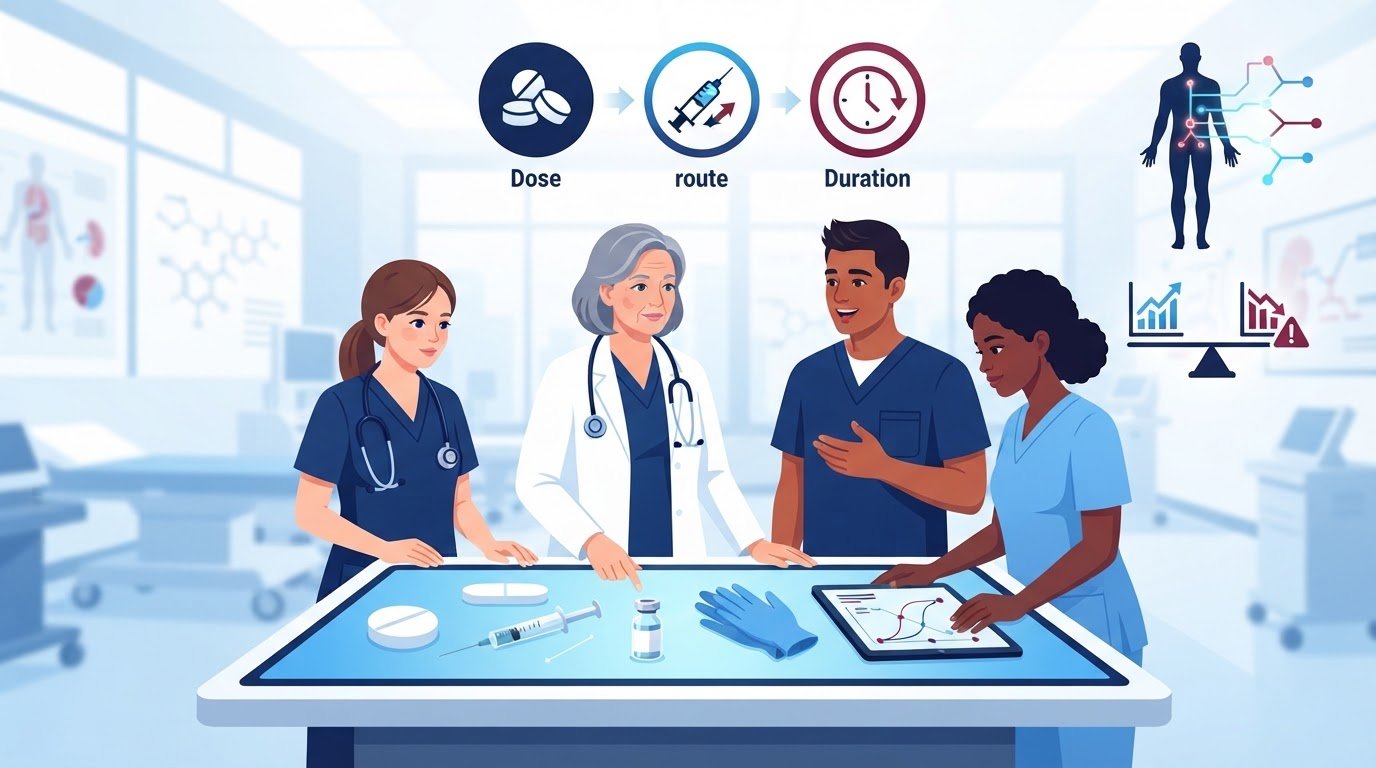
The same chemical can be therapeutic at one dose and harmful at another. Toxicology principles for healthcare students begin with assessing how much exposure occurs, by which route, and for how long. These factors help explain why a substance’s effects differ across people and situations. Connecting them is central to recognizing and reasoning through potential toxic effects.
Toxicology can feel like a set of disconnected facts: dose-response curves, exposure routes, and drug metabolism may seem abstract until applied to a patient case. A clear framework makes these concepts easier to interpret and use in healthcare studies.
This article explains core toxicology concepts, uses aspirin to illustrate metabolic effects, and considers chemical health risks. It also shows how case studies and other learning resources can make the principles clearer, helping pre-health and healthcare students connect foundational science with clinical reasoning.
Key Takeaways
- Assess toxic effects by considering dose, exposure route, and duration, rather than treating a chemical as inherently safe or harmful in every situation.
- Use case studies to connect dose-response concepts with patient factors and strengthen clinical reasoning.
- Understand how aspirin’s metabolic effects relate to poisoning and why toxicology assessment considers more than the substance alone.
- Explore how structured course questions and application-based examinations can help organize learning around poisoning cases.
- Build knowledge with digital learning formats, including PharmEDU’s video vignettes, flashcards, quizzes, and case studies across over 100 topics.
Case studies and application-based examinations
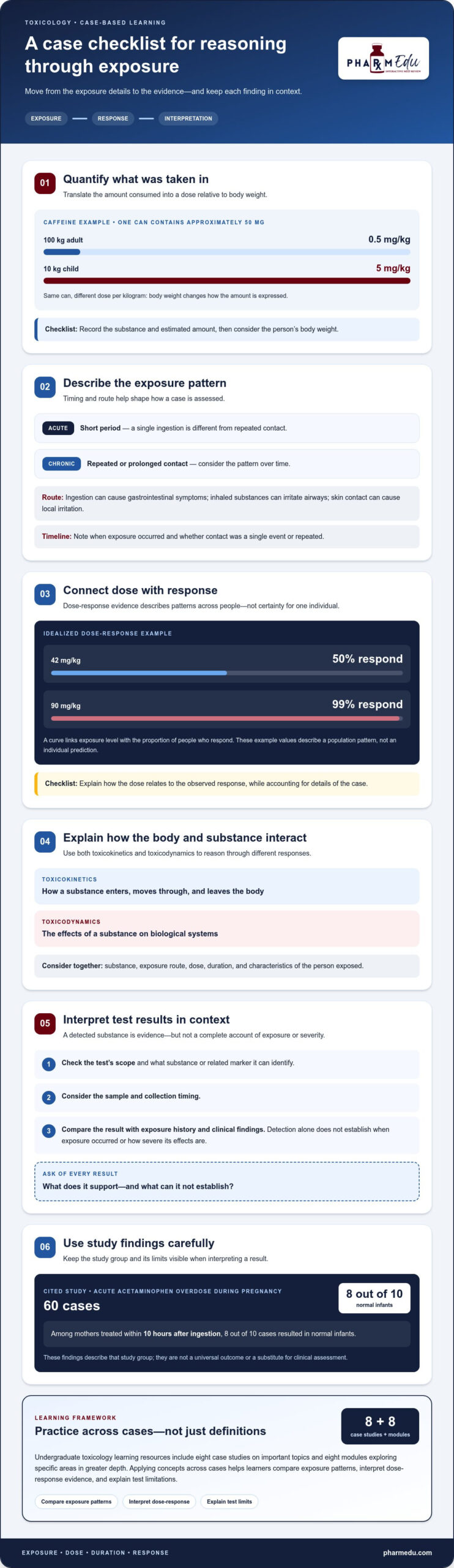
Case studies turn toxicology concepts into decisions about exposure, dose, and response. A cola example shows why body weight matters: one can corresponds to 5 mg/kg of caffeine for a 10 kg child.
Dose-response studies show how responses vary as dose changes. Application-based examinations ask learners to connect this evidence with the details of a case.
Acute and Chronic Exposures
Acute exposure occurs over a short period; chronic exposure develops through repeated or prolonged contact. The distinction matters because timing and pattern shape case assessment: a single ingestion differs from repeated exposure to the same chemical.
Toxicokinetics describes how a substance enters, moves through, and leaves the body. Toxicodynamics describes its effects on biological systems. Both can be influenced by the substance, exposure route, dose, duration, and characteristics of the person exposed. In a case study, students use these factors to explain why exposures may produce different responses.
A dose-response curve links an exposure level with the proportion of people who respond. In an idealized example, 50% respond at 42 mg/kg, while 99% respond at 90 mg/kg. These values illustrate a population pattern, not a prediction for a particular person.
Calculating dose by body weight makes the principle tangible. A can containing approximately 50 mg of caffeine gives a 100 kg adult a dose of 0.5 mg/kg, compared with 5 mg/kg for a 10 kg child. Students can use this contrast to practice translating an amount consumed into a comparable dose.
Interpreting Toxicology Tests
Toxicology tests identify substances or related markers in a sample, but results must be interpreted alongside exposure history and clinical findings. Detecting a substance does not, by itself, establish when exposure occurred or how severe its effects are.
Interpretation also depends on the test’s scope, the sample collected, and the collection timing. A case-based exam may ask students to explain what a result supports, what it cannot establish, and which clinical details provide context. This discourages treating a laboratory result as a complete account of exposure.
Case studies can also teach learners to handle study findings carefully. A cited study of acute acetaminophen overdose during pregnancy included 60 cases; among mothers treated within 10 hours after ingestion, 8 out of 10 cases resulted in normal infants. Those findings describe that study group, not a universal outcome or a substitute for clinical assessment.
Undergraduate toxicology learning resources include eight case studies on important topics and eight modules that explore specific areas in greater depth. Applying concepts across cases helps students compare exposure patterns, interpret dose-response evidence, and explain the limits of test results.
Aspirin poisoning and metabolic effects
Aspirin offers a useful case for connecting drug exposure with metabolic assessment. Students can examine how a suspected poisoning is evaluated using symptoms, exposure history, and laboratory findings.
Route and timing help frame the initial assessment: ingestion can cause gastrointestinal symptoms, inhaled substances can irritate the airways, and skin contact can cause local irritation. Stabilization starts with checking airway, breathing, and circulation, then gathering exposure details and assessing vital signs.
Aspirin-Related Metabolic Effects
Aspirin-related metabolic effects are changes in the body’s chemical processes that clinicians assess alongside exposure history. Symptoms alone do not explain the extent or progression of a suspected poisoning.
In a learning case, students can connect the reported aspirin exposure with acid-base status, ventilation, and salicylate concentration. The key is to interpret these findings together, rather than treating one result as a complete account.
For example, a case might describe possible aspirin ingestion and ask learners which findings would clarify metabolic status. They can consider blood gas results, electrolyte measurements, and the reported timing of ingestion. Each observation adds context, but none should be interpreted outside the full clinical picture.
This reasoning distinguishes the substance’s presence from its effects. A measured salicylate concentration is one part of the assessment; the patient’s symptoms, respiratory status, and laboratory pattern also shape the interpretation. Students should explain how each piece of evidence informs the case, rather than draw a conclusion from a single measurement.
Initial Assessment and Stabilization
Initial assessment and stabilization prioritize immediate threats while establishing what substance entered the body and how. Supportive care and further evaluation depend on the patient’s current condition and exposure details.
A structured approach starts with airway, breathing, and circulation, followed by vital signs and a focused history. Record the substance, route, estimated amount, timing, and any co-ingestants, when available. For suspected aspirin exposure, symptoms and salicylate testing help guide further assessment.
Next, clinicians use examination findings and appropriate laboratory tests to assess the patient’s status. A blood gas can help evaluate acid-base balance, while electrolytes and salicylate concentration provide additional context. Interpret results alongside the exposure timeline and observed changes.
Case-based learning makes this sequence practical. Students can compare a reported ingestion with the patient’s breathing, mental status, and laboratory profile, then explain what needs attention first. They can also distinguish immediate stabilization from later interpretation, keeping clinical priorities clear.
When learners need more practice applying these concepts to patient scenarios, clinical case studies offer a focused way to work through toxicology reasoning.
Acute, or short-term, and chronic, or long-term, chemical exposures can have different effects on a person’s health. Analgesics are the most frequently involved substance in pediatric poisoning deaths. Tenfold calculation errors account for 12% of poisonings that result in death. About 3% to 8% of acetaminophen is metabolized by cytochrome P450 to a reactive metabolite. The page reports 37,701 cases of acetaminophen poisonings involving another drug in the 2006 AAPCC Annual Report; the reported rate of moderate-to-major outcomes for acetaminophen combination-product poisonings was 18%.
Clinical toxicology course design and learning objectives
A strong clinical toxicology course links core concepts with decisions in poisoning cases. Its learning objectives should ask students to identify the exposure, interpret clinical evidence, and explain the reasoning behind an assessment. A 1-credit-hour elective illustrates how focused course design can organize this work around nine key questions for clinical poisoning cases. The questions provide a repeatable structure for examining unfamiliar scenarios.
Each question can guide a different part of case analysis. Students might define the presenting problem, consider the substance, route, and timing, then assess the patient’s findings and identify relevant tests. They can explain how the results inform their interpretation. Instructors can use this sequence across cases so learners practice a consistent framework rather than memorize isolated answers.
Learning objectives become more useful when they describe observable reasoning. For example, students can be asked to distinguish a reported exposure from evidence of toxic effects, interpret a laboratory result in context, or explain why a finding does not establish the full clinical picture. A 3-credit toxicology course at Nazareth College introduces students to basic toxicology principles. Its broader credit structure offers room to connect foundational concepts with additional classroom activities and case discussion.
Assessment should test explanation as well as recall. In one course example, essay questions accounted for 40%-50% of an examination. That format can reveal whether students can support an interpretation, compare possible explanations, and communicate uncertainty in the evidence. Reported average examination performance was 83.4% in required-course years 1996-2001, compared with 81.7% in elective-course years 2002-2007. These figures describe those course periods, not a benchmark for other programs.
Course designers can use this evidence to align instruction and assessment. If an objective asks learners to interpret a case, an exam should require them to apply concepts to case details, not just recall terminology. A short written response can ask students to state the exposure, identify relevant findings, and explain their interpretation. A discussion prompt can explore how a different exposure history changes the reasoning. This makes the learning objective visible in both teaching and assessment.
For healthcare students, this structure turns toxicology into a set of skills that can be practiced and evaluated. Comparing a focused 1-credit-hour elective with a 3-credit introductory course also shows how course scope can vary while maintaining attention to basic principles and clinical reasoning.
A practical method organizes clinical reasoning around the case instead of treating each finding in isolation. The course used nine key questions to address clinical poisoning cases. Instructors can revisit those questions as learners move from describing the problem to explaining an interpretation, keeping attention on how evidence supports a conclusion. Students can use the questions to clarify their reasoning: identify what is known, explain its relevance to the case, and acknowledge what remains uncertain.
When course activities follow the same logic, learners can connect toxicology concepts with clinical judgment. Questions prompt analysis, while written explanations let students show how they reached an answer. This approach keeps the focus on reasoning through the case and explaining the basis for an interpretation.
Toxicology and chemical health risks
Paracelsus, a 15th-century physician, is associated with the principle that the dose makes the poison. Understanding exposure route, amount, and timing helps healthcare learners assess how a chemical may affect health.
When handling hazardous substances, select gloves, eye protection, protective clothing, and respiratory protection according to the chemical’s hazards and exposure route. Follow the product label, safety data sheet, and workplace procedures.
Toxicant Exposure and Absorption Routes
Toxicant exposure occurs when a chemical enters or contacts the body through routes such as ingestion, inhalation, skin contact, or injection. Identifying the route matters because absorption and potential effects vary by chemical and point of entry.
For example, a chemical that is harmful when swallowed may pose a different risk through skin contact. Exposure assessment also considers how much entered the body, how long contact lasted, and how often it occurred. Risk assessors estimate total dose by combining amounts entering through potential routes, then compare that estimate with a dose determined safe through dose-response studies.
This framework prevents one route from dominating the assessment without reason. In a workplace scenario, learners can identify whether a chemical was inhaled, swallowed, absorbed through skin, or injected, then consider whether multiple routes contributed to total exposure. Route informs the assessment, while dose and exposure pattern add context.
Timing matters, too. Some harmful effects, including cancer, may become apparent 10 years after exposure. A delayed effect can make exposure history relevant even when the original contact is no longer visible. Healthcare learners should distinguish the time of exposure from the time symptoms appear.
Antidotes and Decontamination
Antidotes are treatments intended to counter specific toxic effects, while decontamination aims to reduce or stop ongoing exposure. The distinction matters because treatment depends on the substance, route, and patient findings.
An antidote should be considered in relation to the suspected poison and clinical evidence, not as a general response to every exposure. Decontamination must also match the route: a response to skin contact differs from one for ingestion. Inappropriate procedures can add risk, so decisions require appropriate clinical assessment and established protocols.
For a chemical spill involving skin contact, the immediate learning objective is to recognize ongoing exposure and follow the applicable workplace decontamination procedure. For suspected ingestion, a case should prompt learners to identify the substance and route before considering treatment options. These examples show why one universal approach does not fit every chemical.
Risk assessment also supports prevention. When a chemical presents a potential health concern, risk assessors can recommend ways to avoid or reduce exposure. In a classroom case, students can connect the prevention plan to the route, duration, and frequency of contact, then explain how reducing exposure could change the overall risk.
Toxicology teaching resources for pre-health students
Pre-health students can learn toxicology through structured modules, case studies, and focused assignments. These resources connect foundational ideas with examples that help learners explain how chemicals affect health.
In the United States, contact Poison Control promptly if poisoning or potentially harmful exposure is suspected. If the person has severe symptoms, seek emergency help.
Undergraduate toxicology learning resources include eight modules that explore specific areas in greater depth and eight case studies on important topics. Students can pair a module with a case: review a concept, then apply it to a scenario. For example, a chemical-exposure case can prompt learners to identify the route, consider dose, and explain which evidence informs their assessment.
The Society of Toxicology was the lead partner in developing resources for the Toxicology Mentoring and Skills Development Training program, supported by NIH grant 1R25GM139200. That example shows how teaching materials can be developed around a defined educational program. For learners, the practical value lies in using a resource with a clear subject and then testing understanding against a case or question.
Short activities can make technical topics more approachable. The Tox History Crossword Puzzle was developed for a one-credit freshman course. A puzzle can help students review terminology and historical names; a follow-up discussion can connect those terms to current toxicology concepts. Pairing recall practice with explanation helps learners move beyond vocabulary memorization.
Text-based resources can also provide an entry point. Principles and Practice of Toxicology in Public Health is a 464-page introductory text for public health students, written to be readable for learners with little technical background. A student could use a chapter to establish core concepts, then summarize how its examples relate to exposure assessment or chemical health risks.
Choose a learning format that matches the task. A module supports focused study, a case asks learners to apply ideas, and a crossword can reinforce terminology. After each activity, write a brief explanation of the reasoning used. This makes gaps easier to identify before moving to more complex cases.
For structured pharmacology learning alongside these resources, explore focused study materials and apply key concepts through practice.
PharmEDU: PharmEDU Monthly Subscription
PharmEDU supports continued pharmacology study through its PharmEDU Monthly Subscription, designed for learners who want a structured way to review alongside coursework. Its curriculum covers over 100 topics, with High-Yield Video Vignettes helping connect pharmacology concepts to clinical examples.
The PharmEDU Monthly Subscription supports ongoing study in shorter planning cycles, while the PharmEDU Annual Subscription provides a longer review period. Institutions can use the Institutional Platform License across their educational setting. These options support students revisiting difficult concepts, preparing for coursework, or strengthening pharmacology knowledge for exams.
Explore PharmEDU’s learning options at pharmedu.com.
Build a Steady Path for Continued Learning
Turn your interest in toxicology into a sustainable study practice. Set a focused learning goal, identify topics to strengthen, and return to challenging concepts as your coursework develops. Toxicology principles for healthcare students become more useful when you apply them to new learning scenarios and reflect on how your reasoning develops.
For continued pharmacology study, PharmEDU offers the PharmEDU Monthly Subscription and PharmEDU Annual Subscription, along with an Institutional Platform License. Choose the option that fits your study routine or educational setting, then use it to support consistent review alongside your coursework.
Contact PharmEDU to discuss your learning needs. Each deliberate study session can help you build a stronger foundation for the next stage of your healthcare education.
Frequently Asked Questions
What are the core principles of toxicology for healthcare students?
The core principles connect a substance’s dose and exposure pattern with its biological effects. For toxicology principles for healthcare students, this means considering how a chemical enters the body, how the body processes it, and how it affects tissues. Toxicokinetics concerns a substance’s movement through the body; toxicodynamics concerns its effects. For example, acetaminophen overdose can deplete glutathione, allowing the reactive metabolite NAPQI to bind to hepatocyte proteins.
How does dose-response relationship work in toxicology?
A dose-response relationship describes how the likelihood or severity of an effect changes as exposure dose changes. A curve can show the proportion of a population responding at different doses, rather than predicting one person’s outcome. In one wine example, 50% of the population is affected after 4.5 glasses. Students should interpret such values as population-level evidence and consider how individual exposure patterns and susceptibility affect a specific case.