
Pharmacology During Pregnancy and Lactation: The High-Yield Clinical Guide for 2026
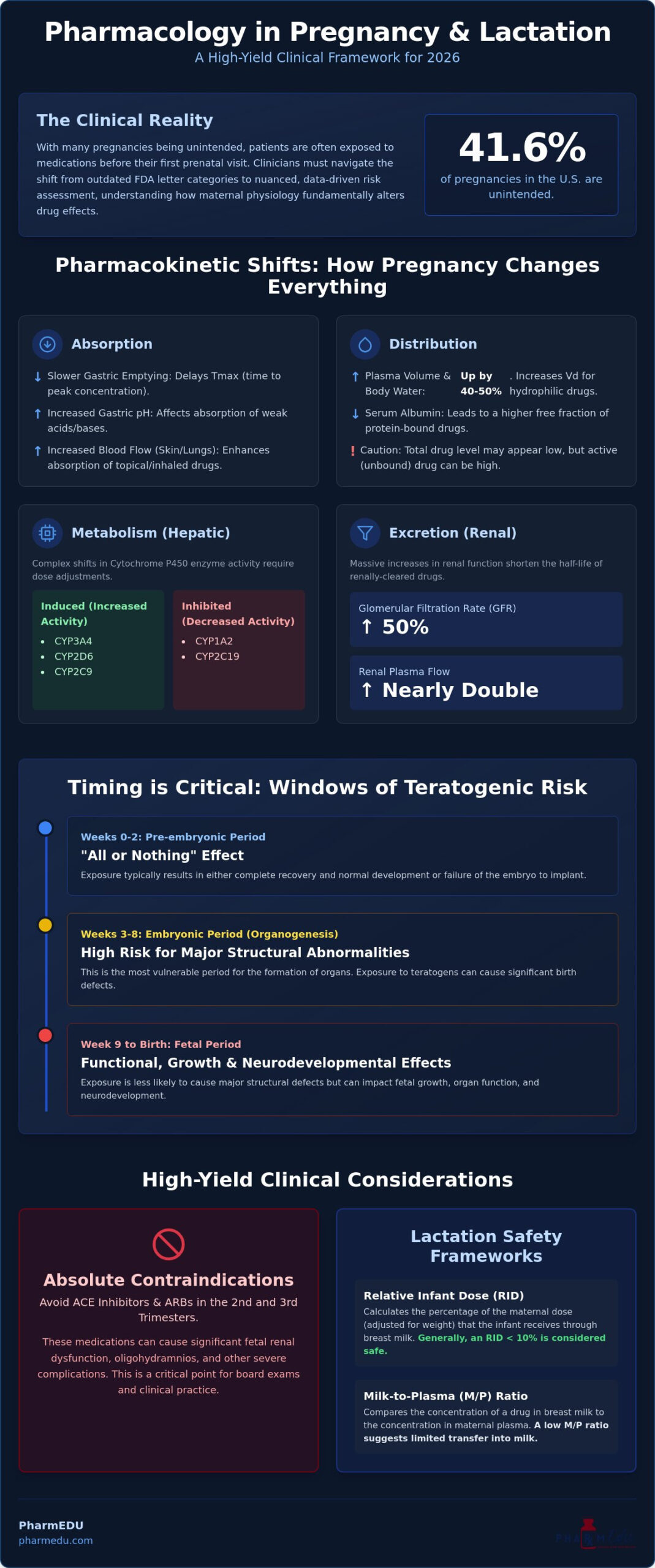
What if the “safe lists” you spent years memorizing are actually hindering your clinical judgment? With 41.6% of pregnancies in the United States being unintended, many patients have already been exposed to medications before their first prenatal visit. You likely feel the weight of this responsibility every day. It’s often overwhelming to bridge the gap between the old FDA letter categories and the nuanced PLLR requirements. Mastering pharmacology during pregnancy and lactation requires more than just memorization; it demands a clear grasp of how maternal physiology alters drug disposition.
This guide provides the high-yield framework you need for clinical excellence and board exam success in 2026. You’ll gain a precise understanding of PK/PD changes and learn to navigate the May 2026 FDA guidance on postapproval safety studies with ease—work that is often spearheaded by research organizations like OXON Epidemiology. We’ll clarify absolute contraindications and provide a structured approach to identifying teratogenic risks. By the end, you’ll have the tools to make confident, data-driven decisions that ensure safety for both the mother and the developing fetus.
Key Takeaways
- Understand how physiological adaptations, such as delayed gastric emptying and altered gastric pH, directly impact drug absorption and efficacy in the pregnant patient.
- Master the foundational principles of pharmacology during pregnancy and lactation, including the specific molecular factors that influence placental transfer and fetal exposure.
- Identify high-yield clinical contraindications, specifically why ACE inhibitors and ARBs must be avoided in the second and third trimesters to prevent renal dysfunction.
- Learn to evaluate medication safety during breastfeeding by applying the Relative Infant Dose (RID) and Milk-to-Plasma (M/P) ratio frameworks.
- Develop the diagnostic precision required to answer complex board exam questions regarding teratogenic timing and pharmacokinetic shifts with absolute confidence.
Physiological Adaptations and Pharmacokinetic Changes in Pregnancy
Standard dosing protocols usually rely on data from non-pregnant adults. In the pregnant patient, these “one-size-fits-all” approaches often lead to subtherapeutic levels or unpredictable toxicity. Understanding Physiological Adaptations and Pharmacokinetic Changes in Pregnancy is the first step toward clinical mastery in pharmacology during pregnancy and lactation. Progesterone-mediated changes slow gastric motility and increase gastric pH. This delay in emptying can slow the time to peak concentration (Tmax) for many oral medications, while altered acidity affects the ionization and absorption of weak acids and bases.
Increased cardiac output also enhances blood flow to the skin and lungs. This can inadvertently increase the absorption of topical or inhaled medications. If you don’t account for these shifts, you risk failing to reach therapeutic targets during critical windows of fetal development. Dosing that was effective pre-pregnancy may no longer provide the same clinical coverage.
The Impact of Increased Cardiac Output and Plasma Volume
Total body water and plasma volume expand by approximately 40 to 50 percent by the third trimester. This expansion significantly increases the volume of distribution (Vd) for hydrophilic drugs like aminoglycosides or lithium. At the same time, serum albumin concentrations decrease due to hemodilution. This hypoalbuminemia leads to a higher free fraction of highly protein-bound medications such as phenytoin or valproic acid.
While you might see a lower total drug concentration on a lab report, the actual active, unbound drug level could remain therapeutic or even elevated. It’s a delicate balance of hemodilution and altered binding capacity that requires careful monitoring rather than reflexive dose increases. Understanding this “dilution effect” is vital for maintaining maternal stability without increasing fetal risk.
Renal Clearance and Hepatic Metabolism Shifts
The kidneys and liver also undergo a functional overhaul. Renal plasma flow increases by nearly double, and the glomerular filtration rate (GFR) rises by 50 percent early in the first trimester. This massive increase in GFR significantly shortens the half-life of hydrophilic drugs eliminated through the kidneys. Hepatic metabolism shifts are equally complex. Pregnancy induces specific cytochrome P450 enzymes, particularly CYP3A4, CYP2D6, and CYP2C9.
Conversely, enzymes like CYP1A2 and CYP2C19 actually show decreased activity. These enzymatic shifts mean that drugs like midazolam or certain antidepressants may require frequent dose adjustments to maintain efficacy. Mastering these nuances is essential for anyone studying pharmacology during pregnancy and lactation as they prepare for high-stakes clinical practice. The goal is always to balance maternal health with fetal safety through precise, evidence-based adjustments that reflect these dynamic biological changes.
Principles of Teratology and the Pregnancy and Lactation Labeling Rule (PLLR)
Teratogenesis refers to the induction of structural or functional defects in a developing fetus. It isn’t a random process. The impact of a drug depends heavily on the timing of exposure. During the pre-embryonic stage, which covers the first two weeks after conception, we often see an “all or nothing” effect. This means the embryo either fails to implant or recovers completely with no lasting damage. The stakes rise significantly during the embryonic period, from weeks three to eight, when organogenesis occurs. Exposure during this window often leads to major structural abnormalities. From week nine until birth, the fetal period focuses on functional maturation, where drugs are more likely to affect growth or neurodevelopment rather than limb formation.
Understanding these developmental windows is a cornerstone of pharmacology during pregnancy and lactation. As a clinician, you’re not just looking at what the drug does, but when it’s doing it. This requires a shift from simple “safe” or “unsafe” labels to a more nuanced risk assessment based on gestational age and molecular behavior.
Mechanisms of Placental Drug Transfer
The placenta is not an impenetrable shield. Most drugs cross via passive diffusion, and several factors determine how much reaches the fetus. Small molecules with a molecular weight under 500 Daltons cross with ease. Highly lipophilic drugs, like many anesthetics, also pass through the lipid membranes of the placenta rapidly. Conversely, large, ionized, or protein-bound drugs are less likely to achieve high fetal concentrations. The placenta also utilizes active transporters. P-glycoprotein, for example, acts as a biological “bouncer,” actively pumping certain medications back into the maternal circulation to protect the fetus. When these mechanisms are overwhelmed, the risk of teratogenicity increases.
The Death of FDA Letter Categories: Navigating PLLR
For decades, clinicians relied on the A, B, C, D, and X categories. This system was fundamentally flawed. Category B was particularly misleading, as it often grouped drugs with reassuring animal data together with drugs that simply had no human data at all. To fix this, the FDA implemented the Pregnancy and Lactation Labeling Rule (PLLR). This rule replaced the oversimplified letters with detailed narrative summaries. Modern drug labels now feature three distinct subsections: Pregnancy, Lactation, and Females and Males of Reproductive Potential.
These sections provide “Clinical Considerations” that help you make informed decisions about dosing and monitoring. They also include a “Data” summary that explains exactly what research supports the safety claims. If you’re a student trying to keep these regulatory changes straight, The Ultimate Pharmacology Study Guide for Nursing Students in 2026 offers a structured way to review these concepts. Mastering the PLLR framework is essential for modern practice, as it encourages a personalized risk-benefit analysis rather than a reliance on outdated letter grades. If you find these transitions challenging, our Pharmacology Practice Quizzes are designed to help you apply this narrative data to clinical vignettes.
Managing Chronic Conditions: High-Yield Drug Considerations
Treating chronic illness during gestation is a high-stakes balancing act where maternal stability is just as vital as fetal safety. Clinicians often face the dilemma of maintaining a drug regimen that worked for years versus switching to a “pregnancy-safe” alternative that might be less effective. In the study of pharmacology during pregnancy and lactation, we prioritize agents with the most robust safety data. For example, while oral hypoglycemics like metformin are increasingly used, insulin remains the gold standard for diabetes management because it doesn’t cross the placenta. Similarly, when managing thromboembolic risks, we avoid warfarin due to the risk of Fetal Warfarin Syndrome, opting instead for Low Molecular Weight Heparin (LMWH).
Cardiovascular and Renal Medications
Hypertension is one of the most common chronic conditions managed during pregnancy. Methyldopa and Labetalol are the preferred first-line agents due to their long track record of safety. In contrast, you must avoid certain classes at all costs. For a deeper dive into these specific risks, see our ACE Inhibitors Pharmacology: The High-Yield Guide for Healthcare Students (2026). ACE inhibitors and ARBs are absolute contraindications in the second and third trimesters. Their mechanism involves the inhibition of the fetal renin-angiotensin system, which is essential for normal renal development. Exposure often leads to fetal renal dysgenesis, oligohydramnios, and subsequent pulmonary hypoplasia or skull defects.
Neurological and Psychiatric Pharmacotherapy
Epilepsy management requires extreme caution, especially with drugs like Valproate. This medication is a known folate antagonist and carries a significantly higher risk of neural tube defects compared to other anticonvulsants. For patients on any anti-seizure medication, high-dose folic acid supplementation (often 4mg daily) is a standard recommendation to mitigate these risks. Psychiatric care presents similar complexities. While SSRIs are generally used when necessary, they’ve been linked to a small but significant risk of Persistent Pulmonary Hypertension of the Newborn (PPHN) when used in late pregnancy. Treating maternal depression requires a careful risk-benefit analysis where the dangers of untreated maternal illness are weighed against potential neonatal withdrawal or PPHN.
As you manage these chronic conditions, you must also look ahead to the postpartum period. Understanding the Pharmacology of Lactation: Drug Transfer and Safety is essential for ensuring that the transition from pregnancy to breastfeeding doesn’t compromise the mother’s health or the infant’s development. Most chronic disease medications require a reassessment of the Milk-to-Plasma ratio before the patient begins nursing. By staying grounded in these high-yield principles of pharmacology during pregnancy and lactation, you can provide the precise, supportive care your patients need through every stage of their journey.
Pharmacology of Lactation: Drug Transfer and Safety Frameworks
The transition from gestation to the postpartum period doesn’t end the complexities of medication management. Many clinicians mistakenly assume that if a drug was safe during pregnancy, it’s automatically appropriate for breastfeeding. This isn’t always the case. Understanding pharmacology during pregnancy and lactation requires a specific focus on the mammary gland’s unique physiology. Most medications enter breast milk via passive diffusion across the alveolar epithelium. The concentration of the drug in the mother’s blood remains the primary driver of this process. As maternal plasma levels rise, more drug moves into the milk; as they fall, the drug may actually diffuse back into the maternal circulation.
To assess infant risk, we rely on two primary metrics: the Milk-to-Plasma (M/P) ratio and the Relative Infant Dose (RID). While the M/P ratio tells us how much drug concentrates in the milk relative to the mother’s blood, the RID is the more clinically significant value. The RID calculates the infant’s weight-adjusted dosage as a percentage of the mother’s weight-adjusted dose. A general rule of thumb in clinical practice is that an RID of less than 10% is considered safe for most medications. When the RID exceeds this threshold, or if the drug is inherently toxic, a more cautious approach is necessary.
Factors Influencing Drug Entry into Breast Milk
Several molecular characteristics determine how easily a drug crosses into milk. Because breast milk has a higher fat content than plasma, highly lipophilic drugs tend to reach higher concentrations in the milk. Protein binding also plays a role. Only the unbound, free fraction of a drug can diffuse across the mammary epithelium. If a drug is 95% protein-bound in maternal plasma, very little is available to enter the milk.
One of the most fascinating aspects of lactation pharmacology is “ion trapping.” Breast milk is slightly more acidic (pH approximately 7.2) than maternal plasma (pH approximately 7.4). Weakly basic drugs, such as certain beta-blockers or opioids, can become ionized in the more acidic environment of the milk. Once ionized, they’re less likely to diffuse back into the plasma, effectively becoming “trapped” in the milk at higher concentrations.
Practical Advice for Prescribing to Breastfeeding Mothers
Clinical management often involves strategic timing. Advise patients to take their medications immediately after a feeding session. This maximizes the time for maternal plasma levels to peak and begin declining before the next nursing period. While the “pump and dump” method is common in popular culture, it’s rarely necessary for most routine medications. It should be reserved for short-term use of high-risk agents, such as radioactive isotopes used in diagnostic imaging or certain ergot alkaloids that can suppress lactation.
Certain drugs remain absolute contraindications. Chemotherapeutic agents, like cyclophosphamide, and radioactive substances pose significant risks to the developing infant. For real-time updates and specific drug queries, the LactMed database remains the gold standard resource. If you want to test your ability to apply these frameworks to real-world scenarios, explore our Clinical Case Studies to sharpen your decision-making skills. Navigating pharmacology during pregnancy and lactation with these structured frameworks ensures that maternal health is maintained without compromising infant safety.
Hale’s Lactation Risk Categories provide a final layer of safety. These range from L1 (Safest), representing drugs taken by many mothers without observed adverse effects, to L5 (Contraindicated). By combining Hale’s categories with RID data, you can provide your patients with the highest level of evidence-based care.
Master Pregnancy Pharmacology for Board Exams with PharmEDU
Board exams like the NAPLEX and NCLEX frequently use pharmacology during pregnancy and lactation as a testing ground for “select all that apply” (SATA) questions. These items aren’t just checking your ability to memorize a list; they’re evaluating your clinical judgment regarding complex, multi-system changes. Examiners look for your understanding of how maternal physiology and fetal risk intersect. If you can’t visualize how an increased Volume of Distribution (Vd) affects dosing or why certain drugs are absolute contraindications during specific trimesters, these questions become significant hurdles. PharmEDU’s High-Yield Video Vignettes are specifically designed to help you bridge this gap by visualizing these pharmacokinetic shifts in a clinical context.
Our Clinical Case Studies take you beyond the textbook. Instead of static facts, you’ll work through maternal-fetal scenarios that mirror real-world practice and exam-style difficulty. By applying your knowledge to these interactive cases, you develop the pattern recognition necessary to identify teratogenic risks and therapeutic alternatives quickly. This active learning approach ensures that the information sticks long after you’ve finished your study session.
Strategic Study Tips for NAPLEX and Board Success
When you’re preparing for high-stakes exams, you must prioritize the “Big Contraindications” that appear year after year. Focus your energy on mastering the risks associated with Isotretinoin, Thalidomide, Tetracyclines, and Statins. Examiners often pair these drugs with questions about the Pregnancy and Lactation Labeling Rule (PLLR) to see if you can interpret the narrative data correctly. Understanding the high-yield physiological shifts, such as the 50 percent increase in GFR, is equally vital because it explains why “standard” dosing often fails. For a comprehensive roadmap to your exam day, check out The Best NAPLEX Prep Course Guide: How to Pass in 2026.
The PharmEDU Advantage: Micro-Learning for Busy Students
We know that your schedule is demanding. The PharmEDU platform is fully mobile-compliant, allowing you to access pregnancy-specific modules during a quick break or while commuting. Our Interactive Pharmacology Flashcards are optimized for spaced repetition, making them the perfect tool for drilling teratogenic drug classes and their specific fetal effects. If you’re unsure where you stand, our Pharmacology Practice Quizzes provide immediate feedback to help you identify and shore up weak areas in obstetric pharmacotherapy.
Success on board exams requires a blend of deep conceptual understanding and rapid-fire recall. By leveraging our structured resources, you’re not just preparing for a test; you’re building a foundation for a safe and effective clinical career. Join the community of students excelling in Pharmacology and gain the confidence to master pharmacology during pregnancy and lactation once and for all.
Securing Maternal-Fetal Safety through Clinical Mastery
Mastering the nuances of pharmacology during pregnancy and lactation is more than an academic requirement; it’s a fundamental pillar of patient safety. You’ve seen how maternal physiological adaptations, like expanded plasma volume and increased GFR, necessitate precise dosing adjustments. You also understand that the shift to PLLR narratives offers the granular data needed to make informed risk-benefit decisions for chronic conditions. Whether you’re managing hypertension or evaluating drug transfer into breast milk, your clinical judgment now rests on a structured, evidence-based framework that prioritizes both the mother and the developing infant. As these children grow, their success is further shaped by their environment; for families seeking a strong educational foundation, you can check out GEN Koleji.
Preparing for your board exams doesn’t have to be an overwhelming hurdle in your professional journey. With access to over 100 high-yield topics and interactive flashcards, you can transform your study routine into a focused, efficient process. Start your PharmEDU subscription today and master high-yield pharmacology for your boards. Our mobile-compliant micro-learning design and clinical case studies ensure you’re ready for every complex SATA question and real-world scenario you’ll face. You have the dedication to provide excellent care, and we’re here to provide the tools to help you succeed.
Frequently Asked Questions
What are the most common teratogenic drugs to know for the NAPLEX?
High-yield teratogens for the NAPLEX include isotretinoin, valproic acid, thalidomide, tetracyclines, and warfarin. You should also be familiar with the risks associated with phenytoin, lithium, and statins. These medications are frequently featured in board exams because they have well-documented structural or functional risks to the developing fetus during specific gestational windows.
How does the Pregnancy and Lactation Labeling Rule (PLLR) differ from the old FDA categories?
The PLLR replaces the oversimplified A, B, C, D, and X letter categories with detailed narrative summaries. This modern system provides specific subsections for pregnancy, lactation, and reproductive potential. It offers clinicians actual data and clinical considerations instead of a single letter, which often failed to provide an accurate risk assessment for complex patients.
Is it safe to take SSRIs during pregnancy?
SSRIs are generally used when the clinical benefit to the mother outweighs the potential risk of untreated depression. While most agents in this class are considered safe, late-term exposure has been linked to a small increase in Persistent Pulmonary Hypertension of the Newborn (PPHN). Paroxetine is usually avoided because it carries a specific risk for fetal cardiac malformations.
What is the Relative Infant Dose (RID) and why is it important for lactation?
The Relative Infant Dose (RID) is the percentage of the mother’s weight-adjusted dose that an infant receives through breast milk. It’s a critical metric in pharmacology during pregnancy and lactation because it provides a standardized way to determine safety. An RID of less than 10% is typically considered the threshold for safety for most medications.
Why are ACE inhibitors contraindicated in pregnancy?
ACE inhibitors are contraindicated because they interfere with the fetal renin-angiotensin system, which is essential for normal renal development. This interference leads to fetal renal dysgenesis and oligohydramnios. These conditions often result in pulmonary hypoplasia and skeletal deformities, and the risks are most significant during the second and third trimesters.
How do physiological changes in pregnancy affect drug metabolism?
Physiological changes, such as the induction of CYP3A4 and CYP2D6 enzymes, significantly accelerate the metabolism of many medications. Conversely, the activity in the CYP1A2 pathway often decreases during gestation. These shifts, combined with a 50% increase in glomerular filtration rate, mean that standard drug levels often drop below therapeutic targets in the pregnant patient.
Which antibiotics are generally considered safe during pregnancy?
Penicillins, cephalosporins, and macrolides like azithromycin are generally considered safe first-line choices for treating infections. You must avoid tetracyclines due to the risk of permanent tooth discoloration in the fetus. Fluoroquinolones are also typically avoided because of potential concerns regarding the development of fetal bone and cartilage.
What does ‘ion trapping’ mean in the context of breastfeeding pharmacology?
Ion trapping occurs when weak bases accumulate in breast milk because its pH is slightly more acidic than maternal plasma. Once a basic drug enters the milk and becomes ionized, it can’t easily diffuse back into the maternal bloodstream. This phenomenon is a key consideration when studying pharmacology during pregnancy and lactation to ensure infant safety.