
Pharmacogenomics for Beginners: How Genes Influence Drug Response
The same medication can work well for one person but have little effect or cause adverse reactions in another. Genetic differences can influence how quickly the body processes certain drugs, which may affect a person’s response to a typical dose. This beginner’s guide to pharmacogenomics explains why those differences matter and what testing can reveal.
It’s natural to expect a medication to affect people in similar ways, but genes are one reason responses can vary. You’ll learn how pharmacogenomic tests examine specific genetic changes, how results may inform medication decisions, and why testing is only one part of precision medicine. We’ll also explore how practical education helps healthcare students and professionals understand the science and its relevance to care.
Key Takeaways
- Learn how genetic differences can influence whether a medication is processed quickly, slowly, or in a way that affects its benefits and risks.
- Understand what pharmacogenomic testing examines and how its findings may inform medication decisions for certain drugs and conditions.
- See how genetic information fits into precision medicine alongside health conditions, other medications, and lifestyle factors.
- Build a clearer foundation in pharmacology through structured learning resources designed for healthcare students and professionals.
How genetic variation affects drug response
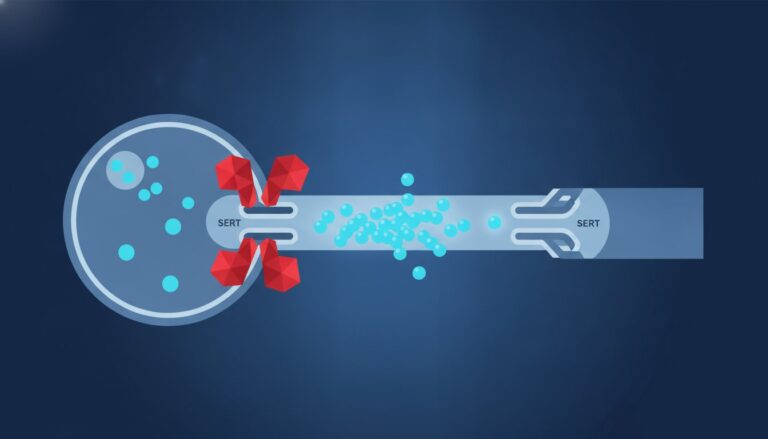
Genes can influence how the body processes a medication, changing its effects or risks. Pharmacogenomics examines these gene-drug relationships to support more informed medication decisions.
Genetic Foundations of Drug Response
Genetic variation means people can carry different versions of genes that affect how they respond to drugs. Those differences matter because the same medication may help one person, have little effect for another, or cause adverse reactions. For example, variants in SLCO1B1 can be associated with muscle pain and weakness during treatment with certain statins for high cholesterol.
Genetic Differences in Drug Metabolism
Drug metabolism is the body’s processing of a medication, and genetic variants can alter its pace. Variants in CYP2D6 and CYP2C19 can affect how quickly the body breaks down certain antidepressants. If a drug is processed too quickly or slowly, its effects may differ from what a typical dose is intended to produce. Other medications, health conditions, and lifestyle also influence drug breakdown.
Testing for Adverse Drug Reaction Risk
Pharmacogenomic testing examines DNA for specific changes linked to medication response. A test may assess one gene or several, using a blood sample or cheek swab. Unlike direct-to-consumer DNA tests, which can report a broad range of genetic traits, pharmacogenomic tests focus on variants relevant to particular medications. Results may help identify risks, such as severe side effects from mercaptopurine in people with low TPMT levels.
Testing costs are decreasing, but out-of-pocket costs in the United States vary depending on insurance coverage. Pharmacists can connect results to medication choices, while genetic counselors can explain inherited findings and their implications. Together, they can help healthcare teams interpret results in light of a person’s medications and health conditions.
Clinical validity and utility of pharmacogenomic tests
A pharmacogenomic result is useful when evidence links a genetic finding to a medication decision. Its practical value depends on the gene, drug, and clinical context.
Clinical Evidence and Guidelines
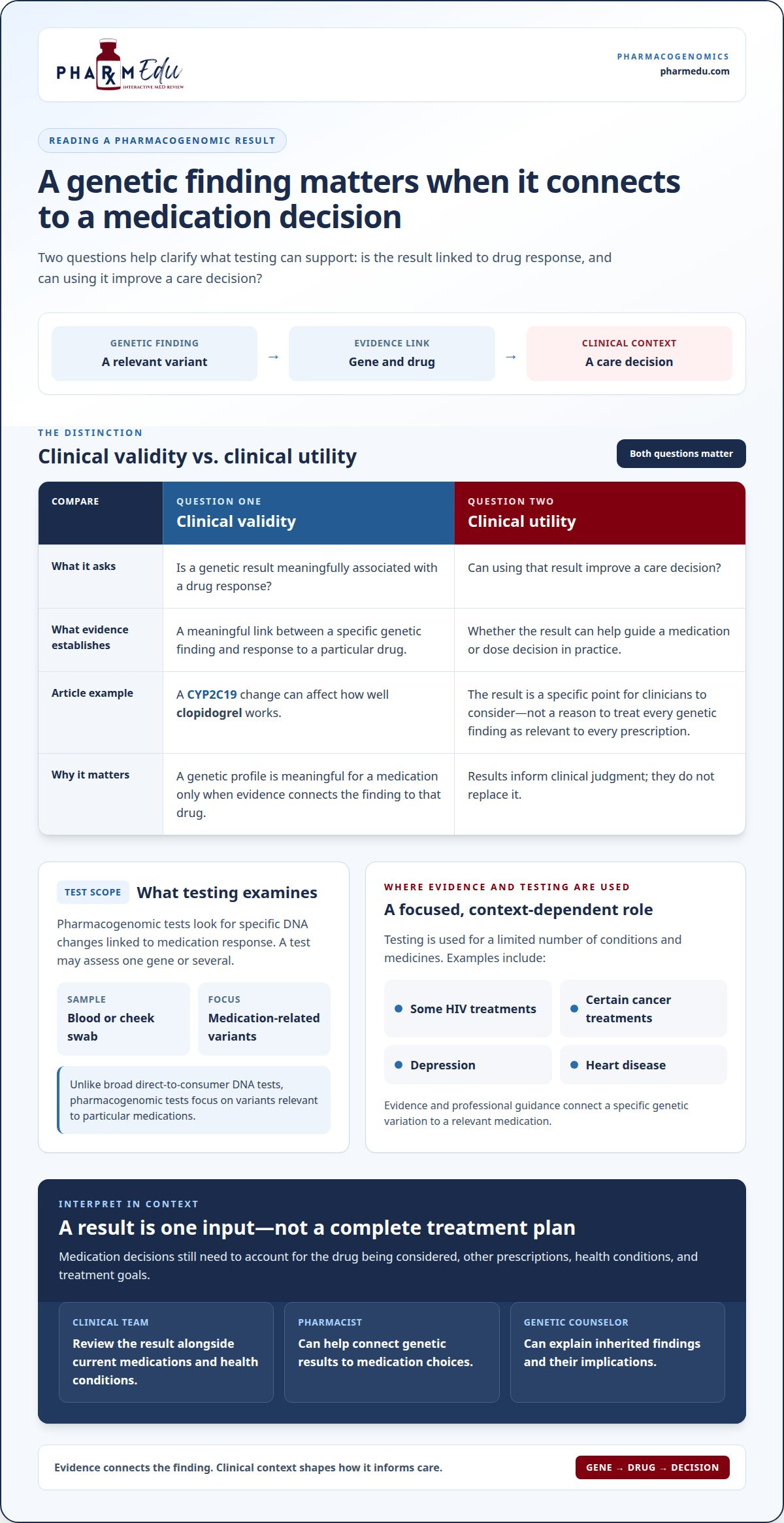
Clinical validity describes whether a genetic result is meaningfully associated with a drug response; clinical utility asks whether using that result can improve a care decision. These distinctions help clinicians assess what a pharmacogenomic test can support. Testing is used for a limited number of conditions and medicines, including some treatments for HIV, certain cancers, depression, and heart disease. Evidence and professional guidance help connect a specific genetic variation to a relevant medication.
Clinical resources can also clarify how a result should inform care. A profile that identifies a gene variant matters only when the evidence relates it to the drug under consideration. For example, a CYP2C19 change can affect clopidogrel’s effectiveness. That relationship gives clinicians a specific point to consider, rather than treating every genetic finding as relevant to every prescription.
Guiding Medication and Dose Decisions
Pharmacogenomic results can help a doctor select a medication or consider a dose by indicating how a patient may process a drug. The result informs, rather than replaces, clinical judgment: the medication, other prescriptions, health conditions, and treatment goals remain relevant. A CYP2D6 or CYP2C19 variant, for instance, may affect how quickly certain antidepressants are broken down, which can inform medication planning in clinical practices like New Age Psychiatry that specialize in psychiatric diagnosis and medication management.
To put testing into practice, a care team needs a clear process for moving from test results to prescribing decisions. A pharmacist can help interpret medication implications, while decision-support tools can flag relevant results during prescribing. In Veterans Affairs clinics, teams can apply the same principle by defining how results are reviewed, documented, and considered alongside a patient’s current medications.
Clinical case studies help healthcare learners practice interpreting gene-drug relationships and applying evidence to medication decisions.
Definition of pharmacogenomics and precision medicine
Pharmacogenomics examines how genetic differences influence a person’s response to medication. It connects genomics with medication decisions by exploring how specific genes relate to particular drugs. A beginner’s guide to pharmacogenomics should start with a practical question: could a genetic difference help explain whether a medicine works as expected? This focus distinguishes pharmacogenomics from broader genetic analysis, which may examine traits unrelated to medication response.
Genes provide instructions to cells and help build proteins, including enzymes that break down medications. If the body processes a drug too quickly, too slowly, or not at all, a typical dose may have little effect or cause significant side effects. This helps explain why dosing recommendations based on population-level evidence may need to take a relevant genetic result into account.
Pharmacogenomics is one part of precision medicine, which personalizes treatment using information about genes, environment, and lifestyle. A genetic result is one input, not a complete treatment plan. For anyone learning pharmacogenomics, this distinction matters: a medication recommendation must also fit the condition being treated, a person’s health, and other factors that influence how a drug is processed.
Trastuzumab illustrates how biological information can guide treatment: it works for people with HER2-positive breast cancer. This example concerns a tumor characteristic, while pharmacogenomics more specifically studies gene-related differences in medication response. Researchers are also studying pharmacogenomics in clinical trials. Potential future applications include tailored drugs for cardiovascular disease, Alzheimer’s disease, cancer, and asthma.
The key distinction is that precision medicine combines relevant patient information, while pharmacogenomics focuses on gene-drug relationships. Evidence linking a genetic variant to a specific medication helps determine whether it can inform a recommendation or dosing. As research develops, clinical use depends on establishing that connection for each drug and relevant genetic finding, rather than assuming one genetic profile predicts every response.
Patient and healthcare professional education
Education helps patients understand what a pharmacogenomic result can and cannot tell them. A clear explanation links three things: the genetic finding, the medication it concerns, and the possible treatment implication. Patients can then discuss how the information fits their health history and current therapy, rather than treating a test result as a medication instruction on its own.
Healthcare professionals also need a practical understanding of these connections. A useful learning sequence starts with gene-drug relationships, moves to interpreting test results, and then considers how findings inform clinical decisions. For example, when reviewing an oncology therapy, a clinician needs to distinguish a result relevant to that specific drug from unrelated genetic information. Pharmacists and genetic counselors can support communication by explaining medication implications and inherited findings.
Structured education can help professionals assess when testing may be relevant. Learning activities can cover how to identify potential candidates, interpret pharmacogenomic information in a drug label, and understand what a laboratory test examines. These topics connect evidence with practice: a result matters most when it relates to a medication decision and can be interpreted in the patient’s clinical context.
Patients benefit from conversations that use plain language and practical steps. A care team can explain what a test examines, what a result may mean for a specific medication, and how other health factors can influence treatment. This approach also helps patients ask focused questions about their therapy. In oncology, for instance, education can clarify how a test-related recommendation fits into the broader treatment plan.
Continuing education keeps pharmacogenomics knowledge connected to evolving evidence. Case-based learning lets healthcare professionals apply concepts to patient scenarios, while focused lessons build understanding of testing and clinical interpretation. The practical takeaway is to make education part of implementation: patients need clear explanations, and care teams need the skills to interpret findings consistently.
PharmEDU
PharmEDU helps healthcare students and professionals build pharmacology knowledge that supports understanding topics such as gene-related medication response. Its curriculum covers over 100 topics through High-Yield Video Vignettes, interactive flashcards, quizzes, and case studies. These structured learning materials can help learners revisit core concepts and connect pharmacology principles with clinical examples.
For learners seeking an ongoing review resource, PharmEDU offers monthly and annual subscriptions. Institutions can use an Institutional Platform License for educational access. Choose the format that fits your learning or teaching needs, whether you’re strengthening foundational pharmacology or reviewing medication concepts for coursework and exams.
For questions about PharmEDU, contact the team.
Build Your Next Step in Pharmacology
A useful next step is to turn introductory knowledge into a regular study practice. If you’re exploring pharmacogenomics, continue building the pharmacology foundation needed to understand gene-drug relationships and evolving clinical evidence. PharmEDU supports this learning with its monthly and annual subscriptions and Institutional Platform License.
Choose an approach that fits your learning or teaching needs, then use structured study to build your understanding over time. This educational foundation can help healthcare students and professionals approach complex medication topics with greater clarity, while keeping clinical decisions grounded in appropriate evidence and professional judgment.
If you’d like to learn more about the available learning options, contact PharmEDU. Keep building your knowledge one clear concept at a time.
Frequently Asked Questions
How do genes affect how medications work?
Genes can influence drug metabolism, transport, or the way a medication interacts with its target. These differences may affect how much active medicine reaches the body’s tissues or how long it remains there. For example, a genetic variant may influence whether a medicine is broken down quickly or slowly. The effect depends on the specific gene and medication, not simply on the presence of a genetic difference.
What guidelines exist to support pharmacogenomic prescribing?
Pharmacogenomic prescribing guidance links evidence about a specific gene-drug pair to practical recommendations for medication selection or dosing. Clinicians can use this guidance alongside relevant drug-label information and the patient’s clinical circumstances. Recommendations should apply only when they relate to the medication being considered. A result concerning one drug should not guide an unrelated prescription.
What is pharmacogenomics?
Pharmacogenomics studies how genetic differences can influence responses to medications. It focuses on relationships between genetic variants and drug effects, rather than using DNA to describe every aspect of a person’s health. For example, it may examine whether a variant affects how the body handles a particular medicine. This field contributes genetic information to precision medicine, which also considers other individual factors.
What is pharmacogenomics and how does it work?
Pharmacogenomics links genetic information to medication response through a sequence of interpretation: identify a relevant genetic variant, determine whether evidence connects it to a drug, then consider that relationship in treatment planning. A test result alone does not prescribe a medicine. Its usefulness depends on whether the finding applies to the medication and clinical question at hand, and how it fits with other patient information.
How can genes affect medication response and side effects?
Some genetic differences can affect both a medicine’s effectiveness and the likelihood of harmful reactions. For example, a variation in HLA-B can cause a severe skin reaction to abacavir. CYP3A5 variation may increase organ transplant rejection risk for people taking tacrolimus after transplantation. These examples show why gene-drug relationships matter, while also illustrating that each finding applies to particular medicines and circumstances.
Which genes and medications are commonly included in pharmacogenomic testing?
Tests may examine one gene or several, depending on the clinical question. Examples of studied gene-drug pairs include HLA-B and abacavir, CYP3A5 and tacrolimus, and UGT1A1 and irinotecan. These relationships concern different treatment settings, including HIV treatment, transplant medicine, and cancer care. A test’s contents therefore vary with the genes and medications relevant to its intended use.