How to Choose a Pharmacology Study Guide: The 2026 Selection Framework
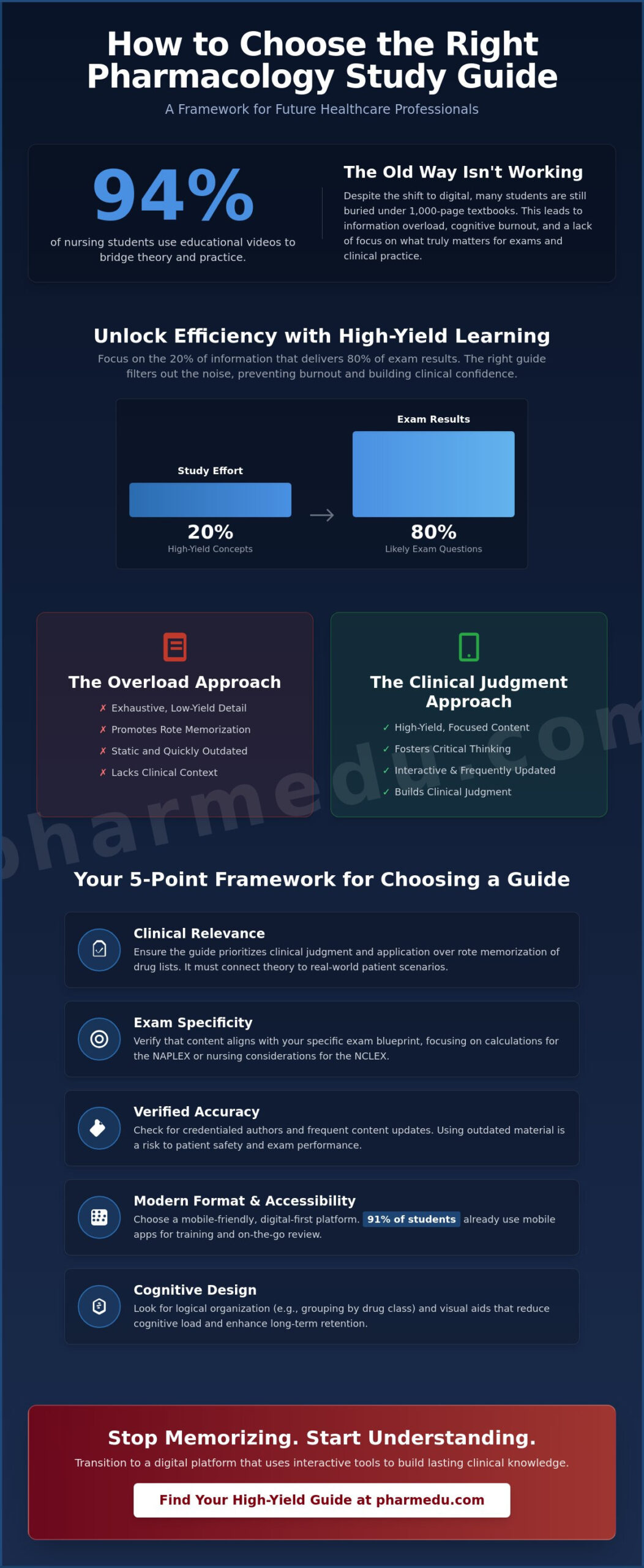
Did you know that 94% of nursing students now utilize educational videos to bridge the gap between theory and practice? Despite this massive shift toward digital learning, many students still feel buried under 1,000-page textbooks that prioritize exhaustive detail over clinical application. It’s a common frustration to spend hours studying drug classes only to feel unprepared for the critical thinking required by the latest board exams. Understanding how to choose a pharmacology study guide is essential when the 2026 NCLEX updates and the rise of complex new drug classes, such as SGLT-2 inhibitors, have already added to your academic load.
In this article, you’ll learn exactly how to evaluate materials to find a guide that cuts through the noise and matches your specific learning style. We’ll provide a structured framework to assess resources based on high-yield content and their ability to foster clinical judgment. You’ll discover how to move beyond rote memorization to achieve the long-term retention needed for the NAPLEX, NCLEX, or USMLE. By the end of this discussion, you’ll have a clear plan to select tools that build your confidence and streamline your path to professional licensure.
Key Takeaways
- Understand the critical link between high-yield study materials and the prevention of cognitive burnout during intensive board preparation.
- Master a structured framework for how to choose a pharmacology study guide that prioritizes clinical judgment over rote memorization of drug lists.
- Align your resources with specific exam blueprints, focusing on calculations for the NAPLEX or nursing considerations for the NCLEX.
- Ensure patient safety and exam accuracy by verifying the professional credentials of authors and the update frequency of clinical monographs.
- Explore the advantages of transitioning to digital platforms that utilize interactive quizzes and video vignettes for improved long-term retention.
Why Your Choice of Pharmacology Study Guide Matters
Success in a healthcare career hinges on a deep understanding of drug interactions, mechanisms, and patient safety. While a comprehensive overview of pharmacology provides the necessary scientific background, translating that massive volume of data into clinical practice requires a specialized approach. Many students fall into the trap of “low-yield” studying, where they spend 80% of their time memorizing obscure details that rarely appear on licensure exams. This inefficiency doesn’t just waste time; it leads to cognitive burnout and a dangerous lack of confidence when facing real-world clinical scenarios. Understanding how to choose a pharmacology study guide is the first step toward reclaiming your mental energy and ensuring your preparation aligns with professional standards.
The concept of “high-yield” learning is central to effective board preparation. It refers to the strategic focus on the 20% of information that yields 80% of exam points. The right guide acts as a bridge, taking you from abstract classroom theory to the practical application required at the bedside. By prioritizing the most frequently tested and clinically relevant concepts, you build a foundation that supports both your academic goals and your future responsibilities as a licensed professional.
The Problem with Traditional Textbooks
Textbooks are monumental works of scholarship, but they aren’t designed for the high-stakes environment of exam preparation. A 1,000-page volume is often counterproductive because it lacks the hierarchy of information needed for quick recall. Physical books also struggle to keep pace with rapid clinical updates, such as the 2026 NCLEX test plan refinements or the approval of new drug classes like GLP-1 receptor agonists. Unlike a specialized study guide, a textbook gives equal weight to every detail, making it difficult for you to distinguish between a rare side effect and a life-threatening contraindication.
Cognitive Load and Information Retention
Effective learning is about managing cognitive load. When you’re presented with a disorganized wall of text, your brain struggles to categorize and store information in long-term memory. A well-structured pharmacology study guide solves this by organizing drugs into logical classes rather than treating each agent as an isolated fact. This organizational strategy helps move information into long-term storage through several key methods:
- Grouping by mechanism of action: This allows you to predict the characteristics of an entire class of drugs, reducing the need for rote memorization.
- Visual hierarchies: Using charts and bolded text to highlight “must-know” nursing considerations and safety alerts.
- Clinical context: Integrating vignettes that force you to apply knowledge in a simulated patient scenario.
By prioritizing drug classes over individual agents, you develop the critical thinking skills needed to handle the “minor refinements” in the 2026 exam plans. This approach ensures you aren’t just memorizing names, but truly understanding how medications interact with the human body.
Key Criteria: Assessing Format, Depth, and Interactivity
Selecting the right tool requires more than just looking at a price tag or a cover design. When you evaluate how to choose a pharmacology study guide, you must look for a balance between scientific depth and practical usability. A high-quality guide shouldn’t just list drugs; it needs to explain the “why” behind the “what.” This means ensuring the content covers essential pharmacokinetics (how the body handles the drug) and pharmacodynamics (how the drug affects the body), while always rooting these concepts in clinical applications. Without this depth, you’re merely memorizing names without understanding the physiological impact. You can explore various pharmacology education resources to see how different publishers balance these scientific pillars.
Accessibility is another non-negotiable factor for the modern student. Research from 2024 indicates that 91% of nursing students already use mobile apps for their training, highlighting a massive shift toward on-the-go learning. Your chosen guide should be mobile-compliant, allowing you to review critical drug monographs during a short commute or between clinical shifts. Relying on a resource that tethers you to a desk is no longer practical in a fast-paced academic environment. If your study material isn’t available where you are, it isn’t serving your needs.
Digital Platforms vs. Traditional Workbooks
The choice between physical and digital formats often comes down to efficiency. While some prefer the tactile feel of a workbook, a comprehensive pharmacy review in a digital format offers advantages that paper simply cannot match. Searchability allows you to find specific contraindications in seconds. Hyperlinking connects related drug classes instantly, creating a web of knowledge rather than a linear list. Digital platforms also excel at explaining complex mechanism-of-action (MOA) topics through high-yield video vignettes, which are often more effective than static diagrams for visual learners who need to see the “pathway” of a drug in motion.
The Importance of Active Recall Tools
Passive reading is the enemy of retention. A study guide without practice questions or self-assessment tools is incomplete. To truly master the material, you need active recall mechanisms like interactive pharmacology flashcards and clinical case studies. These tools force your brain to retrieve information, which strengthens neural pathways and ensures long-term memory. Micro-learning segments, such as five-minute quizzes, are particularly effective for preventing study fatigue and keeping engagement high. If you want to test your readiness in real-time, our pharmacology practice quizzes provide immediate feedback to help you identify and close your knowledge gaps before exam day.
Matching Your Guide to Specific Board Exam Requirements
While the fundamental science of how drugs interact with biological systems remains constant, the way this knowledge is tested varies significantly across healthcare disciplines. A common mistake students make is selecting a generic resource that fails to align with their specific exam blueprint. When you’re determining how to choose a pharmacology study guide, your first step must be an analysis of your target exam’s priorities. A “one-size-fits-all” approach often leaves nursing students overwhelmed with molecular structures they don’t need, while leaving pharmacy students underprepared for the rigorous calculations and compounding safety standards required for licensure.
The National Council of State Boards of Nursing (NCSBN) recently refined the NCLEX test plan for 2026, continuing a heavy emphasis on clinical judgment. This differs sharply from the NAPLEX, which focuses on therapeutic outcomes, drug-drug interactions, and legal compliance. Meanwhile, the USMLE demands a deep understanding of pathophysiology and the molecular mechanisms that drive pharmacological intervention. Without a guide tailored to these specific expectations, you risk spending valuable study hours on “low-yield” information that won’t help you earn your credentials.
Pharmacology for Nursing Students
For those at the bedside, pharmacology isn’t just about theory; it’s about the “Rights of Medication Administration” and immediate patient safety. An effective pharmacology study guide for nursing students must prioritize nursing considerations, patient teaching, and “high-alert” medication flags. You need to know which side effects require immediate intervention and which are expected. In the context of the 2026 NCLEX updates, your study materials should feature safety pearls that help you navigate complex clinical judgment scenarios where multiple answers might seem correct but only one ensures the best patient outcome.
Advanced Review for Pharmacy and Medical Students
Pharmacy and medical students require a much higher level of granularity regarding pharmacokinetics and therapeutic management. If you’re looking for a naplex prep course or a USMLE review, ensure the content includes clinical case studies that mirror real-world practice. These guides should provide deep dives into specific drug classes, such as ACE inhibitors, covering everything from their biochemical pathway to complex pharmacotherapy scenarios involving multi-drug regimens. For these professions, the ability to catch a subtle drug interaction or calculate a precise pediatric dose is the difference between professional success and a critical clinical error. Look for resources that challenge your ability to synthesize data rather than just recall facts.
How to Verify the Clinical Accuracy of Study Materials
Clinical accuracy is the non-negotiable foundation of any medical resource. In a field where a misplaced decimal point or an overlooked contraindication can have fatal consequences, you cannot afford to rely on unverified data. When you evaluate how to choose a pharmacology study guide, you must look beyond the aesthetic of the layout and scrutinize the underlying evidence. High-quality materials don’t just present facts; they cite current clinical guidelines from authoritative bodies such as the American Heart Association (AHA) or the American Diabetes Association (ADA). If a guide fails to reference these standards, it likely lacks the precision required for safe clinical practice.
The danger of using outdated “cheat sheets” or aesthetic study bundles from social media platforms cannot be overstated. While a five-dollar digital download might look organized, these resources are often produced by generic content creators rather than healthcare professionals. They frequently miss critical updates, such as the April 1, 2026, NCLEX test plan refinements or recent black box warnings issued by the FDA. Relying on these unverified sources doesn’t just put your exam score at risk; it undermines the clinical judgment you’ll need as a licensed provider.
Evaluating Content Creators
Expertise matters. You should prioritize platforms founded by licensed pharmacists, medical educators, or clinicians who understand the nuances of pharmacotherapy. One hallmark of credibility is the presence of an institutional platform license, which indicates that schools and hospitals trust the content for their own students and staff. Expert-led video vignettes offer a layer of reliability that anonymous text cannot match, as they provide context and professional insight into how a drug is actually used in a hospital setting. To ensure your knowledge is based on the most current clinical standards, explore our PharmEDU Annual Subscription for peer-reviewed, expert-led content.
The 2026 Update Checklist
The pharmacological landscape moves fast. For your 2026 preparation, your study guide must include the latest FDA-approved agents, particularly in rapidly evolving classes like GLP-1 receptor agonists and SGLT-2 inhibitors. Use this checklist to spot red flags in outdated resources:
- Last Revision Date: If the drug monographs haven’t been updated since 2024, the guide is obsolete.
- Black Box Warnings: Ensure the guide includes the most recent safety alerts for high-alert medications.
- Exam Alignment: The material must reflect the 2026 NCLEX or NAPLEX blueprints, which now place a heavier emphasis on clinical judgment over simple recall.
- Guideline Sync: Check if the hypertension or heart failure sections align with the latest multi-society consensus statements.
A reliable guide will be transparent about its editorial process. If you can’t find information about who wrote the content or when it was last reviewed, it’s best to look elsewhere. Your professional reputation begins with the quality of the tools you use to build your knowledge base.
Beyond the Page: Why Digital Platforms are the Future of Pharm Education
The transition from traditional paper-based resources to interactive digital ecosystems represents a fundamental shift in how healthcare students master complex information. While physical books provide a sense of permanence, they cannot offer the dynamic, data-driven feedback required for high-stakes exam preparation. When you’re deciding how to choose a pharmacology study guide, you must look for a platform that moves beyond passive reading. Active learning, facilitated by real-time analytics and performance tracking, allows you to identify specific knowledge gaps before they become critical errors on an exam or in clinical practice. This modern approach ensures you aren’t just covering the material; you’re mastering it.
Digital guides offer a level of precision that static pages lack. Performance analytics can show you exactly which drug classes, such as anticoagulants or anti-infectives, require more focus. This level of insight transforms your study sessions from a guessing game into a targeted, efficient process. By using digital tools, you transition from a student mindset to that of a lifelong professional learner who values accuracy and efficiency. This evolution is vital in a field where drug monographs and clinical guidelines are updated with increasing frequency.
The PharmEDU Advantage
Our platform is designed to support this active learning model through a structured curriculum of over 100 topics delivered in micro-learning segments. We understand that clinical rotations and heavy course loads leave little time for exhaustive reading. That’s why we’ve integrated High-Yield Video Vignettes and Interactive Pharmacology Flashcards into our system. These tools accelerate retention by focusing on the “must-know” facts and mechanisms. Because the platform is mobile-compliant, you can review Clinical Case Studies or take Pharmacology Practice Quizzes during a commute or a break in your shift, ensuring your preparation never stops.
Starting Your Success Journey
Your final decision should prioritize a guide that evolves alongside the science of drugs. Pharmacology isn’t a static discipline; your study materials shouldn’t be either. By selecting a platform that integrates clinical judgment, active recall, and the latest scientific updates, you’re investing in more than just a passing grade. You’re building the professional foundation required for a safe and successful career in healthcare. Start your preparation with a tool that matches the rigor of your future profession.
Elevate Your Pharmacology Mastery for 2026 and Beyond
Mastering the science of drugs requires more than just access to information; it demands a strategic approach to learning that aligns with modern clinical standards. The most effective preparation involves selecting resources that prioritize high-yield content, verify clinical accuracy through expert authorship, and utilize active recall tools. Mastering how to choose a pharmacology study guide ensures you spend your time on the 20% of information that drives 80% of your exam success and patient safety outcomes. By moving away from passive reading and embracing interactive, data-driven platforms, you build the clinical judgment necessary for professional licensure.
PharmEDU acts as your expert advisor in this journey, providing a comprehensive digital ecosystem tailored to the needs of modern healthcare students. With over 100 high-yield topics, expert-led video vignettes, interactive flashcards, and clinical case studies, we take the stress out of exam prep so you can focus on professional growth. Don’t leave your board exam readiness to chance. Master Pharmacology with PharmEDU: Start Your Subscription Today and join a community of professionals dedicated to scientific precision and excellence. Your path to becoming a confident, safe, and effective provider starts with the right tools. We’re here to support your success every step of the way.
Frequently Asked Questions
What is the best pharmacology study guide for nursing students?
The most effective guide for nursing students is one that prioritizes clinical judgment and patient safety over raw biochemical data. It should emphasize nursing considerations, “high-alert” medication flags, and the specific patient teaching points required for the NCLEX. Look for resources that organize information by drug class to help you predict side effects and therapeutic outcomes in a clinical setting.
Should I buy a physical pharmacology workbook or a digital subscription?
Digital subscriptions generally offer superior value because they provide real-time updates for new drug approvals and clinical guideline changes. While workbooks offer a tactile experience, digital platforms allow for searchability, interactive quizzes, and high-yield video vignettes that accommodate various learning styles. Digital tools also ensure you aren’t studying from a resource that became obsolete the moment it was printed.
How do I know if a pharmacology study guide is high-yield?
You can identify a high-yield resource by its focus on the most frequently tested clinical scenarios and drug classes. When researching how to choose a pharmacology study guide, look for materials that apply the 80/20 rule, focusing on the core 20% of information that accounts for 80% of exam points. A high-yield guide avoids “low-yield” minutiae that distracts from essential safety and efficacy data.
Are free pharmacology study guides reliable for board exams?
Free guides often lack the rigorous peer-review process required to ensure clinical accuracy and safety. They frequently fail to reflect the latest updates, such as the 2026 NCLEX test plan refinements or the newest FDA black box warnings. Relying on unverified or outdated “cheat sheets” from social media can lead to significant knowledge gaps that jeopardize your exam performance and professional reputation.
How often should a pharmacology study guide be updated?
A reliable study guide must be updated at least annually to remain clinically relevant. The pharmaceutical landscape changes rapidly with new FDA approvals, such as recent advancements in GLP-1 receptor agonists. Digital platforms have a distinct advantage in this area, as they can integrate these updates and new safety alerts immediately, whereas physical books may remain outdated for several years between editions.
Can I use the same study guide for both NCLEX and NAPLEX?
Using the same guide for both exams is typically ineffective because their blueprints prioritize different competencies. The NCLEX focuses on nursing interventions, patient safety, and bedside care, while the NAPLEX requires a much deeper understanding of pharmacotherapy, drug-drug interactions, and complex calculations. You should select a guide specifically tailored to the professional requirements and testing style of your target license.
What features should I look for in a pharmacology mobile app?
A high-quality mobile app should offer offline accessibility, interactive flashcards, and a robust search function for quick reference. Understanding how to choose a pharmacology study guide in a digital format means looking for micro-learning segments that allow you to study during clinical rotations. Progress tracking and performance analytics are also essential features that help you identify and close your specific knowledge gaps.
How do clinical case studies help in learning pharmacology?
Clinical case studies help by forcing you to apply theoretical knowledge to simulated patient scenarios, which builds critical thinking skills. They move beyond rote memorization by requiring you to synthesize information about drug mechanisms, contraindications, and patient history to make a safe clinical decision. This method mirrors the “Next Generation” exam formats that prioritize clinical judgment over simple factual recall.