

Loading Dose vs Maintenance Dose: Purpose and Calculation
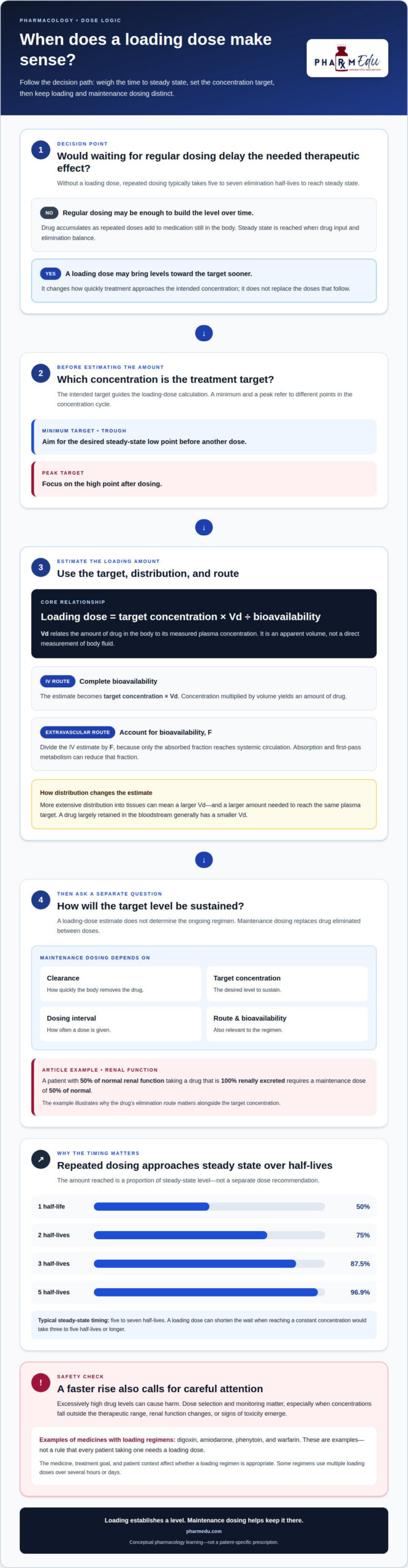
A larger dose does not necessarily maintain treatment. The key difference in loading dose vs maintenance dose is timing: a loading dose raises drug levels toward the therapeutic range sooner, while a maintenance dose sustains them over time. Without a loading dose, repeated dosing typically takes five to seven elimination half-lives to reach steady state.
That delay matters when a drug takes a long time to build up and a therapeutic effect is needed sooner. But a loading dose is not simply an extra amount added to a regimen: its size depends on how the drug distributes through the body, as well as the target concentration and other pharmacokinetic factors.
This article explains what a loading dose does, how volume of distribution informs its calculation, and how maintenance dosing works differently. It also explains how half-life affects the timing and relationship between the two doses, and why loading doses require careful attention to avoid excessively high drug levels. The goal is to clarify these concepts for pharmacology learning, not to provide a dose for an individual patient.
Key Takeaways
- Understand how an initial dose can bring drug levels toward the therapeutic range sooner when waiting for regular dosing would take too long.
- See how volume of distribution helps determine the amount needed to reach a target concentration.
- Distinguish the initial dose’s role from the ongoing dose that sustains drug levels, and learn how half-life shapes their relationship.
- Use PharmEDU’s pharmacology learning resources to reinforce these concepts through focused review.
What is a loading dose?
A loading dose is an initial amount intended to bring drug levels into the therapeutic range sooner. Its target may be a steady-state minimum concentration or a steady-state peak concentration.
Drug Accumulation and Half-Life
Drug accumulation occurs when repeated doses add to medication that remains in the body; steady state is reached when drug input and elimination balance. This matters because the half-life helps estimate how long that balance takes: repeated dosing reaches 50% of steady-state level after one half-life and 75% after two.
By five half-lives, the level reaches 96.9% of steady state; drugs typically take five to seven half-lives to reach it. A loading dose can shorten the wait when reaching a constant concentration would take 3-5 half-lives or longer.
Medications That Require Loading Doses
Loading regimens may be used for medicines such as digoxin, amiodarone, phenytoin, and warfarin. These are examples, not a rule that every patient taking one of these medicines needs an initial loading dose. The medicine, treatment goal, and patient context all affect whether a loading regimen is appropriate.
Some medications also use multiple loading doses over several hours or days to approach the desired concentration. Loading doses carry a toxicity risk, so dose selection and monitoring matter: excessive drug levels can cause harm. Adverse effects vary by medication, so there is no single side-effect list that applies to every loading dose.
For a minimum-concentration target, the loading amount is designed to bring the drug level up to the desired steady-state trough, the low point before another dose. A peak-based target instead focuses on the high point after dosing. These targets refer to different points in the concentration cycle, so the intended therapeutic level guides the loading-dose calculation.
Steady-state plasma concentrations rise with repeated doses until elimination balances the amount entering the body. For example, after three half-lives, repeated administration reaches 87.5% of steady-state level. A loading dose changes how quickly treatment approaches its target; it does not remove the need to consider subsequent dosing and the risk of concentrations becoming too high.
Loading dose calculation using volume of distribution
A loading-dose calculation estimates the amount needed to reach a target plasma concentration. The central relationship is: loading dose = target concentration × volume of distribution ÷ bioavailability. Volume of distribution (Vd) relates the amount of drug in the body to its measured plasma concentration.
Vd is an apparent volume, not a direct measurement of body fluid. A drug that distributes extensively into tissues can have a larger Vd, requiring a larger amount to reach the same plasma target. A drug largely retained in the bloodstream generally has a smaller Vd. Both the chosen target concentration and the drug’s distribution shape the result.
For an intravenous dose, the drug enters systemic circulation directly, so the calculation uses complete bioavailability. The equation becomes target concentration multiplied by Vd. Units must align: concentration multiplied by volume yields an amount of drug. This is a conceptual estimate, not a patient-specific prescription.
An extravascular dose, such as an oral dose, must account for bioavailability, represented by F. The equation divides the IV estimate by F because only the absorbed fraction reaches systemic circulation. Absorption and first-pass metabolism can reduce that fraction. As a result, the administered amount may need to be greater than the equivalent IV amount to reach the same target.
In practice, the calculation depends on selecting a clinically appropriate target and a relevant Vd for the drug and dosing context. Salt forms, route, formulation, and patient characteristics can affect how the calculation is applied. A loading-dose estimate also does not determine the ongoing regimen: maintenance dosing is calculated around drug elimination and the desired concentration over time. Keeping these calculations distinct clarifies what each dose is intended to achieve, without treating the loading amount as a repeated dose.
Loading-dose purpose and therapeutic concentration
A loading dose is used when waiting for regular dosing to build drug levels would delay a needed therapeutic effect. Its purpose is to move the concentration toward the intended treatment range sooner, not to replace the doses that follow. The target may be a minimum concentration or a peak, depending on the drug’s therapeutic window and dosing plan.
A maintenance dose serves a different purpose: it replaces the drug eliminated between doses and sustains the desired concentration. Clinicians calculate it using drug clearance, the target concentration, and the dosing interval; route and bioavailability also matter. Clearance describes how quickly the body removes a drug, while the interval determines how often a dose is given. The loading dose establishes a level; maintenance dosing helps keep it there.
Body weight, age, and kidney function can affect dose selection because they may change drug distribution or elimination. Kidney function is especially relevant for drugs cleared through the kidneys. For example, a patient with 50% of normal renal function taking a drug that is 100% renally excreted requires a maintenance dose of 50% of normal. This illustrates why the drug’s elimination route matters alongside the target concentration.
Doses may need adjustment or monitoring when renal function changes, measured concentrations fall outside the therapeutic range, or signs of toxicity emerge. The therapeutic index, half-life, and dosing convenience affect how easily concentrations stay within the therapeutic window. A narrow therapeutic index leaves less room between effective and harmful concentrations, making careful concentration monitoring more important. Changes in elimination can alter maintenance needs, while changes in distribution can affect the loading amount. These are separate considerations, even when both doses are reviewed together.
Loading dose versus maintenance dose
The difference is the job each dose performs: a loading dose raises drug concentration toward a target, while a maintenance dose sustains it. They are not interchangeable amounts. The loading dose is usually larger, but its size depends on the target concentration and drug distribution. Maintenance dosing instead reflects how quickly the drug is eliminated and how often doses are given.
Their relationship also depends on dosing interval and half-life. When the interval equals the drug’s half-life, the loading-dose-to-maintenance-dose ratio is 2.0. If the interval is shorter than the half-life, the ratio is greater than 2.0; if longer, it is less than 2.0. These relationships explain why a loading dose can’t be estimated simply by doubling the maintenance dose.
For a practical contrast, an adult oral digoxin regimen for rapid digitilisation in secondary care lists a loading dose of 0.75-1.5 mg over 24 hours in divided doses. Its listed maintenance dose is 62.5-250 micrograms daily, with a usual maximum of 125 micrograms daily. The units and schedules differ because the initial regimen aims to build concentration, while subsequent dosing sustains it. These listed amounts describe a specific regimen, not a universal dosing instruction.
Some medicines use more than one loading dose, administered over several hours or days, rather than one large amount. For a very long half-life drug requiring a very large loading dose, dividing it over 24-36 hours may reduce risks from high localized concentrations and toxicity. This makes the distinction clinically important: the initial amount, its timing, and the ongoing schedule each affect exposure.
The takeaway is simple: a loading dose addresses how quickly a target level is reached; a maintenance dose addresses how it is sustained. Both require attention to the drug’s therapeutic window, elimination, and dosing interval. Loading doses need particular caution because they increase the likelihood of drug toxicity.
PharmEDU
After reviewing how loading and maintenance doses serve different purposes, continue your pharmacology learning with PharmEDU. Use its High-Yield Video Vignettes to reinforce key concepts, or explore the PharmEDU Monthly Subscription and PharmEDU Annual Subscription for structured study.
These learning resources can help healthcare students and professionals revisit pharmacokinetic principles, connect them with clinical examples, and strengthen preparation for coursework or licensing exams. They are useful for building on a concept review through focused, ongoing pharmacology study.
Contact PharmEDU to learn more about its educational offerings.
Build confidence through continued pharmacology study
Sound pharmacology practice comes from connecting individual dose decisions to the principles behind them. Keep developing that understanding through case-based learning, focused review, and regular study. Revisiting the difference between a loading dose and a maintenance dose can make pharmacokinetic concepts more familiar in coursework and exam preparation.
PharmEDU offers the PharmEDU Monthly Subscription, PharmEDU Annual Subscription, and Institutional Platform License for individual and institutional learning. Choose the format that fits your study needs and use it to continue strengthening your pharmacology knowledge.
Contact PharmEDU for support with your next step in pharmacology learning. Keep building your knowledge with care and confidence.
Frequently Asked Questions
What is a loading dose in medication?
A loading dose is an initial dose used to bring a medication’s concentration toward a therapeutic target more quickly. The target may be a minimum level or a peak level, depending on the treatment plan. For a medication with a long half-life, ordinary repeated doses can take considerable time to build up, so an initial dose can help shorten that delay.
What is a maintenance dose?
A maintenance dose is the ongoing amount given to sustain the intended drug concentration after treatment begins. Its schedule reflects how quickly the body clears the medication and how frequently it needs to be administered. For drugs cleared through the kidneys, changes in renal function can affect the amount needed to maintain levels, making kidney function relevant to ongoing dose decisions.
What is the difference between a loading dose and a maintenance dose?
The difference is their role in treatment: the loading dose establishes drug exposure, while maintenance doses continue it. In loading dose vs maintenance dose comparisons, the initial amount is not simply a larger version of every later dose. The two amounts depend on different pharmacokinetic considerations, and a loading regimen may be divided rather than given all at once.
How do clinicians calculate a loading dose?
Clinicians estimate a loading dose by relating the target drug concentration to volume of distribution, which describes how extensively a drug distributes beyond plasma. For a medication taken by mouth, the calculation also accounts for bioavailability, the fraction that reaches systemic circulation. Route, formulation, and the selected target concentration therefore affect the estimated amount; the calculation is specific to the drug regimen.
How quickly does a loading dose work compared with a maintenance dose?
A loading dose can bring a medication toward its target concentration sooner than repeated maintenance dosing alone, but it doesn’t guarantee an immediate effect. Absorption and route influence how quickly drug levels rise. Without a loading dose, a drug with a 24-hour half-life can take 4-5 days to reach steady-state conditions; a drug with a one-week half-life can take over 4-5 weeks.
What are the risks and side effects of loading doses?
Loading doses can raise drug levels too high, increasing the risk of toxicity and harm. Specific side effects depend on the medication.