
How to Pass Pharmacology in Pharmacy School: The 2026 Student Guide
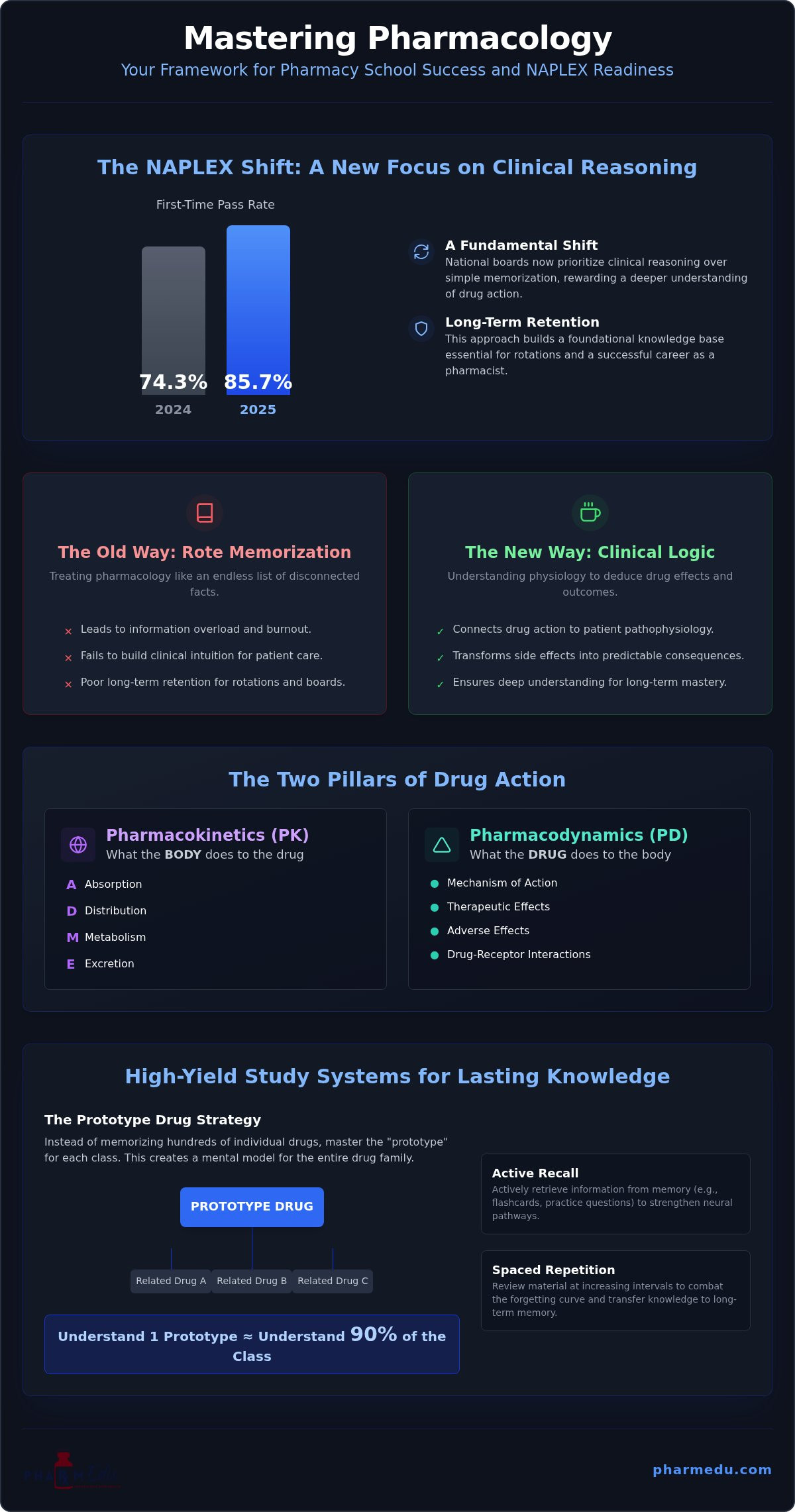
Did you know that the NAPLEX first-time pass rate climbed to 85.7% in 2025, a significant jump from the 74.3% mean seen just a year prior? This shift reflects a new era where national boards prioritize clinical reasoning over simple memorization. It’s no secret that pharmacology is the most daunting hurdle in the Pharm.D. curriculum. You’re likely staring at hundreds of drug classes, struggling to link a molecular mechanism to a real-world patient outcome while the pressure of the 2026 boards looms in the background.
This guide provides a structured framework on how to pass pharmacology in pharmacy school by shifting your focus from rote memorization to high-yield clinical logic. We will explore the exact study systems, visual tools, and reasoning frameworks you need to secure higher exam scores and ensure long-term retention for your future rotations. By the end of this guide, you’ll have a clear roadmap to master the most complex drug classes without the typical burnout associated with traditional pharmacy school study habits. Mastering these concepts isn’t just about passing a test; it’s about building the professional foundation you need for a successful career in healthcare.
Key Takeaways
- Shift your focus from rote memorization to clinical logic by understanding how physiological mechanisms dictate drug effects and patient outcomes.
- Learn how to pass pharmacology in pharmacy school by integrating active recall and spaced repetition into your daily routine to combat information overload.
- Implement a structured study framework that utilizes high-yield video vignettes for conceptual clarity before diving into complex drug monographs.
- Bridge the gap between classroom exams and board readiness by focusing on high-yield topics that align with the 2026 NAPLEX content outline.
- Master the critical distinctions between pharmacokinetics and pharmacodynamics to predict drug interactions and therapeutic responses with professional precision.
Understanding the Pharmacology Hurdle: Why It’s the “Make or Break” Course
Pharmacology is often the point where the academic intensity of pharmacy school truly hits home. It isn’t just another science class; it’s the bridge to your professional life. While pre-pharmacy courses focus on the “what,” this course demands you understand the “why.” You’re moving from basic science into clinical pharmacology, where every fact has a direct impact on a patient’s life. This is why it’s considered the foundation for both your future therapeutics courses and your clinical rotations.
The “Big Three” challenges, nomenclature, mechanisms, and side effects, often create a sense of panic for P1 and P2 students. Nomenclature involves mastering the linguistic patterns of drug names, while mechanisms require you to visualize molecular changes within the body. Side effects are often the most frustrating because they seem like endless lists. However, when you understand the underlying physiology, these effects become predictable consequences of drug action. This is the core strategy for how to pass pharmacology in pharmacy school: you must stop treating it as a memory exercise and start treating it as a logic puzzle.
The Volume of Information
Pharmacology is defined as the study of drug-receptor interactions. When you’re faced with the Top 300 drugs, it’s easy to feel like you’re drowning in data. Most students find that rote memorization fails by the second mid-term because the brain can’t sustain that much disconnected information. To succeed, you must break these drugs into manageable categories based on their class. For a comprehensive overview of pharmacology, you should focus on the prototype drug for each class. If you understand the prototype, you understand 90% of the other drugs in that category. This organizational shift is essential for learning how to pass pharmacology in pharmacy school without experiencing total burnout.
The Clinical Integration Challenge
The shift from “what does this drug do” to “how does this drug help the patient” is where clinical reasoning begins. You have to connect drug classes directly to pathophysiology. If you understand the disease state, the drug’s mechanism becomes intuitive. This approach allows you to predict drug-drug interactions based on shared pathways or competing receptors. It transforms your study sessions from a struggle against the clock into a process of building clinical logic. This mindset is what will carry you through your advanced pharmacy practice experiences (APPEs) and eventually the NAPLEX. Mastering this integration early ensures you aren’t just memorizing facts, but preparing to be a safe and effective pharmacist.
The Mechanism of Action: Moving Beyond Rote Memorization
Many students treat drug mechanisms like a foreign language that must be memorized syllable by syllable. This is the fastest route to academic exhaustion. To truly understand how to pass pharmacology in pharmacy school, you must shift your focus to the physiological logic of the human body. When you understand how a receptor normally functions, predicting what a drug will do when it binds to that receptor becomes intuitive. This approach allows you to deduce therapeutic effects and side effects rather than memorizing them from a static list. It transforms the subject from a burden of memory into a system of clinical reasoning.
Mastering PK and PD
Pharmacokinetics (PK) and Pharmacodynamics (PD) are the two pillars of drug action. PK describes what the body does to the drug, encompassing Absorption, Distribution, Metabolism, and Excretion (ADME). PD describes what the drug does to the body. Understanding these concepts simplifies the complexity of the Top 300 drugs. For instance, knowing a drug’s half-life tells you how often it must be dosed; understanding the Therapeutic Index indicates its margin of safety. If you grasp these foundational principles, you can predict potential toxicities and interactions with precision. Organizations like ASPET provide excellent pharmacology educational resources that help clarify these pillars for students seeking deeper conceptual mastery.
The Prototype Strategy
The most efficient way to study is the “Prototype Drug” method. Instead of studying thirty different drugs for hypertension, focus on one representative agent. For example, by mastering lisinopril, you gain a deep understanding of the entire class of ACE inhibitors. You’ll learn the class-wide effects, such as the potential for a dry cough or hyperkalemia, which apply to almost every drug ending in the suffix “pril.”
Once the class-wide characteristics are locked in, you only need to spend time on the unique “outliers” or specific features of certain drugs within that family. This strategy significantly reduces the volume of information you need to process. It’s a structured approach that emphasizes clinical logic over raw memory. If you find yourself struggling to organize these drug families, using high-yield video vignettes can provide the visual clarity needed to bridge the gap between theory and practice. This method is a cornerstone of how to pass pharmacology in pharmacy school while maintaining your mental well-being during the heavy second-year curriculum.
High-Yield Study Techniques: Visual Mnemonics vs. Active Recall
Success in pharmacology requires a balance between creative memory aids and rigorous scientific review. Visual mnemonics are popular because they turn abstract drug names into memorable characters, but they can become a time-intensive distraction if used in isolation. While these tools help with initial recognition, traditional pharmacology study guides provide the structural depth necessary for high-level clinical exams. The most effective strategy for how to pass pharmacology in pharmacy school involves integrating these visual hooks with active recall to ensure the information sticks when the pressure is on.
Implementing Active Recall
Active recall is the practice of challenging your brain to retrieve information without looking at your notes. It’s often uncomfortable because it exposes exactly what you don’t know. Instead of re-reading a chapter multiple times, you should take a practice quiz after the first pass. Testing yourself strengthens neural pathways by forcing the brain to reconstruct the information from scratch rather than simply recognizing it on a page. You can also use the Feynman Technique, which involves explaining a complex mechanism of action in simple terms as if you’re teaching a peer. If you can’t explain why a beta-blocker reduces heart rate without using jargon, you haven’t mastered the concept yet.
Spaced Repetition Systems (SRS)
Your brain naturally prunes information it doesn’t use frequently. Spaced repetition combats this forgetting curve by scheduling reviews at increasing intervals. Digital flashcards are the most efficient way to manage this process. The secret to how to pass pharmacology in pharmacy school using SRS is consistency over intensity. It’s better to review fifty cards every day than five hundred cards once a week. You must prioritize reviewing old material over learning new drugs. If you lose the foundation of the previous week’s autonomic nervous system drugs, you’ll struggle to understand the cardiovascular agents that follow. Managing your card deck prevents the backlog of doom and ensures that long-term retention becomes a predictable outcome rather than a lucky accident.
Transitioning from static lists to clinical case studies as soon as possible is also vital. Case studies force you to apply PK/PD principles to a specific patient scenario, which is exactly how the 2026 NAPLEX is structured. This application-based learning is superior to memorizing drug-side effect pairs because it mimics the real-world demands of a practicing pharmacist.
Building Your Pharmacology Study System: A Step-by-Step Framework
Having the right tools is only half the battle. Without a repeatable workflow, even the best resources won’t save you from the volume of information in your P2 year. The most effective answer for how to pass pharmacology in pharmacy school isn’t studying harder, but studying with a clinical system. This five-step framework ensures you move from initial exposure to long-term mastery without wasting hours on passive reading.
- Step 1: Prime the Topic. Spend ten minutes pre-reading the lecture slides. Don’t try to learn everything; simply identify the major drug classes and their general indications.
- Step 2: Visualize the Logic. Watch high-yield video vignettes before your lecture. Seeing the mechanism of action in a visual format provides a mental coat rack to hang the details on later.
- Step 3: Lock in the Prototypes. Review flashcards for nomenclature and prototype drugs. Focus on the suffixes and the primary receptors involved.
- Step 4: Clinical Application. Transition immediately to practice quizzes or case studies. Applying the knowledge to a patient scenario forces your brain to retrieve the information actively.
- Step 5: Combat the Forgetting Curve. Dedicate your Friday afternoon to reviewing material from earlier in the week. This prevents the “forgetting curve” from wiping out your progress before the weekend.
Daily vs. Weekly Habits
Consistency is the only defense against information overload. A 30-minute daily review rule is far more effective than a ten-hour weekend cram session. You should also allocate specific deep-work blocks for complex systems like the Autonomic Nervous System, which require intense focus to master the interplay of receptors. Balancing pharmacology with your other courses requires discipline. If you treat pharmacology as a daily habit rather than a weekly chore, the workload becomes manageable. To help maintain this discipline and track your academic progress across all your subjects, you can visit Orderly Learning for an AI-powered platform that integrates tutoring and study tools.
Modern students find that comprehensive pharmacy review platforms offer a significant advantage over traditional textbooks. Digital tools allow you to integrate micro-learning into your daily commute or breaks, turning dead time into productive review sessions. You can also collaborate with study groups using shared digital platforms to analyze complex clinical case studies. To streamline this process, you can access high-yield video vignettes and interactive flashcards designed to fit into a modern pharmacy student’s schedule. This structured roadmap on how to pass pharmacology in pharmacy school while maintaining a life outside the library is the key to professional success in 2026.
PharmEDU: Bridging the Gap Between Classroom Success and NAPLEX Mastery
Many students find that their school curriculum feels disconnected from the ultimate goal of board exam preparation. PharmEDU solves this by offering over 100 high-yield pharmacology topics that align with both your pharmacy school syllabus and the national board requirements. Instead of just learning how to pass pharmacology in pharmacy school, you are simultaneously building the foundation for your NAPLEX prep course. This dual-purpose approach ensures that every hour you spend studying for a mid-term is also an hour invested in your professional licensure.
The transition from a student to a practitioner requires more than just passing grades. It requires the ability to apply complex scientific concepts to diverse patient populations. PharmEDU’s high-yield video vignettes are designed by healthcare educators to bridge this gap. These segments focus on the clinical application of drug mechanisms, ensuring you’re ready for the clinical challenges you’ll face during your advanced pharmacy practice experiences (APPEs). This level of preparation is what separates a student who survives the curriculum from one who excels within it.
The PharmEDU Study Suite
The platform provides a cohesive set of tools designed for efficiency. You can test your knowledge immediately with interactive pharmacology flashcards and practice quizzes that provide instant feedback. This immediate correction is essential for refining your clinical logic. Our clinical case studies mirror real-world pharmacy practice, challenging you to integrate pharmacokinetics and pharmacodynamics into patient care plans. By using these tools, you can track your progress toward board certification readiness with measurable data, ensuring there are no surprises when you finally sit for the NAPLEX.
Preparing for the Future
A deep understanding of pharmacology is the most effective way to reduce board exam anxiety. When you master the logic behind drug actions, the national boards become a test of your reasoning rather than a test of your memory. This clinical excellence carries over to the first day of your rotations; preceptors immediately recognize students who can predict therapeutic outcomes based on drug mechanisms. You aren’t just memorizing lists; you’re developing the professional intuition required for a successful career. To begin mastering these concepts today and secure your academic future, consider starting a PharmEDU Monthly Subscription. This investment provides the structured support needed to learn how to pass pharmacology in pharmacy school while building the confidence of a future healthcare professional.
Securing Your Professional Future in Pharmacy
Mastering the “why” behind drug-receptor interactions is the most reliable way to navigate the heavy Pharm.D. workload. By shifting your focus from rote memorization to clinical logic, you’re not just learning how to pass pharmacology in pharmacy school; you’re building the foundation for your clinical rotations and the NAPLEX. Integrating active recall with a structured study system ensures that these complex mechanisms become intuitive rather than overwhelming. You have the dedication to succeed in this profession, and with the right framework, you’ll enter your rotations with confidence and precision.
Beyond mastering your current coursework, if you are considering further academic advancement or specialized graduate studies, you can visit Top Colleges for professional guidance on the admissions process.
PharmEDU provides a comprehensive pharmacology review designed by healthcare educators to ensure clinical excellence. Our high-yield video vignettes are tailored for busy students who need conceptual clarity without the fluff of traditional academic lectures. You can master pharmacology today with a PharmEDU Subscription and gain access to the tools you need for long-term retention and higher exam scores. Your journey toward becoming a safe, effective pharmacist starts with a commitment to deep, logical understanding. We’re here to support your growth every step of the way.
Frequently Asked Questions
What is the hardest part of pharmacology in pharmacy school?
The hardest part is the sheer volume of drugs combined with the requirement to integrate molecular mechanisms into clinical outcomes. Students often struggle to move beyond simple memorization of drug names to understanding how a drug’s pharmacodynamics affects a patient with multiple comorbidities. This cognitive shift from basic science to clinical application is the primary reason pharmacology is considered the most challenging course in the Pharm.D. curriculum.
How many hours a day should I study for pharmacology?
You should aim for one to two hours of focused study every day rather than long weekend cram sessions. Consistency is the most effective strategy for how to pass pharmacology in pharmacy school because it allows for spaced repetition. Daily review prevents the forgetting curve from resetting your progress. Short, intense sessions focused on active recall or practice quizzes are far more productive than three hours of passive reading.
Should I use visual mnemonics for every drug name?
No, you should reserve visual mnemonics for specific outliers or drug names that don’t follow standard naming conventions. For most medications, understanding the physiological logic of the drug class is more efficient than creating a separate mental image for every agent. Over-relying on mnemonics can lead to a cluttered memory where you remember the character but forget the actual clinical application or contraindications of the medication.
How do I remember the difference between similar-sounding drug names?
The most effective method is grouping medications by their chemical suffixes and therapeutic classes. Focusing on the stems of generic names, such as -olol for beta-blockers or -sartan for ARBs, helps you categorize drugs before you even see the specific prefix. Understanding the underlying mechanism of action ensures that even if two names sound similar, you can distinguish them by their unique clinical indications and side effect profiles.
What are high-yield pharmacology topics for the NAPLEX?
High-yield topics for the 2026 NAPLEX include cardiovascular agents, infectious disease treatments, oncology, and central nervous system medications. These categories represent a significant portion of the Person-Centered Assessment domain, which accounts for 40% of the exam. You should focus heavily on anticoagulants, antibiotics, and diabetes management, as these classes frequently appear in complex clinical case studies requiring precise dosing and drug interaction analysis.
Can I pass pharmacology without using flashcards?
You can pass without flashcards if you replace them with other forms of active recall, such as practice quizzes or the Feynman Technique. However, most students find that digital flashcards are the most efficient way to manage spaced repetition for nomenclature. If you choose not to use them, you must ensure you’re testing your retrieval of the information through clinical cases to strengthen your neural pathways effectively.
What is the prototype drug method and how does it work?
The prototype drug method involves mastering one representative medication from a drug class to understand the characteristics of all drugs in that category. For example, by learning everything about lisinopril, you inherently learn the mechanism, side effects, and monitoring parameters for most ACE inhibitors. This strategy is essential for how to pass pharmacology in pharmacy school because it reduces the total volume of information you must memorize.
How do I study for a pharmacology exam in one weekend?
If you must study in one weekend, prioritize prototype drugs and their primary mechanisms of action. Focus on the must-know side effects and major black box warnings rather than obscure details. Use high-yield video vignettes to gain conceptual clarity quickly, then move immediately to practice quizzes. While cramming isn’t ideal for long-term retention, focusing on the highest-yield logic of each drug class provides the best chance for a passing score.