
Therapeutic Index and Drug Safety: How Dose and Response Relate
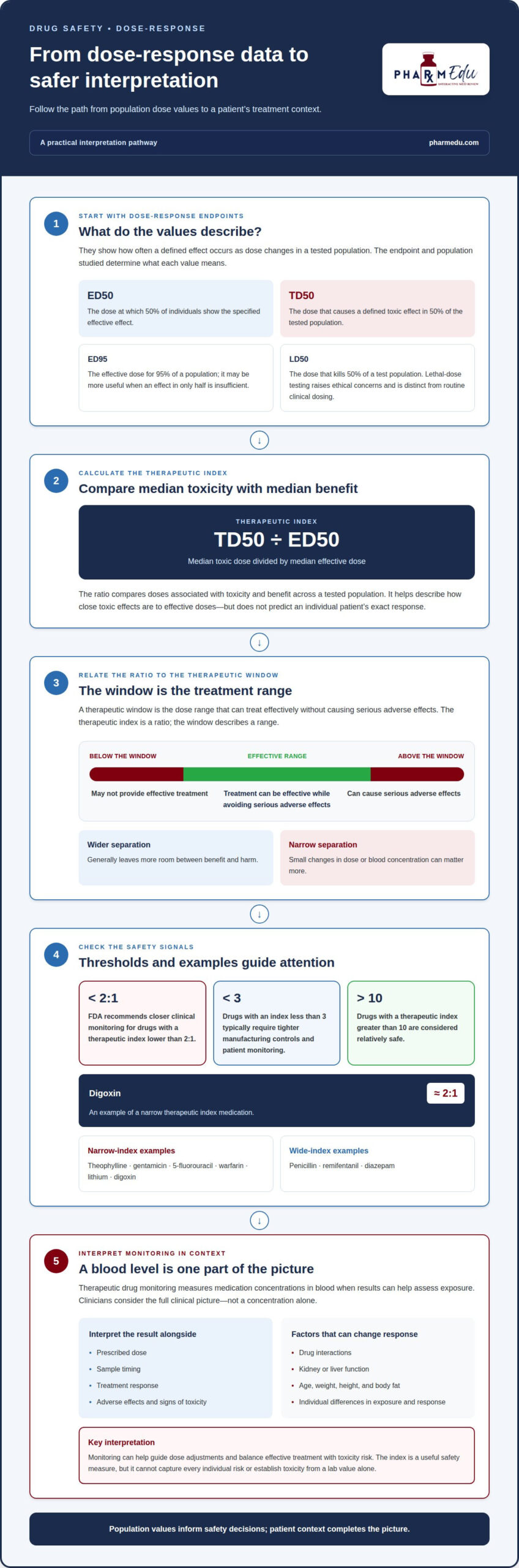
The therapeutic index measures a drug’s safety margin by comparing its toxic dose with its effective dose. It is calculated as TD50 divided by ED50: the doses at which a defined toxic effect and the intended effect occur in 50% of a tested population. The FDA recommends closer clinical monitoring for drugs with a therapeutic index lower than 2:1.
Dose matters, but the number alone does not tell the whole safety story. A drug’s therapeutic window, the range in which it can treat effectively without causing serious adverse effects, explains why even modest changes in dose or blood concentration can matter for some medicines.
This guide explains how therapeutic index and drug safety relate, what dose-response values such as ED50 and TD50 mean, and how to interpret the difference between a wide and narrow therapeutic window. You’ll also see why the index is a useful measure, but not a complete picture of individual risk, since factors such as drug interactions and kidney or liver function can influence response.
Key Takeaways
- Learn why drugs such as warfarin, lithium, and digoxin often call for close monitoring during treatment.
- See how dose-response endpoints describe effects across a population, and why the same dose may not affect everyone alike.
- Understand how doses outside a therapeutic window can either fail to treat effectively or cause serious adverse effects.
- Use the therapeutic index as one safety measure, while recognizing why it cannot capture every risk for an individual patient.
What is the therapeutic index of a drug?
A drug’s therapeutic index compares a dose associated with toxicity against one that produces the intended effect. A wider separation generally leaves more room between benefit and harm. A narrow margin makes small dose or blood-concentration differences more consequential. The FDA recommends closer clinical monitoring for drugs with a therapeutic index lower than 2:1. Drugs with an index less than 3 typically require tighter manufacturing controls and patient monitoring.
Warfarin, lithium, theophylline, digoxin, and gentamicin are narrow-therapeutic-index medications. Small differences in dose or blood concentration can contribute to treatment failure or serious adverse effects. Warfarin may require regular monitoring, while lithium has a narrow therapeutic range when used for psychiatric disorders. In each case, monitoring helps relate medication exposure to clinical response and signs of toxicity.
Therapeutic drug monitoring measures medication concentrations in blood when the results can help assess exposure. Clinicians interpret a result alongside the prescribed dose, sample timing, treatment response, and adverse effects. They may use this combined picture to guide dose adjustments rather than changing medication based on a concentration alone. For a narrow-index drug, monitoring helps balance effective treatment with toxicity risk. Blood concentration is one clinical measure, not a substitute for evaluating the patient.
The index also has limits: it does not account for drug interactions or changes in kidney or liver function, which can affect therapeutic doses. A concentration that suits one patient may not produce the same response in another. A lab value alone cannot establish whether an individual is experiencing toxicity. Clinicians interpret monitoring results in the context of the medication’s purpose, treatment response, and adverse effects, especially when care depends on maintaining a narrow therapeutic range.
What are dose response values?
Dose-response values describe how often a treatment produces defined effects as the dose changes. Their meaning depends on the endpoint measured and the population studied.
Therapeutic Index and Dose Ratios
The therapeutic index is the ratio of the median toxic dose to the median effective dose, expressed as TD50/ED50. A value compares doses associated with toxicity and benefit across a tested population. It doesn’t predict an individual patient’s exact response. The ratio helps explain why a small dose or blood-concentration change can matter more for some medications than others, especially when toxic effects occur near effective doses.
Effective and Toxic Dose Values
An effective dose produces a specified treatment effect, while a toxic dose produces a defined harmful effect. Their values depend on the chosen endpoint, such as symptom relief or a particular adverse effect. ED95 represents the effective dose for 95% of a population, which may be more useful when an effect in only half is insufficient. Dose-response comparisons show how benefit and toxicity change as exposure rises.
ED50, TD50, and LD50
ED50 is the dose at which 50% of individuals show the specified effect; TD50 causes a defined toxic effect in 50% of the tested population. LD50 is the dose that kills 50% of a test population. The therapeutic index convention uses TD50/ED50, comparing median toxicity with median benefit. John William Trevan proposed LD50 as a toxicity measure, using data from 370 laboratory mice injected with lethal cocaine doses. Lethal-dose testing raises ethical concerns because it deliberately causes death; LD50 is distinct from routine clinical dosing.
Dose-Response Endpoints and Population Variability
A quantal dose-response endpoint records whether each individual exhibits a specified effect, rather than measuring its intensity. In this model, ED50 marks the dose producing that effect in 50% of individuals. Age, weight, height, and body fat can affect blood concentration and response. Kidney or liver function and drug interactions can also alter therapeutic doses, so the same dose may produce different exposure or adverse effects. For narrow margins, even a modest dose or concentration shift can move treatment toward toxicity or reduced effect. Interactive pharmacology flashcards can help reinforce how these endpoints differ.
Therapeutic windows and narrow therapeutic index drugs
A therapeutic window is the dose range that treats effectively while avoiding serious adverse effects. The therapeutic index is a ratio comparing toxic and effective doses, so it describes separation differently. This distinction helps explain why a medication’s window matters in clinical dosing.
Therapeutic Windows and Ranges
A therapeutic window is the range between effective treatment and doses associated with serious harm. A narrow therapeutic range means this separation is small, leaving less room for dose changes. Doses below the window may not provide effective treatment, while doses above it can cause serious side effects. For drugs with narrow ranges, clinicians may use measured blood levels to guide dosage adjustments.
Narrow Therapeutic Index Medications
Narrow-index medications have little separation between therapeutic and toxic doses or concentrations. Examples include theophylline, gentamicin, 5-fluorouracil, warfarin, lithium, and digoxin. Their uses differ, from antibiotic treatment with gentamicin to preventing blood clots with warfarin. Because small exposure differences can affect outcomes, these drugs often require careful dosing and patient monitoring.
Wide and Narrow Index Examples
Wide-index drugs have a larger margin between effective and toxic doses; penicillin, remifentanil, and diazepam are examples. Drugs with a therapeutic index greater than 10 are considered relatively safe. Digoxin, by contrast, has an approximate index of 2:1. These comparisons describe relative margins, not a guarantee that a medicine will be safe for every patient or at every dose.
Body Weight in Narrow-Index Dosing
Body weight can help determine effective doses for narrow-index medications, so recent weight is needed for dose calculations. Weight is one factor in the relationship between dosage and blood concentration, not a complete dosing rule on its own. Pharmacology also considers factors that affect exposure and response. For narrow-range drugs, clinicians may combine dose calculations with blood-level measurements to guide adjustments and limit toxicity.
Therapeutic index as a measure of drug safety
The therapeutic index is a comparative safety measure, not a complete verdict on a medication. A larger index generally means a wider margin between effective and toxic exposure; a narrow therapeutic index signals less separation. Candesartan illustrates why the chosen endpoint matters: doses may reach 32 times the ED50 when preventing cardiovascular mortality is the target. That ratio describes a selected outcome, not a universal dosing rule. Viewed this way, therapeutic index and drug safety are related, but the index measures only part of risk.
An index also depends on which harm is measured. A lethal-dose endpoint captures death, while other toxic effects may occur at lower exposure. The ratio therefore cannot describe every adverse effect, interaction, or patient-specific risk. It also does not account for synergistic effects, in which substances intensify one another. The minimum dose that produces a therapeutic effect and the dose associated with toxicity must be interpreted in context.
Drug combinations make this limitation practical. Taking benzodiazepines with opioids, alcohol, or other central nervous system depressants increases the risk of life-threatening overdose. A favorable index for one medication can’t describe the combined effects of these substances. In the United States, the Centers for Disease Control and Prevention says to call 911 when overdose symptoms occur, because overdose is a medical emergency.
Examples also show why index values aren’t rankings of real-world safety. The listed therapeutic index for cocaine is 15:1, but that ratio doesn’t mean its use is safe. A wide margin can still coexist with serious risks tied to interactions, intended use, or a patient’s response. For clinical decisions, therapeutic index and drug safety should be considered alongside endpoints and known hazards, not as permission to increase a dose.
Strengthen your clinical reasoning with pharmacology clinical case studies that connect dose, response, and medication risk.
PharmEDU
PharmEDU helps healthcare students and professionals strengthen their pharmacology knowledge through structured digital learning. If dose-response concepts, narrow therapeutic ranges, or medication monitoring need further review, its curriculum connects core principles with practical learning formats.
Explore pharmacology topics through High-Yield Video Vignettes, alongside PharmEDU Monthly Subscription or PharmEDU Annual Subscription access. These resources support focused review of how drug effects, dosing, and safety considerations relate, complementing clinical learning rather than replacing patient-specific medical guidance.
For learners building confidence across pharmacology coursework or preparing for licensing and board certification exams, PharmEDU offers a way to continue studying at a manageable pace. Contact PharmEDU to learn more about its educational platform.
Keep building clinical confidence
Applying pharmacology knowledge in practice means continuing to refine how you interpret evidence, assess medication risks, and connect mechanisms with clinical decisions. A deeper understanding of therapeutic index and drug safety supports ongoing learning, especially as new questions arise in coursework or professional practice.
PharmEDU offers flexible learning through the PharmEDU Monthly Subscription, PharmEDU Annual Subscription, and Institutional Platform License. Choose the learning format that fits your study or educational setting, then use it to keep developing your pharmacology knowledge over time.
If you have questions about PharmEDU or its learning options, contact PharmEDU to discuss your questions. Each step you take to strengthen your understanding can support more informed, thoughtful clinical learning.
Frequently Asked Questions
What’s the most important thing for patients to know about NTI drugs?
Take a narrow therapeutic index medication exactly as prescribed, and do not change or stop the dose on your own. Keep your medication routine consistent and tell your healthcare team about new prescriptions, over-the-counter medicines, or supplements. These details can affect treatment decisions. For warfarin, for example, monitoring is part of managing the medication’s effects, so attend scheduled tests and promptly discuss unexpected bleeding or other concerning symptoms.
What is the therapeutic index of a drug, and how is it calculated?
The therapeutic index compares a dose associated with toxicity against a dose that produces a desired effect, using TD50 divided by ED50. In an example with a 500 mg therapeutic dose and a 10,000 mg toxic dose, the ratio is 20:1. This calculation summarizes data from a tested population; it isn’t a personal dose calculator or a direction to approach the toxic dose.
What is a narrow therapeutic index drug, and which drugs are examples?
A narrow therapeutic index drug has a small separation between exposures that produce benefit and those associated with harm. Examples include warfarin, lithium, digoxin, theophylline, gentamicin, and levothyroxine. These medications serve different purposes, so the monitoring approach depends on the drug and its clinical use. A patient changing from a brand-name to a generic NTI medication should do so under close healthcare-provider supervision.
How does therapeutic index relate to drug safety and risk of toxicity?
A narrow index signals that a smaller change in exposure may shift treatment toward toxicity or reduced benefit. The index alone can’t predict every hazard. For example, combining benzodiazepines with opioids, alcohol, or other central nervous system depressants increases the risk of life-threatening overdose. The Centers for Disease Control and Prevention advises calling 911 for suspected overdose in the United States, because it’s a medical emergency.
How do clinicians monitor blood levels and adjust doses for narrow therapeutic index drugs?
Clinicians interpret a measured drug concentration alongside the dose, blood-sample timing, treatment response, and possible adverse effects. For example, a warfarin level or other relevant test is considered in the context of the patient’s treatment, not in isolation. Kidney or liver function and interacting medications may also influence decisions. Monitoring results can inform a dose adjustment, followed by assessment of the medication’s effect.
How does the FDA define and regulate narrow therapeutic index drugs in the United States?
Assessments of a drug’s potential risks may consider safety information and relevant medical literature. The FDA recommends closer clinical monitoring for drugs with an index lower than 2:1. Its Office of Generic Drugs applies tighter quality and bioequivalence criteria to generic NTI drugs than to generic non-NTI drugs.