Antidote chart for common toxins: which antidote is used
The right antidote depends on the substance involved. An antidote chart for common toxins pairs acetaminophen with N-acetylcysteine, opioid poisoning with naloxone, and cyanide poisoning with hydroxocobalamin or a cyanide antidote kit. These are reference points, not interchangeable treatments. Selecting and administering an antidote requires attention to the suspected toxin and appropriate clinical monitoring.
It’s understandable to want a clear match between a toxin and its antidote, especially because different poisonings may involve different agents. This guide outlines common pairings to support efficient review, while making clear where a chart is useful and where its limits matter.
You’ll find a practical chart of toxin-antidote associations, followed by context on less straightforward cases and why antidote selection and monitoring matter. Use it as a concise pharmacology study aid, not a substitute for patient-specific toxicology guidance.
Key Takeaways
- Use the chart to quickly review toxin-antidote pairings, including less familiar examples.
- Recognize that a listed antidote is a reference point, not a stand-alone treatment plan.
- Understand why antidote selection, dosing, and monitoring depend on the poisoning involved.
- Build stronger pharmacology recall by connecting antidote names with the toxins they address.
Antidote chart for common toxins
An antidote chart is a quick reference linking a suspected toxin with agents used to counter its effects. The match helps organize pharmacology knowledge, but it doesn’t establish that an antidote is appropriate for every patient. Exposure details, clinical findings, timing, and monitoring all matter. The Northern New England Poison Center released its Antidote Chart in May 2018 to help hospitals in Maine, New Hampshire, and Vermont make stocking decisions.
Use the pairings below as study references, not as patient-specific treatment instructions. Some poisonings have more than one listed antidote, and some agents have important limits or monitoring requirements.
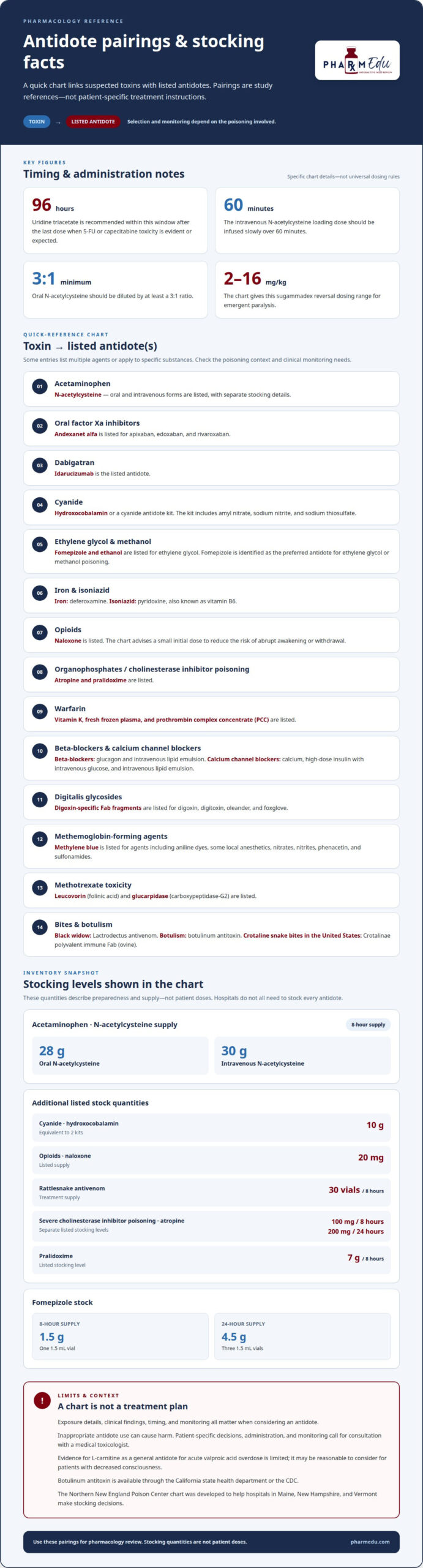
- Acetaminophen: N-acetylcysteine is the listed antidote. The chart includes oral and intravenous forms, which have separate stocking details.
- Oral factor Xa inhibitors: Andexanet alfa is listed for apixaban, edoxaban, and rivaroxaban. Dabigatran: idarucizumab is the listed antidote.
- Cyanide: Hydroxocobalamin or a cyanide antidote kit is listed. The kit includes amyl nitrate, sodium nitrite, and sodium thiosulfate.
- Ethylene glycol: Fomepizole and ethanol are listed. Fomepizole is the preferred antidote for ethylene glycol or methanol poisoning, according to the California Poison Control System.
- Iron: Deferoxamine is listed. Isoniazid: pyridoxine, also known as vitamin B6, is listed.
- Opioids: Naloxone is listed. The chart advises a small initial dose to reduce the risk of abrupt awakening or withdrawal.
- Organophosphates: Atropine and pralidoxime are listed. These agents are also associated with cholinesterase inhibitor poisoning.
- Warfarin: Vitamin K, fresh frozen plasma, and prothrombin complex concentrate, or PCC, are listed.
- Beta-blockers: Glucagon and intravenous lipid emulsion are listed. Calcium channel blockers: calcium, high-dose insulin with intravenous glucose, and intravenous lipid emulsion are listed.
- Digitalis glycosides: Digoxin-specific Fab fragments are listed for digoxin, digitoxin, oleander, and foxglove.
- Methemoglobin-forming agents: Methylene blue is listed for agents including aniline dyes, some local anesthetics, nitrates, nitrites, phenacetin, and sulfonamides.
- Methotrexate toxicity: Leucovorin, also called folinic acid, and glucarpidase, also called carboxypeptidase-G2, are listed.
- Black widow bites: Lactrodectus antivenom is listed. Botulism: botulinum antitoxin is listed.
- Crotaline snake bites: Crotalinae polyvalent immune Fab (ovine) is listed for bites in the United States.
Inventory quantities in the chart describe stocking levels, not patient doses. Examples include 30 vials of rattlesnake antivenom for an 8-hour treatment supply, and 10 g of hydroxocobalamin, equivalent to 2 kits, for cyanide poisoning. The listed naloxone stock is 20 mg for an 8-hour supply. For acetaminophen poisoning, the chart lists 28 g of oral N-acetylcysteine or 30 g of intravenous N-acetylcysteine for an 8-hour supply. Oral N-acetylcysteine should be diluted by at least a 3:1 ratio; the intravenous loading dose should be infused slowly over 60 minutes.
Stocking guidance is designed for preparedness, not to imply that every facility needs every listed agent. The Northern New England Poison Center notes that hospitals do not all need to stock every antidote in its chart. Other listed quantities include 100 mg of atropine for an 8-hour supply and 200 mg for a 24-hour supply in severe cholinesterase inhibitor poisoning. The chart lists 7 g of pralidoxime at the 8-hour stocking level. Alongside clinical preparation, workplaces managing potential chemical risks often ensure frontline personnel are trained in immediate emergency response through accredited courses from Siren Training.
Some entries need added context. Evidence for L-carnitine as a general antidote for acute valproic acid overdose is limited, though it is reasonable to consider for patients with decreased consciousness. Uridine triacetate is recommended within 96 hours of the last dose when 5-FU or capecitabine toxicity is evident or expected. Because inappropriate antidote use can cause harm, consult a medical toxicologist for patient-specific decisions, administration, and monitoring. California Poison Control System also notes that many veterinarians carry rattlesnake antivenom and vaccines for pets.
Stocking details add another layer to these pairings. For cyanide, the chart lists hydroxocobalamin and the cyanide antidote kit, whose components are amyl nitrate, sodium nitrite, and sodium thiosulfate. For fomepizole, the chart recommends stocking 1.5 g, supplied as one 1.5 mL vial, for an 8-hour supply, and 4.5 g, supplied as three 1.5 mL vials, for a 24-hour supply.
Other entries cover reversal and access as well as toxin matching. The chart states that sugammadex reversal dosing for emergent paralysis can range from 2 mg/kg to 16 mg/kg. It also says botulinum antitoxin is available through the California state health department or the CDC. These notes give additional stocking and availability details alongside the antidote pairings.
PharmEDU: PharmEDU Monthly Subscription
PharmEDU’s monthly subscription supports ongoing pharmacology review beyond a quick-reference chart. Use this topic as a starting point, then revisit the underlying mechanisms and drug relationships with PharmEDU’s high-yield video vignettes. Structured review can help connect antidote names with the pharmacology concepts that make those associations easier to remember.
PharmEDU’s curriculum covers over 100 topics for healthcare students and professionals. The Monthly Subscription offers a way to keep building your pharmacology knowledge, while the Annual Subscription suits learners planning sustained review. For organizations supporting learners, an Institutional Platform License is another option. These educational resources support coursework and exam preparation; they aren’t a substitute for patient-specific toxicology consultation.
Contact PharmEDU to learn more about its pharmacology learning options.
Build a stronger pharmacology review routine
Turn each reference entry into an active-recall prompt: cover the antidote, name the toxin, then explain the relationship in your own words. An antidote chart for common toxins can anchor that practice, while follow-up review helps you spot which associations you recall confidently and which need another pass. Grouping entries by drug class or mechanism can also make related concepts easier to compare.
Keep your learning routine practical. Revisit difficult concepts in focused sessions, and use case-based study to connect isolated facts with clinical reasoning. PharmEDU’s educational resources can support ongoing pharmacology review as you prepare for coursework or exams. For learning support, contact PharmEDU and choose a next step that fits your study goals. Steady, deliberate review can help you approach complex pharmacology topics with greater confidence.