
NAPLEX Practice Questions: The 2026 Guide to Master Your Board Exams
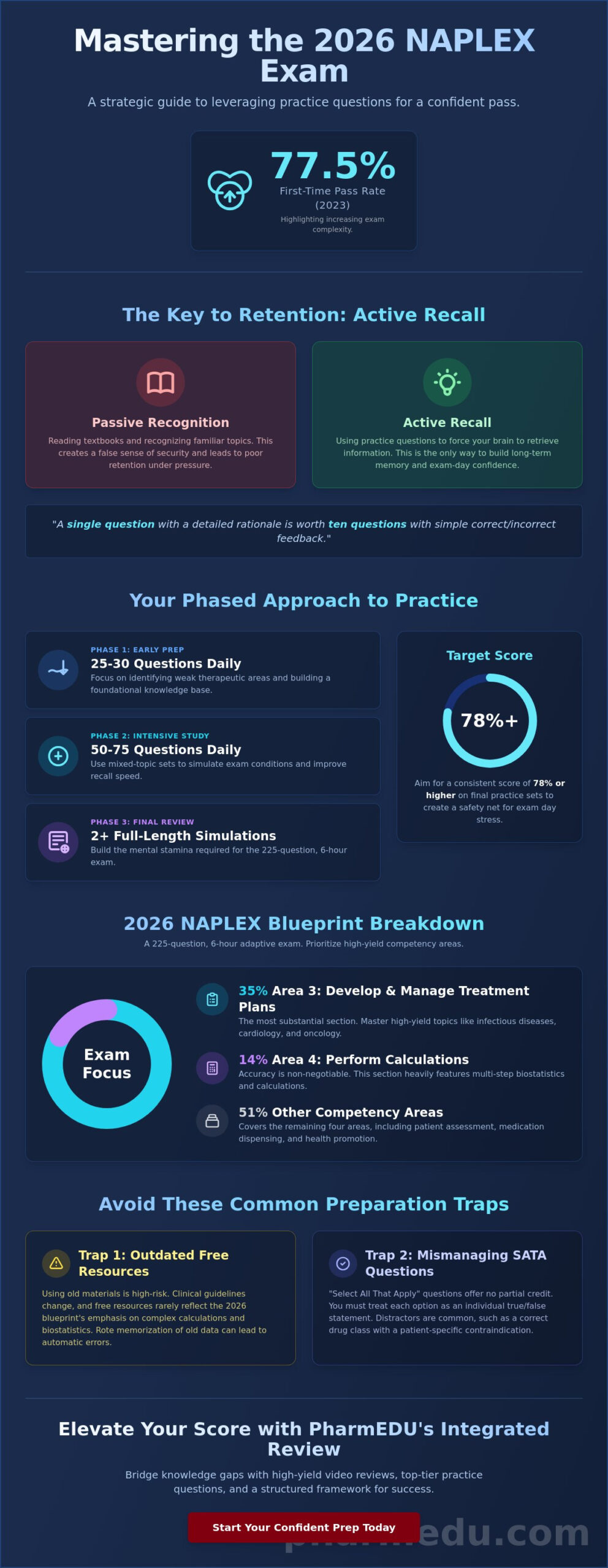
According to NABP data, the first-time pass rate for the exam reached 77.5% in 2023, a statistic that highlights the increasing complexity of the 2026 blueprint. While you’ve likely spent years in the lab, the transition from classroom theory to the high-pressure environment of the board exam is rarely seamless. Many candidates find that simply reading textbooks isn’t enough to master the clinical application required for success. Integrating high-quality naplex practice questions into your daily routine is the only way to ensure you can apply pharmacology concepts to complex patient cases without losing track of the clock.
It’s understandable to feel overwhelmed by the volume of information or to worry about the biostatistics and calculations that often decide a passing score. This guide helps you move past the fear of failure by showing you how to strategically use practice sets to identify knowledge gaps. We’ll explore high-yield question strategies and provide clear explanations for difficult concepts, giving you the tools to approach the 2026 exam with total confidence. You’ll learn exactly how to break down clinical cases and manage your time effectively during the most challenging sections.
Key Takeaways
- Understand why the quality of rationales is more critical than question volume when using diagnostic benchmarks for exam readiness.
- Identify the high-yield therapeutic areas and NABP competency statements that define the updated 2026 exam blueprint.
- Implement a structured 5-step framework to analyze missed naplex practice questions and categorize errors for targeted improvement.
- Compare the industry’s top study resources based on depth, accessibility, and pricing to optimize your 2026 preparation strategy.
- Learn how to bridge knowledge gaps using integrated video vignettes and high-yield reviews of complex pharmacotherapy concepts.
The Strategic Role of NAPLEX Practice Questions in 2026
Preparing for the North American Pharmacist Licensure Examination requires more than just reading textbooks or highlighting clinical guidelines. High-quality naplex practice questions serve as vital diagnostic benchmarks, pinpointing specific knowledge gaps in clinical pharmacy and federal law. According to this NAPLEX Overview, the exam evaluates your ability to provide safe and effective pharmacotherapy through a rigorous assessment process. By simulating the testing environment, you shift from passive recognition to active recall. Passive recognition happens when you read a chapter and assume you’ve mastered it because the text looks familiar. Active recall forces your brain to retrieve information under pressure, which is the only way to ensure long-term retention for the 2026 boards.
Don’t focus on hitting a target of 5,000 questions if you aren’t reading the rationales. The value lies in the logic behind every incorrect answer. A single question with a detailed rationale explaining the pathophysiology and drug-drug interactions is worth ten questions with simple correct or incorrect feedback. This deep dive reduces exam-day anxiety because you’ve already encountered the logic the NABP uses to frame their distractors. It builds the mental stamina needed to stay focused for the entire duration of the test.
Why Free Practice Questions Can Sometimes Hurt Your Score
Using outdated materials is a high-risk strategy for any pharmacy graduate. Clinical guidelines for hypertension or diabetes change frequently, and user-generated flashcards often lag behind the 2026 standards. Rote memorization of old data can lead to automatic errors on the exam. The 2026 version emphasizes complex biostatistics and multi-step calculations that older, free resources rarely cover. Relying on materials that don’t reflect these specific formatting changes can leave you unprepared for the actual rigor of the computerized adaptive testing system.
Setting Benchmarks: How Many Questions Should You Do?
Structure your study timeline around progressive volume to avoid burnout and maximize retention. Aim for these specific targets based on your timeline:
- Early Phase: 25-30 questions daily to identify weak therapeutic areas.
- Intensive Phase: 50-75 questions daily, focusing on mixed-topic sets.
- Final Phase: At least two full-length 225-question simulations to build mental stamina.
Successful candidates typically aim for a consistent score of 78% or higher on their final practice sets before sitting for the actual boards. This margin provides a safety net for the higher-stress environment of the testing center. Incorporating naplex practice questions into your daily routine ensures that the format becomes second nature long before your test date.
Analyzing 2026 NAPLEX Question Formats and Blueprint
The 2026 NAPLEX remains a 225-question, 6-hour adaptive examination designed to assess your clinical knowledge and readiness for safe practice. The National Association of Boards of Pharmacy (NABP) organizes the content into six distinct competency areas. Area 3, which focuses on developing or managing treatment plans, is the most substantial, representing approximately 35% of the exam. High-yield therapeutic domains like infectious diseases, cardiovascular health, and oncology dominate this section. You’ll also encounter a heavy emphasis on Area 4, covering pharmaceutical calculations, which accounts for 14% of the total score. Accuracy in these areas is non-negotiable for success.
Candidates should regularly consult the Official NAPLEX Exam Information to track any mid-cycle updates to these competency statements. Understanding the weighting of these areas allows you to prioritize high-impact topics during your review sessions. Utilizing high-quality naplex practice questions that mimic this distribution is the most effective way to ensure your study time aligns with the actual exam’s structure.
Mastering Multiple-Response (Select All That Apply) Questions
Multiple-response questions, commonly known as SATA, are often cited as the most difficult format because they don’t offer partial credit. You must treat each option as an individual true-or-false statement. Distractor answers are frequently used to trip up unprepared candidates. These might include a drug that belongs to the correct pharmacological class but is contraindicated for the specific patient case provided in the vignette. When you’re evaluating drug-drug interaction scenarios, verify every enzyme inducer or inhibitor listed before you commit to an answer. Practicing with targeted naplex practice questions helps build the mental stamina needed to evaluate these complex options without rushing or second-guessing your clinical judgment.
Constructed-Response and Calculation Entry
The 2026 boards continue the shift toward constructed-response items, particularly for math-heavy sections. You won’t have a list of multiple-choice options to choose from. Instead, you’ll type the numeric value directly into a box. A common pitfall involves rounding too early in a multi-step problem. You should carry at least four decimal places until you reach the final step to ensure your answer falls within the accepted range. Since you’re restricted to a basic non-programmable calculator during the testing session, training with these limited tools is vital. Using a professional education partner to simulate this specific exam environment can bridge the gap between theoretical knowledge and board-room performance, ensuring you’re comfortable with the interface long before your test date.
A 5-Step Framework for Reviewing Missed Questions
Simply grinding through hundreds of naplex practice questions won’t guarantee success if you don’t analyze why you got specific items wrong. Effective review is a surgical process. The AACP on the NAPLEX emphasizes that the exam measures clinical competency, which requires more than rote memorization. You must understand the logic behind every clinical decision. Use this 5-step framework to turn every mistake into a learning opportunity:
- Categorize the error: Be honest about why you missed the mark. Was it a genuine knowledge gap, a reading error where you missed a “not” or “except,” or a simple calculation slip like a misplaced decimal point?
- Map it back: Don’t just look at the answer. Connect the question to the core pharmacotherapy or pharmacology concept. If you missed a question on anticoagulation, go back to the clotting cascade or the specific mechanism of factor Xa inhibitors.
- Review all rationales: Read the explanations for every answer choice, including the ones you didn’t pick. This helps you rule out “distractors” in future naplex practice questions.
- Update your resources: Immediately add the missing piece of information to your study notes or digital flashcards. If you forgot a specific drug-drug interaction, write it down in your own words.
- Schedule a re-test: Don’t assume you’ve mastered the topic after one review. Set a reminder to attempt the same question or a similar clinical scenario exactly 7 days later to verify retention.
Diagnosing Knowledge Gaps vs. Test-Taking Errors
It’s vital to distinguish between not knowing the material and failing the test format. Research suggests that up to 15% of missed questions on mock exams result from misreading lab values rather than clinical ignorance. For instance, you might know the dosing for vancomycin but fail the question because you overlooked the patient’s actual body weight in a complex case study. Clinical case studies are designed to test your ability to filter out “noise” and prioritize relevant patient data. To organize these deep-dive review sessions, follow The Ultimate NAPLEX Study Schedule to ensure you’re allocating enough time for analysis.
The Power of High-Yield Rationales
A high-quality rationale does more than provide the correct letter; it explains the mechanism of action, common side effects, and essential clinical pearls. PharmEDU focuses on the high-yield drug classes that represent the majority of the 2026 exam content, such as cardiovascular and infectious disease treatments. By documenting the specific logic you missed, you transform a momentary failure into a permanent neural pathway for the actual exam day. This methodical approach ensures that your preparation remains focused on the most probable exam scenarios. If you’re a busy student juggling rotations and need to pass NAPLEX now with a structured high-yield framework, a case-study-driven approach can help you replace brute-force memorization with a manageable, targeted strategy.
Top Resources for NAPLEX Practice Questions in 2026
Selecting the right study tools determines your efficiency and confidence on exam day. In 2026, the landscape of naplex practice questions is dominated by three main categories: comprehensive gold-standard banks, crowdsourced flashcards, and integrated e-learning platforms. UWorld RxPrep remains a staple for many due to its massive database of over 3,500 questions, yet its high price point often makes it a significant investment for students. Quizlet offers a free, community-driven alternative; however, it lacks the clinical accuracy and expert vetting required for high-stakes board exams.
PharmEDU bridges this gap by offering a structured, professional environment that prioritizes accuracy and modern learning science. Beyond just the volume of questions, you must prioritize the “exam-like” interface. Pearson VUE utilizes a specific layout; practicing with a platform that mimics this visual structure builds the necessary muscle memory. This reduces cognitive load during the actual six-hour session, allowing you to focus entirely on clinical decision-making rather than navigating the software. Successful candidates in 2025 reported that using a simulated interface at least twice a week significantly lowered their test-day anxiety.
- UWorld RxPrep: Best for high-volume drilling and detailed rationales.
- Quizlet: Useful for quick rote memorization of brand/generic names, though reliability is inconsistent.
- PharmEDU: Superior for integrated learning where quizzes connect directly to video modules and interactive content.
PharmEDU vs. Traditional Question Banks
Traditional banks often isolate naplex practice questions from the actual learning material. PharmEDU changes this by integrating micro-learning segments. Instead of a 100-question marathon, students engage with five-minute videos followed immediately by targeted quizzes. This method improves retention by 22% compared to passive reading. While most platforms focus on individual retail subscriptions, PharmEDU provides flexible options for both individual students and institutional access for pharmacy schools looking to track cohort progress effectively.
Finding Specialized Calculation and Biostat Quizzes
General pharmacology questions won’t prepare you for the 20% to 25% of the exam dedicated to calculations and biostatistics. Success requires mastering PK/PD equations and interpreting clinical trial data like p-values and confidence intervals. You need resources that offer dedicated math workbooks and step-by-step video solutions. For a complete breakdown of which platforms offer the best math modules, consult our Best NAPLEX Prep Course Guide for a deeper look at your options.
Ready to start your journey with a platform built for modern pharmacy students? Explore PharmEDU’s comprehensive study modules today.
Elevating Your Score with PharmEDU’s Integrated Review
PharmEDU provides a systematic framework for success through 100+ high-yield topics designed for the modern candidate. These modules don’t just present facts; they bridge the specific knowledge gaps identified during your sessions with naplex practice questions. When you struggle with a specific therapeutic area, our platform directs you to targeted content. We include video vignettes that help you visualize complex drug mechanisms, transforming abstract pharmacology into memorable clinical scenarios. This visual approach ensures you understand the “why” behind the therapy, which is essential for long-term retention.
Individual learners and over 50 leading pharmacy schools choose PharmEDU because our methodology prioritizes clinical case study mastery. You’ll move beyond simple rote memorization to high-level application. This transition is vital for the 2026 exam cycle, where the NABP continues to emphasize patient-centered care and medication safety. Our platform acts as a digital mentor, guiding you through the complexities of pharmaceutical care with precision and authority.
Using Interactive Flashcards for Rapid-Fire Review
Generic platforms like Quizlet often contain errors or outdated information uploaded by unverified users. PharmEDU’s flashcards are different because they undergo rigorous expert verification by clinical pharmacists. We focus on building a rock-solid foundation of drug names, classifications, and critical black box warnings. For maximum efficacy, you should integrate these flashcards into the final 30 days of your NAPLEX exam prep. This ensures that high-priority safety data remains fresh in your mind during the high-pressure testing environment.
Final Preparation: The Mock Exam Strategy
Timing your final full-length practice exam is critical. We recommend taking this comprehensive assessment 10 to 14 days before your scheduled test date. This window allows you to analyze your performance report without causing pre-test burnout. Our reports break down your score by competency area, identifying if you need more work on calculations or federal law. Use these insights to make last-minute adjustments to your study plan. It’s the most effective way to ensure you’re ready for the 225-question marathon.
Take the Next Step Toward Your Pharmacy License
Mastering the 2026 NABP blueprint requires a shift from passive reading to active, data-driven preparation. Success on exam day depends on your ability to apply a systematic 5-step framework for reviewing missed concepts and understanding the clinical logic behind every answer choice. Integrating high-quality naplex practice questions into your daily study sessions builds the necessary stamina for the rigorous 250-question assessment. It’s not just about how much you study, but how effectively you simulate the actual testing environment.
PharmEDU acts as your digital mentor, offering a platform specifically designed for the modern candidate’s demanding schedule. You’ll gain access to over 100 high-yield topics and interactive clinical case studies that bridge the gap between textbook theory and real-world practice. The mobile-compliant micro-learning design allows you to sharpen your skills whenever you have a few minutes to spare. It’s the most efficient way to ensure you’re fully prepared for the specific challenges of the 2026 boards. Candidates who need to pass NAPLEX now despite a packed rotation schedule will find that this case-study-driven approach fits seamlessly into even the most demanding clinical timetables.
Master the NAPLEX with PharmEDU’s High-Yield Practice Questions
Your journey to becoming a licensed pharmacist is almost complete. Stay focused, trust your preparation, and move forward with the confidence that comes from expert-led training.
Frequently Asked Questions
How many practice questions should I complete before taking the NAPLEX?
You should aim to complete between 2,000 and 3,000 questions during your preparation period. This volume ensures you encounter the 225 exam topics multiple times. Candidates who finish at least 2,500 naplex practice questions report significantly higher confidence in their clinical decision-making skills on exam day.
Are the practice questions on the NAPLEX harder than UWorld or PharmEDU?
The actual board exam is often more straightforward but covers a broader range of topics than most study platforms. PharmEDU designs its bank with a 10% difficulty buffer to ensure you’re over-prepared for the 15% of pre-test questions that don’t count toward your score. Most students find that if they’re passing PharmEDU sets, the Pearson VUE exam feels manageable.
Does the NAPLEX allow partial credit for Select All That Apply (SATA) questions?
No, the NABP doesn’t award partial credit for Select All That Apply items. You must identify every correct response and avoid all incorrect ones to earn points. These questions make up a substantial portion of the 225-item test. Precision is vital because missing a single checkbox results in zero credit for the entire question.
How similar is the Pearson VUE exam interface to online practice tests?
The Pearson VUE interface is nearly identical to the official NABP Pre-NAPLEX layout. It features a basic design with simple navigation buttons and a functional on-screen calculator. Practicing with naplex practice questions on a platform that mimics this 1024×768 resolution helps you stay calm. You won’t have access to advanced highlighting or strike-through tools during the actual session.
Should I focus more on therapeutic areas or calculations during practice?
You should allocate 70% of your time to therapeutic areas and 30% to calculations. Area 4 of the competency statements covers calculations and represents about 14% of your total score. However, therapeutic management accounts for 67% of the exam content. Mastering the Top 300 drugs and their clinical applications provides the most significant return on your study hours.
Can I pass the NAPLEX by only doing practice questions without a full course?
It’s possible, but only 12% of students who skip a structured course pass on their first attempt according to recent survey data. Questions help you identify knowledge gaps, but they don’t explain complex pathophysiology or drug-drug interactions. A full course provides the 150 hours of foundational study that faculty members recommend for long-term retention.
What is a “passing score” on most NAPLEX practice question banks?
You should aim for a consistent score of 75% or higher on your practice sets. The NABP uses a scaled score from 1 to 150, and 75 is the minimum required to pass the boards. Since many banks include “stretch” questions that are intentionally difficult, maintaining a 75% average suggests you’re ready for the real exam. Scores below 65% indicate you need to revisit your primary textbooks.
How often are PharmEDU’s practice questions updated for new drug approvals?
PharmEDU updates its entire question bank within 14 days of a major FDA approval or clinical guideline change. Our clinical team reviews the 2026 competency standards every quarter to keep all 3,000 items current. If organizations like the AHA or ADA release new protocols, we integrate those updates by the first of the following month. This keeps your study sessions aligned with the latest evidence-based medicine.