Understanding Drug Suffixes and Prefixes: The 2026 Guide to Decoding Pharmacology
What if you could identify the mechanism of action and clinical indications of a brand-new medication without ever opening a textbook? For many healthcare professionals, the sheer volume of pharmacology content feels like an insurmountable wall of text. It’s common to feel anxious about similar-sounding generic names during board exams or feel overwhelmed by the thousands of drugs hitting the market. We understand that your time is valuable and that memorizing lists isn’t a sustainable strategy for clinical success. This guide provides a clear path forward by understanding drug suffixes and prefixes as a logical system rather than a memory exercise.
You’ll learn to recognize patterns instantly, allowing you to categorize medications as soon as you see the label. We’ll break down the 2026 USP Drug Classification updates and the latest USAN naming principles to give you a reliable framework for your rotations and exams. This approach transforms pharmacology from a source of stress into a tool for professional excellence. By the end of this guide, you’ll have the tools to decode the systematic language of medicine, reducing your study time and increasing your confidence at the bedside.
Key Takeaways
- Learn how the USAN Council utilizes standardized stems to ensure global clinical clarity and prevent medication errors in professional practice.
- Accelerate your clinical recognition by understanding drug suffixes and prefixes as a logical system rather than a list for rote memorization.
- Master the complexities of sub-class identification, including the specific naming conventions for monoclonal antibodies (mAbs) and biologics.
- Develop a systematic five-step logic chain to deduce the mechanisms, side effects, and contraindications of medications during board exams and rotations.
- Discover how high-yield video vignettes and interactive tools can anchor these linguistic patterns in your long-term memory for superior retention.
The Science of Nomenclature: Why Drug Suffixes and Prefixes Matter
Medicine doesn’t rely on creative branding to ensure patient safety; it relies on a rigorous drug nomenclature system. Every generic drug name is a carefully constructed puzzle designed to communicate specific information about the compound’s behavior. By understanding drug suffixes and prefixes, you gain the ability to look past marketing labels and see the underlying pharmacological class. This systematic approach is essential for preventing medication errors and maintaining clinical clarity across global healthcare borders.
The United States Adopted Names (USAN) Council acts as the architect of this language. They regulate “stems,” which are the official building blocks found within generic drug names. These stems aren’t arbitrary syllables. They’re precise linguistic markers that indicate a drug’s relationship to a specific therapeutic class. The stem system serves as the primary method used by the FDA to categorize new molecular entities.
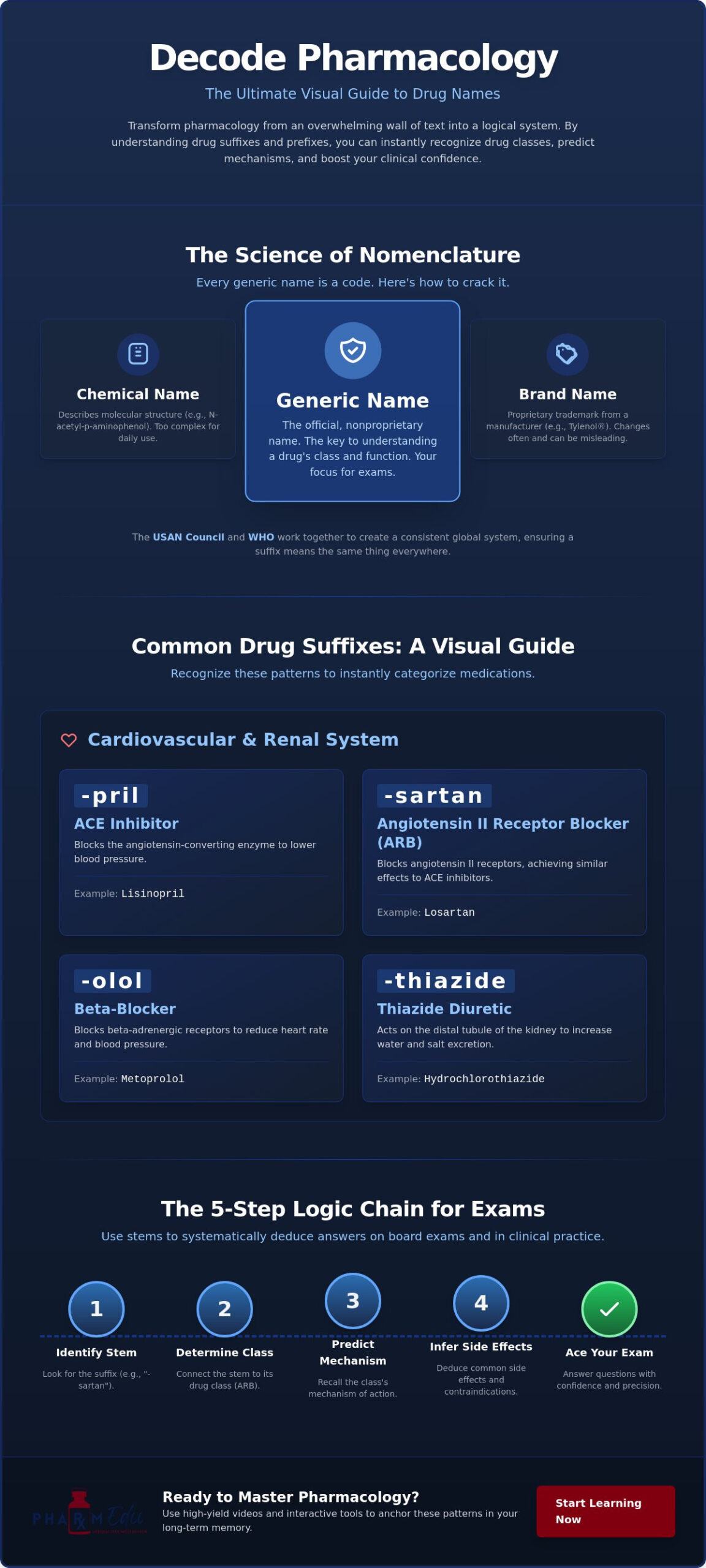
To master this framework, you must distinguish between three distinct naming levels. Chemical names describe the molecular structure according to IUPAC rules, often becoming too complex for daily clinical use. Brand names are proprietary trademarks chosen by manufacturers for marketing purposes. Generic names, however, are the nonproprietary standard that healthcare professionals use to ensure accuracy. When you focus on the generic name, you’re looking at the drug’s true identity.
The Role of the USAN Council and WHO
The USAN Council works in close coordination with the World Health Organization (WHO) to maintain international consistency. On May 8, 2026, the AMA updated the USAN naming guidelines to refine how stems, prefixes, and infixes are assigned to new therapies. A new stem must be distinct, easy to pronounce, and signify a unique pharmacological group. This ensures that a clinician in London and a researcher in Tokyo identify the same mechanism when they see a specific suffix. The 2026 standards also address the growing complexity of biosimilars, ensuring that understanding drug suffixes and prefixes remains a viable strategy for even the most modern treatments.
Generic vs. Brand Names: Decoding the Confusion
Generic names are the gold standard for board exams like the NAPLEX or NCLEX. While brand names change or expire, the generic stem remains constant. Relying on brand names is a dangerous clinical habit because it ignores the drug’s mechanism of action. Stems provide a reliable shortcut to mastering pharmacology without relying on rote memorization. Instead of memorizing ten different brand names for beta-blockers, you simply learn to recognize the “-olol” suffix. This pattern recognition reduces cognitive load and allows you to predict side effects for drugs you’ve never encountered before.
Common Drug Suffixes: Mapping Patterns to Body Systems
The suffix is the most frequent location for a drug class stem. It acts as a linguistic anchor, allowing you to categorize a medication the moment you hear its generic name. Mastering the cardiovascular system starts with understanding drug suffixes and prefixes, as these endings provide immediate insight into a drug’s physiological impact and therapeutic category. By grouping these suffixes by body system, you build a mental map that replaces the need for exhaustive lists.
The USAN naming guidelines provide the structural basis for these classifications. This ensures that healthcare providers rely on consistent terminology across all clinical settings. For the 2026 board certifications, identifying these high-yield patterns is the fastest way to improve your score and clinical accuracy.
Cardiovascular and Renal System Stems
ACE inhibitors and ARBs are foundational to hypertension management. By recognizing the “-pril” suffix, you identify a drug that blocks the angiotensin-converting enzyme. Conversely, the “-sartan” suffix denotes an angiotensin II receptor blocker. Beta-blockers are identified by the “-olol” stem, though variations like “-alol” or “-ilol” may indicate additional alpha-blocking activity. For renal support, diuretics follow distinct patterns: “-thiazide” indicates a distal tubule intervention, while “-semide” typically marks potent loop diuretics like furosemide. To reinforce these connections, using interactive pharmacology flashcards can help you move from rote memorization to active recall.
Central Nervous System and Behavioral Health Stems
In behavioral health, subtle differences in naming signify distinct pharmacokinetic profiles. Benzodiazepines typically end in “-azepam” or “-azolam.” While they share a similar GABA-enhancing mechanism, drugs ending in “-azolam” often have a shorter half-life. For migraine management, the “-triptan” class acts as selective serotonin receptor agonists. While barbiturates ending in “-tal” are seeing decreasing clinical use due to safety profiles, they remain high-yield for understanding sedative-hypnotic history and emergency seizure management.
Anti-Infective and Antimicrobial Suffixes
Antimicrobial therapy relies heavily on specific stems. The “-cillin” suffix marks the penicillin family, while “-cycline” indicates tetracyclines. Fluoroquinolones are identified by “-floxacin.” A common point of confusion is the “-mycin” and “-micin” endings. While both often refer to aminoglycosides or macrolides, the spelling usually indicates the fungal or bacterial source of the antibiotic. For viral infections, the “-vir” suffix is the standard. This includes specific sub-stems like “-navir” for protease inhibitors, which are critical in modern HIV and hepatitis regimens.
Prefixes and Infixes: Identifying Sub-Classes and Biologics
While suffixes provide the broad strokes of a drug’s identity, the finer details often lie at the beginning or in the middle of the word. Understanding drug suffixes and prefixes as a complete system requires looking beyond the ending. Infixes, located in the center of a generic name, are particularly crucial for identifying the nuances of modern biologics and specialized sub-classes. These linguistic segments reveal the origin of the medication and its specific target within the body. Infixes in biologics often reveal the source of the protein, such as human, mouse, or chimeric origins.
The Anatomy of a Monoclonal Antibody Name
Monoclonal antibodies, or mAbs, utilize one of the most complex naming structures in pharmacology. To decode these, you must look at four distinct parts: the variable prefix, two internal substems, and the universal suffix “-mab.” The variable prefix is simply designed to distinguish the drug from others in its class. However, the substems provide critical clinical data. Substem A identifies the drug’s target; for instance, “-li-” refers to the immune system, while “-tu-” indicates a tumor target. Substem B identifies the source of the antibody. A “-u-” indicates a fully human source. Conversely, “-xi-” denotes a chimeric antibody containing both human and animal proteins. Recognizing these infixes allows you to predict potential infusion reactions or immunogenic responses before the first dose is administered.
Prefix-Based Drug Classes
Some of the most common medication classes are identified by their prefixes rather than their endings. The “cef-” or “ceph-” prefix is the hallmark of cephalosporins. While they all share a similar beta-lactam structure, the prefix helps clinicians categorize them into generations. This determines their spectrum of activity against gram-positive and gram-negative bacteria. Another vital prefix is “sulfa-,” used for sulfonamide antibiotics. This prefix serves as an immediate red flag for potential cross-reactivity in patients with documented sulfa allergies. Finally, the “pred-” prefix identifies corticosteroids like prednisone or prednisolone. Because these drugs have wide-ranging systemic effects, seeing this prefix reminds the clinician to monitor for side effects like hyperglycemia or acute weight gain. Mastery of these patterns is a cornerstone of understanding drug suffixes and prefixes in a high-stakes clinical environment.
Strategic Application: Using Stems to Ace Board Exams
Mastering the theory of nomenclature is only half the battle. The true value of understanding drug suffixes and prefixes becomes apparent when you’re faced with an unfamiliar medication during a high-stakes exam like the NAPLEX or NCLEX. Instead of panicking when you encounter a drug name you haven’t memorized, you can use a systematic decoding process to work backward toward the correct answer. This logical approach allows you to deduce a drug’s mechanism, side effects, and contraindications based on its linguistic family.
When you identify a drug’s stem, you aren’t just naming a class. You’re unlocking a vault of clinical knowledge. For example, recognizing an “-ace” or “-pril” suffix immediately brings to mind the risk of hyperkalemia and the characteristic dry cough associated with ACE inhibitors. This deductive reasoning is far more effective than rote memorization, especially when managing the complex patient scenarios found in 2026 board certifications. To build these habits early, many successful candidates incorporate a pharmacology study guide for nursing students into their daily review sessions.
The 5-Step Stem Analysis Process
Success in clinical exams requires a methodical approach to every question. Use this five-step logic chain to analyze unknown medications:
- Step 1: Isolate the suffix and check for a match. Look at the last four to six letters first, as this is where most official stems reside.
- Step 2: If no suffix match is found, check the prefix. Remember that classes like cephalosporins (“cef-“) or corticosteroids (“pred-“) rely on the beginning of the word.
- Step 3: Identify the system or organ based on the stem. Does the stem indicate a cardiovascular, renal, or central nervous system intervention?
- Step 4: Recall class-wide “black box” warnings. If you identify a fluoroquinolone via “-floxacin,” you should immediately think of tendon rupture risks.
- Step 5: Verify against the clinical presentation. Ensure the drug’s class logically fits the patient’s symptoms and history provided in the case study.
Managing Nomenclature Exceptions
While the USAN system is robust, some high-alert medications do not follow standard naming conventions. These “outlier” drugs, such as Warfarin or Digoxin, require individual attention because they lack the predictable stems found in newer agents. Additionally, some drugs may have overlapping suffixes that cause confusion if you aren’t careful. A strategic way to handle these exceptions is to focus your rote memorization efforts strictly on the “Top 200” drugs that break the naming rules, while using pattern recognition for everything else. This hybrid strategy ensures you’re prepared for both the systematic and the idiosyncratic elements of pharmacology. To test your ability to spot these outliers under pressure, consider practicing with our pharmacology practice quizzes to refine your exam-day performance.
PharmEDU: High-Yield Tools for Mastering Drug Nomenclature
PharmEDU provides a structured environment where understanding drug suffixes and prefixes moves from a theoretical concept to a practical clinical skill. Our high-yield video vignettes are specifically designed to use visual cues that anchor drug stems in your long-term memory. Unlike static textbooks, these vignettes create a narrative around each drug class, making it easier to recall mechanisms and side effects during high-pressure moments. By focusing on the linguistic architecture of medications, we help you build a foundation that remains relevant even as new drugs enter the market.
A high-quality naplex prep course should prioritize nomenclature over the traditional method of rote list memorization. While lists are easily forgotten, a deep understanding of stems provides a lifelong tool for drug identification. Our interactive pharmacology flashcards offer a significant advantage over static lists by utilizing active recall and spaced repetition. This ensures that the patterns you’ve learned become second nature, significantly reducing the cognitive load required during clinical rotations and board exams.
Micro-Learning and Retention
The PharmEDU method breaks down complex drug classes into manageable, high-yield segments. This micro-learning approach is ideal for busy students who need to maximize their study time without feeling overwhelmed. Our mobile-compliant pharmacology practice quizzes allow you to test your knowledge of stems during clinical downtime or between lectures. By consistently applying suffix knowledge to real-world patient scenarios through clinical case studies, you bridge the gap between classroom theory and bedside practice. This active application reinforces the patterns and ensures you’re ready for the unpredictable nature of clinical environments.
Preparing for 2026 Certification
As the pharmaceutical landscape evolves, so does our content. PharmEDU’s 2026 curriculum updates include the latest FDA-approved stems and USP classification changes, ensuring your knowledge is always current with the latest regulatory standards. We also provide institutional platform licenses to support pharmacy and nursing schools in improving their board pass rates through standardized, high-quality education. Pharmacology doesn’t have to be a chaotic hurdle in your career. It’s a manageable system that, once decoded, becomes your greatest asset. Start your PharmEDU subscription today to unlock our full library of stem-based learning tools and take the first step toward professional mastery.
Mastering the Language of Clinical Excellence
Pharmacology is often viewed as a barrier to professional success, but it’s actually a highly structured language designed for safety and clarity. By understanding drug suffixes and prefixes, you’ve transitioned from memorizing disconnected lists to mastering a systematic framework. We’ve examined how the USAN Council regulates stems to prevent errors and how you can apply a five-step logic chain to identify unknown medications during high-stakes exams or bedside rotations. This approach doesn’t just save time; it builds the clinical confidence necessary for long-term excellence.
To further solidify these patterns, you need tools that match the pace of modern healthcare education. You can master pharmacology with PharmEDU’s High-Yield Video Vignettes, which cover over 100 high-yield topics through visual storytelling. Our platform includes interactive flashcards for every drug class and a mobile-compliant design for on-the-go studying during your clinical downtime. You have the capacity to decode the complexities of modern medicine. With the right strategy and consistent practice, you’ll find that pharmacology is not a hurdle to clear, but a powerful tool you’ve already begun to master.
Frequently Asked Questions
What is the difference between a drug prefix and a drug suffix?
A drug prefix appears at the beginning of a generic name, while a suffix is located at the end. While suffixes like “-sartan” are the most common way to identify a class, prefixes like “cef-” are essential for recognizing specific sub-groups or generations of medications. Both serve as linguistic markers that help clinicians navigate the vast array of available therapies without relying on brand names.
How do drug suffixes help in predicting medication side effects?
Suffixes allow you to identify the drug’s class and its associated mechanism of action. Once you recognize that a drug ending in “-statin” is an HMG-CoA reductase inhibitor, you can immediately predict class-wide side effects like myalgia or liver enzyme elevations. This predictive power is a core benefit of understanding drug suffixes and prefixes in a clinical setting.
Are there any drugs that do not follow the standard suffix patterns?
Several high-alert medications, particularly older agents, don’t adhere to the modern USAN stem system. Examples include Digoxin, Warfarin, and Nitroglycerin. Because these drugs were named before the current standardized guidelines were fully implemented, they require individual study. Candidates should focus their memorization efforts on these outliers while using pattern recognition for newer molecular entities.
How has monoclonal antibody (mAb) naming changed in recent years?
Monoclonal antibody naming has evolved to include more descriptive infixes that reveal the drug’s target and protein source. Recent 2026 updates from the AMA and USAN Council have refined these substems to ensure global consistency. For instance, the infix “-li-” specifically points to the immune system, while “-tu-” indicates a tumor target, providing immediate clinical insight into the drug’s purpose.
Why do some drugs have the same suffix but belong to different classes?
True USAN stems are unique to their class, but similar-sounding syllables can sometimes cause confusion. This often happens when a suffix is not an official stem but a common ending in the English language. It’s critical to isolate the exact official stem, such as “-prazole” for proton pump inhibitors, rather than just looking at the final two or three letters of the medication name.
Can I rely solely on drug stems to pass the NAPLEX or NCLEX?
While stems are a powerful shortcut, they’re only one component of a successful exam strategy. You must also understand dosing, specific contraindications, and the “Top 200” medications that may break the rules. understanding drug suffixes and prefixes provides the framework, but clinical case studies and practice quizzes are necessary to apply that knowledge to complex patient scenarios.
What is the most common drug suffix found on board exams?
Cardiovascular stems like “-olol” for beta-blockers and “-pril” for ACE inhibitors are among the most frequent on board exams. Anti-infective suffixes, such as “-floxacin” for fluoroquinolones, are also high-yield topics. These classes are prioritized because they have significant safety profiles and are used extensively in various clinical environments across the country.
How does the USAN Council decide on a new drug stem?
The USAN Council selects new stems based on their ability to represent a unique pharmacological group while remaining distinct from existing names. The process involves ensuring the name is easy to pronounce and lacks any misleading therapeutic claims. They work closely with the WHO to ensure these stems are recognized and utilized consistently by healthcare professionals worldwide.