
How to Pass Pharmacology: High-Yield Study Guide for 2026

How to Pass Pharmacology: High-Yield Study Guide for 2026

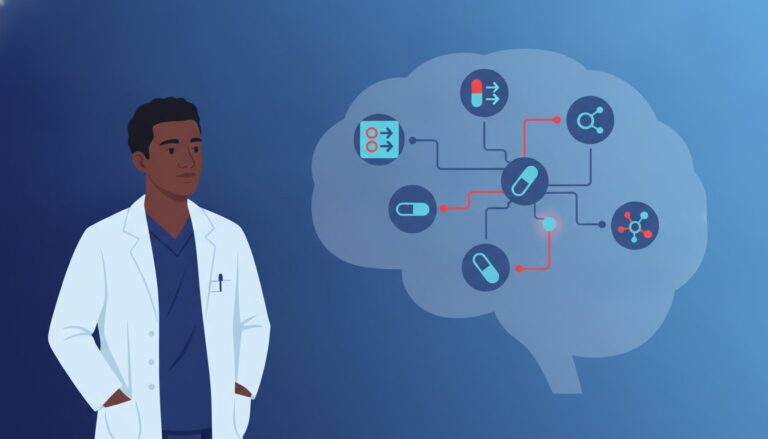
What if the secret to mastering hundreds of drug classes isn’t a photographic memory, but a simple shift in how you view the human body? Many healthcare students feel buried under a mountain of flashcards, struggling to tell one “-olol” from another while trying to figure out how to pass pharmacology before the 2026 board exams arrive. It’s incredibly frustrating to spend hours highlighting a textbook only to forget the mechanism of action the moment you walk into a clinical rotation. You aren’t alone in feeling overwhelmed by the sheer volume of information and the high stakes of professional certification.

Success in this subject doesn’t require you to work harder; it requires you to treat the curriculum like a logic puzzle rather than a list of random facts. We promise that by shifting from rote memorization to a conceptual, mechanism-based framework, you’ll gain the long-term retention needed for both exams and patient care. This guide provides a clear, repeatable study system designed to reduce your stress and boost your scores. We will explore how to categorize medications effectively, master high-yield topics, and build the professional confidence necessary to excel in your healthcare career.

Key Takeaways

  • Replace rote memorization with a conceptual framework that focuses on mechanisms of action to prevent information overload and burnout.
  • Decode drug classifications instantly by mastering the suffixes and prefixes that serve as the universal language of modern pharmacology.
  • Master how to pass pharmacology by prioritizing active recall and spaced repetition over passive reading and traditional highlighting.
  • Bridge the gap between the classroom and the clinic by applying drug knowledge to realistic case studies and complex exam scenarios.
  • Integrate micro-learning into your schedule with high-yield video vignettes to build professional confidence without sacrificing your limited study time.

The Pharmacology Mindset: Why Rote Memorization Fails

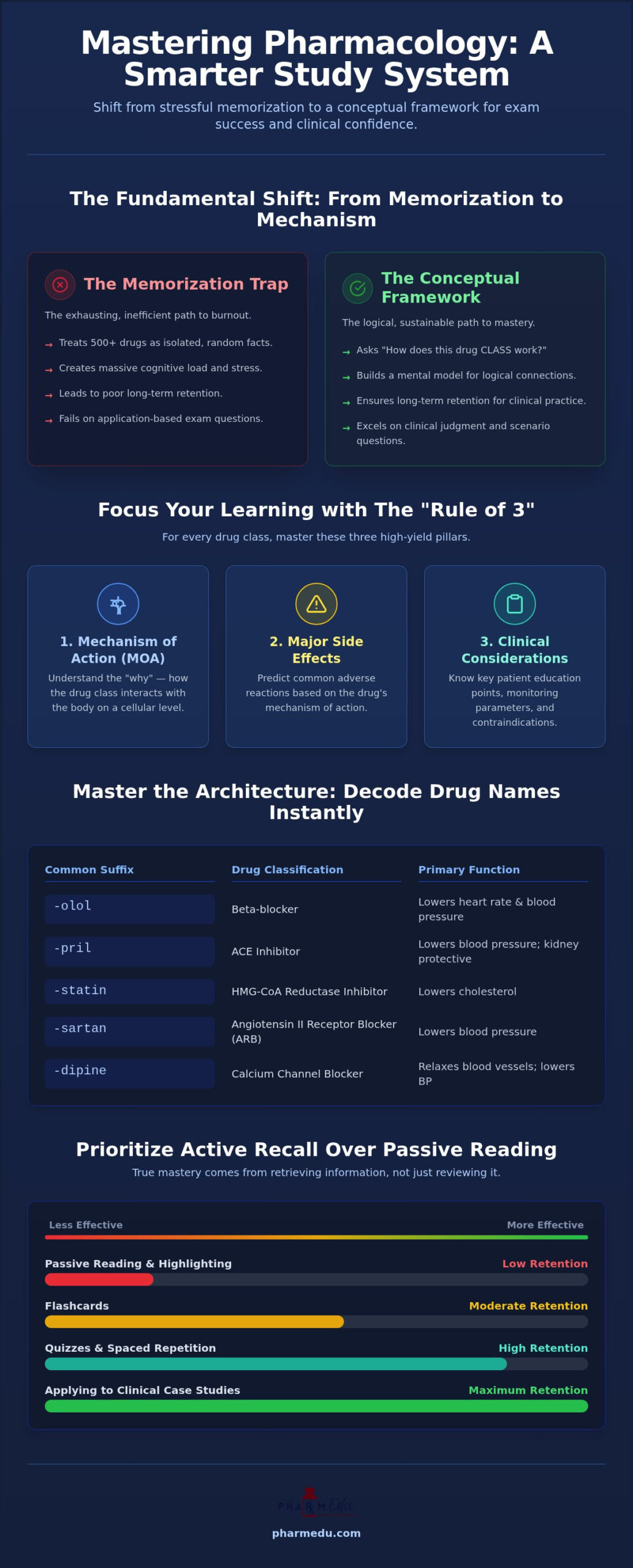
Many students approach the study of pharmacology by attempting to brute-force their way through hundreds of drug names. This “Memorization Trap” is a direct route to burnout. Trying to memorize 500 individual medications as isolated entities isn’t just exhausting; it’s scientifically inefficient. Your brain’s working memory has a limited capacity. When you treat each drug like a random string of characters, you’re creating a massive cognitive load without any structure to support it. Isolated facts that aren’t anchored to a conceptual “hook” tend to disappear the moment you close your book.

Understanding how to pass pharmacology requires a fundamental shift in perspective. Instead of asking “What is this drug?”, you must ask “How does this drug class work?”. In 2026, board exams like the NCLEX and NAPLEX are continuing to move further away from simple recall. They now prioritize application-based questions that test your clinical judgment. If you don’t understand the underlying mechanism, you won’t be able to predict how a patient will react in a complex clinical scenario. Logic must replace luck if you want to succeed in a high-stakes testing environment.

Understanding the Science of Learning

Effective learning requires a framework to store pharmacological data. There’s a massive difference between recognition and recall. You might recognize a drug name on a page and feel confident, but true recall is the ability to retrieve that information under exam pressure without prompts. You need to transition from a passive reader to an active clinical detective. A detective doesn’t just look at the clues; they connect them to understand the motive. In this field, the “motive” is the physiological change the drug induces in the body. Once you understand the “why,” the “what” becomes much easier to remember.

Setting Realistic Study Goals

Don’t try to master entire chapters at once. Breaking the curriculum into manageable drug classes prevents the panic that leads to burnout. Use the “Rule of 3” for every class you study. Focus on three main pillars: the mechanism of action (MOA), major side effects, and nursing or clinical considerations. If you know how a drug class interacts with receptors, you can often predict the side effects and the necessary patient education. For a deeper dive into these foundations, check out our Pharmacology: The Comprehensive Guide to the Science of Drugs. By focusing on these high-yield areas, you’ll find that how to pass pharmacology becomes a predictable, structured process.

Master the Architecture: Prefixes, Suffixes, and Drug Classifications

Pharmacology isn’t a collection of random names; it’s an organized system with its own architectural rules. Learning the nomenclature allows you to identify drug classes instantly, even if you’ve never seen a specific medication before. This is one of the most effective pharmacology study strategies for students who feel overwhelmed by the curriculum. By focusing on word parts, you turn an impossible list of names into a manageable set of patterns that reveal the drug’s identity and function.

The suffix is your most powerful tool for navigating an exam when your memory fails. If you encounter a drug name you don’t recognize, the last few letters usually act as a “spoiler” for its classification. Drug nomenclature serves as a mental shortcut for clinical safety by providing immediate context for a medication’s physiological impact and potential side effects. This pattern recognition is a core component of how to pass pharmacology without succumbing to the stress of rote memorization.

Common Suffixes and Prefixes You Must Know

Mastering a few key endings can unlock dozens of medications. For example, medications ending in “-olol” are beta-blockers, while those ending in “-pril” belong to the ACE inhibitor class. If you see a drug ending in “-statin,” you immediately know it’s used for lipid management. This system allows you to identify the pharmacological class and predict the mechanism of action for drugs you haven’t even studied yet. If you find these naming conventions difficult to track, our High-Yield Video Vignettes break down these patterns into digestible, visual segments.

The ‘Class-First’ Study Method

To truly master this subject, you must group drugs by their physiological target rather than just their therapeutic use. While therapeutic use tells you what a drug treats, such as hypertension, the Mechanism of Action (MOA) tells you how it achieves that goal. Grouping drugs by systems, such as the Renin-Angiotensin-Aldosterone System (RAAS) or the autonomic nervous system, allows you to identify shared side effects and contraindications across a whole family of medications.

Instead of learning every drug in a class, focus on the “Prototype Drug.” This is the representative medication that embodies the entire family. If you understand the prototype, you understand the class. For instance, mastering lisinopril gives you the foundation for all ACE Inhibitors Pharmacology: The High-Yield Guide for Healthcare Students (2026). This strategic focus is essential for anyone researching how to pass pharmacology while maintaining the retention required for the 2026 boards.

Active Recall Strategies: Flashcards, Quizzes, and Spaced Repetition

Passively reviewing highlighted textbooks is one of the most common mistakes students make. While it feels productive, re-reading is the least effective way to study pharmacology because it doesn’t challenge the brain to retrieve information. To truly master the curriculum, you must embrace active recall. This process involves forcing your brain to retrieve knowledge under pressure, which strengthens the neural pathways associated with that data. It’s the difference between recognizing a drug name on a multiple-choice list and being able to explain its contraindications during a clinical shift.

The “forgetting curve” is a real threat to long-term retention. Without regular review, you can lose a significant portion of new information within 24 hours. Spaced repetition solves this by scheduling reviews at increasing intervals. Instead of cramming for ten hours before a midterm, you review for twenty minutes every few days. This consistent exposure moves pharmacological facts from short-term memory into long-term storage, which is vital for the 2026 boards. Understanding this cycle is the core of how to pass pharmacology efficiently.

Building Effective Pharmacology Flashcards

Creating your own study materials is helpful, but they must be structured correctly. A common error is cluttering one card with too much data. Stick to a “single-fact” rule: one drug, one mechanism of action, or one major adverse drug reaction (ADR). You can also use the Feynman Technique by trying to explain a drug’s function in simple terms to a non-medical person. If you can’t simplify it, you don’t understand it yet. Our Interactive Pharmacology Flashcards from PharmEDU are pre-optimized with this “high-yield” philosophy to save you time and mental energy.

The Role of Practice Quizzes in Exam Readiness

You shouldn’t wait until the week of your final to start answering questions. Integrating practice quizzes into your daily routine from day one is essential for anyone figuring out how to pass pharmacology. The real value isn’t in your score; it’s in the rationales provided for each answer. Analyzing why the incorrect options were wrong is often more educational than confirming why you were right. This habit builds the clinical judgment required for board certification. For a structured approach to your preparation, consult The Ultimate Pharmacology Study Guide for Nursing Students in 2026. Supplementing these quizzes with High-Yield Video Vignettes can help clarify the most difficult concepts through visual storytelling.
How to Pass Pharmacology: High-Yield Study Guide for 2026

Bridging the Gap: Applying Pharmacology to Clinical Case Studies

Moving from classroom theory to clinical application is the most significant hurdle for many healthcare students. It’s one thing to answer a question about what a drug does; it’s quite another to predict what will happen to a specific patient with multiple comorbidities. Mastery of this subject requires you to link drug therapy directly to pathophysiology and specific lab values. For example, if you’re administering a loop diuretic, you shouldn’t just think about fluid loss. You should be looking at the patient’s potassium levels and cardiac rhythm to prevent life-threatening arrhythmias.

Handling “Select All That Apply” (SATA) questions is a common source of anxiety during exams. The most effective strategy for these is focusing on contraindications and safety parameters. If you understand why a drug shouldn’t be given to a certain population, you can quickly eliminate incorrect options. Learning how to pass pharmacology involves more than just passing a test; it’s about developing the clinical intuition to keep your patients safe. Your “Safety First” rule should always prioritize adverse drug reactions (ADRs) and black box warnings, as these high-stakes details are frequently the focus of board exams.

Deconstructing a Clinical Case

Exam questions often provide a long narrative filled with “distractor” information designed to test your focus. To succeed, you must identify the core clinical problem and prioritize the most important nursing intervention for that specific medication. Board exams simulate high-pressure environments, so practicing with realistic scenarios is essential. If you want to sharpen these skills, our Clinical Case Studies offer a structured way to practice clinical judgment before you step onto the hospital floor.

Mastering Adverse Reactions and Interactions

Adverse reactions aren’t random side effects; they’re usually predictable extensions of the drug’s mechanism of action. When you understand the MOA, you can logically deduce why certain interactions occur. For instance, the interaction between grapefruit juice and statins happens because the juice inhibits the specific enzyme responsible for breaking down the medication, leading to toxic levels in the blood. Patient safety is the ultimate goal of pharmacological expertise and serves as the foundation for all clinical decision-making. Developing this level of insight is a critical part of learning how to pass pharmacology and excel as a future healthcare professional.

Optimizing Your Study Workflow with PharmEDU in 2026

Mastering the vast syllabus of pharmacology requires more than just a good strategy; it requires the right infrastructure. A PharmEDU Monthly Subscription serves as a digital mentor, providing a structured roadmap through over 100 high-yield topics. Instead of wondering where to start, you follow a methodical path designed by experts to ensure no critical drug class is overlooked. This systematic approach is the final piece of the puzzle for students determining how to pass pharmacology while balancing a heavy clinical workload.

The modern healthcare student doesn’t have hours to sit in front of a textbook. This is where “Micro-Learning” becomes a game-changer. By breaking down complex physiological interactions into 10-minute High-Yield Video Vignettes, the platform allows you to master difficult concepts during short windows of time. Whether you’re on a clinical break or a morning commute, the mobile-compliant design ensures your study materials are always accessible. This flexibility transforms dead time into productive review sessions, making the goal of how to pass pharmacology achievable even with a packed schedule.

High-Yield Content for Busy Students

Efficiency is the core of our philosophy. We focus on high-yield content, which targets the 20% of pharmacological information that typically accounts for 80% of exam questions. This allows you to skip the academic filler and focus on what actually appears on the boards. The platform also includes administrative tools that track your progress, helping you identify weak spots before they become failing grades. For those nearing the end of their program, our The Best NAPLEX Prep Course Guide: How to Pass in 2026 provides the specific strategies needed for that final hurdle.

Preparing for the Boards and Beyond

Success in the classroom is just the beginning. PharmEDU aligns its content with national certification standards for both pharmacy and nursing, ensuring your preparation is relevant for the NAPLEX or NCLEX. This comprehensive review evolves with industry standards, providing you with the most up-to-date clinical knowledge available in 2026. Transitioning from a student to a licensed professional requires confidence in your pharmacological expertise. Start your PharmEDU Monthly Subscription today and master pharmacology! By integrating these tools into your daily workflow, you’ll be prepared to pass your boards on the first try and excel in your professional career.

Securing Your Clinical Future with Pharmacological Mastery

Transitioning from the classroom to clinical practice requires a fundamental change in how you process information. By moving away from rote memorization and focusing on the underlying mechanisms of drug classes, you build a foundation that won’t fail during board exams or at the bedside. Mastering suffixes and prefixes provides the mental architecture needed to identify medications instantly, while active recall strategies ensure long-term retention. Understanding how to pass pharmacology is ultimately about developing the clinical judgment that ensures patient safety and professional excellence.

You don’t have to face this challenging subject alone. With access to over 100 high-yield topics and interactive flashcards and quizzes, you can streamline your study sessions for maximum efficiency. Our mobile-compliant micro-learning vignettes fit into any schedule, helping you stay prepared for the 2026 boards. Start your high-yield pharmacology journey with a PharmEDU subscription and gain the confidence you need to excel. You’ve got the drive to succeed, and the right tools will make all the difference in your healthcare career.

Frequently Asked Questions

How can I pass pharmacology without just memorizing everything?

You can pass by shifting your focus from individual drugs to the Mechanism of Action (MOA) of drug classes. Understanding how a specific class interacts with the body allows you to predict the effects and side effects of dozens of medications simultaneously. This conceptual approach is the most efficient way to learn how to pass pharmacology without facing the burnout associated with rote memorization. It turns a list of facts into a logical system.

Is pharmacology harder than anatomy and physiology?

Pharmacology is often perceived as more difficult because it requires you to apply the foundational knowledge you gained in anatomy and physiology. While A&P focuses on the body’s normal structures and functions, pharmacology examines how external chemicals alter those processes. It’s a layer of complexity that demands clinical judgment. If you have a strong grasp of physiology, you’ll find it much easier to understand how drugs interact with receptors at a molecular level.

What are the best suffixes to know for pharmacology exams?

Prioritize suffixes that identify the most common drug classes seen on board exams. Key examples include “-olol” for beta-blockers, “-pril” for ACE inhibitors, and “-statin” for cholesterol medications. Mastering these word parts acts as a mental shortcut during high-pressure tests. Once you recognize the suffix, you can immediately identify the drug’s classification and its likely physiological impact, which is a critical skill for anyone studying how to pass pharmacology in 2026.

How many hours a day should I study for pharmacology?

Aim for approximately one to two hours of focused study each day rather than cramming during long weekend sessions. This consistency allows you to utilize spaced repetition, which is far more effective for moving information into long-term memory. Breaking your study time into smaller, manageable blocks helps prevent cognitive overload. Using micro-learning tools like High-Yield Video Vignettes can make these daily sessions more productive and help you maintain a steady pace throughout the semester.

How do I remember the difference between side effects and adverse reactions?

Side effects are generally predictable and expected physiological responses that occur at therapeutic doses, such as nausea or a dry mouth. Adverse reactions are more severe, unintended, and potentially life-threatening responses that require immediate clinical intervention. Distinguishing between the two is vital for patient safety and is a frequent topic on exams. Always prioritize learning the “black box warnings” and major contraindications, as these represent the most critical adverse reactions for any drug class.

Can PharmEDU help me prepare for the NAPLEX or NCLEX exams?

PharmEDU is specifically designed to help students transition from classroom success to passing national certification boards like the NAPLEX or NCLEX. Our platform provides High-Yield Video Vignettes and Pharmacology Practice Quizzes that mirror the format and difficulty of official exams. By focusing on the concepts most likely to appear on the 2026 boards, we help you study more efficiently. Our administrative tools also allow you to track your progress and identify specific weak spots.

What is a ‘prototype drug’ and why is it important?

A prototype drug is the lead medication in a specific class that serves as the model for the entire family. For example, by mastering the prototype Lisinopril, you gain an understanding of the mechanism of action and side effects for all ACE inhibitors. This strategy allows you to learn one drug deeply rather than trying to memorize twenty similar medications. It’s a highly efficient way to build a comprehensive knowledge base for clinical practice and exams.

Are flashcards or practice questions better for pharmacology?

Both tools are valuable, but they serve different stages of the learning process. Flashcards are excellent for memorizing suffixes, prefixes, and prototype drug names through active recall. Practice questions are superior for developing clinical judgment and learning how to apply your knowledge to complex patient scenarios. For the best results, use Interactive Pharmacology Flashcards to build your foundation and then move to Pharmacology Practice Quizzes to test your ability to handle difficult board-style questions.


What if the secret to mastering hundreds of drug classes isn’t a photographic memory, but a simple shift in how you view the human body? Many healthcare students feel buried under a mountain of flashcards, struggling to tell one “-olol” from another while trying to figure out how to pass pharmacology before the 2026 board exams arrive. It’s incredibly frustrating to spend hours highlighting a textbook only to forget the mechanism of action the moment you walk into a clinical rotation. You aren’t alone in feeling overwhelmed by the sheer volume of information and the high stakes of professional certification.

Success in this subject doesn’t require you to work harder; it requires you to treat the curriculum like a logic puzzle rather than a list of random facts. We promise that by shifting from rote memorization to a conceptual, mechanism-based framework, you’ll gain the long-term retention needed for both exams and patient care. This guide provides a clear, repeatable study system designed to reduce your stress and boost your scores. We will explore how to categorize medications effectively, master high-yield topics, and build the professional confidence necessary to excel in your healthcare career.

Key Takeaways

  • Replace rote memorization with a conceptual framework that focuses on mechanisms of action to prevent information overload and burnout.
  • Decode drug classifications instantly by mastering the suffixes and prefixes that serve as the universal language of modern pharmacology.
  • Master how to pass pharmacology by prioritizing active recall and spaced repetition over passive reading and traditional highlighting.
  • Bridge the gap between the classroom and the clinic by applying drug knowledge to realistic case studies and complex exam scenarios.
  • Integrate micro-learning into your schedule with high-yield video vignettes to build professional confidence without sacrificing your limited study time.

The Pharmacology Mindset: Why Rote Memorization Fails

Many students approach the study of pharmacology by attempting to brute-force their way through hundreds of drug names. This “Memorization Trap” is a direct route to burnout. Trying to memorize 500 individual medications as isolated entities isn’t just exhausting; it’s scientifically inefficient. Your brain’s working memory has a limited capacity. When you treat each drug like a random string of characters, you’re creating a massive cognitive load without any structure to support it. Isolated facts that aren’t anchored to a conceptual “hook” tend to disappear the moment you close your book.

Understanding how to pass pharmacology requires a fundamental shift in perspective. Instead of asking “What is this drug?”, you must ask “How does this drug class work?”. In 2026, board exams like the NCLEX and NAPLEX are continuing to move further away from simple recall. They now prioritize application-based questions that test your clinical judgment. If you don’t understand the underlying mechanism, you won’t be able to predict how a patient will react in a complex clinical scenario. Logic must replace luck if you want to succeed in a high-stakes testing environment.

Understanding the Science of Learning

Effective learning requires a framework to store pharmacological data. There’s a massive difference between recognition and recall. You might recognize a drug name on a page and feel confident, but true recall is the ability to retrieve that information under exam pressure without prompts. You need to transition from a passive reader to an active clinical detective. A detective doesn’t just look at the clues; they connect them to understand the motive. In this field, the “motive” is the physiological change the drug induces in the body. Once you understand the “why,” the “what” becomes much easier to remember.

Setting Realistic Study Goals

Don’t try to master entire chapters at once. Breaking the curriculum into manageable drug classes prevents the panic that leads to burnout. Use the “Rule of 3” for every class you study. Focus on three main pillars: the mechanism of action (MOA), major side effects, and nursing or clinical considerations. If you know how a drug class interacts with receptors, you can often predict the side effects and the necessary patient education. For a deeper dive into these foundations, check out our Pharmacology: The Comprehensive Guide to the Science of Drugs. By focusing on these high-yield areas, you’ll find that how to pass pharmacology becomes a predictable, structured process.

Master the Architecture: Prefixes, Suffixes, and Drug Classifications

Pharmacology isn’t a collection of random names; it’s an organized system with its own architectural rules. Learning the nomenclature allows you to identify drug classes instantly, even if you’ve never seen a specific medication before. This is one of the most effective pharmacology study strategies for students who feel overwhelmed by the curriculum. By focusing on word parts, you turn an impossible list of names into a manageable set of patterns that reveal the drug’s identity and function.

The suffix is your most powerful tool for navigating an exam when your memory fails. If you encounter a drug name you don’t recognize, the last few letters usually act as a “spoiler” for its classification. Drug nomenclature serves as a mental shortcut for clinical safety by providing immediate context for a medication’s physiological impact and potential side effects. This pattern recognition is a core component of how to pass pharmacology without succumbing to the stress of rote memorization.

Common Suffixes and Prefixes You Must Know

Mastering a few key endings can unlock dozens of medications. For example, medications ending in “-olol” are beta-blockers, while those ending in “-pril” belong to the ACE inhibitor class. If you see a drug ending in “-statin,” you immediately know it’s used for lipid management. This system allows you to identify the pharmacological class and predict the mechanism of action for drugs you haven’t even studied yet. If you find these naming conventions difficult to track, our High-Yield Video Vignettes break down these patterns into digestible, visual segments.

The ‘Class-First’ Study Method

To truly master this subject, you must group drugs by their physiological target rather than just their therapeutic use. While therapeutic use tells you what a drug treats, such as hypertension, the Mechanism of Action (MOA) tells you how it achieves that goal. Grouping drugs by systems, such as the Renin-Angiotensin-Aldosterone System (RAAS) or the autonomic nervous system, allows you to identify shared side effects and contraindications across a whole family of medications.

Instead of learning every drug in a class, focus on the “Prototype Drug.” This is the representative medication that embodies the entire family. If you understand the prototype, you understand the class. For instance, mastering lisinopril gives you the foundation for all ACE Inhibitors Pharmacology: The High-Yield Guide for Healthcare Students (2026). This strategic focus is essential for anyone researching how to pass pharmacology while maintaining the retention required for the 2026 boards.

Active Recall Strategies: Flashcards, Quizzes, and Spaced Repetition

Passively reviewing highlighted textbooks is one of the most common mistakes students make. While it feels productive, re-reading is the least effective way to study pharmacology because it doesn’t challenge the brain to retrieve information. To truly master the curriculum, you must embrace active recall. This process involves forcing your brain to retrieve knowledge under pressure, which strengthens the neural pathways associated with that data. It’s the difference between recognizing a drug name on a multiple-choice list and being able to explain its contraindications during a clinical shift.

The “forgetting curve” is a real threat to long-term retention. Without regular review, you can lose a significant portion of new information within 24 hours. Spaced repetition solves this by scheduling reviews at increasing intervals. Instead of cramming for ten hours before a midterm, you review for twenty minutes every few days. This consistent exposure moves pharmacological facts from short-term memory into long-term storage, which is vital for the 2026 boards. Understanding this cycle is the core of how to pass pharmacology efficiently.

Building Effective Pharmacology Flashcards

Creating your own study materials is helpful, but they must be structured correctly. A common error is cluttering one card with too much data. Stick to a “single-fact” rule: one drug, one mechanism of action, or one major adverse drug reaction (ADR). You can also use the Feynman Technique by trying to explain a drug’s function in simple terms to a non-medical person. If you can’t simplify it, you don’t understand it yet. Our Interactive Pharmacology Flashcards from PharmEDU are pre-optimized with this “high-yield” philosophy to save you time and mental energy.

The Role of Practice Quizzes in Exam Readiness

You shouldn’t wait until the week of your final to start answering questions. Integrating practice quizzes into your daily routine from day one is essential for anyone figuring out how to pass pharmacology. The real value isn’t in your score; it’s in the rationales provided for each answer. Analyzing why the incorrect options were wrong is often more educational than confirming why you were right. This habit builds the clinical judgment required for board certification. For a structured approach to your preparation, consult The Ultimate Pharmacology Study Guide for Nursing Students in 2026. Supplementing these quizzes with High-Yield Video Vignettes can help clarify the most difficult concepts through visual storytelling.

How to Pass Pharmacology: High-Yield Study Guide for 2026

Bridging the Gap: Applying Pharmacology to Clinical Case Studies

Moving from classroom theory to clinical application is the most significant hurdle for many healthcare students. It’s one thing to answer a question about what a drug does; it’s quite another to predict what will happen to a specific patient with multiple comorbidities. Mastery of this subject requires you to link drug therapy directly to pathophysiology and specific lab values. For example, if you’re administering a loop diuretic, you shouldn’t just think about fluid loss. You should be looking at the patient’s potassium levels and cardiac rhythm to prevent life-threatening arrhythmias.

Handling “Select All That Apply” (SATA) questions is a common source of anxiety during exams. The most effective strategy for these is focusing on contraindications and safety parameters. If you understand why a drug shouldn’t be given to a certain population, you can quickly eliminate incorrect options. Learning how to pass pharmacology involves more than just passing a test; it’s about developing the clinical intuition to keep your patients safe. Your “Safety First” rule should always prioritize adverse drug reactions (ADRs) and black box warnings, as these high-stakes details are frequently the focus of board exams.

Deconstructing a Clinical Case

Exam questions often provide a long narrative filled with “distractor” information designed to test your focus. To succeed, you must identify the core clinical problem and prioritize the most important nursing intervention for that specific medication. Board exams simulate high-pressure environments, so practicing with realistic scenarios is essential. If you want to sharpen these skills, our Clinical Case Studies offer a structured way to practice clinical judgment before you step onto the hospital floor.

Mastering Adverse Reactions and Interactions

Adverse reactions aren’t random side effects; they’re usually predictable extensions of the drug’s mechanism of action. When you understand the MOA, you can logically deduce why certain interactions occur. For instance, the interaction between grapefruit juice and statins happens because the juice inhibits the specific enzyme responsible for breaking down the medication, leading to toxic levels in the blood. Patient safety is the ultimate goal of pharmacological expertise and serves as the foundation for all clinical decision-making. Developing this level of insight is a critical part of learning how to pass pharmacology and excel as a future healthcare professional.

Optimizing Your Study Workflow with PharmEDU in 2026

Mastering the vast syllabus of pharmacology requires more than just a good strategy; it requires the right infrastructure. A PharmEDU Monthly Subscription serves as a digital mentor, providing a structured roadmap through over 100 high-yield topics. Instead of wondering where to start, you follow a methodical path designed by experts to ensure no critical drug class is overlooked. This systematic approach is the final piece of the puzzle for students determining how to pass pharmacology while balancing a heavy clinical workload.

The modern healthcare student doesn’t have hours to sit in front of a textbook. This is where “Micro-Learning” becomes a game-changer. By breaking down complex physiological interactions into 10-minute High-Yield Video Vignettes, the platform allows you to master difficult concepts during short windows of time. Whether you’re on a clinical break or a morning commute, the mobile-compliant design ensures your study materials are always accessible. This flexibility transforms dead time into productive review sessions, making the goal of how to pass pharmacology achievable even with a packed schedule.

High-Yield Content for Busy Students

Efficiency is the core of our philosophy. We focus on high-yield content, which targets the 20% of pharmacological information that typically accounts for 80% of exam questions. This allows you to skip the academic filler and focus on what actually appears on the boards. The platform also includes administrative tools that track your progress, helping you identify weak spots before they become failing grades. For those nearing the end of their program, our The Best NAPLEX Prep Course Guide: How to Pass in 2026 provides the specific strategies needed for that final hurdle.

Preparing for the Boards and Beyond

Success in the classroom is just the beginning. PharmEDU aligns its content with national certification standards for both pharmacy and nursing, ensuring your preparation is relevant for the NAPLEX or NCLEX. This comprehensive review evolves with industry standards, providing you with the most up-to-date clinical knowledge available in 2026. Transitioning from a student to a licensed professional requires confidence in your pharmacological expertise. Start your PharmEDU Monthly Subscription today and master pharmacology! By integrating these tools into your daily workflow, you’ll be prepared to pass your boards on the first try and excel in your professional career.

Securing Your Clinical Future with Pharmacological Mastery

Transitioning from the classroom to clinical practice requires a fundamental change in how you process information. By moving away from rote memorization and focusing on the underlying mechanisms of drug classes, you build a foundation that won’t fail during board exams or at the bedside. Mastering suffixes and prefixes provides the mental architecture needed to identify medications instantly, while active recall strategies ensure long-term retention. Understanding how to pass pharmacology is ultimately about developing the clinical judgment that ensures patient safety and professional excellence.

You don’t have to face this challenging subject alone. With access to over 100 high-yield topics and interactive flashcards and quizzes, you can streamline your study sessions for maximum efficiency. Our mobile-compliant micro-learning vignettes fit into any schedule, helping you stay prepared for the 2026 boards. Start your high-yield pharmacology journey with a PharmEDU subscription and gain the confidence you need to excel. You’ve got the drive to succeed, and the right tools will make all the difference in your healthcare career.

Frequently Asked Questions

How can I pass pharmacology without just memorizing everything?

You can pass by shifting your focus from individual drugs to the Mechanism of Action (MOA) of drug classes. Understanding how a specific class interacts with the body allows you to predict the effects and side effects of dozens of medications simultaneously. This conceptual approach is the most efficient way to learn how to pass pharmacology without facing the burnout associated with rote memorization. It turns a list of facts into a logical system.

Is pharmacology harder than anatomy and physiology?

Pharmacology is often perceived as more difficult because it requires you to apply the foundational knowledge you gained in anatomy and physiology. While A&P focuses on the body’s normal structures and functions, pharmacology examines how external chemicals alter those processes. It’s a layer of complexity that demands clinical judgment. If you have a strong grasp of physiology, you’ll find it much easier to understand how drugs interact with receptors at a molecular level.

What are the best suffixes to know for pharmacology exams?

Prioritize suffixes that identify the most common drug classes seen on board exams. Key examples include “-olol” for beta-blockers, “-pril” for ACE inhibitors, and “-statin” for cholesterol medications. Mastering these word parts acts as a mental shortcut during high-pressure tests. Once you recognize the suffix, you can immediately identify the drug’s classification and its likely physiological impact, which is a critical skill for anyone studying how to pass pharmacology in 2026.

How many hours a day should I study for pharmacology?

Aim for approximately one to two hours of focused study each day rather than cramming during long weekend sessions. This consistency allows you to utilize spaced repetition, which is far more effective for moving information into long-term memory. Breaking your study time into smaller, manageable blocks helps prevent cognitive overload. Using micro-learning tools like High-Yield Video Vignettes can make these daily sessions more productive and help you maintain a steady pace throughout the semester.

How do I remember the difference between side effects and adverse reactions?

Side effects are generally predictable and expected physiological responses that occur at therapeutic doses, such as nausea or a dry mouth. Adverse reactions are more severe, unintended, and potentially life-threatening responses that require immediate clinical intervention. Distinguishing between the two is vital for patient safety and is a frequent topic on exams. Always prioritize learning the “black box warnings” and major contraindications, as these represent the most critical adverse reactions for any drug class.

Can PharmEDU help me prepare for the NAPLEX or NCLEX exams?

PharmEDU is specifically designed to help students transition from classroom success to passing national certification boards like the NAPLEX or NCLEX. Our platform provides High-Yield Video Vignettes and Pharmacology Practice Quizzes that mirror the format and difficulty of official exams. By focusing on the concepts most likely to appear on the 2026 boards, we help you study more efficiently. Our administrative tools also allow you to track your progress and identify specific weak spots.

What is a ‘prototype drug’ and why is it important?

A prototype drug is the lead medication in a specific class that serves as the model for the entire family. For example, by mastering the prototype Lisinopril, you gain an understanding of the mechanism of action and side effects for all ACE inhibitors. This strategy allows you to learn one drug deeply rather than trying to memorize twenty similar medications. It’s a highly efficient way to build a comprehensive knowledge base for clinical practice and exams.

Are flashcards or practice questions better for pharmacology?

Both tools are valuable, but they serve different stages of the learning process. Flashcards are excellent for memorizing suffixes, prefixes, and prototype drug names through active recall. Practice questions are superior for developing clinical judgment and learning how to apply your knowledge to complex patient scenarios. For the best results, use Interactive Pharmacology Flashcards to build your foundation and then move to Pharmacology Practice Quizzes to test your ability to handle difficult board-style questions.
Similar Posts

Leave a Reply

Your email address will not be published. Required fields are marked *