10 Essential Pharmacology Study Group Tips: The 2026 Success Checklist
What if your weekly study session is actually slowing you down instead of accelerating your path to clinical mastery? Many healthcare students find themselves drowning in hundreds of drug names, only to realize their group meetings have devolved into social hours or disorganized reading sessions. Finding the right pharmacology study group tips is essential for turning that frustration into a strategic advantage, particularly as the 2026 NAPLEX blueprint now places 65% of its weight on the medication use process and person-centered assessment.
We understand that the pressure to distinguish between similar drug classes can feel insurmountable when you’re studying in a vacuum. This guide provides a structured checklist to help you and your peers master complex mechanisms faster while reducing the anxiety that often accompanies high-stakes exams. You’ll learn how to simulate real-world clinical scenarios and utilize digital tools to ensure your collaborative efforts lead to higher scores and better long-term retention. Let’s look at how to build a study framework that transforms peer-learning into a professional development powerhouse.
Key Takeaways
- Discover why maintaining a group size of three to five members creates the ideal environment for deep retention and focused discussion.
- Implement high-yield pharmacology study group tips, such as the teach-back method, to ensure every member can explain complex drug mechanisms clearly.
- Shift from rote memorization to clinical application by using group-sourced mnemonics and predictive side-effect scenarios.
- Master the “Parking Lot” technique to eliminate social distractions and keep your team focused on high-priority exam domains.
- Learn how to integrate digital resources like High-Yield Video Vignettes and Interactive Pharmacology Flashcards to streamline your collaborative review.
Setting the Foundation for a High-Yield Pharmacology Study Group
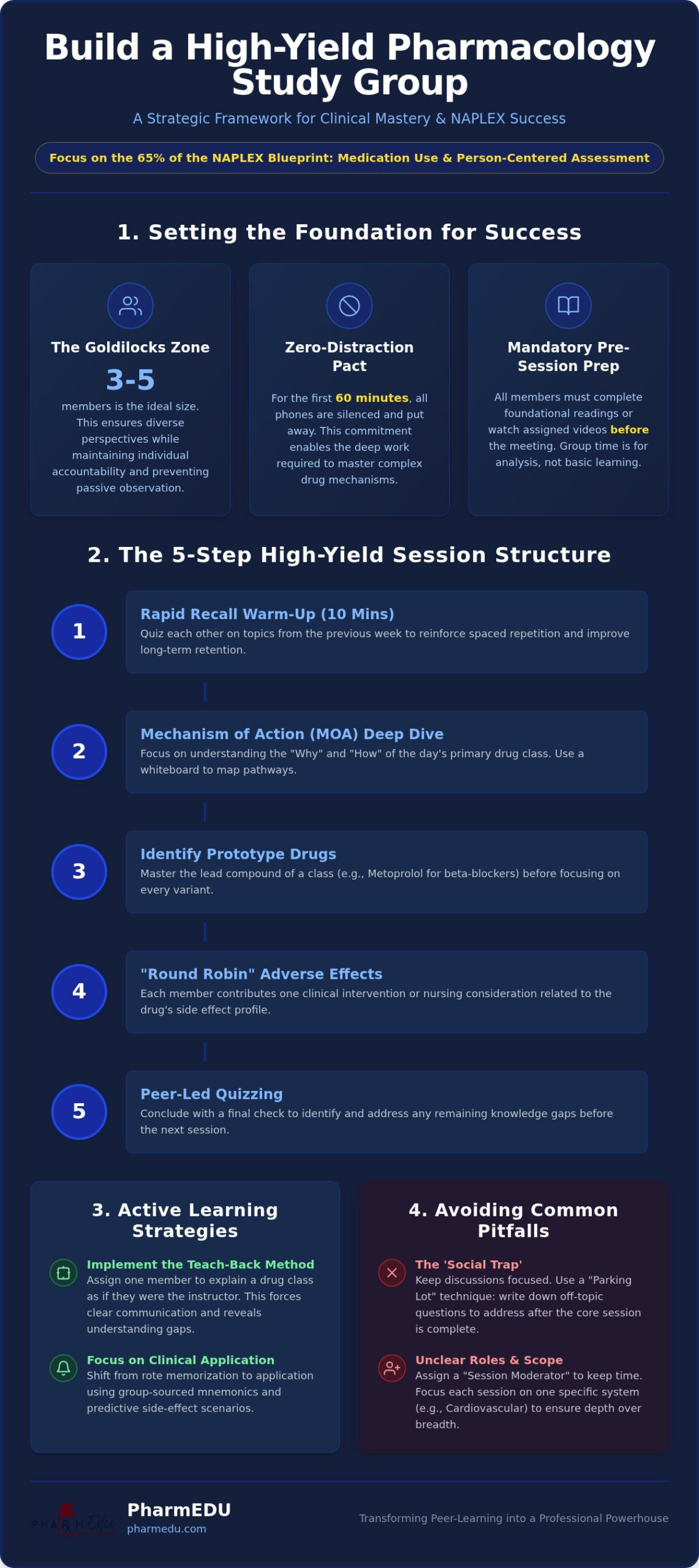
Establishing a high-yield environment is the first step toward clinical proficiency. Success isn’t just about showing up; it’s about the architecture of the group. One of the most effective pharmacology study group tips is to keep your numbers between three and five members. This “Goldilocks zone” ensures there are enough perspectives to cover complex drug classes without the session devolving into a crowded social event. Individual accountability drops in larger groups. When you have more than five people, it’s far too easy for members to become passive observers rather than active participants.
You should also prioritize diversity in clinical backgrounds. A peer who has worked as a pharmacy technician might offer unique insights into dosage forms, while a nursing student with clinical experience in a cardiac unit can ground cardiovascular drug mechanisms in real-world patient care. To protect this collective expertise, establish a “Zero-Distraction” pact. For the first 60 minutes, all phones should be silenced and put away. This commitment allows the group to enter a state of deep work, which is essential for mastering the intricate details of pharmacokinetics and pharmacodynamics.
Choosing Your Peer-Teaching Partners
Look for partners who prioritize the “Why” behind a drug’s action. Memorizing a list of side effects is a low-level task, but understanding why a beta-blocker causes bradycardia requires a grasp of receptor physiology. Integrating effective study skills into your selection process means choosing people with varied learning styles. A visual learner might draw out the RAAS pathway on a whiteboard, while an auditory learner explains the feedback loop to the group. Assigning a “Session Moderator” is also vital. This person doesn’t need to be the expert, but they must ensure the group stays on task and respects the predetermined time limits for each drug class.
Establishing Your Group’s Pharmacology Scope
Clarity on the session’s scope prevents the feeling of being overwhelmed by hundreds of compounds. Rather than trying to cover all of “Autonomics,” focus specifically on one system, such as Cardiovascular or Respiratory agents. This allows for a deeper dive into drug-drug interactions and contraindications. Your goals should align with a structured pharmacology study guide for nursing students to ensure you’re covering high-yield content relevant to your upcoming professional assessments. Finally, implement a strict pre-session requirement. Every member must complete the foundational reading or watch assigned video vignettes before the meeting starts. This ensures that group time is spent on high-level analysis and peer-teaching rather than basic information gathering. Following these pharmacology study group tips will transform your sessions from passive reading into active clinical preparation.
The 5-Step Session Structure to Master Drug Classes
A productive session requires more than just a stack of notes. It needs a repeatable protocol. Many students struggle because they dive into new material without proper context. One of the most effective pharmacology study group tips is to implement a 5-step session structure that mimics clinical reasoning. Start with a 10-minute “Rapid Recall” warm-up. During this time, the group quizzes each other on topics from the previous week. This reinforces spaced repetition, which is vital for long-term retention of drug classifications.
The second step involves a deep dive into the Mechanism of Action (MOA) for the day’s primary drug class. Once the “how” is established, move to step three: identifying “Prototype Drugs.” Focus your energy on the lead compound of a class, such as Metoprolol for beta-blockers, before worrying about every variant. Step four is a “Round Robin” of adverse effects and nursing considerations. Each member must contribute one clinical intervention related to the drug’s side profile. Finally, conclude with peer-led quizzing. This final check identifies knowledge gaps that require further review before your next meeting.
Implementing the ‘Teach-Back’ Method for Mechanisms
The teach-back method is the gold standard for peer learning. Assign one member to explain the pharmacodynamics of a specific drug class as if they were the instructor. Use a whiteboard to map out cellular pathways, such as how a calcium channel blocker prevents ion entry into vascular smooth muscle. This process forces the “teacher” to organize their thoughts and allows the “students” to ask probing “why” questions. These interactions significantly deepen your collective understanding of pharmacology. If the group hits a wall, consult PharmEDU’s High-Yield Video Vignettes to resolve the confusion instantly.
Dividing and Conquering the Top 200 Drugs
Mastering the Top 200 drugs requires a “divide and conquer” strategy. Rather than everyone researching everything, split the list by therapeutic categories. One member might focus on diuretics while another handles anticoagulants. When you reconvene, share digital summary sheets that highlight high-yield suffixes and prefixes. Knowing that “-pril” denotes an ACE inhibitor allows you to recognize dozens of drugs instantly. You can find additional pharmacology study tips that emphasize this classification-first approach. Applying these pharmacology study group tips ensures you cover the entire syllabus without burning out individual members.
Active Learning Strategies: Moving Beyond the Textbook
Passive reading is often the primary cause of information overload. To truly master drug mechanisms, your team must transition from silent highlighting to dynamic engagement. One of the best pharmacology study group tips is to implement active learning strategies that force you to apply knowledge in real time. This approach transforms the study session into a clinical simulation where you don’t just memorize names but understand how they alter patient outcomes. By engaging in “Clinical Scenario” games, your group can predict side effects based solely on a drug’s Mechanism of Action (MOA), reinforcing the physiological “why” behind every therapeutic effect.
Comparing drug classes is another high-yield strategy. Instead of studying ACE inhibitors and ARBs in isolation, debate why a clinician would choose one over the other. Discussing the specific pathway of bradykinin and its role in the “ACE cough” provides a logical anchor for why a patient might be switched to a sartan. You can even use roleplay to simulate drug-drug interaction errors. Having one member act as the prescribing physician and another as the safety-checking pharmacist allows the group to practice identifying real-world risks in a controlled, supportive environment.
Group-Sourced Mnemonics and Suffix Guides
Textbook mnemonics often feel forced or irrelevant to your specific curriculum. Home-grown cues created during a group session stick much better because they’re tied to a shared conversation or a specific clinical example you’ve discussed. Standardizing your group’s shorthand is essential for speed and accuracy during peer-quizzing. Creating a collaborative “Master Suffix List” allows the group to instantly recognize drug classifications. This living document serves as a central source of truth, ensuring everyone is on the same page when identifying suffixes like -olol for beta-blockers or -statin for HMG-CoA reductase inhibitors.
Case Study Simulations and Clinical Application
Clinical Case Studies are the most effective way to bridge the gap between theoretical knowledge and professional practice. During your sessions, use these scenarios to debate the “Best Next Step” for patients with complex medical histories. This forces you to consider contraindications and therapeutic goals rather than just reciting facts. Engaging with Clinical Case Studies prevents rote-memorization burnout by providing the practical context necessary to see drug facts as vital patient-care tools. By focusing on these applications, your group mirrors the 2026 NAPLEX emphasis on person-centered assessment and treatment planning, which accounts for 40% of the exam’s content.
Avoiding the ‘Social Trap’ and Productivity Killers
Even the most disciplined groups can fall into the “social trap” where productivity vanishes. One of the most practical pharmacology study group tips is to use the ‘Parking Lot’ technique. When a member asks an off-topic question or starts a social conversation, the moderator “parks” that topic on a separate list to be addressed only after the core content is finished. This preserves the flow of high-intensity topics like pharmacodynamics. You must also manage the ‘Expert vs. Novice’ dynamic. If one member dominates the conversation, the learning process stalls for everyone else. Encourage the “expert” to mentor others through questioning rather than lecturing. This ensures the entire group advances together toward clinical competency.
Recognizing when a group has become too large is equally important. As mentioned earlier, keeping the size between three and five members is ideal. If the group expands beyond this, it’s often better to split into two smaller, more focused cohorts. Applying consistent pharmacology study group tips helps maintain this professional boundary. Always set a hard stop time for every meeting. Fatigue leads to diminishing returns, and pushing past the point of mental exhaustion increases the likelihood of absorbing incorrect information. Professionalism in study habits means respecting everyone’s time and cognitive limits.
Time-Blocking for High-Yield Focus
Efficiency is the hallmark of a successful session. Using the Pomodoro technique for groups, 50 minutes of deep work followed by a 10-minute social break, provides a structured rhythm that prevents burnout. During work blocks, your priority should be high-yield topics. For example, mastering ACE Inhibitors and their impact on renal physiology is far more valuable for board exams than debating the nuances of rare, niche medications. Use a timer to limit these “rabbit hole” debates to three minutes. If a dispute isn’t resolved by then, move it to the parking lot.
Dealing with Group Misinformation
Misinformation can spread quickly in a collaborative setting if you don’t have a designated “Source of Truth.” When technical disputes arise, the group should immediately reference a reliable digital platform rather than relying on memory. Gracious correction is a skill every healthcare professional needs. If a peer misstates a drug’s mechanism, correct them by saying, “Let’s double-check that against the clinical guidelines,” rather than simply telling them they’re wrong. Verifying facts against a comprehensive pharmacy review ensures your group sessions remain accurate and high-yield. To ensure your group always has access to the most current clinical data, explore the resources available through a PharmEDU Annual Subscription.
Leveraging Digital Tools for Collaborative Pharmacology Review
Modern pharmacology education has moved far beyond static pages. Integrating modern technology into your sessions is one of the most effective pharmacology study group tips for 2026. Digital tools allow a group to sync their progress and ensure everyone is working from the same clinical “source of truth.” Instead of debating outdated textbook entries, your team can utilize High-Yield Video Vignettes to anchor your discussions in current evidence-based practice. These micro-learning modules provide the visual and auditory cues necessary to build shared mental maps of complex drug interactions.
Projecting Clinical Case Studies during a meeting transforms the room into a collaborative diagnostic center. This approach allows the group to tackle multi-layered patient scenarios together, simulating the clinical decision-making required for professional licensure. You can also introduce an element of gamification by using Interactive Pharmacology Flashcards for “Speed Round” competitions. These rounds test rapid recall under pressure, which is a vital skill for both high-stakes exams and fast-paced clinical environments. Tracking your collective performance through a shared dashboard helps the group identify which drug classes require a deeper dive in the next session.
Using Video Vignettes as Discussion Starters
Starting a topic with a five-minute high-yield video ensures that every member begins with the same foundational understanding. Don’t just watch the video passively. Pause the playback at critical junctures to ask the group predictive questions, such as “What would happen to the heart rate if we blocked these specific receptors?” This active engagement turns a simple viewing into a rigorous peer-teaching exercise. The visual cues provided in these vignettes help the group visualize drug-receptor binding and physiological cascades, making the information far easier to recall during a stressful exam.
Collaborative Self-Testing with Digital Quizzes
Self-testing is most powerful when done in a group setting. You can set up “Group Challenges” using Pharmacology Practice Quizzes to see how your collective knowledge stacks up against standardized benchmarks. After the quiz, don’t just look at the scores. Analyze the missed questions as a team to find collective weak points. If three out of four members miss a question on renal clearance, it’s a clear signal that the group needs to revisit that mechanism. This digital feedback loop significantly accelerates the group’s learning curve. By following these pharmacology study group tips, you ensure your team remains at the forefront of clinical education and professional readiness.
Mastering Pharmacology Through Strategic Collaboration
Success in modern healthcare education hinges on your ability to synthesize complex data into actionable clinical judgment. By implementing a disciplined 5-step session structure and prioritizing active learning over rote memorization, you ensure your peer sessions remain focused and productive. These pharmacology study group tips provide the framework necessary to navigate the 2026 blueprint with confidence and precision. Moving beyond the social trap allows your group to focus on the mechanisms that truly impact patient outcomes.
Your path to mastery is significantly shortened when you utilize a reliable digital partner to settle disputes and guide your research. Start your high-yield pharmacology journey with a PharmEDU subscription today. You’ll gain access to 100+ high-yield pharmacology topics and clinical case studies designed for mobile-compliant study groups on the go. Utilizing interactive flashcards for group testing ensures that your preparation is both rigorous and efficient. Stay focused on your professional growth, and let structured collaboration drive your clinical results.
Frequently Asked Questions
How many people should be in a pharmacology study group?
Aim for three to five members to maintain a high-yield environment. This range is often called the “Goldilocks zone” because it provides enough diverse clinical perspectives to cover complex drug classes without the session becoming disorganized. Larger groups often lead to passive learning and social distractions, while smaller pairs might lack the breadth of experience needed for a comprehensive review of diverse therapeutic categories.
What is the best way to divide drug classes among group members?
The most efficient method is to assign specific therapeutic categories or organ systems to individual members before the meeting. For example, one person might focus on diuretics while another prepares a breakdown of anticoagulants. This “divide and conquer” strategy ensures every drug class receives a deep dive without overwhelming a single student, provided everyone shares their findings through structured digital summaries or shared mental maps.
How can we keep our pharmacology study group from becoming a social hour?
Implementing a “Zero-Distraction” pact and a “Parking Lot” for off-topic chatter is essential for staying focused. Set a timer for 50-minute work blocks followed by 10-minute social breaks to maintain a professional rhythm. If a non-academic topic arises during work time, the moderator should “park” it on a separate list to be addressed only after the core academic goals for the session are met.
Should we use a textbook or an online platform for our study group?
While textbooks offer foundational knowledge, a digital platform is superior for collaborative sessions because it provides a “central source of truth” with real-time updates. Using a platform with high-yield video vignettes and interactive quizzes allows the group to sync progress and access current clinical data instantly. This is vital for the 2026 NAPLEX, which emphasizes clinical decision-making over simple rote memorization.
How often should a pharmacology study group meet?
Consistency is more important than frequency; meeting once or twice per week is usually ideal for most healthcare students. This schedule allows enough time for individual pre-reading and mastery of foundational concepts while maintaining a steady rhythm of peer-teaching. Regular sessions help prevent the “cramming” phenomenon and keep the group aligned with their course syllabus or professional board exam preparation timeline.
What are the most important drug classes to focus on in a group?
Prioritize high-yield categories that appear most frequently on professional exams, such as cardiovascular agents, endocrine medications, and antimicrobials. Focus your pharmacology study group tips on drug classes with complex mechanisms or narrow therapeutic indices. These areas often require the collective reasoning of a group to fully grasp the nuances of adverse effects and patient-centered treatment planning.
Can a study group help with memorizing drug suffixes and prefixes?
A group can create a collaborative “Master Suffix List” that serves as a shared living document for all members. Engaging in “Speed Round” competitions using digital flashcards helps reinforce the connection between suffixes like -olol or -sartan and their respective drug classes. This group effort makes the identification of the Top 200 drugs much faster and more intuitive than studying in isolation.
How do we handle a group member who hasn’t done the pre-reading?
Handling unprepared members requires a professional but firm approach to protect the group’s collective productivity. The session moderator should stick to the planned schedule to ensure the group meets its learning objectives, even if one member is behind. If someone consistently fails to do the pre-reading, the group should have a candid discussion about the shared commitment to high-yield learning and professional accountability.