
Mastering Pharmacology: The Ultimate Spaced Repetition Study Schedule for 2026
Did you know that without active reinforcement, your brain likely discards roughly half of every new drug mechanism you learn within just 24 hours? It’s a frustrating reality for healthcare students who often feel buried under an endless list of generic names, indications, and side effects. You’ve probably experienced that mid-semester burnout where yesterday’s lecture on complex drug classes already feels like a distant memory. We agree that the traditional “cram and forget” method is an ineffective way to prepare for a career in patient care. This guide will show you how to stop the cycle of forgetting by building a scientifically-backed spaced repetition pharmacology schedule designed for the 2026 academic landscape.
You’ll learn how to transform overwhelming information into manageable, long-term knowledge that remains accessible when it matters most. We will explore the mechanics of the forgetting curve, the necessity of active recall, and how to integrate high-yield video vignettes with interactive flashcards to ensure you walk into your board exams with total confidence. By the end of this article, you’ll have a clear, structured roadmap to reduce study anxiety and significantly improve your NAPLEX or NCLEX scores through methodical, evidence-based preparation.
Key Takeaways
- Learn how increasing study intervals leverage neuroplasticity to transform fleeting drug data into permanent knowledge.
- Follow a step-by-step template to build a personalized spaced repetition pharmacology schedule that transitions from initial video encoding to active recall.
- Implement the “Atomic Card” strategy to ensure each interactive flashcard focuses on a single concept for maximum cognitive efficiency.
- Utilize PharmEDU’s automated platform to streamline your workflow with expert-curated vignettes and quizzes designed for 2026 board exam standards.
- Transition from passive reading to a retrieval-heavy workflow that prepares you for the evolving block formats of modern licensing exams.
Why Pharmacology Cramming Fails and How Spaced Repetition Saves Your Boards
Cramming for a pharmacology exam feels like trying to fill a bucket with a massive hole in the bottom. You pour in hundreds of drug names, mechanisms, and side effects during a midnight caffeine binge, only to find the information has vanished by the time you reach the testing center. This happens because the human brain is evolved to filter out data that isn’t reinforced. In the context of medical education, a spaced repetition pharmacology schedule acts as the plug for that hole. It is an evidence-based learning technique that schedules reviews at increasing intervals, specifically timed to catch you just as you are about to forget.
This method moves information from the fragile “encoding” phase, where you first understand a concept, into the “retrieval” phase, where long-term retention is forged. Unlike passive re-reading, which creates a false sense of fluency, spaced repetition forces your brain to work. This “desirable difficulty” is exactly what builds the neural pathways required for high-stakes board exams like the NAPLEX or NCLEX. If you don’t challenge the brain to pull information from deep storage, it won’t prioritize that data for long-term access.
The Ebbinghaus Forgetting Curve in Medical Education
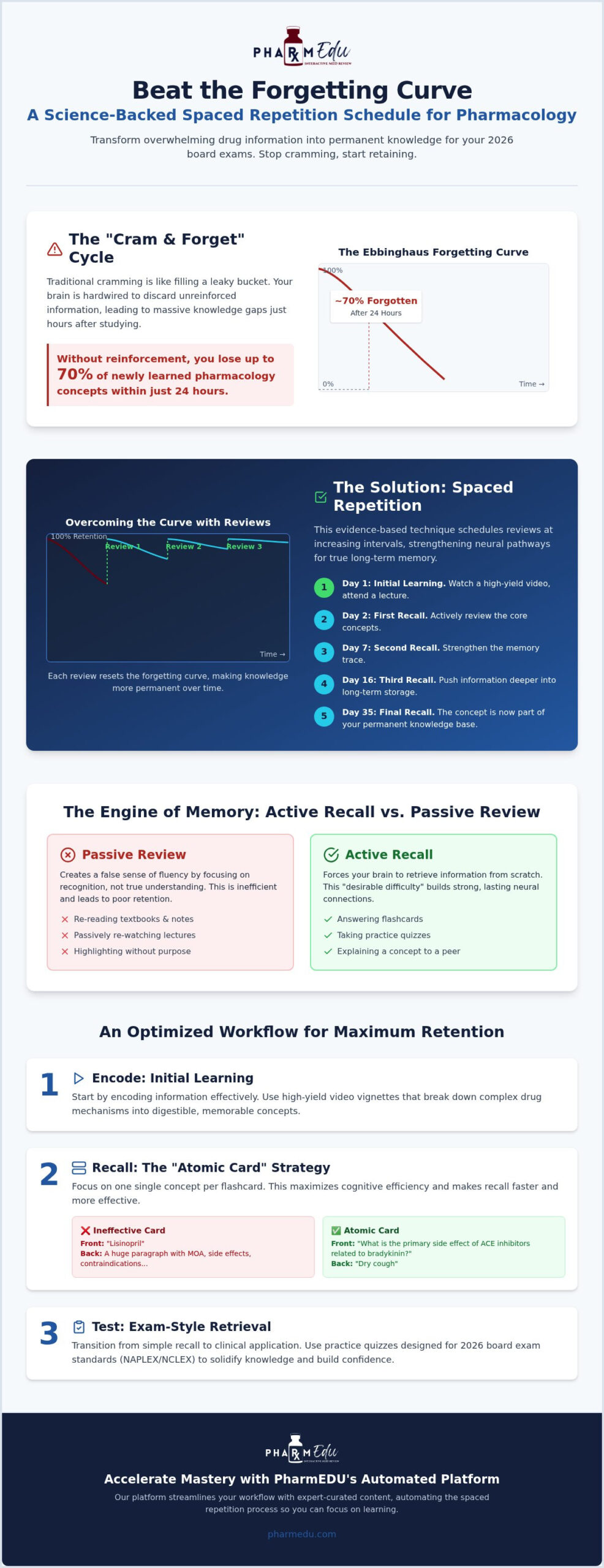
Research into the cognitive science of spaced repetition highlights the brutal reality of the Ebbinghaus Forgetting Curve. Without active reinforcement, students lose approximately 70% of new information within 24 hours. Pharmacology is particularly susceptible to this decay because drug names are often arbitrary and lack intuitive context. For example, mastering the class-wide effects and specific contraindications of ACE inhibitors requires more than a one-time lecture. The cognitive load is simply too high for a single exposure to stick.
Consistent, 15-minute daily reviews are significantly more effective than a 10-hour marathon session. By using a structured spaced repetition pharmacology schedule, you interrupt the decay process. Each review resets the forgetting curve, making the slope shallower each time until the knowledge becomes permanent. This methodical approach reduces the anxiety of “forgetting everything” because you’re working with your brain’s natural architecture rather than against it.
Active Recall: The Engine of Spaced Repetition
The secret to why this system works is active recall. This is the process of challenging your brain to retrieve information from scratch rather than simply recognizing it on a page. Recognition is a trap; you might recognize the name “Lisinopril” and assume you know its profile, but can you recall its specific effect on bradykinin levels without a prompt? Recognition lives in short-term memory, while recall builds the clinical confidence needed for practice.
PharmEDU’s Pharmacology Practice Quizzes are designed to facilitate this mental heavy lifting. Instead of passively looking at notes, you’re forced to pull the answer from your memory. This effort signals to your brain that the information is vital for professional survival, triggering the neuroplasticity needed for long-term storage. By shifting your focus from “input” (reading) to “output” (retrieving), you ensure that complex drug mechanisms are available for instant recall during your 2026 exams.
The Cognitive Science of Spaced Repetition: Overcoming the Forgetting Curve
Understanding why a spaced repetition pharmacology schedule works requires a look at the biological machinery of the human brain. Memory isn’t a static filing cabinet; it is a dynamic network of synaptic connections. Every time you retrieve the mechanism of a drug, you trigger neuroplasticity. This process strengthens the neural pathways associated with that information, making future retrieval faster and more reliable. By timing your reviews to occur just as you are about to forget, you maximize the “desirable difficulty” of the task. Research indicates that the harder your brain has to work to pull a fact from memory, the more permanent that memory becomes.
This scientific approach addresses the critical gap between short-term recognition and long-term mastery. Many students mistake the feeling of familiarity for actual knowledge. You might recognize a drug name on a multiple-choice quiz, but mastery means you can explain its pharmacokinetics in a clinical setting without prompts. Implementing a spaced repetition pharmacology schedule ensures your study time remains efficient by filtering out what you already know and focusing exclusively on the concepts at risk of fading.
The Spacing Effect and Synaptic Plasticity
The spacing effect is the phenomenon where learning is greater when studying is spread out over time. At a cellular level, neurons that “fire together, wire together.” However, this wiring requires downtime to solidify. Sleep is a non-negotiable part of this cycle. During rapid eye movement (REM) and deep sleep, the brain consolidates the day’s encoding into structural changes within the hippocampus and cortex. 2026 trends in medical education emphasize micro-learning, showing that short, frequent bursts of retrieval are superior to long sessions for mastering dense terminology. This approach prevents cognitive overload and keeps your synapses primed for new data.
Encoding Complexity: Making Drug Names Stick
Before you can repeat a concept, you must first understand it. This is the encoding phase. Rote memorization of drug lists is a recipe for failure because it lacks “conceptual anchoring.” You need a mental hook to hang the information on. Using high-yield video vignettes allows you to see the drug in a clinical context, creating a strong initial memory trace. When you see a patient scenario or a visual representation of a receptor, the drug name stops being an arbitrary string of letters and becomes a tool for a specific medical outcome.
Once you’ve established this baseline understanding, you can transition into the retrieval phase with confidence. If you’re ready to move beyond passive reading and start building a resilient knowledge base, you can explore our interactive pharmacology tools to see how science-backed design simplifies your study routine.
Creating Your Spaced Repetition Pharmacology Schedule: A Step-by-Step Template
Moving from theory to practice requires a structured calendar that removes the guesswork from your daily study routine. A well-designed spaced repetition pharmacology schedule ensures that you are always reviewing material at the precise moment of maximum cognitive benefit. This template follows a five-step progression designed to move drug data from initial exposure to permanent clinical mastery.
- Step 1: Initial Encoding (Day 0): Start by building a conceptual framework. Watch a high-yield video vignette to understand the “why” behind a drug class. Don’t worry about memorizing every detail yet; focus on the core mechanism and primary indications.
- Step 2: First Retrieval (Day 1): Test your memory 24 hours later using interactive flashcards. This session identifies what didn’t stick during the encoding phase.
- Step 3: Intermediate Review (Day 3 and Day 7): These sessions solidify the memory. If you recall a drug easily, the interval expands. If you struggle, the schedule resets for that specific card.
- Step 4: Long-term Consolidation (Day 30 and Day 90): These reviews move the information into deep storage. By this stage, you should be able to recall contraindications and side effects with minimal effort.
- Step 5: Targeted Weakness Review (Pre-Exam Blitz): In the final weeks before your board exam, focus exclusively on the cards that the system has flagged as “difficult.”
The 1-3-7-30 Day Interval Strategy
The 1-3-7-30 day strategy is particularly effective for dense classes like Beta-Blockers. On Day 0, you might learn the difference between selective and non-selective agents. By Day 3, your spaced repetition pharmacology schedule should challenge you to recall which agents are preferred for heart failure versus those used for portal hypertension. If you find the distinction between Metoprolol Succinate and Tartrate confusing, you should manually shorten the interval to review it daily until the confusion clears. For a broader look at how to align this with your testing dates, refer to our NAPLEX study schedule for board-specific timing and milestones.
Adapting the Schedule for High-Yield vs. Low-Yield Drugs
Not all drugs require the same level of attention. High-yield drugs are those most likely to appear on boards or those with a narrow therapeutic index. Safety-critical medications such as anticoagulants, insulin, and lithium require tighter review intervals. You can’t afford to forget the signs of toxicity or the specific reversal agents for these drugs. Conversely, low-yield or rarely prescribed medications can be managed with longer spacing. This prioritization prevents burnout by ensuring your mental energy is spent on the information that has the highest impact on your exam scores and future patient safety.
Optimizing Your Study Workflow: Active Recall and Flashcard Strategy
Executing a spaced repetition pharmacology schedule requires more than just a calendar; it demands a precise strategy for the content you review. The most common mistake students make is creating “kitchen sink” flashcards that contain too much information. If a single card asks for the mechanism of action, three side effects, and a black box warning, your brain might recall only two out of five facts. This leads to a false sense of security or an inaccurate interval reset. Instead, you should adhere to the “Atomic Card” principle. Each card should address exactly one concept, ensuring that your retrieval is binary: you either know it or you don’t.
Digital flashcards are the only viable way to manage this complexity in 2026. Manual tracking of hundreds of drug cards across shifting intervals is a logistical nightmare that often leads to burnout. Digital platforms automate the math, presenting only the cards you’re on the verge of forgetting. To maintain the integrity of your schedule, you must commit to “Zeroing Out” your daily deck. Letting reviews pile up breaks the forgetting curve reset, making the eventual study session twice as hard. Consistency, not intensity, is the primary driver of success in long-term retention.
Designing High-Yield Pharmacology Flashcards
Structure your deck by breaking drug profiles into distinct, bite-sized pieces. Create separate cards for the Mechanism of Action, specific Side Effects, and critical Black Box Warnings. For those in specialized clinical tracks, utilizing nursing pharmacology flash cards can provide the focused prep needed for patient-facing safety questions. We also encourage the use of mnemonics directly within the cards. These “mental shortcuts” provide an extra layer of sticky recall for particularly difficult generic names or complex interactions.
Integrating Quizzes into the SRS Cycle
While flashcards build foundational knowledge, Pharmacology Practice Quizzes validate that your spaced repetition pharmacology schedule is actually translating into clinical reasoning. We recommend taking an integrated quiz every seven days to practice “interleaving.” This technique mixes different drug classes together, mimicking the unpredictable nature of the NAPLEX or NCLEX. PharmEDU’s quizzes provide real-time data on your performance, allowing you to manually adjust your SRS intervals if a specific class consistently causes errors. You can start using our interactive pharmacology flashcards today to streamline your workflow and ensure every minute of study time counts toward your final score.
Accelerating Mastery with PharmEDU: The High-Yield Spaced Repetition Solution
Manually managing a spaced repetition pharmacology schedule is a significant administrative burden that most students can’t sustain alongside clinical rotations. PharmEDU eliminates this friction by automating the entire encoding-to-retrieval pipeline. Our platform features over 100 high-yield topics curated by healthcare educators, ensuring that you’re always studying the most relevant material for the 2026 licensing exams. By integrating High-Yield Video Vignettes with Interactive Pharmacology Flashcards, the system tracks your performance and adjusts review intervals in real-time. This precision allows you to focus your energy on the drug classes that challenge you most, rather than wasting time on concepts you’ve already mastered.
In the modern educational environment, digital tools have become the gold standard for comprehensive pharmacy review. Unlike static resources, PharmEDU evolves with your progress. The platform’s logic ensures that your spaced repetition pharmacology schedule remains optimized, preventing the cognitive overload that often leads to burnout. This data-driven approach transforms study sessions from a source of anxiety into a structured path toward professional readiness and clinical confidence.
Micro-Learning and Mobile Accessibility
Success in pharmacology doesn’t require four-hour marathon sessions. In fact, research shows that 5 to 10 minute micro-learning bursts throughout the day are more effective for long-term retention. PharmEDU’s mobile-compliant design is specifically built for this workflow. Whether you’re between classes or on a quick break during clinical rotations, you can complete a few cards or a short quiz. The app tracks your progress across all devices, so your data is always current. This flexibility ensures that “dead time” becomes productive study time, making it easier to maintain your schedule without sacrificing your personal well-being.
From Video Vignettes to Board Success
The journey toward board success starts with clear encoding. Our High-Yield Video Vignettes provide the clinical context needed to make drug names stick. Once you’ve established that initial understanding, the platform guides you through the retrieval phase with flashcards and Pharmacology Practice Quizzes. This seamless transition is why institutional partners trust the PharmEDU curriculum to prepare the next generation of healthcare professionals. Our evidence-based methodology isn’t just about passing an exam; it’s about building the foundational knowledge required for safe patient care. Start your journey toward mastery today with a PharmEDU Monthly or Annual Subscription.
Elevate Your Clinical Preparedness for 2026
Mastering complex drug classes requires a fundamental shift from passive reading to deliberate, interval-based retrieval. You’ve seen how the forgetting curve aggressively erodes knowledge without reinforcement and why a structured spaced repetition pharmacology schedule is your most effective defense against information overload. By focusing on atomic card design and leveraging the power of active recall, you transform fleeting data into a permanent clinical asset that stays with you long after the exam is over.
The transition from student to practitioner demands a reliable knowledge base that doesn’t fail under clinical pressure. PharmEDU provides the automated framework you need to succeed, offering High-Yield Video Vignettes, Interactive Pharmacology Flashcards optimized for SRS, and Practice Quizzes with real-time feedback. This evidence-based approach removes the administrative burden of tracking intervals, allowing you to focus on mastering the curriculum and passing your boards with total confidence.
Take the first step toward long-term retention and reduced study anxiety today. You can Master Pharmacology with a PharmEDU Monthly Subscription and join a community of healthcare professionals dedicated to academic excellence. Your future patients deserve a provider who doesn’t just recognize drug names but understands them deeply.
Frequently Asked Questions
Is spaced repetition effective for pharmacology memorization?
Spaced repetition is exceptionally effective for pharmacology because it directly counteracts the steep decay of the forgetting curve. Drug names and mechanisms are often arbitrary, making them difficult to retain without active retrieval. Implementing a spaced repetition pharmacology schedule ensures that you strengthen neural pathways at the optimal moment. Research indicates that this method can improve long-term memory retention by up to 331% compared to traditional passive reading or cramming.
How many pharmacology flashcards should I review per day?
The ideal number depends on your exam timeline, but 20 to 50 new cards per day is a sustainable range for most healthcare students. This volume prevents cognitive overload while ensuring steady progress through the curriculum. Remember that your daily total will include both new cards and scheduled reviews. Keeping your daily review count manageable ensures you “zero out” your deck consistently without experiencing burnout or mental fatigue.
What are the best intervals for a spaced repetition pharmacology schedule?
Optimal intervals usually follow an expanding sequence of 1 day, 3 days, 7 days, 30 days, and 90 days. This spaced repetition pharmacology schedule is designed to trigger a review just before the information is lost. Digital platforms like PharmEDU automate these intervals based on your performance, shortening the gap for difficult drug classes and extending it for mastered concepts. This precision ensures you spend your time where it is most needed.
Can I use spaced repetition for NAPLEX or NCLEX preparation?
Yes, spaced repetition is the gold standard for high-stakes licensing exams. These boards test a massive volume of information that is nearly impossible to retain through cramming alone. Integrating PharmEDU’s Interactive Pharmacology Flashcards into your board prep allows you to build a resilient knowledge base. This methodical approach ensures you can recall side effects and contraindications under the pressure of the testing center, where clinical reasoning is vital.
How do I handle “leech” cards that I keep forgetting?
Leech cards are concepts you consistently forget, often due to poor initial encoding or confusing mnemonics. When you encounter a leech, stop reviewing it temporarily and return to the high-yield video vignette for that topic. Re-watching the clinical context helps rebuild the mental framework. You might also need to break the card into smaller, “atomic” pieces to reduce the cognitive load of that specific drug profile or interaction.
Is it better to use digital or paper flashcards for spaced repetition?
Digital flashcards are superior for managing complex study schedules in 2026. While paper cards offer a tactile experience, they cannot automatically calculate the precise intervals needed to overcome the forgetting curve. Digital platforms like PharmEDU handle the logistical math for you, tracking your progress across devices and ensuring you never miss a critical review window during busy clinical rotations. This automation is essential for maintaining a long-term study habit.
How long does it take to see results from a spaced repetition schedule?
Most students notice a significant improvement in their recall within two to three weeks of consistent daily use. At first, the volume of reviews might feel challenging, but as the spacing intervals expand, your confidence in drug mechanisms will grow. You’ll find that you no longer struggle to recognize generic names and can accurately describe pharmacotherapeutic profiles during quizzes, clinical case studies, or hospital rounds with your preceptor.
Can I start spaced repetition just two weeks before my exam?
While starting early is ideal, you can still benefit from spaced repetition in a two-week “blitz.” In this scenario, you should focus exclusively on high-yield drug classes and safety-critical medications. Use the platform to identify your weakest areas through practice quizzes and then use flashcards to drill those specific concepts. It’s a much more efficient use of your remaining time than passive reading or re-watching entire lectures without active recall.