Medical School in 2026: The Ultimate Guide to Admissions, Curriculum, and Survival
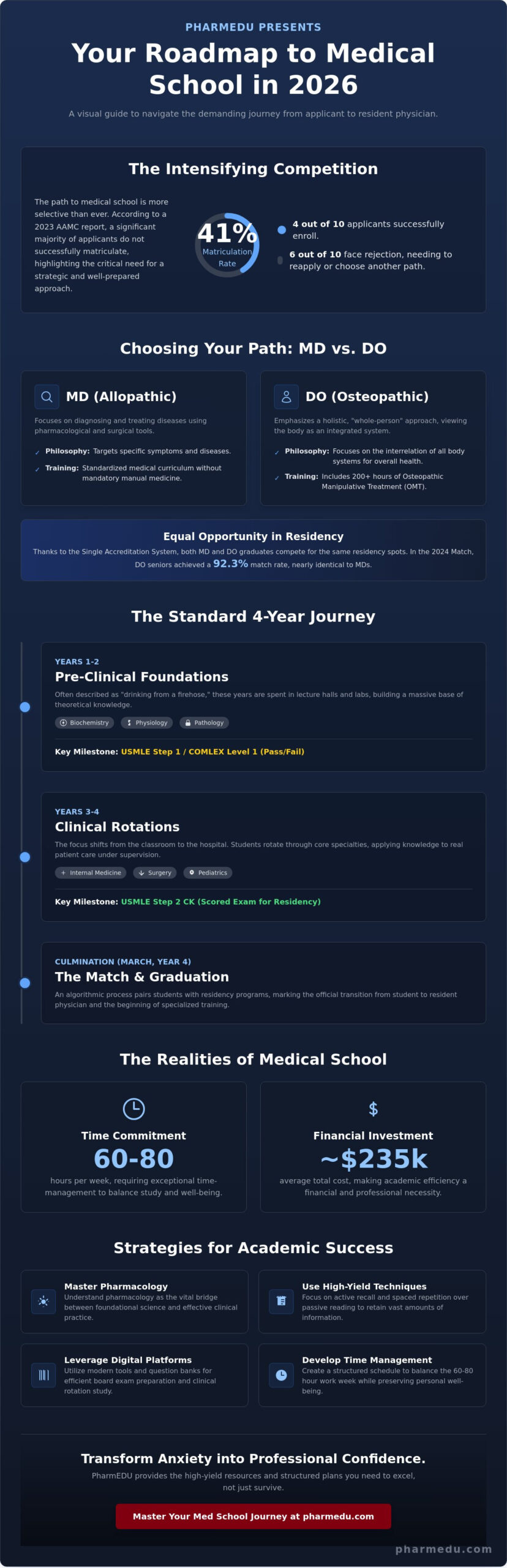
According to the Association of American Medical Colleges (AAMC) 2023 report, only 41% of applicants successfully matriculated into a program, a figure that highlights the intensifying competition in healthcare education. You’ve likely spent hundreds of hours staring at MCAT prep books, yet the fear of information overload and the daunting shadow of the USMLE Step 1 still keep you up at night. It’s natural to feel overwhelmed by the volume of requirements and the threat of burnout. Entering medical school in 2026 demands more than just high grades; it requires a strategic approach to your professional development.
This guide provides a structured, evidence-based roadmap to help you master every stage of your journey, ensuring you don’t just survive but actually excel. We’ll break down the 2026 admissions cycle, offer specific study frameworks for clinical rotations, and provide a clear timeline for the next four years of your life. You’ll leave with a precise plan to transform anxiety into professional confidence.
Key Takeaways
- Understand the critical distinctions between MD and DO pathways and learn how to navigate the evolving admissions requirements of the 2026 cycle.
- Master the transition from science-based foundations to clinical practice by focusing on pharmacology as the vital bridge to patient care.
- Develop effective time-management strategies to balance the rigorous 60-80 hour weekly demands of medical school while maintaining personal well-being.
- Identify high-yield study techniques and leverage modern digital platforms to optimize your preparation for board exams and clinical rotations.
What is Medical School in 2026? A National Overview
Medical school in 2026 remains the rigorous four year professional foundation required to practice medicine in the United States. This intensive program leads to either a Doctor of Medicine (MD) or a Doctor of Osteopathic Medicine (DO) degree. While both pathways license individuals to practice the full scope of medicine and surgery, the curriculum is designed to transform a student into a resident physician through a highly standardized national framework. When exploring the broader context of What is a Medical School?, it’s clear that the U.S. model focuses heavily on integrating clinical experience with advanced biological sciences early in the process.
Choosing this path requires a different commitment than other healthcare roles. For example, the process of becoming a pharmacist involves a deep dive into pharmacology and medication management, whereas medical school emphasizes diagnostic logic, surgical intervention, and direct patient management. The ultimate goal of these four years isn’t just graduation; it’s the successful transition into a residency program where specialized training begins.
MD vs. DO: Choosing Your Path
The distinction between Allopathic (MD) and Osteopathic (DO) pathways has narrowed significantly since the 2020 transition to a Single Accreditation System for graduate medical education. MD programs traditionally focus on allopathic medicine, which targets specific symptoms or diseases using various pharmacological or surgical tools. DO programs emphasize a holistic philosophy, often teaching that all body systems are interrelated. This includes 200 hours of training in Osteopathic Manipulative Treatment (OMT).
Today, students from both paths compete for the same residency spots. In the 2024 Match, DO seniors achieved a 92.3% match rate, nearly identical to their MD counterparts. You should choose based on whether the “whole person” philosophy of osteopathic medicine resonates with your personal approach to care, as the professional opportunities are now virtually equal.
The Standard 4-Year Timeline
The medical school journey is split into two distinct phases, each lasting roughly 24 months. This structure ensures that theoretical knowledge is solidified before students take on the responsibilities of patient interaction in a hospital setting.
- Years 1-2 (Pre-clinical): These years focus on the foundational sciences. You’ll spend your time in lecture halls and anatomy labs studying biochemistry, physiology, and pathology. By the end of year two, you’ll face the USMLE Step 1 or COMLEX Level 1, which are now pass/fail examinations.
- Years 3-4 (Clinical): The focus shifts to the hospital. You’ll complete core rotations in specialties like internal medicine, surgery, and pediatrics. Year four includes specialty electives and the critical USMLE Step 2 CK, which provides the numerical score residency directors use for ranking.
The culmination of this timeline is “The Match” in March of the fourth year. This algorithmic process pairs students with residency programs, marking the official end of undergraduate medical education and the start of professional practice.
The Academic Journey: From Pre-Clinical Foundations to Clinical Rotations
The transition into medical school marks a shift from general science to rigorous, integrated medical education. Most modern programs have abandoned the traditional siloed approach; instead, they favor organ-system-based learning. This methodology ensures students understand the heart or lungs from every angle, including anatomy, physiology, and pathology, in a single block. At the center of this integration sits pharmacology, which acts as the vital bridge between theoretical science and clinical practice. Understanding how drugs interact with these systems is what transforms a student into a clinician. While the curriculum is demanding, students must also consider the investment involved. According to the Education Data Initiative, The Cost of Medical School averages over $235,000, making academic efficiency a financial necessity as well as a professional one.
The Pre-Clinical Years: Drinking from a Firehose
The first 24 months of medical school are often described as drinking from a firehose because of the sheer volume of data. Students frequently fall into the trap of passive reading, which leads to rapid forgetting. Success requires mastering foundational sciences like biochemistry and anatomy as the bedrock for future board exams. To survive this phase, high-performing students utilize active recall and spaced repetition. Tools like Anki or digital flashcards help move information from short-term memory to long-term retention. This disciplined approach ensures that when you reach the wards, your foundational knowledge is accessible and precise.
Clinical Rotations: The Real-World Application
In the third and fourth years, the classroom disappears, and the hospital becomes the primary learning environment. You’ll rotate through the “Big Six” specialties:
- Internal Medicine: The foundation of adult hospital care and diagnostic reasoning.
- Surgery: Focusing on operative interventions and perioperative management.
- OB/GYN: Managing reproductive health, labor, and delivery.
- Pediatrics: Specialized care for infants, children, and adolescents.
- Psychiatry: Diagnosing and treating mental health disorders.
- Family Medicine: Comprehensive, longitudinal care for all ages.
Your final grade depends on a combination of clinical evaluations from attending physicians and standardized shelf exams. Beyond the scores, these years are about developing a professional bedside manner and refining clinical reasoning skills. You’ll learn to communicate complex diagnoses to patients while maintaining empathy. As you progress, staying ahead of clinical trends through structured platforms becomes a habit that supports your lifelong professional development and ensures you remain a mebdicsl expert in an evolving field.
Navigating the Admissions Maze: Requirements and Strategies
Securing a seat in a 2026 medical school class requires a strategy that balances objective data with a compelling narrative. Admissions committees have moved beyond simple GPA filters; they now seek candidates who demonstrate resilience and cultural competency. Data from recent cycles shows that the average matriculant GPA has reached 3.77, which means academic excellence is now the baseline rather than the primary differentiator. You’ll need a portfolio that proves you can handle the rigors of medicine while maintaining a human connection with patients.
Academic Prerequisites and the MCAT
Core requirements remain consistent across most institutions. You’ll need one year each of Biology, Physics, General Chemistry, and Organic Chemistry, all including laboratory components. Many programs now also recommend Biochemistry and Statistics to better prepare for the 2026 MCAT. For specific school variations, students should consult the Medical School Admission Requirements (MSAR) database. MCAT scores continue to climb. A score above the 80th percentile is often necessary for competitive MD programs. You should start intensive preparation at least six months before your test date. Holistic review is a mission-driven admissions process that evaluates an applicant’s academic metrics, personal experiences, and unique attributes to determine their potential contribution to the physician workforce.
Extracurriculars and the “Soft” Skills
Admissions teams prioritize sustained commitment over brief, high-profile internships. Service-based volunteering in underserved communities provides better evidence of empathy than a week-long international medical trip. You should aim for at least 150 hours of direct patient contact to prove you understand the clinical environment. Research remains vital, especially for R1 institutions, but it doesn’t always require a publication to be valuable. Your portfolio should include:
- Clinical Shadowing: Aim for 50 to 100 hours across multiple specialties to show a broad understanding of the field.
- Strong Letters of Recommendation: Secure 3 to 5 letters from faculty and clinicians who can provide specific examples of your character and work ethic.
- MMI Preparation: Practice the Multiple Mini Interview format, which uses 6 to 10 timed stations to assess your ethical decision-making and communication skills.
The personal statement is your chance to humanize your data. You shouldn’t rely on clichés about “wanting to help people.” Instead, focus on a specific clinical encounter or a personal challenge that shaped your resolve. This document must connect your past experiences to your future goals as a physician. It’s your narrative bridge. Make sure every word earns its place on the page. If you’ve faced setbacks, use this space to demonstrate how you’ve grown. A medical school application is a professional pitch; treat it with the precision and dignity the profession demands.
The Realities of Medical School: Costs, Time, and Resilience
Entering medical school requires a calculated assessment of the investment involved. It’s not just a cognitive challenge; it’s a financial and emotional marathon that demands structured preparation and a clear understanding of the professional landscape. Success depends on your ability to manage high-pressure environments while maintaining a focus on long-term career goals.
Financing Your Medical Education
By 2026, the median annual tuition for public institutions is projected to reach $45,000 for residents, while private schools often exceed $72,000. When you factor in living expenses, equipment, and exam fees, total four-year costs frequently surpass $360,000. Most students bridge this gap through federal Direct Unsubsidized Loans and Grad PLUS loans. For those seeking debt-free paths, the Health Professions Scholarship Program (HPSP) through the military or HRSA scholarships for primary care in underserved areas offer full tuition coverage in exchange for service. While the debt seems daunting, the long-term ROI remains strong. The median physician salary across all specialties was $229,000 in 2023, ensuring that with disciplined repayment strategies, the financial burden is manageable.
Maintaining Wellness and Avoiding Burnout
Survival in medical school hinges on managing 60 to 80-hour study weeks without sacrificing mental health. Data from the Journal of the American Medical Association indicates that approximately 27 percent of medical students experience symptoms of depression. Recognizing burnout early is critical. Signs include persistent fatigue, irritability, and a sense of detachment from clinical work. To sustain performance, you should adopt these strategies:
- Structured Peer Support: Small study groups help mitigate the isolation of heavy academic loads and provide a platform for shared problem-solving.
- Institutional Resources: Utilize wellness programs and counseling services which are now standard at 95 percent of accredited institutions.
- Physical Boundaries: Schedule non-negotiable time for exercise and social interaction to prevent cognitive fatigue.
Beyond the formal syllabus, you’ll encounter the “Hidden Curriculum.” This refers to the unwritten rules, professional hierarchies, and cultural norms within the clinical environment. Learning how to communicate effectively with attendings and residents is just as vital as mastering anatomy. Success requires a blend of clinical knowledge and the emotional intelligence to navigate these social structures efficiently.
Mastering High-Yield Subjects: Strategies for Academic Success
Success in medical school by 2026 depends on your ability to filter noise. The volume of peer-reviewed medical literature grows by approximately 7% annually, making it impossible to memorize every detail. Traditional methods often fail because they rely on linear reading of static materials. Students are increasingly pivoting toward digital platforms vs. traditional textbooks to ensure their information remains current with the latest clinical trials and FDA approvals. High-yield content focuses on the 20% of information that accounts for 80% of exam questions, a strategy that’s essential for surviving the updated USMLE and COMLEX formats.
Pharmacology: The Med School Hurdle
Pharmacology remains the most daunting pillar of the preclinical years. It’s not just about the sheer number of drug classes; it’s about the complex mechanisms of action and adverse effect profiles that appear on every major assessment. Data suggests that roughly 18% of USMLE Step 1 questions involve pharmacologic principles. Moving beyond rote memorization requires a conceptual approach where you link drugs to specific clinical pathologies. You’ll find that using mnemonics and case studies transforms abstract chemical names into clinical realities. Mobile-compliant tools are vital here. They allow you to review drug-drug interactions or contraindications during the 10-minute windows of clinical downtime, turning brief pauses in your schedule into productive study sessions.
Leveraging High-Yield Resources
Integrating PharmEDU into your daily workflow streamlines the preparation for high-stakes exams. By focusing on vignettes that mirror actual board questions, you bridge the gap between theory and patient care. The curriculum focuses on high-yield content, specifically targeting the drug classes most likely to appear in clinical scenarios, such as anti-infectives and cardiovascular agents. Micro-learning segments break down complex biochemical pathways into digestible five-minute intervals, which significantly reduces cognitive load for busy students. This methodical approach ensures you aren’t just studying harder, but studying with a precision that reflects the demands of modern medicine.
- Interactive flashcards: These tools use spaced repetition to ensure long-term retention of drug mechanisms.
- Video vignettes: Short, visual stories simulate patient encounters to provide context for therapeutic choices.
- Targeted Quizzes: Frequent testing helps identify knowledge gaps before they become exam-day failures.
By 2026, the most successful students will be those who treat their time as a finite resource. Utilizing a digital mentor like PharmEDU allows you to navigate the ever-expanding world of healthcare education with confidence. This strategy moves you away from the “firehose” method of learning and toward a structured, evidence-based mastery of the most critical medical concepts.
Building Your Future in Medicine
Success in medical school during the 2026 academic year requires a balance of clinical preparation and efficient study habits. The Association of American Medical Colleges reports over 53,000 applicants vying for limited spots annually, making precision in your application and academic performance essential. You’ll need to master over 200 core competencies while managing the 80-hour weekly commitment of clinical rotations. Efficiency is your greatest asset in this high-stakes environment.
Mastering complex subjects like pharmacology shouldn’t be a source of stress. You can master high-yield pharmacology with PharmEDU’s digital platform to stay ahead of the curve. Our platform features 100+ high-yield topics delivered through mobile-compliant micro-learning segments designed for a busy lifestyle. Use interactive flashcards and quizzes to reinforce your knowledge during short breaks. You’ve the talent to excel in healthcare; let the right tools support your growth every step of the way.
Frequently Asked Questions
How many years does it take to finish medical school?
Completing medical school takes four years of full-time study in the United States. The first two years focus on foundational sciences like physiology and pathology, while the final two years involve clinical rotations in hospitals. You’ll then spend three to seven years in residency training. Data from the AAMC shows that 82 percent of students graduate within this four-year timeframe, though some extend their studies for research or dual degrees.
Is medical school harder than undergraduate pre-med?
The professional curriculum is significantly more demanding than undergraduate pre-med due to the sheer volume of information. While pre-med focuses on individual subjects like organic chemistry, doctoral training requires mastering vast systems simultaneously. Students report spending 40 to 60 hours per week on independent study. It’s a shift from learning facts to applying complex clinical reasoning under pressure, which tests your endurance more than your initial undergraduate coursework did.
What is the average age of a first-year medical student?
The average age of a first-year student is 24 years old. This reflects a growing trend where 60 percent of applicants take at least one gap year before enrolling. Mature students bring diverse professional experiences that enhance their clinical empathy. According to 2023 enrollment statistics, the age range for matriculants typically spans from 21 to 35, proving that the path to a healthcare career isn’t restricted to recent college graduates.
Can I work a part-time job while in medical school?
Most administrations strongly discourage students from working part-time jobs during their studies. The academic workload effectively functions as a 60-hour or 80-hour work week, leaving little room for external employment. Some students find small opportunities for tutoring or research assistantships, but these rarely exceed 5 hours per week. Maintaining your academic standing is the priority, as failing even one module can jeopardize your entire professional timeline and financial investment.
What is the hardest subject in the medical school curriculum?
Gross Anatomy and Biochemistry are frequently ranked as the most difficult subjects in the medical school curriculum. Students must memorize over 1,000 anatomical structures and complex metabolic pathways within the first six months. Surveys from 2023 indicate that 25 percent of first-year students find the pace of Biochemistry particularly overwhelming. Success in these courses requires disciplined time management and the use of advanced digital learning tools to consolidate high volumes of specialized data.
How much does the average medical student graduate with in debt?
The average student graduates with $200,000 in educational debt according to 2023 AAMC reports. This figure includes tuition, fees, and living expenses accrued over the four-year program. Roughly 73 percent of graduates carry some form of student loan debt into their residency. While this number is high, the long-term earning potential in specialized medicine helps professionals manage these repayments through structured federal programs or hospital-based forgiveness initiatives after they enter the workforce.
What happens if you fail a class in medical school?
If you fail a class, you’ll likely undergo a formal remediation process overseen by an academic progress committee. This often involves retaking the exam or completing a summer intensive course to demonstrate competency. Statistics show that 95 percent of students who fail a single course successfully remediate and continue their education. However, failing multiple subjects might require you to repeat the entire academic year to ensure you meet the rigorous standards required for patient care.
How do I choose between an MD and a DO program?
You should choose between MD and DO programs based on your interest in Osteopathic Manipulative Medicine and a holistic approach to patient care. DO students complete 200 hours of specialized musculoskeletal training that MD students don’t receive. Both paths lead to the same residency opportunities and licensing privileges in all 50 states. Currently, 25 percent of all students in these programs are enrolled in DO tracks, reflecting the widespread acceptance of both degrees.