
How to Make Pharmacology Less Boring: 5 Proven Strategies for 2026

How to Make Pharmacology Less Boring: 5 Proven Strategies for 2026

What if the primary obstacle to mastering drug mechanisms isn’t your memory, but the way the information is delivered? Many healthcare students and professionals feel buried under a mountain of dry, academic language and endless lists of generic names that seem to vanish the moment the textbook closes. It’s a common frustration to feel like you’re memorizing data for a test rather than learning how to save a life. If you’ve been searching for how to make pharmacology less boring, you aren’t alone in feeling that the traditional approach is often soul-crushing, but there’s a more effective way to study.

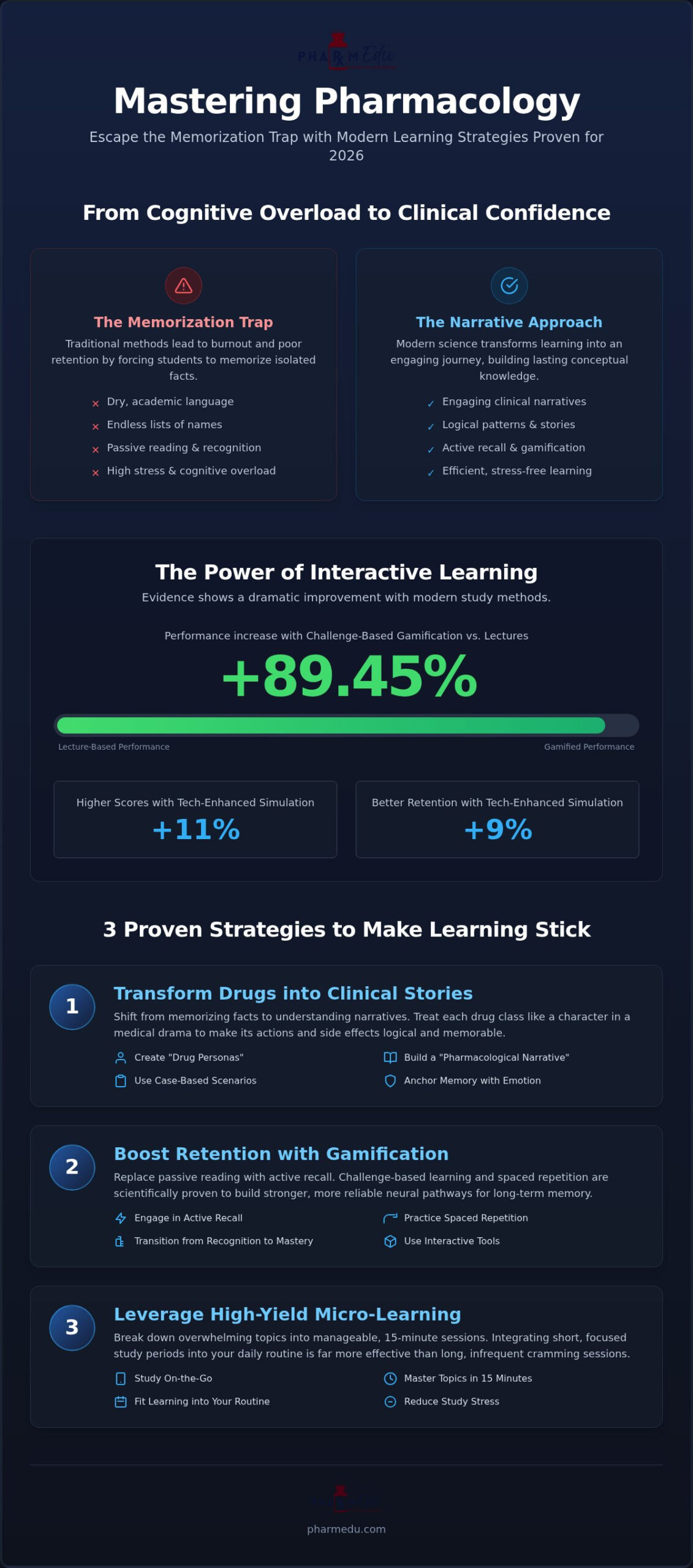
In this guide, you’ll discover how to transform static drug lists into engaging clinical narratives. We’ll show you how to connect complex theory to real-world practice so you can retain information longer. Evidence suggests that challenge-based gamification can improve student performance by 89.45% compared to lecture-based education. We’re going to preview five proven strategies for 2026, including micro-learning and high-yield video vignettes, that ensure you pass your exams with less stress. By moving beyond the lecture hall and into interactive, digital-first methods, you can finally master this critical subject while actually enjoying the process.

Key Takeaways

  • Move beyond the memorization trap by treating drug classes as characters in a clinical narrative rather than just names on a list.
  • Replace passive reading with active recall and spaced repetition to improve long-term retention and reduce study stress.
  • Learn how to make pharmacology less boring by integrating micro-learning sessions into your daily routine, mastering complex topics in just 15 minutes.
  • Discover how challenge-based gamification can significantly boost your performance compared to traditional lecture-based methods.
  • Transition from dry academic language to high-yield video vignettes and interactive tools to make your board preparation more efficient and engaging.

Why Does Pharmacology Feel So Boring?

Many students enter the healthcare field with a genuine passion for medicine, only to find themselves drowning in a sea of generic names and side effects. This disconnect creates a pervasive sense of boredom. It isn’t that the subject lacks excitement; it’s that the “Memorization Trap” forces you to prioritize isolated data points over clinical logic. When you’re searching for how to make pharmacology less boring, you’re essentially looking for a way to manage cognitive overload. When the brain is presented with too much unstructured information at once, it shuts down to protect its resources, leading to that familiar feeling of mental exhaustion and disengagement.

The Psychology of the Memorization Trap

The human brain is naturally wired to retain stories and logical patterns rather than isolated strings of text. When you attempt to memorize a list of 50 beta-blockers without first understanding the underlying physiology, your mind classifies that information as “noise” and discards it. This process is often worsened by the stress of upcoming boards. Elevated cortisol levels can inhibit long-term potentiation, making it physically more difficult for your neurons to form lasting memories. Most students also struggle with the difference between recognition and true mastery. You might feel like you know a drug because you recognize it on a page, but the cognitive science of active recall demonstrates that without active retrieval practice, that knowledge won’t stick when you’re under pressure in a clinical environment.

Textbooks vs. Modern Learning Science

Traditional 800-page textbooks are often the biggest barrier to engagement. These manuals are written as reference tools, not as educational guides for the modern learner. They present information in a linear, exhaustive format that completely ignores how we process visual stimuli. Statistics indicate that technology-enhanced simulation results in 11% higher scores on declarative knowledge and 9% better retention than these traditional methods. To truly master the material, you need to transition toward a comprehensive pharmacy review that utilizes modern learning science. Visual stimuli and interactive elements aren’t just “extras”; they’re essential tools that help bypass the dry, academic language that makes studying feel like a chore. Understanding how to make pharmacology less boring means moving from rote learning to a conceptual framework where every drug has a clear, logical purpose.

Strategy 1: Transforming Drug Classes into Clinical Stories

Learning how to make pharmacology less boring requires a fundamental shift from memorizing data to constructing a vivid “Pharmacological Narrative.” Instead of viewing a drug class as a static list of chemical properties, you should treat it as a character within a medical drama. Every character has specific behaviors, motivations, and predictable reactions. When you assign these human traits to medications, you stop fighting against your brain’s natural tendency to forget unrelated facts. You start building a mental framework where every side effect is a logical consequence of the drug’s “personality” rather than a random word to memorize.

Humanizing the Mechanism of Action

Think of ACE inhibitors not as a chemical formula, but as pressure relief valves for the heart. When the system is under too much tension, these drugs step in to open the vents and lower the stakes. You can create “Drug Personas” for common classes to aid your memory. For example, Beta-Blockers act like a strict mediator, stepping in to calm the sympathetic nervous system’s frantic demands during a crisis. The Mechanism of Action is the plot of a drug’s story, dictating exactly how the character interacts with the body’s internal environment. This approach aligns with effective learning strategies in medical school, which emphasize that contextualizing information is far superior to rote repetition.

The Power of Case-Based Learning

A patient’s face and history are far easier to recall than a paragraph of text. When you study through the lens of a clinical scenario, the stakes become real. You aren’t just learning about diuretics; you’re helping a 65 year old grandfather manage his congestive heart failure so he can attend a family wedding. This emotional connection acts as a “memory anchor,” making the pharmacological details much harder to lose. Bridging the gap between the lab and the bedside is essential for long-term retention. By using Clinical Case Studies, you can practice these real-world applications in a safe, digital environment. It’s much more engaging to solve a patient’s puzzle than to stare at a spreadsheet of generic names. This method ensures that when you see a similar case in your clinical rotations, the correct drug class and its potential side effects will come to mind naturally because you’ve already lived the story.

Strategy 2: Gamification and Active Recall Techniques

Passive reading is often the primary reason students feel disconnected from their coursework. Staring at a page for hours might feel like work, but it’s actually the most inefficient way to learn. If you’re wondering how to make pharmacology less boring, the answer lies in shifting from passive consumption to active engagement. The science of active recall involves forcing your brain to retrieve information rather than simply recognizing it on a screen. Research shows that challenge-based gamification can improve student performance by 89.45% compared to traditional lecture-based education. By turning study sessions into a series of active challenges, you move beyond the soul-crushing boredom and start building neural pathways that actually last.

Flashcards: Beyond Simple Definitions

High-yield flashcards are a cornerstone of effective retention, but only if they’re used correctly. Many students make the mistake of creating cards that are too wordy or focus on simple definitions. Instead, structure your cards to focus on one specific clinical fact or mechanism at a time. This keeps the cognitive load manageable and prevents burnout. It’s also vital to practice “interleaving,” which means mixing different drug classes within a single session. This mimics the reality of clinical practice where patients don’t present in alphabetical order. Utilizing a pharmacology study guide for nursing students can help you identify which topics deserve the most attention in your card decks. PharmEDU’s Interactive Pharmacology Flashcards are specifically designed to facilitate this type of spaced repetition, ensuring you review the most difficult concepts at the optimal time for long-term memory.

Quizzing as a Learning Tool, Not Just Assessment

Most learners view quizzes as a final test of knowledge, but they’re actually one of the most powerful teaching tools available. Taking a quiz before you even start a new module can prime your brain to look for specific answers, making your study time significantly more focused. This “pre-testing effect” helps you identify gaps in your knowledge early on. Gamifying your progress through score tracking and leaderboards also provides the dopamine hits needed to stay motivated during long study blocks. The global healthcare gamification market is projected to reach US$ 37.6 billion by 2034, highlighting a massive shift toward these interactive methods. When you use PharmEDU’s Pharmacology Practice Quizzes, you aren’t just checking your score; you’re engaging in a dynamic learning process that makes the material stick without the usual academic dry spells.
How to Make Pharmacology Less Boring: 5 Proven Strategies for 2026

Strategy 3: Leveraging High-Yield Micro-Learning

Micro-learning is the practice of breaking down complex topics into bite-sized, manageable units. In pharmacology, this means abandoning the idea that you need a two-hour block to make progress. If you want to know how to make pharmacology less boring, look at your calendar. The 15-minute rule allows you to master a single drug class during a coffee break or between clinical rounds. This approach prevents the mental fatigue associated with traditional 60-minute lectures, which often lead to passive “zoning out” rather than active engagement. As we move further into 2026, the demand for flexible, digital-first education continues to outpace traditional classroom settings. The microlearning market reached $3.32 billion in 2026, reflecting a global shift toward this highly efficient educational model.

The Science of Video Vignettes

Hour-long lectures often include unnecessary filler that doesn’t contribute to your final score. Data shows that microlearning has an average completion rate of 80%, while long-form courses hover around 20%. The brain retains 10-minute segments far better because it respects the limits of our working memory. High-yield content focuses strictly on the information you’ll actually see on exams and in practice. For instance, a targeted review of ace inhibitors provides the essential mechanism, side effects, and contraindications you need right now. By narrowing the focus, you reduce the cognitive burden and increase your confidence. This efficiency is why high-yield video vignettes have become the preferred antidote to dry textbooks.

Studying on the Go: Mobile Compliance

Most healthcare students and professionals have busy clinical schedules that don’t allow for hours of desk time. Mobile-compliant platforms allow you to turn “dead time” into productive study sessions. Whether you’re commuting, waiting for a lab result, or standing in line, you can complete a quick module. This “anytime, anywhere” mindset reduces the friction of starting a study session. When the barrier to entry is just a few taps on your phone, you’re more likely to stay consistent with your review. This flexibility is a key component of how to make pharmacology less boring, as it integrates learning into your life rather than forcing it to be a separate, painful event. You don’t need to be at a library to be a top-tier student.

To start optimizing your study time today, consider a PharmEDU Annual Subscription for access to our full library of mobile-friendly, high-yield content.

How PharmEDU Makes Pharmacology Click

PharmEDU serves as the definitive antidote to the soul-crushing boredom that often accompanies traditional medical education. We’ve designed a platform that respects your time and your intelligence, moving away from the “memorization trap” and toward true clinical mastery. If you’re looking for how to make pharmacology less boring, the solution is a multi-modal approach that mirrors real-world practice. Our library features over 100 topics delivered through high-yield video vignettes, ensuring you focus only on the most relevant information for your exams and your career. You don’t have to face the overwhelming volume of drug names alone; our digital mentor approach provides the structure needed to succeed.

The PharmEDU Methodology

The core of our methodology is the seamless integration of visual, auditory, and interactive learning tools. We don’t just provide videos; we surround them with Interactive Pharmacology Flashcards and Pharmacology Practice Quizzes that reinforce every concept. This system ensures that the information moves from your short-term memory into long-term retention. The platform tracks your progress toward board mastery, allowing you to see exactly where you stand in your preparation. Students prefer PharmEDU because it makes the material “stick” through logical progression. By using our Clinical Case Studies, you apply what you’ve learned to patient scenarios immediately, which is far more engaging than staring at a static list of contraindications. It’s a comprehensive system designed to reduce the administrative and mental burden of your education.

Your Path to Board Certification

Success on high-stakes exams requires more than just hard work; it requires the right strategy. PharmEDU is a critical component of any successful naplex prep course strategy, providing the clarity needed to pass with less stress. Whether you choose a PharmEDU Monthly Subscription or an Annual Subscription, you gain instant access to a full library of resources tailored to your specific needs. Transitioning from a student to a confident professional is a journey that requires a reliable partner. We provide the precision and support necessary to navigate the ever-changing landscape of drug regulations and scientific results. Remember that pharmacology doesn’t have to be a chore if you have the right tools. By embracing a modern, mobile-compliant platform, you can master the science of drugs while enjoying the learning process. Start your journey today and see how clear clinical logic can transform your professional life.

Mastering Pharmacology for Your Professional Future

Transitioning from dry textbooks to high-yield digital content isn’t just about efficiency; it’s about reclaiming your passion for clinical practice. By treating drug classes as clinical narratives and implementing active recall techniques, you’ve discovered how to make pharmacology less boring while building a foundation for long-term retention. These strategies ensure that complex mechanisms of action become logical tools rather than isolated facts you’ll forget after the exam.

The shift toward micro-learning allows you to integrate mastery into the busiest clinical schedule, effectively turning minor breaks into high-impact study sessions. With a reliable digital partner, the mental burden of board preparation becomes manageable. You’re no longer just memorizing names; you’re preparing to provide exceptional patient care with precision. Our platform supports this journey with over 100 high-yield topics and a mobile-compliant design for busy students. You can access a comprehensive library of videos, flashcards, and quizzes that make learning stick.

Start Your PharmEDU Subscription Today and Master Pharmacology Faster

You have the potential to excel in your licensing exams and your future career. Your professional growth starts with a smarter, more engaging approach to the science of drugs. Take the next step toward your certification with confidence.

Frequently Asked Questions

Why is pharmacology so hard for most students to enjoy?

Pharmacology feels difficult because it’s often taught as a list of unrelated generic names and numbers. Most students get stuck in the memorization trap where they prioritize data over clinical logic. Shifting your focus to the “why” behind the drug makes the subject far more accessible. Learning how to make pharmacology less boring involves moving away from passive reading and toward active, conceptual understanding.

Can I really learn pharmacology in 15-minute sessions?

You can absolutely master complex topics in 15-minute windows using micro-learning strategies. This method works because it aligns with how our brains process information, preventing the fatigue of long lectures. By tackling one drug class per break, you maintain high focus and improve retention rates. It’s a proven way to fit board prep into a demanding clinical schedule without feeling overwhelmed.

What are high-yield video vignettes and how do they help?

High-yield video vignettes are short, targeted presentations that focus strictly on the most critical information for exams and practice. They eliminate the filler content found in traditional 60-minute lectures. These vignettes act as a digital mentor, guiding you through essential mechanisms and side effects. They’re designed to keep you engaged while ensuring you’re fully prepared for high-stakes licensing boards.

How do clinical case studies make pharmacology less boring?

Clinical case studies transform dry lists of side effects into a human narrative with real-world stakes. It’s much easier to remember a medication’s impact when you see it applied to a specific patient scenario. These stories act as memory anchors, bridging the gap between theory and the bedside. When the information has a face and a history, the subject becomes a puzzle to solve rather than a chore to memorize.

Is it better to use flashcards or practice quizzes?

The most effective strategy is to combine both interactive flashcards and practice quizzes. Flashcards are ideal for spaced repetition and mastering specific clinical facts over time. Quizzes, on the other hand, provide active recall and help you identify knowledge gaps before they become a problem. Using both ensures you’re moving beyond simple recognition and toward true mastery of the material.

How can I prepare for the NAPLEX without getting burned out?

To avoid burnout, replace long, passive study sessions with active recall and micro-learning. Focusing on high-yield content ensures you aren’t wasting energy on low-priority details. Using a mobile-compliant platform allows you to study in short bursts throughout the day. This approach reduces the friction of starting and keeps your motivation levels consistent during the long road to board certification.

Do I need a physical textbook if I use an online platform?

You don’t need a physical textbook if you’re utilizing a comprehensive digital platform like PharmEDU. Modern digital resources provide more interactive and high-yield information than a static 800-page manual can offer. These platforms are updated more frequently and designed specifically for the way students learn today. Shifting to a digital-first approach is a key part of how to make pharmacology less boring and more efficient.

What is the most effective way to memorize drug side effects?

The best way to memorize side effects is to link them directly to the drug’s mechanism of action. When you understand the plot of the drug’s story, the side effects become a logical consequence of its behavior in the body. Treating each drug class like a character with predictable reactions makes the details stick. This conceptual framework is much more reliable than trying to memorize random lists under stress.
What if the primary obstacle to mastering drug mechanisms isn’t your memory, but the way the information is delivered? Many healthcare students and professionals feel buried under a mountain of dry, academic language and endless lists of generic names that seem to vanish the moment the textbook closes. It’s a common frustration to feel like you’re memorizing data for a test rather than learning how to save a life. If you’ve been searching for how to make pharmacology less boring, you aren’t alone in feeling that the traditional approach is often soul-crushing, but there’s a more effective way to study.

In this guide, you’ll discover how to transform static drug lists into engaging clinical narratives. We’ll show you how to connect complex theory to real-world practice so you can retain information longer. Evidence suggests that challenge-based gamification can improve student performance by 89.45% compared to lecture-based education. We’re going to preview five proven strategies for 2026, including micro-learning and high-yield video vignettes, that ensure you pass your exams with less stress. By moving beyond the lecture hall and into interactive, digital-first methods, you can finally master this critical subject while actually enjoying the process.

Key Takeaways

  • Move beyond the memorization trap by treating drug classes as characters in a clinical narrative rather than just names on a list.
  • Replace passive reading with active recall and spaced repetition to improve long-term retention and reduce study stress.
  • Learn how to make pharmacology less boring by integrating micro-learning sessions into your daily routine, mastering complex topics in just 15 minutes.
  • Discover how challenge-based gamification can significantly boost your performance compared to traditional lecture-based methods.
  • Transition from dry academic language to high-yield video vignettes and interactive tools to make your board preparation more efficient and engaging.

Why Does Pharmacology Feel So Boring?

Many students enter the healthcare field with a genuine passion for medicine, only to find themselves drowning in a sea of generic names and side effects. This disconnect creates a pervasive sense of boredom. It isn’t that the subject lacks excitement; it’s that the “Memorization Trap” forces you to prioritize isolated data points over clinical logic. When you’re searching for how to make pharmacology less boring, you’re essentially looking for a way to manage cognitive overload. When the brain is presented with too much unstructured information at once, it shuts down to protect its resources, leading to that familiar feeling of mental exhaustion and disengagement.

The Psychology of the Memorization Trap

The human brain is naturally wired to retain stories and logical patterns rather than isolated strings of text. When you attempt to memorize a list of 50 beta-blockers without first understanding the underlying physiology, your mind classifies that information as “noise” and discards it. This process is often worsened by the stress of upcoming boards. Elevated cortisol levels can inhibit long-term potentiation, making it physically more difficult for your neurons to form lasting memories. Most students also struggle with the difference between recognition and true mastery. You might feel like you know a drug because you recognize it on a page, but the cognitive science of active recall demonstrates that without active retrieval practice, that knowledge won’t stick when you’re under pressure in a clinical environment.

Textbooks vs. Modern Learning Science

Traditional 800-page textbooks are often the biggest barrier to engagement. These manuals are written as reference tools, not as educational guides for the modern learner. They present information in a linear, exhaustive format that completely ignores how we process visual stimuli. Statistics indicate that technology-enhanced simulation results in 11% higher scores on declarative knowledge and 9% better retention than these traditional methods. To truly master the material, you need to transition toward a comprehensive pharmacy review that utilizes modern learning science. Visual stimuli and interactive elements aren’t just “extras”; they’re essential tools that help bypass the dry, academic language that makes studying feel like a chore. Understanding how to make pharmacology less boring means moving from rote learning to a conceptual framework where every drug has a clear, logical purpose.

Strategy 1: Transforming Drug Classes into Clinical Stories

Learning how to make pharmacology less boring requires a fundamental shift from memorizing data to constructing a vivid “Pharmacological Narrative.” Instead of viewing a drug class as a static list of chemical properties, you should treat it as a character within a medical drama. Every character has specific behaviors, motivations, and predictable reactions. When you assign these human traits to medications, you stop fighting against your brain’s natural tendency to forget unrelated facts. You start building a mental framework where every side effect is a logical consequence of the drug’s “personality” rather than a random word to memorize.

Humanizing the Mechanism of Action

Think of ACE inhibitors not as a chemical formula, but as pressure relief valves for the heart. When the system is under too much tension, these drugs step in to open the vents and lower the stakes. You can create “Drug Personas” for common classes to aid your memory. For example, Beta-Blockers act like a strict mediator, stepping in to calm the sympathetic nervous system’s frantic demands during a crisis. The Mechanism of Action is the plot of a drug’s story, dictating exactly how the character interacts with the body’s internal environment. This approach aligns with effective learning strategies in medical school, which emphasize that contextualizing information is far superior to rote repetition.

The Power of Case-Based Learning

A patient’s face and history are far easier to recall than a paragraph of text. When you study through the lens of a clinical scenario, the stakes become real. You aren’t just learning about diuretics; you’re helping a 65 year old grandfather manage his congestive heart failure so he can attend a family wedding. This emotional connection acts as a “memory anchor,” making the pharmacological details much harder to lose. Bridging the gap between the lab and the bedside is essential for long-term retention. By using Clinical Case Studies, you can practice these real-world applications in a safe, digital environment. It’s much more engaging to solve a patient’s puzzle than to stare at a spreadsheet of generic names. This method ensures that when you see a similar case in your clinical rotations, the correct drug class and its potential side effects will come to mind naturally because you’ve already lived the story.

Strategy 2: Gamification and Active Recall Techniques

Passive reading is often the primary reason students feel disconnected from their coursework. Staring at a page for hours might feel like work, but it’s actually the most inefficient way to learn. If you’re wondering how to make pharmacology less boring, the answer lies in shifting from passive consumption to active engagement. The science of active recall involves forcing your brain to retrieve information rather than simply recognizing it on a screen. Research shows that challenge-based gamification can improve student performance by 89.45% compared to traditional lecture-based education. By turning study sessions into a series of active challenges, you move beyond the soul-crushing boredom and start building neural pathways that actually last.

Flashcards: Beyond Simple Definitions

High-yield flashcards are a cornerstone of effective retention, but only if they’re used correctly. Many students make the mistake of creating cards that are too wordy or focus on simple definitions. Instead, structure your cards to focus on one specific clinical fact or mechanism at a time. This keeps the cognitive load manageable and prevents burnout. It’s also vital to practice “interleaving,” which means mixing different drug classes within a single session. This mimics the reality of clinical practice where patients don’t present in alphabetical order. Utilizing a pharmacology study guide for nursing students can help you identify which topics deserve the most attention in your card decks. PharmEDU’s Interactive Pharmacology Flashcards are specifically designed to facilitate this type of spaced repetition, ensuring you review the most difficult concepts at the optimal time for long-term memory.

Quizzing as a Learning Tool, Not Just Assessment

Most learners view quizzes as a final test of knowledge, but they’re actually one of the most powerful teaching tools available. Taking a quiz before you even start a new module can prime your brain to look for specific answers, making your study time significantly more focused. This “pre-testing effect” helps you identify gaps in your knowledge early on. Gamifying your progress through score tracking and leaderboards also provides the dopamine hits needed to stay motivated during long study blocks. The global healthcare gamification market is projected to reach US$ 37.6 billion by 2034, highlighting a massive shift toward these interactive methods. When you use PharmEDU’s Pharmacology Practice Quizzes, you aren’t just checking your score; you’re engaging in a dynamic learning process that makes the material stick without the usual academic dry spells.

How to Make Pharmacology Less Boring: 5 Proven Strategies for 2026

Strategy 3: Leveraging High-Yield Micro-Learning

Micro-learning is the practice of breaking down complex topics into bite-sized, manageable units. In pharmacology, this means abandoning the idea that you need a two-hour block to make progress. If you want to know how to make pharmacology less boring, look at your calendar. The 15-minute rule allows you to master a single drug class during a coffee break or between clinical rounds. This approach prevents the mental fatigue associated with traditional 60-minute lectures, which often lead to passive “zoning out” rather than active engagement. As we move further into 2026, the demand for flexible, digital-first education continues to outpace traditional classroom settings. The microlearning market reached $3.32 billion in 2026, reflecting a global shift toward this highly efficient educational model.

The Science of Video Vignettes

Hour-long lectures often include unnecessary filler that doesn’t contribute to your final score. Data shows that microlearning has an average completion rate of 80%, while long-form courses hover around 20%. The brain retains 10-minute segments far better because it respects the limits of our working memory. High-yield content focuses strictly on the information you’ll actually see on exams and in practice. For instance, a targeted review of ace inhibitors provides the essential mechanism, side effects, and contraindications you need right now. By narrowing the focus, you reduce the cognitive burden and increase your confidence. This efficiency is why high-yield video vignettes have become the preferred antidote to dry textbooks.

Studying on the Go: Mobile Compliance

Most healthcare students and professionals have busy clinical schedules that don’t allow for hours of desk time. Mobile-compliant platforms allow you to turn “dead time” into productive study sessions. Whether you’re commuting, waiting for a lab result, or standing in line, you can complete a quick module. This “anytime, anywhere” mindset reduces the friction of starting a study session. When the barrier to entry is just a few taps on your phone, you’re more likely to stay consistent with your review. This flexibility is a key component of how to make pharmacology less boring, as it integrates learning into your life rather than forcing it to be a separate, painful event. You don’t need to be at a library to be a top-tier student.

To start optimizing your study time today, consider a PharmEDU Annual Subscription for access to our full library of mobile-friendly, high-yield content.

How PharmEDU Makes Pharmacology Click

PharmEDU serves as the definitive antidote to the soul-crushing boredom that often accompanies traditional medical education. We’ve designed a platform that respects your time and your intelligence, moving away from the “memorization trap” and toward true clinical mastery. If you’re looking for how to make pharmacology less boring, the solution is a multi-modal approach that mirrors real-world practice. Our library features over 100 topics delivered through high-yield video vignettes, ensuring you focus only on the most relevant information for your exams and your career. You don’t have to face the overwhelming volume of drug names alone; our digital mentor approach provides the structure needed to succeed.

The PharmEDU Methodology

The core of our methodology is the seamless integration of visual, auditory, and interactive learning tools. We don’t just provide videos; we surround them with Interactive Pharmacology Flashcards and Pharmacology Practice Quizzes that reinforce every concept. This system ensures that the information moves from your short-term memory into long-term retention. The platform tracks your progress toward board mastery, allowing you to see exactly where you stand in your preparation. Students prefer PharmEDU because it makes the material “stick” through logical progression. By using our Clinical Case Studies, you apply what you’ve learned to patient scenarios immediately, which is far more engaging than staring at a static list of contraindications. It’s a comprehensive system designed to reduce the administrative and mental burden of your education.

Your Path to Board Certification

Success on high-stakes exams requires more than just hard work; it requires the right strategy. PharmEDU is a critical component of any successful naplex prep course strategy, providing the clarity needed to pass with less stress. Whether you choose a PharmEDU Monthly Subscription or an Annual Subscription, you gain instant access to a full library of resources tailored to your specific needs. Transitioning from a student to a confident professional is a journey that requires a reliable partner. We provide the precision and support necessary to navigate the ever-changing landscape of drug regulations and scientific results. Remember that pharmacology doesn’t have to be a chore if you have the right tools. By embracing a modern, mobile-compliant platform, you can master the science of drugs while enjoying the learning process. Start your journey today and see how clear clinical logic can transform your professional life.

Mastering Pharmacology for Your Professional Future

Transitioning from dry textbooks to high-yield digital content isn’t just about efficiency; it’s about reclaiming your passion for clinical practice. By treating drug classes as clinical narratives and implementing active recall techniques, you’ve discovered how to make pharmacology less boring while building a foundation for long-term retention. These strategies ensure that complex mechanisms of action become logical tools rather than isolated facts you’ll forget after the exam.

The shift toward micro-learning allows you to integrate mastery into the busiest clinical schedule, effectively turning minor breaks into high-impact study sessions. With a reliable digital partner, the mental burden of board preparation becomes manageable. You’re no longer just memorizing names; you’re preparing to provide exceptional patient care with precision. Our platform supports this journey with over 100 high-yield topics and a mobile-compliant design for busy students. You can access a comprehensive library of videos, flashcards, and quizzes that make learning stick.

Start Your PharmEDU Subscription Today and Master Pharmacology Faster

You have the potential to excel in your licensing exams and your future career. Your professional growth starts with a smarter, more engaging approach to the science of drugs. Take the next step toward your certification with confidence.

Frequently Asked Questions

Why is pharmacology so hard for most students to enjoy?

Pharmacology feels difficult because it’s often taught as a list of unrelated generic names and numbers. Most students get stuck in the memorization trap where they prioritize data over clinical logic. Shifting your focus to the “why” behind the drug makes the subject far more accessible. Learning how to make pharmacology less boring involves moving away from passive reading and toward active, conceptual understanding.

Can I really learn pharmacology in 15-minute sessions?

You can absolutely master complex topics in 15-minute windows using micro-learning strategies. This method works because it aligns with how our brains process information, preventing the fatigue of long lectures. By tackling one drug class per break, you maintain high focus and improve retention rates. It’s a proven way to fit board prep into a demanding clinical schedule without feeling overwhelmed.

What are high-yield video vignettes and how do they help?

High-yield video vignettes are short, targeted presentations that focus strictly on the most critical information for exams and practice. They eliminate the filler content found in traditional 60-minute lectures. These vignettes act as a digital mentor, guiding you through essential mechanisms and side effects. They’re designed to keep you engaged while ensuring you’re fully prepared for high-stakes licensing boards.

How do clinical case studies make pharmacology less boring?

Clinical case studies transform dry lists of side effects into a human narrative with real-world stakes. It’s much easier to remember a medication’s impact when you see it applied to a specific patient scenario. These stories act as memory anchors, bridging the gap between theory and the bedside. When the information has a face and a history, the subject becomes a puzzle to solve rather than a chore to memorize.

Is it better to use flashcards or practice quizzes?

The most effective strategy is to combine both interactive flashcards and practice quizzes. Flashcards are ideal for spaced repetition and mastering specific clinical facts over time. Quizzes, on the other hand, provide active recall and help you identify knowledge gaps before they become a problem. Using both ensures you’re moving beyond simple recognition and toward true mastery of the material.

How can I prepare for the NAPLEX without getting burned out?

To avoid burnout, replace long, passive study sessions with active recall and micro-learning. Focusing on high-yield content ensures you aren’t wasting energy on low-priority details. Using a mobile-compliant platform allows you to study in short bursts throughout the day. This approach reduces the friction of starting and keeps your motivation levels consistent during the long road to board certification.

Do I need a physical textbook if I use an online platform?

You don’t need a physical textbook if you’re utilizing a comprehensive digital platform like PharmEDU. Modern digital resources provide more interactive and high-yield information than a static 800-page manual can offer. These platforms are updated more frequently and designed specifically for the way students learn today. Shifting to a digital-first approach is a key part of how to make pharmacology less boring and more efficient.

What is the most effective way to memorize drug side effects?

The best way to memorize side effects is to link them directly to the drug’s mechanism of action. When you understand the plot of the drug’s story, the side effects become a logical consequence of its behavior in the body. Treating each drug class like a character with predictable reactions makes the details stick. This conceptual framework is much more reliable than trying to memorize random lists under stress.
Similar Posts

Leave a Reply

Your email address will not be published. Required fields are marked *