Nursing Pharmacology Flashcards: 2026 Mastery Guide
What if the secret to surviving pharmacology isn’t spending more hours with your 1,200-page textbook, but spending fewer, more intentional minutes with a digital mentor? You’ve likely felt the crushing weight of information overload as drug classes, mechanisms, and side effects blur into an unrecognizable haze. Using interactive pharmacology flashcards for nursing students can bridge the gap between temporary memorization and the deep, clinical understanding required to avoid medication errors during your rotations.
This guide will show you how to leverage these tools to achieve long-term retention and higher exam scores while significantly reducing your study time. By moving away from passive reading and toward active, science-backed recall, you’ll find that mastering complex medications becomes a manageable part of your routine rather than a source of dread. We’ll examine the science of micro-learning, provide a roadmap for mastering high-yield drug vignettes, and explain how modern tools build the clinical confidence you need to excel in 2026 and throughout your professional career.
Key Takeaways
- Understand why traditional study methods often lead to information overload and how to transition toward a high-yield learning strategy.
- Discover how interactive pharmacology flashcards for nursing students utilize active recall and spaced repetition to ensure long-term retention of drug mechanisms.
- Learn the “Suffix Strategy” to quickly identify drug families and anticipate side effects by focusing on prototype agents rather than individual generic names.
- Compare the benefits of digital study tools over physical decks, including portability and real-time updates for new drug approvals and safety warnings.
- Explore how integrating flashcards with video vignettes and practice quizzes creates a multi-modal learning experience that builds clinical confidence.
The Pharmacology Hurdle: Why Flashcards are Essential for Nursing Students
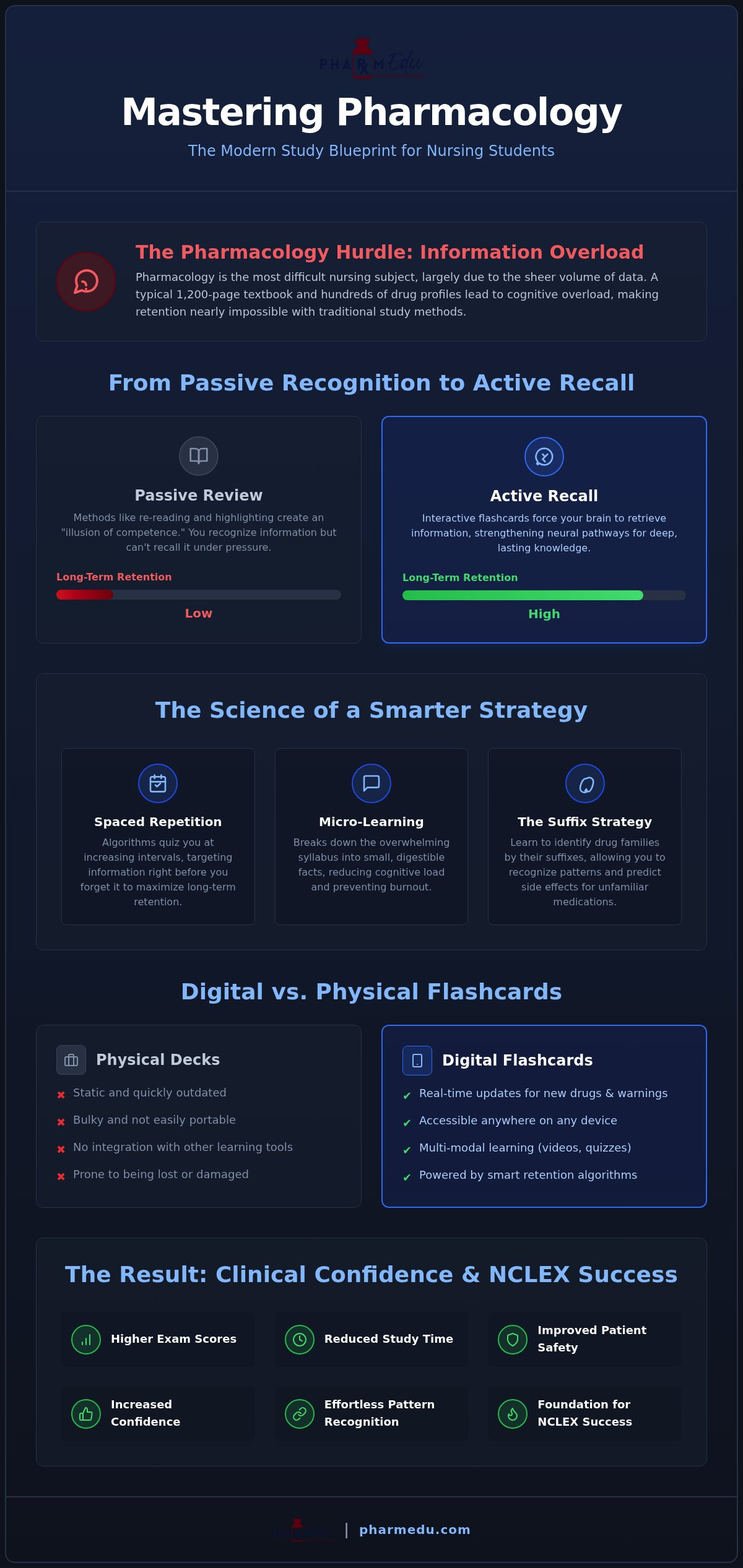
Pharmacology is consistently cited as the most difficult subject in the nursing school curriculum. The challenge isn’t just the complexity of the science; it’s the sheer volume of data. Students must navigate a labyrinth of generic names, proprietary brand names, and intricate biochemical mechanisms while simultaneously managing their clinical rotations. This “Volume Problem” often leads to a reliance on passive study methods, such as re-reading chapters or highlighting text. However, these methods frequently create an illusion of competence. You might recognize a drug name on a page, but true clinical safety requires the ability to recall its contraindications under pressure. Interactive pharmacology flashcards for nursing students bridge this gap by shifting the focus from recognition to active retrieval.
The Reality of Information Overload in Nursing School
The human brain isn’t designed to absorb a 1,200-page textbook through brute force. When you’re faced with hundreds of drug profiles, cognitive load becomes a significant barrier to learning. Breaking this massive syllabus into micro-learning segments is the only sustainable way to move forward. By using flashcards, you isolate specific facts, which reduces the mental fatigue associated with long study sessions. Traditional note-taking often fails because it encourages “recognition” learning. You feel like you know the material because it looks familiar, but interactive pharmacology flashcards for nursing students force your brain to work. This effort strengthens the neural pathways associated with each drug, ensuring the information is available when you’re standing at a patient’s bedside or sitting in an exam hall.
Flashcards as a Foundation for NCLEX Success
Board examinations and clinical safety both rely on your ability to identify patterns rather than just memorizing isolated facts. The NCLEX heavily weights pharmacological interventions because they are tied directly to patient safety and the prevention of medical errors. Mastering this subject requires building a mental “drug library” that you can access instantly. Flashcards facilitate this by helping you transition from rote memorization to identifying drug-class patterns. Consider the benefits of this approach:
- Pattern Recognition: You learn to associate specific suffixes with entire drug families, allowing you to predict side effects for medications you haven’t even studied yet.
- Clinical Confidence: Rapid recall of contraindications reduces the anxiety often felt during clinical rotations.
- Exam Efficiency: Strengthening your recall through spaced repetition allows you to answer questions faster and with higher accuracy.
Ultimately, flashcards serve as more than just a study tool; they are a foundational element of professional preparation. They transform a chaotic list of chemicals into an organized, accessible body of knowledge that supports both your academic goals and your future as a safe, competent healthcare provider.
Why ‘Interactive’ Matters: The Science of Active Recall and Spaced Repetition
The transition from traditional studying to modern mastery relies on more than just digital convenience. Interactive pharmacology flashcards for nursing students utilize sophisticated algorithms to quiz users at strategically increasing intervals. This isn’t just a digitized version of a paper deck; it’s a tool designed to synchronize with your brain’s neurobiology. By moving away from static lists, these platforms address the “Forgetting Curve,” a psychological phenomenon where information is lost over time if not actively reinforced. Digital interactivity ensures that you’re not just looking at a drug name, but engaging in a dialogue with the material that corrects misconceptions in real time.
Active Recall vs. Passive Review
Active Recall is the process of actively stimulating memory during the learning process. When you read a textbook or highlight a syllabus, you’re engaging in passive review. This often leads to “fluency bias,” where you mistake familiarity for knowledge. You recognize the words on the page, so you assume you’ve mastered the content. In contrast, flashcards force you to retrieve information from scratch. This effortful processing signals to your brain that the data is critical for survival. While these “hard” study sessions might feel more taxing, they lead to significantly better long-term memory than “easy” reading. Testing yourself frequently transforms the learning process from a memorization chore into a durable clinical skill.
Spaced Repetition: Beating the Forgetting Curve
Spaced Repetition Systems (SRS) are the engine behind effective digital learning. These platforms calculate the optimal time to show you a card again, usually just as you’re about to forget it. This method is far superior to physical boxes because it manages your review schedule automatically. It prioritizes the drug classes you struggle with while pushing mastered content further into the future. This efficiency allows you to focus your limited energy where it’s needed most. Instead of wasting hours reviewing what you already know, you’re constantly challenged by the medications that haven’t yet stuck.
The immediate feedback provided by digital tools is also vital for clinical safety. If you misidentify a mechanism of action, the system provides the correct answer instantly, preventing the reinforcement of incorrect information. This precision is what builds the confidence required for high-stakes clinical rotations. To experience how science-backed learning can streamline your preparation, you can explore Interactive Pharmacology Flashcards that integrate these cognitive principles into every session. This approach ensures that your study time translates directly into higher exam scores and safer patient care.
Digital vs. Physical Flashcards: Choosing the Right Format in 2026
Nursing students in 2026 face a choice between aesthetic physical decks and high-yield digital platforms. While physical cards offer a tactile experience, they can’t keep pace with the rapid changes in medical guidelines. Interactive pharmacology flashcards for nursing students provide a dynamic solution that physical paper simply can’t match. Imagine carrying over 1,000 detailed drug cards in your pocket instead of a heavy, three-pound box. Beyond portability, digital formats offer real-time updates. When the FDA issues a new black box warning or approves a novel drug class, your digital library reflects those changes immediately, ensuring you’re never studying outdated information.
Customization is another area where digital tools excel. You can tag cards by difficulty level or organize them to match your specific nursing course modules. This flexibility allows you to build a personalized study path. Additionally, multimedia integration transforms a simple text prompt into a multi-modal experience. Modern platforms link cards directly to video explanations and audio pronunciations, which helps you master complex drug names and mechanisms through both sight and sound.
The Advantage of Mobile-Compliant Learning
Micro-learning is the most effective way to manage a heavy pharmacology load. You can utilize “dead time” during commutes or between clinical shifts for quick, high-yield sessions. Digital platforms sync your progress across devices, so you can start a session on your laptop and finish it on your smartphone without losing your place. For students in clinical settings, offline access is vital. It allows you to verify drug mechanisms or contraindications even when hospital Wi-Fi is unreliable, turning your study tool into a real-time clinical reference.
Cost-Effectiveness and Longevity
While physical card sets might seem like a one-time investment, they’re essentially static products that begin to age the moment they’re printed. A comprehensive digital library offers significantly more value over time. It functions as a living platform that grows with you from your first semester through your final board exams. This longevity is essential for building a deep professional knowledge base. For a broader look at how to structure your education, consult The Ultimate Pharmacology Study Guide for Nursing Students in 2026. By choosing a digital-first approach, you’re investing in a tool that remains relevant throughout your entire career, rather than a stack of paper that will eventually be discarded.
Strategic Study Methods: How to Master Drug Classes, Not Just Names
Mastering pharmacology requires a shift from memorizing an endless list of drug names to understanding the functional architecture of drug classes. Attempting to learn each of the thousands of medications individually is a recipe for burnout. Instead, a strategic approach involves grouping drugs by their classification and identifying “prototype” agents. These prototypes serve as the mental anchor for an entire family of medications. By using interactive pharmacology flashcards for nursing students, you can implement the Leitner System principles automatically. The software handles the logic of sorting cards based on your performance, ensuring you spend time on difficult concepts while maintaining your knowledge of easier ones. This systematic approach transforms a chaotic syllabus into a structured, manageable body of knowledge.
Mastering Drug Classifications and Suffixes
Focusing on a drug’s mechanism of action (MOA) saves significant time because the MOA usually applies to the entire class. You don’t need to memorize the side effects of ten different ACE inhibitors if you understand how the class affects the renin-angiotensin-aldosterone system. A key part of this strategy is identifying common prefixes and suffixes that every nursing student must know for the NCLEX. For example, recognizing “-olol” for beta-blockers or “-pril” for ACE inhibitors allows you to categorize unfamiliar drugs instantly during an exam. PharmEDU flashcards specifically emphasize these prototype drugs, providing a foundational structure that makes the rest of the syllabus feel logical rather than overwhelming.
Contextual Learning: From Flashcard to Bedside
Knowledge is only useful if it translates to clinical safety. Your study sessions should connect card facts directly to patient safety, potential side effects, and specific nursing interventions. For example, knowing that a medication causes orthostatic hypotension isn’t just a fact for a test; it’s a clinical prompt to instruct your patient on how to move safely. Integrating flashcards with Clinical Case Studies and High-Yield Video Vignettes helps you visualize how these drugs behave in a living human body. For a deeper dive into the fundamental principles of medication, read Pharmacology: The Comprehensive Guide to the Science of Drugs.
Finally, verify your mastery by moving from flashcards to integrated practice quizzes. These quizzes simulate the testing environment and force you to apply your knowledge to clinical scenarios, ensuring you’re ready for both the classroom and the bedside. To start building your clinical drug library today, you can explore our Interactive Pharmacology Flashcards and begin your journey toward exam success with a science-backed study plan.
PharmEDU: The Premier Interactive Flashcard System for Nursing Success
PharmEDU represents a paradigm shift in how healthcare professionals approach medication education. By offering over 100 pharmacology topics delivered through a multi-modal digital platform, it provides a level of depth that static study aids simply can’t match. These interactive pharmacology flashcards for nursing students aren’t designed in isolation; they’re built to complement high-yield video content and clinical case studies. This micro-learning architecture is specifically engineered for the busy nursing student’s schedule, allowing for meaningful progress in five-minute intervals. Because healthcare educators developed the content, you can trust in the institutional-grade accuracy of every drug profile and mechanism of action.
The PharmEDU Subscription Advantage
Choosing a subscription over a stack of physical textbooks is a strategic decision for your academic and financial health. A PharmEDU subscription grants you access to a full library of resources, including High-Yield Video Vignettes and Pharmacology Practice Quizzes, that work in tandem with your flashcards. You aren’t just memorizing; you’re verifying your mastery through progress tracking tools that identify your specific strengths and weaknesses. This data-driven approach ensures you don’t waste time on concepts you’ve already mastered. Digital platforms offer better long-term value because they evolve with the industry, providing a living resource that remains current as you transition through different clinical specialties.
Preparing for Your Career Beyond the Exam
The journey doesn’t end when you pass the NCLEX. Safe medication administration is a lifelong commitment to precision and professional growth. PharmEDU supports this by serving as a reliable partner for practicing healthcare professionals who need to stay updated on new drug approvals or changes in regulatory guidelines. Having a mobile-compliant pharmacology reference in your pocket provides a safety net during clinical shifts, allowing you to quickly verify contraindications or dosages at the point of care. This transition from a student study tool to a professional clinical resource is what makes the platform a cornerstone of nursing excellence.
Start your PharmEDU subscription and master pharmacology today to secure your academic success and build a foundation for a safe, confident nursing career.
Securing Your Clinical Future Through Precision Learning
The transition from academic theory to clinical safety requires a shift in how you process complex information. We’ve explored how moving away from passive reading toward active recall allows you to build a reliable mental drug library that functions under pressure. By focusing on prototype agents and the suffix strategy, you’re not just memorizing names; you’re developing the clinical intuition needed to identify drug families and anticipate side effects. Utilizing interactive pharmacology flashcards for nursing students ensures that your study time is efficient, science-backed, and aligned with current medical standards.
PharmEDU provides the architecture for this success with over 100 high-yield topics developed by experienced healthcare educators. This mobile-compliant micro-learning platform fits into your busy schedule, allowing you to strengthen your knowledge during commutes or between shifts. You don’t have to face information overload alone when you have a digital partner designed for your professional growth. Unlock interactive pharmacology mastery with a PharmEDU subscription and take the first step toward higher exam scores and safer patient care. Your journey to becoming a confident, prepared nurse starts with the right tools.
Frequently Asked Questions
Are interactive flashcards better than physical ones for the NCLEX?
Yes, interactive flashcards are generally superior for NCLEX preparation because they adapt to your specific knowledge gaps. Unlike static physical cards, interactive pharmacology flashcards for nursing students use algorithms to prioritize the medications you find most difficult. This ensures that your limited study time is spent on high-yield content that directly impacts your board exam performance while maintaining your mastery of easier topics.
How many medications should a nursing student memorize?
Most nursing curricula focus on approximately 200 to 300 essential medications rather than the thousands available on the market. Instead of attempting to memorize every individual generic name, it’s more effective to focus on primary drug classes and their prototype agents. Mastering these core medications allows you to predict the behavior of other drugs within the same family, making the volume of information manageable.
What is the best way to use pharmacology flashcards for long-term retention?
The most effective strategy is to engage in short, daily sessions rather than infrequent marathon sessions. Using interactive pharmacology flashcards for nursing students for 15 to 20 minutes each day builds stronger neural pathways through consistent active recall. This method ensures that drug mechanisms and contraindications move from your short-term memory into long-term storage, providing the clinical confidence needed for rotations.
Can I access PharmEDU interactive flashcards on my phone?
Yes, the PharmEDU platform is fully mobile-compliant and designed for micro-learning on the go. You can access your full library of flashcards, video vignettes, and practice quizzes through any modern smartphone browser. This flexibility allows you to turn “dead time” during your commute or clinical breaks into productive study sessions without the need to carry heavy textbooks or physical card decks.
Do PharmEDU flashcards include drug side effects and nursing interventions?
Every card in the PharmEDU library includes comprehensive clinical data, including side effects, contraindications, and specific nursing interventions. This ensures that you aren’t just learning names but also the practical steps required for safe patient administration. The content is developed by healthcare educators to ensure that the information remains accurate and relevant to the current standards of nursing practice.
How does the spaced repetition algorithm work in interactive study tools?
The algorithm tracks how easily you recall a specific fact and schedules the next review accordingly. If you answer a card correctly, the system waits longer before showing it to you again. If you struggle, the card appears more frequently. This scientific approach prevents the “forgetting curve” by reintroducing information at the exact moment your brain is likely to lose it.
Is a pharmacology subscription worth it compared to buying a textbook?
A digital subscription offers significantly more value because it provides a multi-modal learning experience that a static textbook cannot replicate. Textbooks quickly become outdated as new FDA warnings are issued, but a digital platform receives real-time updates. Subscriptions also integrate video content, practice quizzes, and progress tracking, which are essential for students who need more than just text to master complex drug classes.
What are ‘prototype drugs’ and why are they featured on flashcards?
Prototype drugs are the lead medications in a specific class that represent the characteristics of the entire group. For example, Lisinopril serves as the prototype for ACE inhibitors. By mastering the prototype, you learn the mechanism of action, side effects, and nursing considerations for every other drug in that class. This strategy significantly reduces the amount of individual data you need to memorize during your studies.