
Mastering the NAPLEX: 2026 Study Guide for Graduates
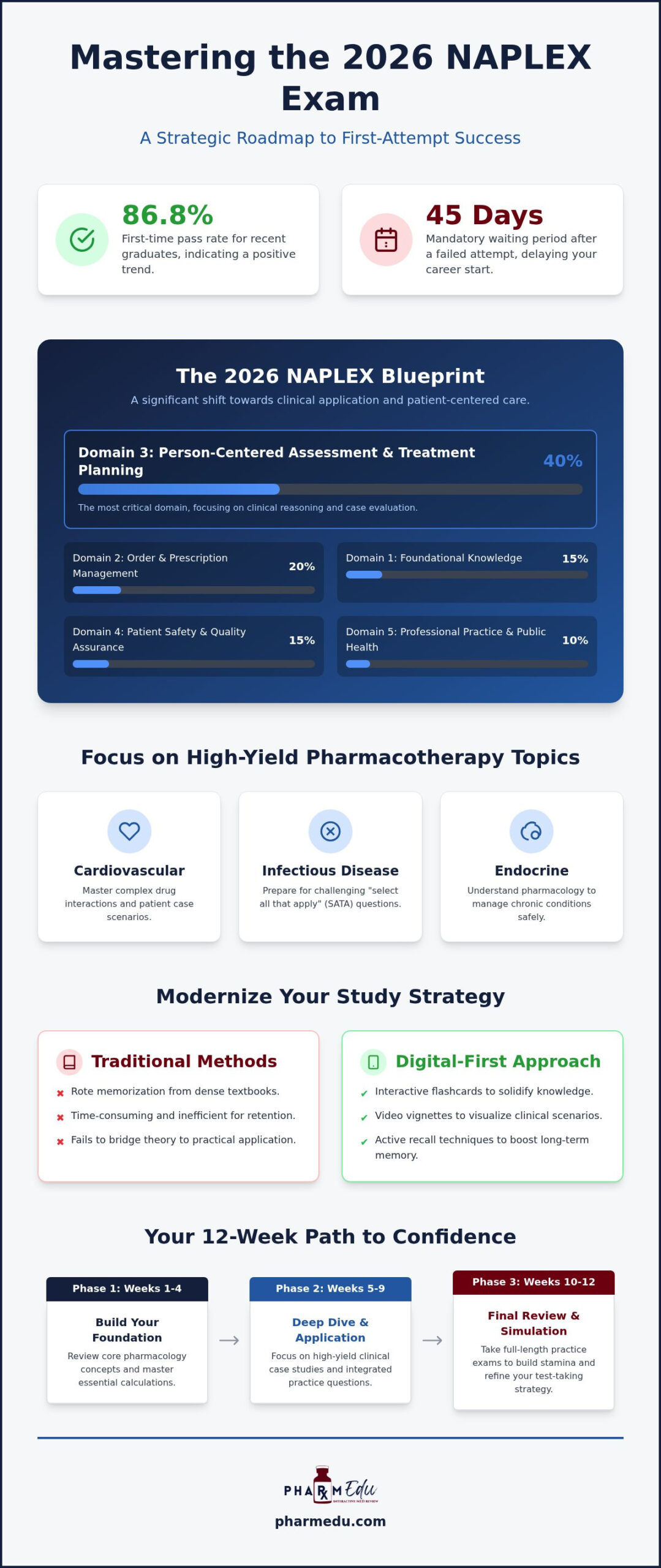
While the 86.8% first-time pass rate for recent graduates suggests a positive trend, the 2026 naplex exam demands more than just rote memorization of drug classes. With 40% of the blueprint now dedicated to person-centered assessment and treatment planning, the challenge has shifted toward clinical reasoning. You’ve spent four years absorbing an incredible amount of information, and it’s natural to feel overwhelmed by the prospect of condensing it all into a single study plan. The fear of a 45-day mandatory waiting period after a failed attempt is a significant weight on any graduate’s shoulders.
We understand that your goal is to transition from student to licensed pharmacist as efficiently as possible. This guide offers a strategic roadmap to passing the NAPLEX on your first attempt by focusing on high-yield study techniques and expert insights. You’ll discover how to navigate the five content domains, master integrated math skills, and use active recall to solidify your pharmacology knowledge. We’ll preview the essential clinical topics and provide a manageable schedule that replaces anxiety with professional confidence.
Key Takeaways
- Master the 2026 naplex exam structure and eligibility requirements to streamline your path to professional US licensure.
- Prioritize your preparation by focusing on high-yield domains like pharmacotherapy and calculations, which carry the most weight in the current blueprint.
- Replace time-consuming traditional textbooks with efficient digital tools like interactive flashcards and video vignettes to boost your long-term memory.
- Follow a manageable 12-week roadmap that breaks down complex pharmacology into logical phases for a stress-free preparation experience.
- Utilize specialized digital resources and clinical case studies to bridge the gap between classroom theory and practical board exam application.
What is the NAPLEX Exam? Understanding Your Path to Licensure
The North American Pharmacist Licensure Examination, or What is the NAPLEX Exam?, is the final hurdle in your transition from student to professional. It serves as the national standard for pharmacy licensure across all U.S. jurisdictions. While your four years of pharmacy school were about gaining deep knowledge, the naplex exam is specifically designed to measure how you use that knowledge in practice. It’s the ultimate gatekeeper. Failing to pass doesn’t just mean more studying; it delays your ability to earn a pharmacist’s salary and start your career. It’s also distinct from the MPJE, which you’ll likely take separately to prove your understanding of pharmacy law.
Eligibility requirements vary depending on your training. If you’re an ACPE-accredited graduate, you’ll work with your state board of pharmacy to verify your degree and intern hours. Foreign-educated pharmacists have a steeper climb, as they must first earn FPGEC Certification. Regardless of your background, the stakes remain high. This exam ensures that every person behind a pharmacy counter possesses the clinical judgment necessary to protect public health. It’s a rigorous process, but it’s the foundation of your professional credibility.
The Goal of the NAPLEX: Competence vs. Excellence
It’s helpful to remember that the exam tests for “minimum competency” rather than academic perfection. The board doesn’t need you to be a walking textbook; they need to know you’re a safe practitioner. This means the 2026 format leans heavily into clinical judgment. You won’t just recite drug mechanisms. You’ll evaluate patient cases to identify contraindications and dosing errors. Under the current pass/fail scoring system, your objective is to demonstrate that you can manage medication use processes without risking patient safety. It’s about being reliable and precise in a high-pressure environment.
Exam Logistics: Registration and Pearson VUE
Managing the administrative side of the naplex exam is your first real test of professional diligence. You’ll need to create an e-Profile through the NABP website to start your application. After your state board confirms your eligibility, you’ll receive an Authorization to Test (ATT) letter. This document is your golden ticket. Without it, you can’t book a seat at a Pearson VUE testing center. These facilities are highly regulated and secure. Since the exam lasts six hours, you should plan your testing date well in advance to secure a location that’s convenient for you.
Breaking Down the 2026 NAPLEX Content Blueprint and Domains
The architecture of the 2026 naplex exam reflects a significant shift toward clinical application. According to the 2026 NAPLEX Content Blueprint, the exam is now structured around five primary domains rather than the previous six. This change emphasizes the integration of knowledge. You’ll face 225 questions in total, 200 of which are scored, while 25 serve as unscored pretest items. The most critical takeaway for your study plan is the heavy weighting of Domain 3, which covers person-centered assessment and treatment planning. This single area accounts for approximately 40% of the exam, making it the primary factor in determining your success.
Patient safety and professional practice standards are woven into every scenario. You won’t find many isolated facts to recall. Instead, the exam uses complex clinical case studies to evaluate your ability to identify medication errors, recognize contraindications, and ensure therapeutic appropriateness. Because you cannot go back to change an answer once it’s submitted, your first instinct must be grounded in a deep understanding of these professional standards. It’s about demonstrating that you can manage the medication use process safely in a real-world environment.
High-Yield Area: Pharmacotherapy Mastery
Domain 3 requires you to be an expert in cardiovascular, infectious disease, and endocrine pharmacology. These topics appear frequently because they represent the highest volume of patient care in standard pharmacy practice. You’ll need to master drug-drug interactions and be prepared for the challenging “select all that apply” (SATA) clinical scenarios. These questions test the limits of your clinical judgment; if you miss a single contraindication in a list, the entire answer is incorrect. To bridge the gap between your notes and these complex cases, reviewing high-yield video vignettes can help you visualize how these drug classes interact in a clinical setting.
Foundational Knowledge: Calculations and Compounding
While calculations are no longer a standalone section, they remain a vital part of Domain 1, which represents 25% of the naplex exam. Precision is non-negotiable here. A simple decimal point error in a dosing regimen or an mEq conversion can lead to a failure, as these questions often require you to type in a specific numerical value rather than selecting from a list. You’ll also face questions regarding sterile and non-sterile compounding safety. Understanding alligations and the proper handling of hazardous drugs isn’t just about passing; it’s about proving you have the foundational knowledge to prevent patient harm from the moment you start your first shift.
Strategic Prep: Digital Review vs. Traditional Study Methods
Traditional pharmacy education often relies on 1,000-page textbooks and dense lecture notes. While these are vital for your initial years, they can become a liability when you’re preparing for the naplex exam. Passive reading creates an illusion of competence; you recognize the words on the page, but your brain hasn’t learned to retrieve that information under pressure. Digital review platforms prioritize efficiency. They replace the “sledgehammer” approach of a textbook with the “scalpel” of targeted review. This transition is essential for building exam stamina. Sitting through a six-hour computer-based test requires more than just knowledge. It requires the mental agility to pivot between topics without fatigue. You can find more details on the logistics of this process through the Official NAPLEX Exam Information portal.
Many students find that an Institutional Platform License provides the most structured path. When a university integrates these digital tools, it aligns your final year of rotations with the high-yield topics you’ll face on the boards. This institutional support removes the administrative burden of finding reliable study materials, allowing you to focus entirely on mastery. Pharmacology Practice Quizzes are particularly effective here. They simulate the “no going back” rule of the actual exam, forcing you to commit to your clinical decisions and learn from your mistakes in real time.
The Power of High-Yield Video Vignettes
Visual learning is a game-changer for complex mechanisms of action. High-Yield Video Vignettes use animations and concise narration to explain how a drug works, its side effects, and its clinical applications in minutes rather than hours. This is especially helpful during your final month of review. Instead of re-reading a chapter on anticoagulants, you can watch a focused summary that connects the pharmacology to real-world clinical case studies. This mental “hook” makes the information much easier to recall when you’re faced with a multi-step patient profile on test day.
Active Recall and Spaced Repetition
The science of learning proves that spaced repetition is the most effective way to move drug classes into long-term memory. Interactive Pharmacology Flashcards use this principle by showing you difficult topics more frequently than those you’ve already mastered. This bridges the gap between pharmacy school and professional boards. While this guide focuses on graduates, the core principles of active recall are universal. For instance, you can see how these methods are applied in The Ultimate Pharmacology Study Guide for Nursing Students in 2026. By forcing your brain to work for the answer, you build the neural pathways needed for a first-attempt pass on the naplex exam.
How to Build an Effective 12-Week NAPLEX Study Schedule
- Phase 1: Foundation (Weeks 1-4) – Focus on Domain 1. Dedicate this month to pharmaceutical calculations and core drug classes. Precision in dosing regimens and mEq conversions must become second nature during this period.
- Phase 2: Deep Dive (Weeks 5-8) – Tackle the 40% pharmacotherapy domain. Prioritize cardiovascular, infectious disease, and endocrine pharmacology. This is also the time to master sterile and non-sterile compounding standards.
- Phase 3: Integration (Weeks 9-11) – Shift toward exam stamina. Complete full-length practice sets and review your weak points. You should be comfortable answering 225 questions in a single sitting without losing clinical focus.
- Phase 4: The Final Stretch (Week 12) – Use this time for high-yield summaries and mental preparation. Avoid introducing complex new topics. Focus on rapid-fire recall of contraindications and black box warnings.
Balancing Study with Rotations or Residency
Most graduates don’t have the luxury of studying in a vacuum. You’re likely balancing your naplex exam prep with APPE rotations or the start of a residency. The key is micro-learning. Instead of waiting for a four-hour block of time that may never come, use 15-minute intervals between patient rounds. Mobile-compliant tools allow you to flip through Interactive Pharmacology Flashcards on the go. Setting realistic daily goals, such as mastering five drug monographs or ten calculation problems, prevents the burnout that often leads to a delayed career start.
Self-Assessment and Course Correction
Your schedule shouldn’t be set in stone. It needs to evolve based on your performance. Using Pharmacology Practice Quizzes early and often helps you identify knowledge gaps before they become liabilities on test day. If your quiz scores in infectious disease are consistently low, pivot your Phase 2 schedule to allow for more intensive review in that area. For a deeper look at selecting the right resources for your specific needs, consult The Best NAPLEX Prep Course Guide: How to Pass in 2026. Constant self-assessment is the only way to ensure you’re ready for the “no going back” rule of the actual exam.
To ensure your 12-week plan is backed by the most relevant clinical data, you can start your PharmEDU Annual Subscription today and gain immediate access to our full library of high-yield vignettes.
Leveraging PharmEDU for NAPLEX Success
Passing the naplex exam is your immediate priority, but the volume of information shouldn’t dictate your stress levels. A PharmEDU Monthly Subscription offers a flexible, high-yield alternative to the rigid schedules of traditional review programs. Our platform features over 100 pharmacology topics specifically curated for board preparation and clinical practice. By focusing on the most relevant drug classes and therapeutic guidelines, we help you filter out the noise and concentrate on the material that actually appears on the test. For academic leaders, an Institutional Platform License provides a scalable way to support entire cohorts, ensuring every graduate has access to standardized, high-quality review tools.
Our Pharmacology Practice Quizzes are engineered to mirror the actual exam’s environment. They challenge your clinical logic and force you to commit to decisions under pressure, just as you’ll have to do when faced with the “no going back” rule at the testing center. This isn’t just about answering questions; it’s about refining your thought process. You’ll learn to navigate complex patient profiles and identify critical errors with the precision of a seasoned pharmacist. This methodical approach transforms your study time from a chore into a targeted professional development session.
High-Yield Content for the Busy Graduate
Success on the naplex exam requires you to be an expert in the “must-know” drug classes. We prioritize cardiovascular, endocrine, and infectious disease pharmacology because these areas represent the core of patient-centered treatment planning. Our Clinical Case Studies bridge the gap between classroom theory and real-world application. You’ll practice identifying drug-drug interactions and contraindications within multi-step scenarios, which is the exact skill set needed for the 2026 blueprint. Transitioning to these focused tools is a central theme in our Comprehensive Pharmacy Review: Digital Platforms vs. Traditional Textbooks in 2026.
Beyond the Exam: Lifelong Pharmacology Mastery
Your professional journey is just beginning when you receive your license. PharmEDU serves as a long-term partner, helping you stay current as drug therapies and clinical standards evolve. The transition from student to practitioner is seamless when you have a reliable source for rapid clinical updates and pharmacology refreshers. We provide the tools you need to maintain your expertise and provide safe, effective care throughout your career. Don’t leave your first attempt to chance. Start your journey today with a PharmEDU Monthly Subscription.
Securing Your Professional Future in Pharmacy
Passing the naplex exam is the definitive step toward your licensure and the beginning of your professional career. By prioritizing high-yield pharmacotherapy domains and adopting a structured 12-week study schedule, you can transform years of academic theory into clinical competence. The shift toward digital, interactive learning isn’t just a trend; it’s a necessity for mastering the complex reasoning required by the 2026 blueprint. Success depends on your ability to apply knowledge safely and precisely in a high-pressure environment.
You don’t have to navigate this transition alone. PharmEDU provides the essential tools you need to succeed, featuring over 100 high-yield topics and interactive case studies designed for maximum retention. Our mobile-compliant micro-learning platform ensures you can study effectively even during your busiest rotations or residency shifts. Approach your test date with the confidence of a prepared professional and leave the burden of information overload behind.
Master the NAPLEX with PharmEDU High-Yield Review and take the final step toward your career with certainty. Your future as a licensed pharmacist is within reach.
Frequently Asked Questions
How many questions are on the NAPLEX in 2026?
The 2026 naplex exam consists of 225 total questions. Out of these, 200 are used to determine your performance, while the remaining 25 are unscored pretest items. These experimental questions are indistinguishable from the scored ones, so you should treat every item with the same level of clinical focus. The exam is administered in a single six-hour session, providing ample time to navigate the five content domains defined by the NABP.
What is a passing score for the NAPLEX exam?
The NAPLEX is currently reported as a pass/fail result rather than a numerical scaled score. This shift emphasizes meeting a minimum competency standard for safe pharmacy practice. You won’t see a specific number on your official transcript; you’ll simply be notified if you met the requirements for licensure. This format encourages candidates to focus on comprehensive clinical reasoning and patient safety across all domains instead of chasing a specific percentage.
How many times can I retake the NAPLEX if I fail?
Candidates are generally allowed a maximum of five attempts to pass the exam. If you don’t succeed on your first try, there is a mandatory 45-day waiting period before you can schedule a retake. This time is best used for targeted review through Interactive Pharmacology Flashcards or Clinical Case Studies. Failing a second or third time may trigger additional state-specific requirements or longer waiting periods depending on your jurisdiction’s regulations.
Can I use a calculator during the NAPLEX exam?
You aren’t permitted to bring a personal calculator into the testing room. An on-screen calculator is provided within the testing software for all calculation-heavy items. It’s important to practice with a basic four-function or scientific digital interface during your preparation. Precision is critical for the naplex exam, as many math questions require you to type in a specific numerical value rather than selecting a multiple-choice option.
What should I bring to the Pearson VUE testing center on exam day?
You must bring two valid forms of government-issued identification, and one must contain a recent photograph. Most candidates also bring a printed or digital copy of their Authorization to Test (ATT) letter for verification. Personal items like phones, watches, or study materials aren’t allowed in the testing room and must be stored in a provided locker. Arrive at least 30 minutes early to complete the security check-in process smoothly.
How long should I study for the NAPLEX?
A 12-week study plan is the most effective timeframe for most graduates. This duration allows you to move through foundational topics in the first month before diving into specialized pharmacotherapy. If you’re balancing prep with a residency or rotations, micro-learning tools like High-Yield Video Vignettes can help you maximize short breaks. Consistency is more important than cramming, so aim for daily sessions that include active recall to solidify your long-term memory.
Is the NAPLEX exam harder than pharmacy school finals?
The difficulty lies in the exam’s breadth rather than its depth. While pharmacy school finals often test specific, recent lecture material, this board exam covers four years of integrated knowledge. It evaluates your clinical judgment and ability to identify safety risks in complex patient profiles. Many graduates find the “no going back” rule more challenging than the questions themselves, as it requires absolute confidence in every clinical decision you make.
What is the difference between NAPLEX and MPJE?
The NAPLEX focuses on clinical knowledge and your ability to provide safe patient care through medication management. In contrast, the Multistate Pharmacy Jurisprudence Examination (MPJE) tests your understanding of federal and state-specific pharmacy laws. While one ensures you are a competent clinician, the other ensures you understand the legal framework of the profession. Most graduates take both exams to satisfy the full requirements for their pharmacist license.