
PANCE Pharmacology Study Plan: The 2026 High-Yield Review Guide
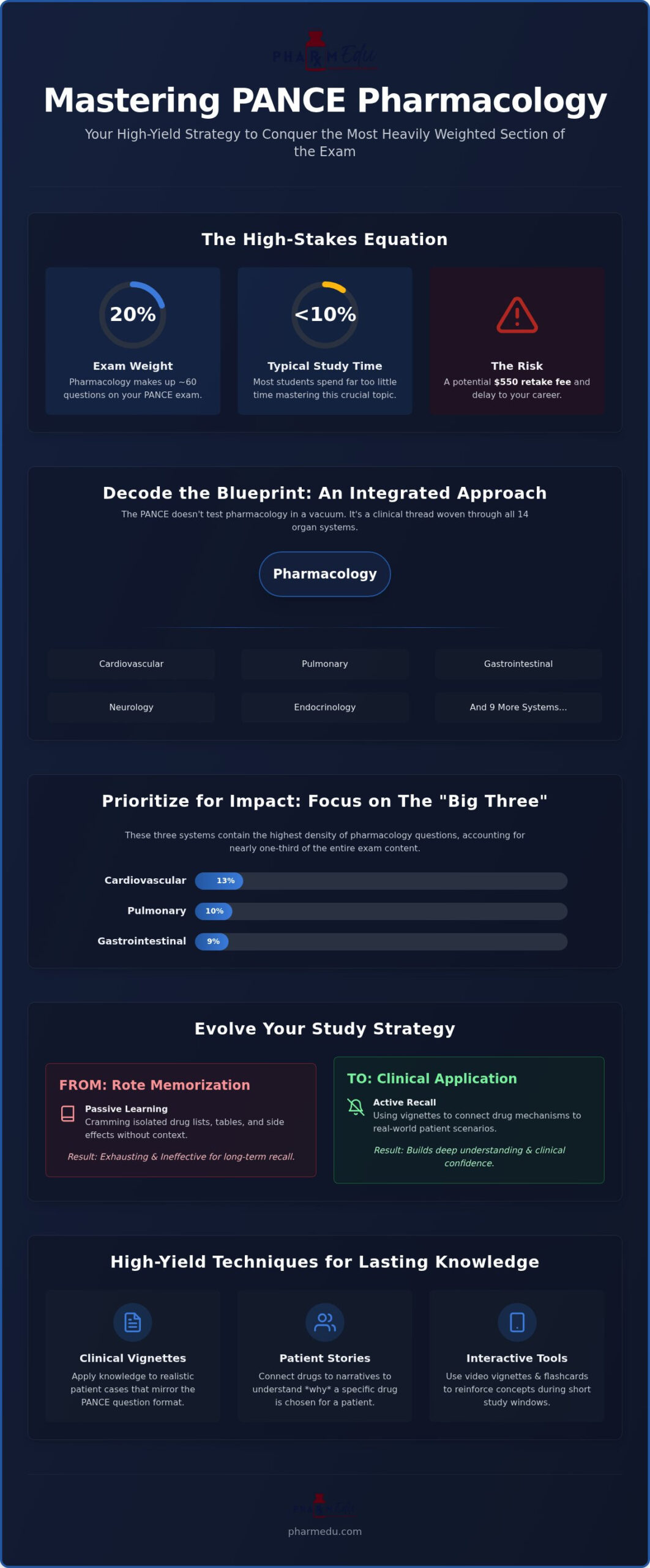
Did you know that pharmacology represents nearly 20% of your total PANCE score, yet many students spend less than 10% of their study time truly mastering it? With approximately 60 questions dedicated to drug mechanisms and clinical applications, this single category often determines whether you pass or face a $550 retake fee. It’s completely understandable if you feel overwhelmed by the sheer volume of information. Trying to memorize every side effect from a massive textbook is exhausting, especially when you need to connect those facts to complex clinical vignettes under exam pressure.
This PANCE pharmacology study plan solves that problem by shifting your focus from rote memorization to high-yield application over a structured four-week period. We’ll break down the 2026 NCCPA blueprint into a manageable daily schedule that integrates drug classes directly into their respective organ systems. You’ll learn how to approach the exam with a logical framework that replaces anxiety with clinical confidence. By the end of this guide, you’ll have a clear path to mastering the most heavily weighted topics while using efficient methods that ensure the information actually sticks.
Key Takeaways
- Understand the 18-20% weighting of pharmacology on the PANCE and how it integrates across all 14 organ systems rather than appearing as a standalone subject.
- Prioritize your review by focusing on the “Big Three” high-volume systems-cardiovascular, pulmonary, and gastrointestinal-which contain the highest density of pharmacology questions.
- Implement a structured four-week PANCE pharmacology study plan to move systematically through the NCCPA blueprint without experiencing information overload.
- Shift from passive reading to active recall by using clinical vignettes and patient stories to connect drug mechanisms to real-world medical scenarios.
- Leverage interactive digital tools like PharmEDU’s high-yield video vignettes and flashcards to reinforce complex concepts during short study windows between clinical rotations.
Why Your PANCE Success Depends on a Dedicated Pharmacology Study Plan
Many PA students treat pharmacology as a secondary subject, something to be crammed into the final days before the exam. This approach is a strategic error. Because the NCCPA blueprint weaves drug therapy into every organ system, your success hinges on a structured PANCE pharmacology study plan that mirrors this integration. Standard review books often list drugs in isolated tables, but the exam requires you to bridge the gap between a patient’s symptoms and the appropriate pharmaceutical intervention. A dedicated plan ensures you don’t just recognize drug names but understand their clinical utility when the clock is ticking.
The 20% Rule: Understanding Exam Weighting
Pharmacology accounts for approximately 18-20% of the PANCE content. In a 300-question exam, that translates to 54-60 questions. These aren’t just bonus points; they are a critical foundation of your score. In 2026, the NCCPA continues to emphasize clinical reasoning over simple recall. Missing “easy” pharmacology questions, such as standard first-line treatments for hypertension or common contraindications, can sink your overall performance. The exam moves beyond simple recognition. You won’t just identify a drug name; you’ll apply knowledge of its effects within the context of a complex clinical scenario. Success requires knowing which drug to choose when two or three options seem plausible for a specific patient profile.
Pharmacology as a Clinical Thread
The PANCE doesn’t test drugs in a vacuum. Instead, it uses clinical vignettes to evaluate your competency. To answer correctly, you must understand the underlying pathology of an organ system and link it to the correct mechanism of action. If you are exploring the foundational concepts of What is Pharmacology?, you’ll find it involves understanding how substances interact with living systems to produce a therapeutic effect. Mastering this in a clinical context requires a specialized pharmacology study guide that emphasizes these connections.
By treating pharmacology as a clinical thread rather than a list of facts, you ensure that you cover high-yield classes long before the final week panic sets in. This systematic approach allows you to build the deep understanding necessary for the 2026 blueprint’s focus on clinical application. You’ll move from memorizing lists to understanding why a specific beta-blocker is preferred in a post-MI patient with certain comorbidities, which is exactly what the NCCPA expects from a practicing Physician Assistant.
Decoding the NCCPA Blueprint: Mapping Drugs to Organ Systems
To master your PANCE pharmacology study plan, you can’t treat the exam like a random list of 300 questions. You have to decode the Official NCCPA PANCE Blueprint. This document shows that pharmacology isn’t a separate category but a heavy layer applied over 14 organ systems. Focus your initial energy on the “Big Three”: Cardiovascular (13%), Pulmonary (10%), and Gastrointestinal (9%). These systems represent the highest density of pharmacology-heavy questions. By mastering the drugs within these categories first, you’ve already addressed nearly a third of the exam’s total content.
Distinguishing between “must-know” first-line agents and “nice-to-know” alternatives is vital for efficiency. Boards love testing the drug of choice for specific patient populations, such as treating a pregnant patient with hypertension or choosing an antibiotic for a patient with a penicillin allergy. You don’t need to be an encyclopedia; you need to be a clinician. PharmEDU’s high-yield video vignettes help you visualize these system-specific drug mechanisms, turning abstract chemical names into clinical realities. If you’re struggling to keep these straight, exploring PharmEDU’s clinical case studies can provide the context you need to make the information stick.
Cardiovascular Pharmacology: The PANCE Powerhouse
Cardiovascular pharmacology is the undisputed powerhouse of the boards. You’ll need to master hypertension guidelines, antiarrhythmics, and heart failure protocols. ACE inhibitors are cornerstone medications in the management of hypertension and heart failure, often tested for their mortality benefits and specific contraindications. Watch for “red flag” side effects like the dry cough associated with bradykinin accumulation or the risk of hyperkalemia. These specific details are exactly what clinical vignettes use to distract you from the correct answer during the exam.
Endocrine and Metabolic Drugs
Endocrine and metabolic drugs map to the 12% weight of the endocrine system. Diabetes management is particularly high-yield for PA students. You must understand the differences between insulin types, the mechanism of oral hypoglycemics like metformin, and the renal benefits of SGLT2 inhibitors. Thyroid and adrenal medications also require attention, specifically regarding dosing nuances and adverse reactions like the risk of adrenal crisis during steroid withdrawal. Understanding these drugs within the context of endocrine pathology ensures you’re prepared for the 12% of questions that will likely involve some form of pharmaceutical management.
The 4-Week PANCE Pharmacology Study Plan: A Day-by-Day Schedule
A successful PANCE pharmacology study plan shouldn’t feel like a desperate race against the clock. Instead, it’s a methodical process of layering knowledge, starting with the most heavily weighted systems and ending with the nuanced details that separate a passing score from an exceptional one. This four-week schedule is designed to help you integrate drug mechanisms into clinical vignettes, moving beyond simple flashcard memorization. By following a structured timeline, you ensure that high-yield topics receive the attention they deserve while leaving space for active recall and stamina building.
Week 1: Foundations and Heavy Hitters
Focusing on high-volume systems during your first seven days provides an immediate confidence boost. These categories represent the largest portion of the exam blueprint and require deep conceptual understanding.
- Days 1-2: Cardiovascular Pharmacology. Prioritize hypertension and heart failure protocols. You’ll need to know the step-wise approach for ACEIs, ARBs, and Beta-blockers, specifically noting which agents reduce mortality in chronic heart failure.
- Days 3-4: Pulmonary. Mastery of asthma and COPD step-wise therapy is non-negotiable. Focus on the transition from SABA and low-dose ICS to LABA and LAMA combinations based on patient symptom severity.
- Days 5-7: GI and Nutrition. Devote this time to PPIs, H2RAs, and motility agents. Understanding the long-term side effects of PPIs, such as B12 deficiency or increased fracture risk, is a common board favorite.
Week 2 shifts toward specialty systems like endocrine, renal, and hematology. This mirrors the structured approach found in a typical PA Program Pharmacology Curriculum Example, where complexity builds over time. During Week 3, you’ll tackle “Complexity Systems,” including neurology, psychiatry, and infectious diseases (ID). Psychiatry pharmacology is particularly dense; you must distinguish between various antidepressant classes and their unique side effect profiles, such as the risk of serotonin syndrome or hypertensive crisis with MAOIs.
Week 4: The Final Polish and Red-Flag Drugs
The final week isn’t for learning new material. It’s for the “Final Polish.” Dedicate your time to reviewing Black Box Warnings and high-risk drug-drug interactions that frequently appear in clinical vignettes. Perform rapid-fire recall of the “drug of choice” for specific infectious diseases, such as the first-line treatment for Lyme disease in various age groups or the management of MRSA. Finally, simulate full-length pharmacology blocks using practice quizzes to build the mental stamina required for the 300-question exam day. This ensures your PANCE pharmacology study plan concludes with you at peak performance, ready to apply your knowledge with precision.
Beyond Rote Memorization: High-Yield Study Techniques for PA Students
Rote memorization often fails when you’re faced with the clinical application focus of the 2026 NCCPA blueprint. To truly succeed with your PANCE pharmacology study plan, you must transition from passive reading to active engagement. Passive methods, like highlighting textbooks, often create a false sense of security. You might recognize a drug name on the page, but that doesn’t mean you can apply it in a high-pressure exam block. Instead, use active recall to force your brain to retrieve information from scratch. This process strengthens neural pathways and ensures that drug mechanisms are accessible when the clock is ticking.
Spaced repetition is another essential tool for long-term retention. By using interactive flashcards to review drug classes at increasing intervals, you effectively combat the forgetting curve. Rather than studying a single class once, you revisit it just as you’re about to forget it. Grouping drugs into comparative tables also helps. Instead of memorizing side effects for every individual drug, group them by class and focus on the “outliers.” For example, knowing which specific cephalosporins cover Pseudomonas is much more high-yield than memorizing the entire class’s general profile. Learning through patient stories also transforms abstract facts into clinical realities. When you associate a drug with a specific patient presentation, the mechanism of action becomes a logical part of the diagnosis rather than a random fact to remember.
Utilizing High-Yield Video Vignettes
Micro-learning is a powerful strategy for busy PA students. High-Yield Video Vignettes allow you to digest complex topics in short segments, making it easier to study during rotation breaks or your daily commute. By visualizing mechanisms of action through these vignettes, you can often predict side effects based on physiology rather than memorizing endless lists. This visual approach turns abstract pharmacology into a logical extension of the pathology you’ve already mastered. It’s a far more efficient way to spend your limited study time than slogging through dense chapters of a traditional textbook.
Mastering the “If-Then” Logic of the PANCE
The PANCE rewards systematic clinical thinking. When you encounter a pharmacology question, apply “If-Then” logic: If the diagnosis is X, then the first-line treatment is Y, unless the patient has contraindication Z. This framework helps you quickly rule out distractor drugs that might be correct for a different condition but are inappropriate for the patient in the vignette. Comprehensive pharmacy review digital platforms outperform traditional textbooks for active recall because they simulate this decision-making process through interactive tools. To start applying these techniques today, explore PharmEDU’s Interactive Pharmacology Flashcards for a more effective way to reinforce your clinical knowledge.
Optimizing Your Review with PharmEDU’s High-Yield Resources
PharmEDU acts as the digital architecture for your PANCE pharmacology study plan, providing a structured environment where theory meets clinical reality. With over 100 topics specifically aligned to the 2026 NCCPA blueprint, the platform ensures no high-yield drug class is overlooked. You can leverage interactive flashcards for “quick-fire” sessions during short windows of downtime, reinforcing the active recall techniques discussed earlier. Instead of wrestling with a massive textbook, you use clinical case studies to bridge the gap between pharmacological facts and the complex vignettes you’ll face on exam day. Tracking your progress through integrated quiz modules allows you to identify and remediate weak spots before they impact your actual score.
Integrating PharmEDU into Your 4-Week Plan
To maximize efficiency, assign specific PharmEDU modules to each day of your schedule. For instance, during Week 1, focus exclusively on the cardiovascular and pulmonary video vignettes. The platform’s mobile-compliant design is a significant advantage for PA students on clinical rotations; it allows you to master a topic between patient rounds or during a commute. This accessibility is part of why many consider PharmEDU the best pharmacology resource for those balancing heavy clinical loads with board preparation. By syncing your daily tasks with the platform’s curriculum, you transform a daunting blueprint into a series of achievable goals.
Final Preparation: The Day Before the PANCE
The 24 hours leading up to your exam should focus on mental preservation rather than new information. Avoid the urge to “cram” specific drug names or rare side effects. Instead, review high-level mental frameworks and the systematic “if-then” logic you’ve practiced over the last month. The PANCE is a five-hour marathon that requires sustained focus; entering the testing center with a clear, well-rested mind is just as important as your pharmacological knowledge. Trust the methodology you’ve followed and the data provided by your progress trackers. You’ve spent four weeks building a foundation of clinical reasoning. On the day of the exam, rely on that foundation and the confidence that comes from a completed, high-yield PANCE pharmacology study plan.
Secure Your Professional Future with a Strategic Approach
Success on the boards requires more than just hours of study; it requires a precise, system-based strategy. By aligning your preparation with the NCCPA blueprint and focusing on high-yield clinical vignettes, you transform a massive subject into a manageable series of professional milestones. Transitioning from passive reading to active recall ensures that you don’t just recognize drug names but understand how to apply them in a high-stakes clinical environment. This shift in methodology is what separates those who simply study from those who master the material.
Implementing a structured PANCE pharmacology study plan is the most effective way to manage the 20% weighting of the exam without feeling overwhelmed. With access to 100+ high-yield pharmacology topics and expert-led video vignettes, you can build the confidence needed to excel. PharmEDU’s mobile-compliant micro-learning platform is designed to fit into your busy schedule, turning every clinical break into a productive review session. You have the tools and the schedule; now it’s time to execute.
Start Your PANCE Pharmacology Mastery with PharmEDU Today. Trust your preparation and take the next step toward your PA certification with confidence. You’re ready to turn your hard work into a passing score.
Frequently Asked Questions
How much pharmacology is actually on the PANCE in 2026?
Pharmacology-related questions make up approximately 18-20% of the exam, which equates to roughly 54 to 60 questions out of the 300 total. These questions aren’t isolated but are integrated into clinical vignettes across all 14 organ systems. Because this is nearly one-fifth of your score, mastering your PANCE pharmacology study plan is essential for ensuring you don’t lose easy points on first-line treatments and common contraindications.
Can I pass the PANCE without a dedicated pharmacology study plan?
While technically possible, passing without a specific strategy is extremely difficult because pharmacology is woven into nearly every clinical scenario. If you lack a structured PANCE pharmacology study plan, you risk being unable to distinguish between similar drug choices in high-pressure vignettes. Given that cardiovascular and pulmonary systems alone represent a huge chunk of the exam, skipping a dedicated review of their respective drug classes significantly lowers your margin for error.
What are the most commonly tested drug classes on the PANCE?
The most frequently tested classes align with the most heavily weighted organ systems, specifically the cardiovascular, pulmonary, and endocrine systems. You should prioritize mastering antihypertensives, heart failure protocols, asthma and COPD step-wise therapies, and diabetes medications like metformin and SGLT2 inhibitors. Antimicrobials also appear frequently, often requiring you to choose the correct antibiotic based on specific patient allergies or the site of infection.
How should I study for PANCE pharmacology if I have very little time?
If your time is limited, prioritize the “Big Three” systems: Cardiovascular, Pulmonary, and Gastrointestinal. Use high-yield micro-learning tools like video vignettes and interactive flashcards to study in short bursts between clinical tasks. Focus on first-line treatments and major contraindications rather than obscure side effects. This targeted approach ensures you cover the topics most likely to appear on the exam while maximizing your available study minutes.
Are PANCE pharmacology questions more about mechanisms or clinical use?
PANCE questions emphasize clinical application and reasoning rather than rote memorization of chemical mechanisms. You’ll typically encounter a patient case where you must identify the most appropriate next step in treatment or recognize a drug’s adverse effect. While understanding a mechanism of action helps you predict side effects, the exam’s primary goal is to ensure you can safely and effectively prescribe medications in a real-world clinical setting.
What happens if I fail the pharmacology-heavy sections of the PANCE?
The PANCE is a single, comprehensive exam, so you cannot fail just one section; however, poor performance in pharmacology will likely result in a failing overall score. If you don’t pass, you must wait at least 90 days to retake the exam and pay the $550 fee again. This highlights the importance of a structured review to avoid the administrative and financial burden of multiple attempts within the six-year-six-attempt window.
Is the PharmEDU platform mobile-friendly for studying on rotations?
Yes, the PharmEDU platform is fully mobile-compliant and specifically designed for students on rotations. You can access high-yield video vignettes and practice quizzes on your phone or tablet during breaks or between patient rounds. This flexibility allows you to maintain your study rhythm without needing a laptop or heavy textbooks, making it a reliable partner for busy professionals who need to maximize their efficiency.
How often does the NCCPA update the pharmacology blueprint?
The NCCPA updates the content blueprint periodically to reflect current clinical practice and educational standards. The current blueprint became effective in January 2025 and remains the standard for the 2026 and 2027 testing cycles. Staying aligned with this official document ensures that your study materials are relevant and that you’re preparing for the exact distribution of topics you’ll face on your scheduled exam day.