Beta-Blockers Mechanism of Action: A High-Yield Pharmacology Guide for 2026
What if the lifelong beta-blocker prescription you’ve been taught to expect after a myocardial infarction is actually unnecessary for many stable patients? Recent data from the 2026 SMART-DECISION trial suggests that discontinuing therapy after one year isn’t inferior to continuing it, a finding that challenges decades of clinical dogma. To understand why these guidelines are shifting, you first need a rock-solid grasp of the beta blockers mechanism of action. Mastering how these drugs interface with G-protein coupled receptors is about more than just passing a test. It’s about predicting clinical outcomes and side effects with precision.
It’s completely normal to feel overwhelmed by the sheer volume of drug names and the confusing overlap between receptor types. You’re likely tired of mixing up cardioselectivity with non-selective agents or struggling to remember which generation causes peripheral vasodilation. This high-yield guide promises to clear that mental fog by mapping out the molecular pathways and clinical classifications you’ll encounter on board exams and in practice. We’ll examine the three generations of drugs, the latest 2026 formulary updates, and the specific signaling cascades that define this essential drug class.
Key Takeaways
- Master the fundamental beta blockers mechanism of action by exploring how competitive inhibition at G-protein coupled receptors directly modulates intracellular calcium levels.
- Learn to differentiate between the three generations of drugs, moving from non-selective agents to cardioselective and vasodilatory options with clinical precision.
- Develop the ability to predict adverse effects and therapeutic outcomes by connecting drug receptor selectivity to specific physiological locations.
- Gain high-yield study strategies and classification shortcuts, such as suffix recognition, to excel in pharmacology board exams and complex clinical rotations.
What are Beta-Blockers? Understanding Receptor Basics
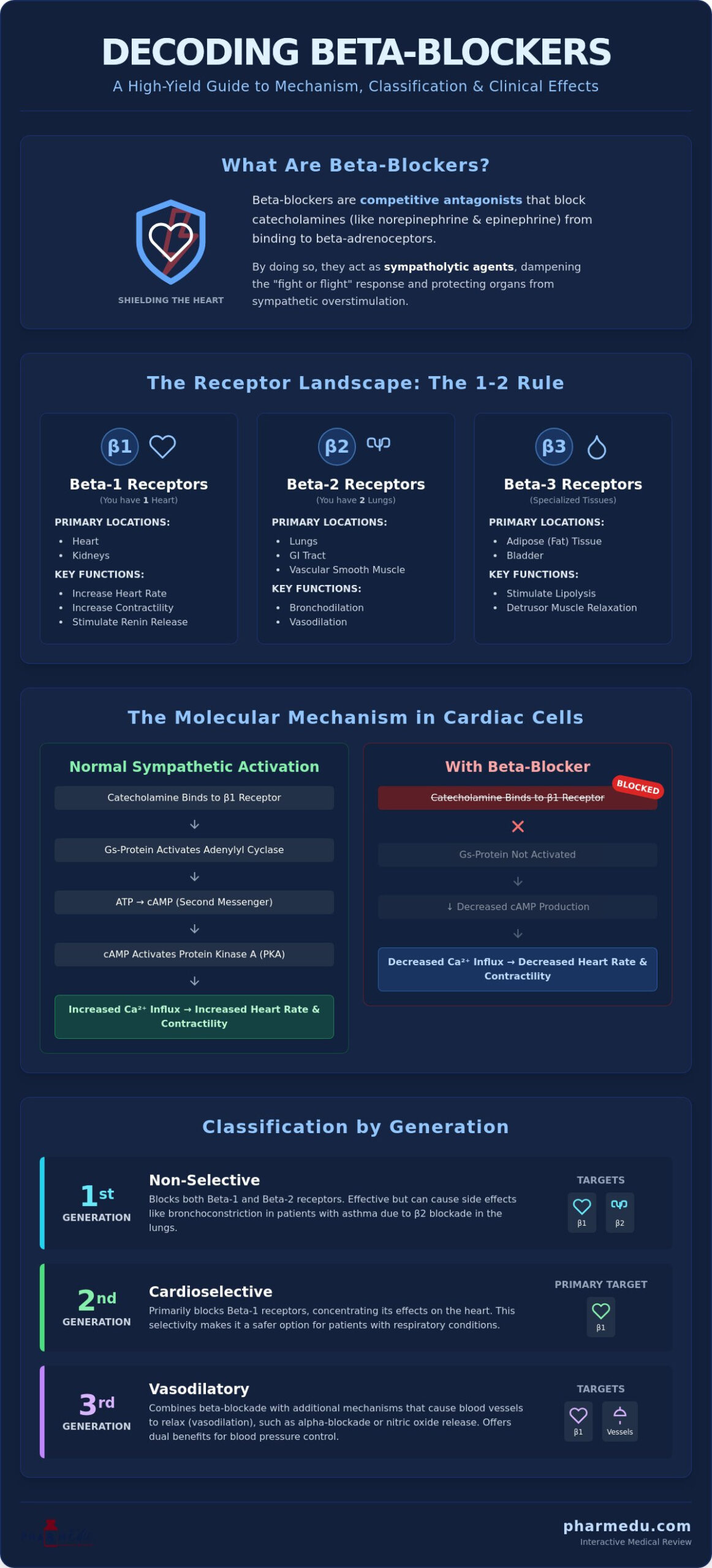
Beta-blockers are competitive antagonists of the sympathetic nervous system. This fundamental definition serves as the starting point for understanding how these medications manage everything from heart failure to performance anxiety. Technically known as beta-adrenoceptor antagonists, Beta-blockers function by preventing catecholamines like norepinephrine and epinephrine from binding to their designated sites. In clinical terms, we describe them as sympatholytic agents because they dampen the “fight or flight” response, effectively shielding the heart and other organs from the taxing effects of sympathetic overstimulation.
To truly master the beta blockers mechanism of action, you must first visualize the landscape of the receptors they target. These receptors aren’t just random markers; they are specific G-protein coupled receptors distributed throughout the body in a predictable pattern. By understanding where these receptors live, you can predict both the therapeutic benefits and the potential side effects of any given drug in this class.
Receptor Distribution: The 1-2 Rule
The easiest way to remember receptor locations is the “1-2 rule” for the major organs. Beta-1 receptors are primarily located in the heart and the kidneys. You have one heart, so that’s where Beta-1 resides, increasing heart rate and contractility while stimulating renin release in the kidneys. This renal component is often overlooked but it’s vital for blood pressure regulation.
Beta-2 receptors are found in the lungs, the gastrointestinal tract, and the smooth muscle of blood vessels. You have two lungs, making Beta-2 the primary mediator of bronchodilation. Finally, Beta-3 receptors are less commonly discussed but remain high-yield for specialized exams. They are found in adipose tissue, where they stimulate lipolysis, and in the bladder, where they aid in detrusor muscle relaxation.
Agonism vs. Antagonism at the Beta-Site
Under normal physiological conditions, endogenous catecholamines act as agonists. They bind to the receptor, “turn the key,” and initiate a second messenger cascade. Beta-blockers disrupt this process through competitive binding. They occupy the receptor’s binding site, essentially blocking the keyhole without turning the lock. Because this binding is competitive, the effect can be overcome by high concentrations of agonists, a fact that’s critical during a catecholamine storm or a drug overdose.
Some agents possess Intrinsic Sympathomimetic Activity (ISA). These drugs, like pindolol, act as partial agonists. They block the full effect of potent catecholamines while providing a low level of background stimulation. This unique nuance in the beta blockers mechanism of action means these drugs cause less bradycardia at rest compared to pure antagonists, though they are rarely used as first-line therapy in modern 2026 protocols.
The Molecular Mechanism: How Beta-Blockers Affect the Heart
The beta blockers mechanism of action relies on the precise modulation of the Gs-protein coupled receptor (GPCR) pathway. When you block the Beta-1 receptor, you’re essentially putting a brake on the intracellular signaling that normally accelerates cardiac function. In a resting physiological state, catecholamines bind to the receptor, which activates the Gs-protein alpha subunit. This subunit then stimulates the enzyme adenylyl cyclase to convert ATP into cyclic adenosine monophosphate (cAMP). By introducing a beta-blocker, you competitively inhibit this entire sequence right at the cell membrane.
The Gs-Protein Signaling Cascade
The reduction in second messenger production is the primary molecular driver behind the clinical effects we observe in patients. Reduced levels of intracellular cAMP lead to a slower heart rate by decreasing the firing rate of the sinoatrial node. This isn’t just about speed; it’s about metabolic efficiency. When cAMP levels fall, there’s a subsequent decrease in the activation of Protein Kinase A (PKA). This enzyme normally phosphorylates several key proteins, including L-type calcium channels and the protein phospholamban. For a more granular look at these biochemical interactions, the Beta Blockers StatPearls provides a comprehensive breakdown of the specific enzymatic shifts involved.
By preventing the phosphorylation of L-type calcium channels, beta-blockers limit the amount of trigger calcium that enters the cardiac myocyte during the plateau phase of the action potential. Less calcium entering the cell means less calcium is released from the sarcoplasmic reticulum. This leads to what clinicians call the “Three Negatives”:
- Negative Chronotropy: A decrease in heart rate originating from the SA node.
- Negative Inotropy: A reduction in the force of myocardial contraction.
- Negative Dromotropy: A slowing of electrical conduction, particularly through the AV node.
These effects collectively reduce the heart’s workload and its myocardial oxygen demand. This is precisely why these drugs are so effective for managing ischemic heart disease and stable angina. If you find it difficult to visualize how these molecular shifts translate to exam questions, our High-Yield Video Vignettes simplify these complex pathways into digestible, exam-focused segments.
Renal Effects: The RAAS Connection
The beta blockers mechanism of action also involves a critical secondary site: the kidneys. Beta-1 receptors are densely packed on the juxtaglomerular cells. Under sympathetic stress, these receptors trigger the release of renin, which is the rate-limiting step of the Renin-Angiotensin-Aldosterone System (RAAS). By blocking these receptors, beta-blockers suppress renin release, which ultimately leads to lower levels of Angiotensin II and aldosterone. This suppression helps lower systemic vascular resistance and reduces fluid retention over time. It’s this dual action on both the heart and the kidneys that makes beta-blockers such a robust tool for long-term blood pressure control and heart failure management.
Classifying Beta-Blockers: 1st, 2nd, and 3rd Generation Differences
Understanding the evolution of these drugs is essential for clinical practice. We divide them into three generations based on their receptor affinity and additional properties. While the core beta blockers mechanism of action remains the competitive inhibition of catecholamines, the nuances of each generation determine their therapeutic niche. First-generation agents like propranolol and nadolol are non-selective, meaning they block both Beta-1 and Beta-2 receptors with equal fervor. This “block everything” approach is useful for systemic issues like portal hypertension or essential tremor but carries a higher risk of side effects in specific patient populations.
Second-generation agents, including metoprolol and atenolol, introduced cardioselectivity. These drugs primarily target Beta-1 receptors in the heart, sparing the Beta-2 receptors in the lungs and vasculature at standard therapeutic doses. It’s vital to remember that receptor selectivity is dose-dependent and can be lost at high concentrations, leading to unintended Beta-2 blockade even with selective agents. This loss of selectivity is a high-yield concept for board exams, as it explains why a patient on high-dose metoprolol might still experience respiratory distress. For a comprehensive overview of beta-blockers and their specific pharmacological profiles, clinicians often turn to government databases for the most current data.
Non-Selective vs. Cardioselective
Cardioselective agents are the preferred choice for patients with reactive airway diseases like asthma or COPD. You can easily remember these drugs using the “A through M” mnemonic; agents starting with these letters, such as Acebutolol, Atenolol, and Metoprolol, are Beta-1 selective. In contrast, non-selective agents pose a significant bronchoconstriction risk. By blocking Beta-2 receptors in the lungs, they prevent the bronchodilation that patients with respiratory issues rely on to maintain airway patency. This distinction is a cornerstone of safe prescribing in primary care.
Third Generation: The Vasodilators
The third generation represents a leap in the beta blockers mechanism of action by adding vasodilatory properties. Carvedilol and labetalol achieve this through concurrent Alpha-1 blockade, which reduces peripheral vascular resistance. This makes them exceptionally effective in managing hypertensive emergencies and chronic heart failure where afterload reduction is critical. Nebivolol takes a different path, inducing vasodilation through nitric oxide modulation rather than alpha blockade. You’ll typically choose a third-generation agent when a patient requires significant afterload reduction or when traditional second-generation drugs fail to reach blood pressure targets.
Clinical Indications and High-Yield Adverse Effects
The clinical utility of these drugs is inseparable from the beta blockers mechanism of action, as every therapeutic benefit is mirrored by a potential adverse reaction. FDA-approved indications primarily focus on cardiovascular protection. For instance, these agents are cornerstones in managing hypertension, chronic stable angina, and improving post-myocardial infarction survival by reducing the heart’s metabolic workload. Beyond the heart, clinicians frequently employ them for off-label uses. Propranolol is a classic choice for performance anxiety and essential tremor, while various agents are utilized for migraine prophylaxis due to their effects on vascular tone and central signaling.
However, the same physiological dampening that treats disease can lead to significant patient distress. Common adverse reactions include bradycardia, profound fatigue, and sexual dysfunction. Fatigue often results from the reduced cardiac output during exercise, making it difficult for patients to maintain their usual activity levels. Non-selective beta-blockers pose a unique risk to diabetic patients because Beta-2 blockade masks the adrenergic warning signs of hypoglycemia, such as tachycardia and tremors, which are mediated by the sympathetic nervous system. This “masking” effect requires careful patient education and monitoring of blood glucose levels.
If you’re struggling to keep these clinical nuances straight for your next exam, our Interactive Pharmacology Flashcards provide a structured way to drill these drug-specific side effects and indications until they become second nature.
The ‘Big Three’ Contraindications
Safety starts with knowing when to withhold a prescription. In patients with asthma or severe COPD, the risk of life-threatening bronchospasm is high because blocking Beta-2 receptors prevents the smooth muscle relaxation needed for airway patency. Similarly, patients with high-grade heart block should avoid these medications; further slowing the AV node can lead to complete heart block or asystole. Finally, while beta-blockers are vital for chronic heart failure, they are contraindicated in acute decompensated heart failure. During an acute “crash,” the heart requires sympathetic drive to maintain perfusion, and the negative inotropic effect of a beta-blocker can worsen outcomes.
Metabolic and CNS Side Effects
Beta-blockers can also influence metabolic profiles, sometimes leading to increased triglyceride levels and decreased HDL cholesterol. Central Nervous System (CNS) side effects are particularly common with lipophilic agents like Propranolol. Because these drugs easily cross the blood-brain barrier, they are frequently associated with vivid dreams, insomnia, and even depression. Patients may also report the “cold extremities” phenomenon. This occurs because Beta-2 blockade in the peripheral vasculature leaves Alpha-1 mediated vasoconstriction unopposed, which can exacerbate conditions like Raynaud’s phenomenon.
Pharmacology Study Strategies for Board Exam Success
Succeeding in pharmacology requires more than rote memorization; it demands a systematic approach to drug classification and clinical logic. The first step for any student is recognizing the “-olol” suffix, which identifies most agents in this class instantly. While this suffix is a reliable starting point, your exams will test your ability to distinguish between specific formulations. For example, a common board trap involves the two forms of metoprolol. Metoprolol succinate is the long-acting, “sustained” version used for heart failure, whereas metoprolol tartrate is the short-acting version typically dosed twice daily. Understanding these nuances is a core component of PharmEDU’s pharmacology study guide for nursing students, which helps bridge the gap between textbook theory and clinical application.
To truly master the beta blockers mechanism of action, you should use active recall tools like flashcards to drill receptor selectivity. Don’t just memorize names. Instead, categorize each drug by its generation and its impact on specific receptors. This method allows you to predict side effects and contraindications without having to memorize endless lists. When you understand that a drug is non-selective, you automatically know it carries a risk of bronchospasm, making it a poor choice for a patient with asthma.
NAPLEX and NCLEX High-Yield Points
Patient safety is a major focus of national board exams. One of the most critical counseling points is the warning against abrupt discontinuation. Because the beta blockers mechanism of action involves long-term receptor blockade, the body compensates by upregulating the number of available beta-receptors. If the drug is stopped suddenly, the heart is suddenly exposed to a massive sympathetic surge, leading to dangerous rebound hypertension and tachycardia. Clinicians must also monitor heart rate and blood pressure cut-offs, typically withholding the dose if the heart rate drops below 60 beats per minute or systolic blood pressure falls below 90-100 mmHg. In the context of heart failure, you’ll often be asked to compare these agents to ACE inhibitors, which work through the renin-angiotensin system rather than direct sympathetic blockade.
Leveraging PharmEDU for Mastery
Visual learners can benefit greatly from using video vignettes to see the GPCR cascade in action. Seeing the molecular “key” fit into the receptor “lock” makes the concepts of competitive antagonism far more intuitive. Once you’ve mastered the theory, test your knowledge with board-style quizzes that focus on high-stakes scenarios like beta-blocker toxicity or specific contraindications. To ensure you’re using the most current evidence-based strategies, consider signing up for a comprehensive pharmacy review. These digital platforms are updated in real-time to reflect the 2026 guidelines, providing a more reliable alternative to static, traditional textbooks.
Elevate Your Pharmacology Performance for 2026 and Beyond
Mastering the beta blockers mechanism of action is more than just a requirement for your boards; it’s a foundational skill for high-level clinical decision-making. By connecting the molecular G-protein signaling pathways to the specific outcomes of each drug generation, you can transition from simple memorization to true pharmacological mastery. Whether you’re navigating the latest 2026 clinical guidelines or preparing for complex patient cases, your ability to differentiate between cardioselectivity and vasodilatory properties will ensure better patient safety and higher exam scores.
Don’t let dense textbooks slow your progress. PharmEDU is designed to be your digital mentor, offering micro-learning segments that fit into even the busiest student schedule. With interactive flashcards covering 100+ drug classes and a comprehensive curriculum tailored for NAPLEX and NCLEX prep, we provide the tools you need to excel. Master Pharmacology with PharmEDU’s High-Yield Video Vignettes and gain the confidence to lead in your professional career. You’ve got the drive to succeed, and we’re here to help you reach the finish line.
Frequently Asked Questions
What is the difference between Beta-1 and Beta-2 receptors?
Beta-1 receptors are primarily located in the heart and kidneys, where they increase heart rate, contractility, and renin release. In contrast, Beta-2 receptors are found in the smooth muscle of the lungs, blood vessels, and gastrointestinal tract. Activation of Beta-2 receptors leads to bronchodilation and vasodilation. Understanding this distinction is vital for predicting how different drugs will influence a patient’s respiratory and cardiovascular systems simultaneously.
Why are some beta-blockers called ‘cardioselective’?
Cardioselective agents have a much higher affinity for Beta-1 receptors than for Beta-2 receptors. This means they primarily target the heart while sparing the lungs and peripheral vasculature at standard therapeutic doses. This selectivity is the reason why drugs like metoprolol are preferred for patients with mild respiratory issues. However, clinicians must remember that this selectivity is dose-dependent and can be lost if the dosage is increased significantly.
Can patients with asthma take beta-blockers?
Patients with asthma should generally avoid non-selective beta-blockers due to the high risk of life-threatening bronchospasm. Blocking Beta-2 receptors in the lungs prevents the smooth muscle relaxation necessary to maintain open airways. While cardioselective agents are sometimes used in stable patients with COPD or mild asthma, they are still administered with extreme caution. The risk of losing Beta-1 selectivity at higher doses makes these medications a secondary choice in reactive airway disease.
How do beta-blockers help in heart failure if they decrease contractility?
While it seems counterintuitive to use a negative inotrope in heart failure, the benefit lies in long-term cardiac protection. By dampening chronic sympathetic overstimulation, these drugs reduce myocardial oxygen demand and prevent harmful structural remodeling of the heart. This specific beta blockers mechanism of action allows the heart to function more efficiently over time. It’s important to note that they are only used in stable, chronic heart failure rather than acute decompensation.
What happens if you stop taking beta-blockers suddenly?
Abruptly stopping these medications can lead to a dangerous phenomenon known as rebound hypertension or reflex tachycardia. During long-term therapy, the body compensates for the blockade by upregulating the number of beta-receptors on the cell surface. When the drug is removed suddenly, these extra receptors are exposed to endogenous catecholamines, causing a massive sympathetic surge. This can trigger unstable angina, myocardial infarction, or severe hypertensive crises in vulnerable patients.
Do beta-blockers affect blood sugar levels in diabetic patients?
Beta-blockers don’t typically change blood sugar levels directly, but they interfere with the body’s response to hypoglycemia. Non-selective agents mask the adrenergic warning signs of low blood sugar, such as tremors and tachycardia, which are mediated by the sympathetic nervous system. This makes it difficult for diabetic patients to recognize when their glucose levels have dropped dangerously low. Sweating is usually the only symptom that remains unmasked, as it’s mediated by cholinergic pathways.
What is intrinsic sympathomimetic activity (ISA) in beta-blockers?
Intrinsic sympathomimetic activity refers to the ability of certain drugs, like pindolol, to act as partial agonists. These agents block the effects of potent catecholamines while providing a low level of background stimulation to the receptor. This unique nuance in the beta blockers mechanism of action results in less resting bradycardia compared to pure antagonists. While they are high-yield for exams, they are rarely used in modern 2026 clinical practice for heart failure or post-MI care.
Which beta-blockers also have alpha-blocking properties?
Labetalol and carvedilol are the primary agents that provide dual alpha and beta blockade. By blocking Alpha-1 receptors in the peripheral vasculature, these drugs induce vasodilation and reduce systemic vascular resistance. This makes them particularly effective for managing hypertensive emergencies and advanced heart failure where afterload reduction is a priority. These third-generation agents offer a broader hemodynamic effect than traditional first or second-generation beta-blockers that only target adrenoceptors in the heart and lungs.